I learned asset management from Andrew Ang's book
Now I'm building a company with him.
Before this he was a professor at Columbia and ran factor investing at BlackRock. These days we mostly argue about how much of an investment process you can hand to AI agents, and what rules they have to follow.
Still feels a bit unreal
@DamiDefi Late to this, but thank you for the write-up. Still the clearest explainer of the paper I've seen. Andrew is doing a live session Dec 2 if your readers want to ask him directly
@jposhaughnessy@MebFaber Would be glad to compare notes once you start. For us the hard part wasn't the models, it was look-ahead: the agents already know how history played out
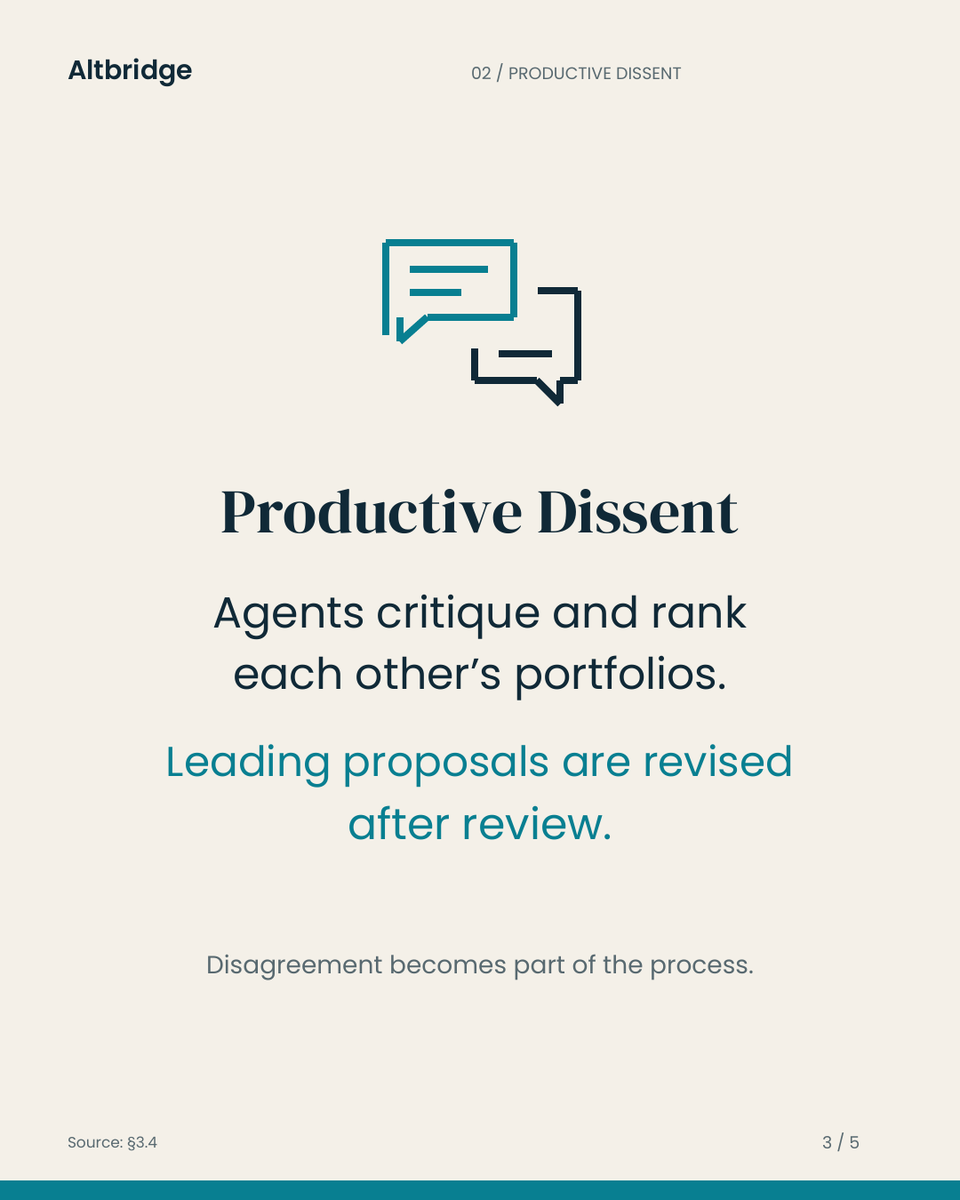
@MebFaber Co-author here. The part people ask about most is the dissent: agents arguing for different regimes and the CIO agent having to settle it
Andrew walks through it live on Dec 2 if anyone wants to go deeper
@patrick_saner Curious which driver was hardest to hedge. Motor repairs and construction ran well ahead of CPI in 2022, so I'd guess CPI-linked hedges left the biggest gap there
@GestaltU Do you normalize on mid-cycle margins or just flip PE for cyclicals? Semis are the hard one for me, the cycle and the secular story get mixed up
Worth adding a fourth to your "less obvious sources of look-ahead": with LLM agents the quant parts can be fully out-of-sample and the agent layer still leaks
The model already knows how 2008 ended. Masking names and dates helps, but doesn't fix it
We ended up treating our backtest as an illustration and trusting only live results
Andrew Ang's first webinar with us is on Dec 2
He'll walk through our Self-Driving Portfolio paper: AI agents running strategic asset allocation
The part allocators care about most: where does the human sit?
11:00 ET / 16:00 London. Free. Link below
Spoke at Investor EQD in Abu Dhabi today
An analyst covers maybe 50 stocks. Now each stock can have its own agent, and what one learns the others can use
The PM's job moves from doing the analysis to supervising it.
What would you hand over first?
Why hasn't AI changed investing yet?
I was in the room when Andrew Ang opened the UBS AI in Finance keynote in Singapore with this question. His answer goes back more than a century
When factories electrified in the 1890s, the first step was to swap the steam engine for an electric motor. Same belts, same shafts, same floor plan. Productivity barely moved. The big gains came only when the factory itself was redesigned around the new power source
Most of us use AI the same way today: take an existing process, carve out one task, hand it to an agent. New engine, same factory
Redesigning investment workflows around agentic AI is the work we're doing at Altbridge
If you could rebuild one part of your investment process from scratch, where would you start?
Someone is building open-source alternatives to Photoshop, Premiere, AutoCAD and Excel. With built-in controls for AI agents. Every startup founder should pay attention - including me.
What happens to product-market fit when the time needed to reproduce a product keeps shrinking?
The project is called ArtCraft. Yes, the apps are still early, and building an alternative is very different from matching decades of reliability and functionality. But seeing this many complex software categories being tackled at once gives me pause to be honest.
Building something people want is still hard - but now I think the bottleneck is moving. For years, the engineering effort behind a sophisticated product bought you time. You could find product-market fit and spend years improving, distributing, and scaling it.
Now competitors can move way faster. And the same technology helping you build also changes what customers expect your product to do. You can execute your roadmap perfectly and still find that the market has moved underneath it.
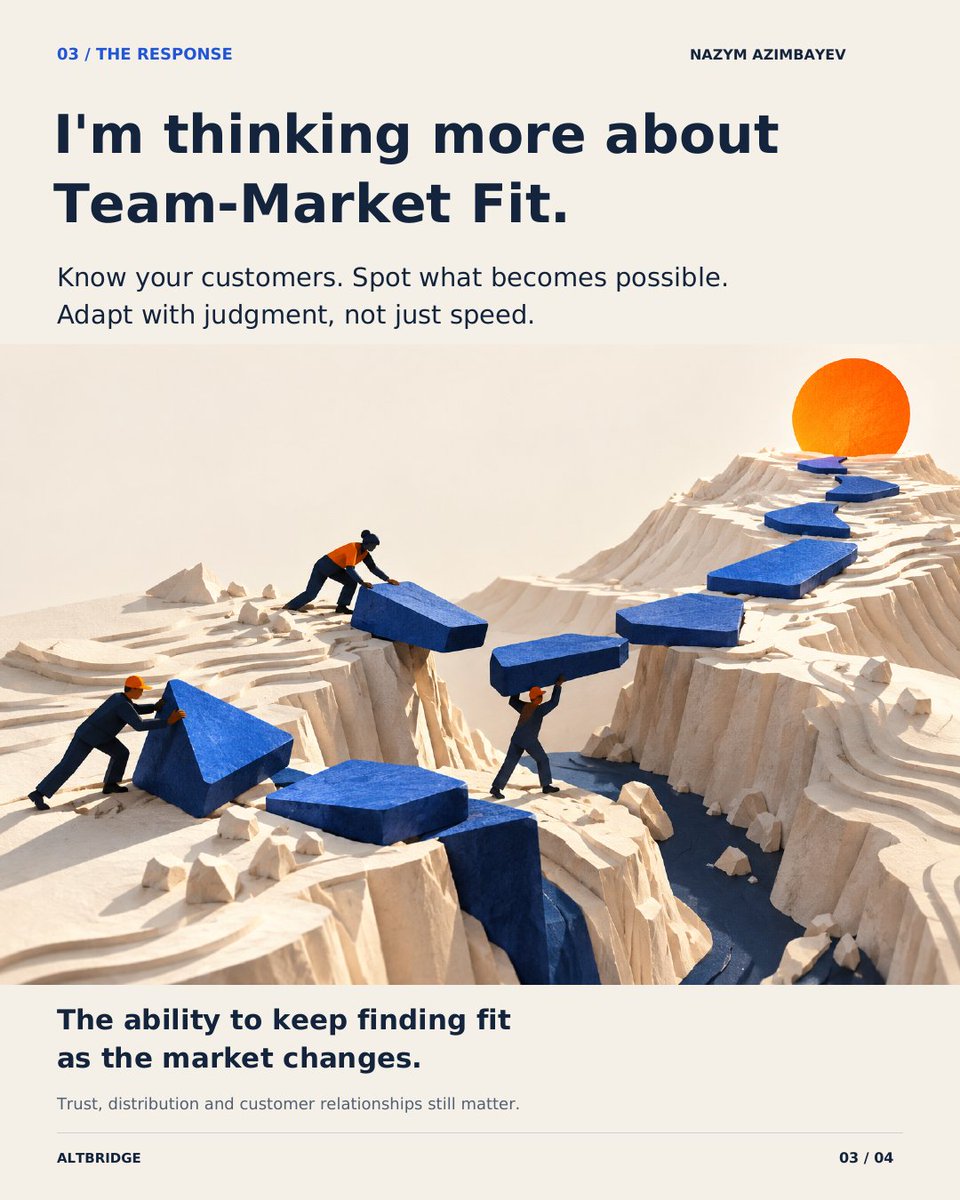
That’s why I’m thinking more about Team-Market Fit. A team that understands its customers deeply. Spots what new technology makes possible. Learns quickly enough to change direction, with the judgment to know when it shouldn’t.
Product-market fit tells you whether your product works for the market today. Team-market fit is the ability to keep finding that fit as the market changes.
Trust, distribution, and customer relationships still matter. But I’m less convinced that the product itself buys you as much time as it once did.
Founders: is product-market fit still a milestone for you, or has it become a moving target?
Watch Nick Baltas and Alan Dunne’s discussion, starting at 32:36: https://t.co/AkvRRyNqAb
Read our paper, “The Self-Driving Portfolio”: https://t.co/lnjf0KIByr
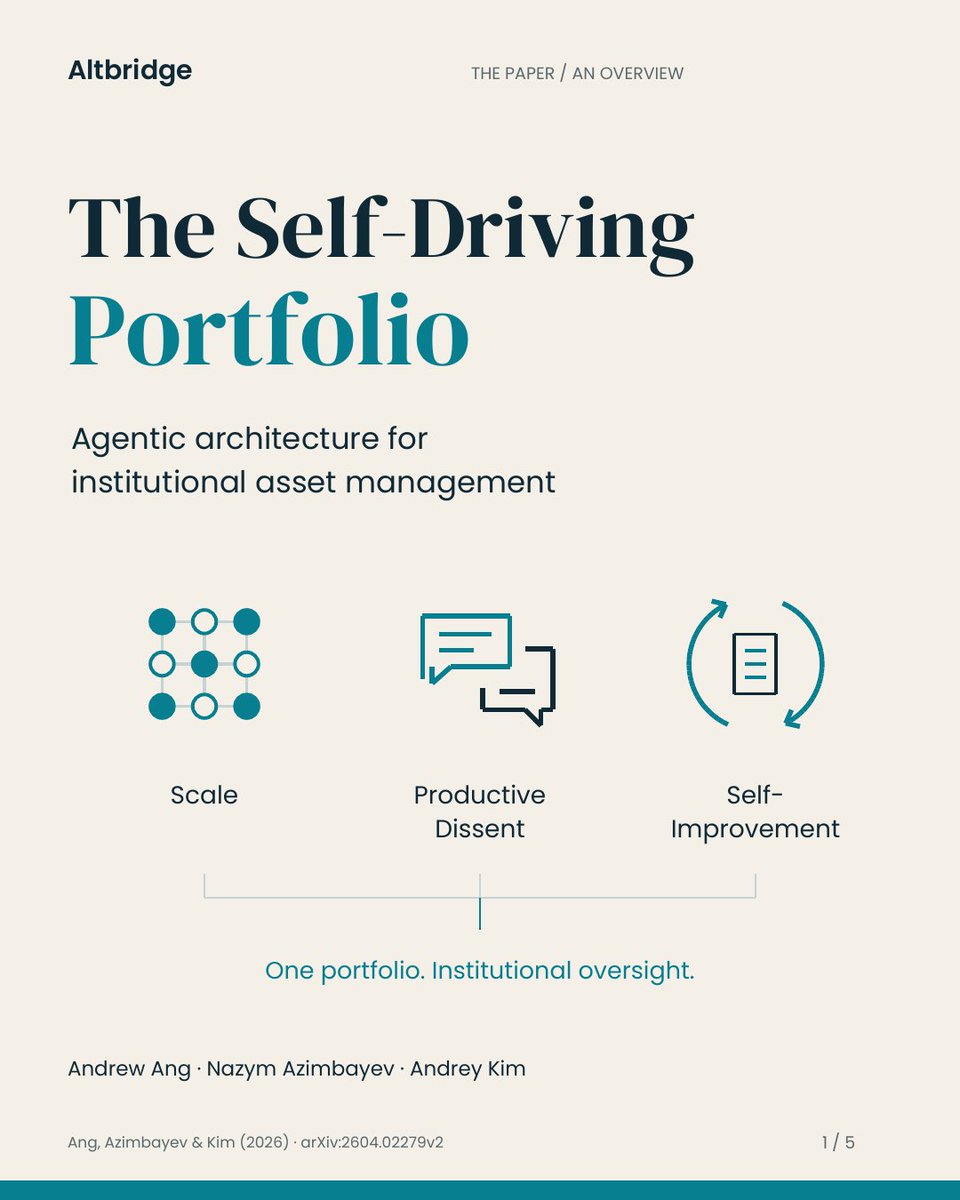
Thank you, @nbaltas and @alanjdunne, for the thoughtful discussion of our paper, "The Self-Driving Portfolio," on @TopTradersLive.
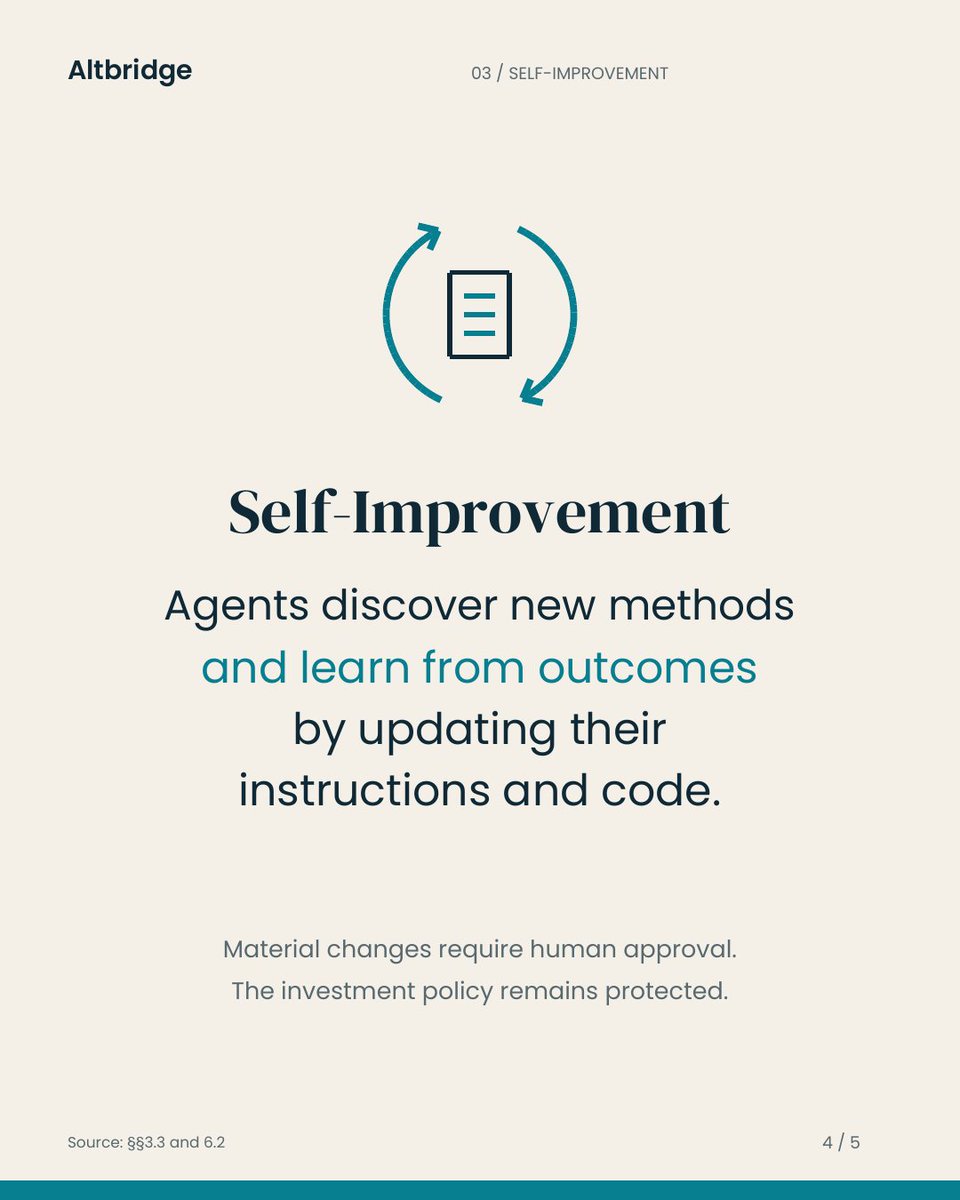
In the paper, Andrew Ang, Andrey Kim, and I explore how agents can work together to build portfolios, challenge investment decisions, and operate under institutional oversight. It was great to hear these ideas discussed in such depth.
If you missed the episode, it's well worth a listen. I've summarized the key ideas in the carousel below.
This is just the beginning, and there's much more coming from us at Altbridge. If your institution is exploring agentic investment workflows, we'd love to talk about what this could look like for your organization.