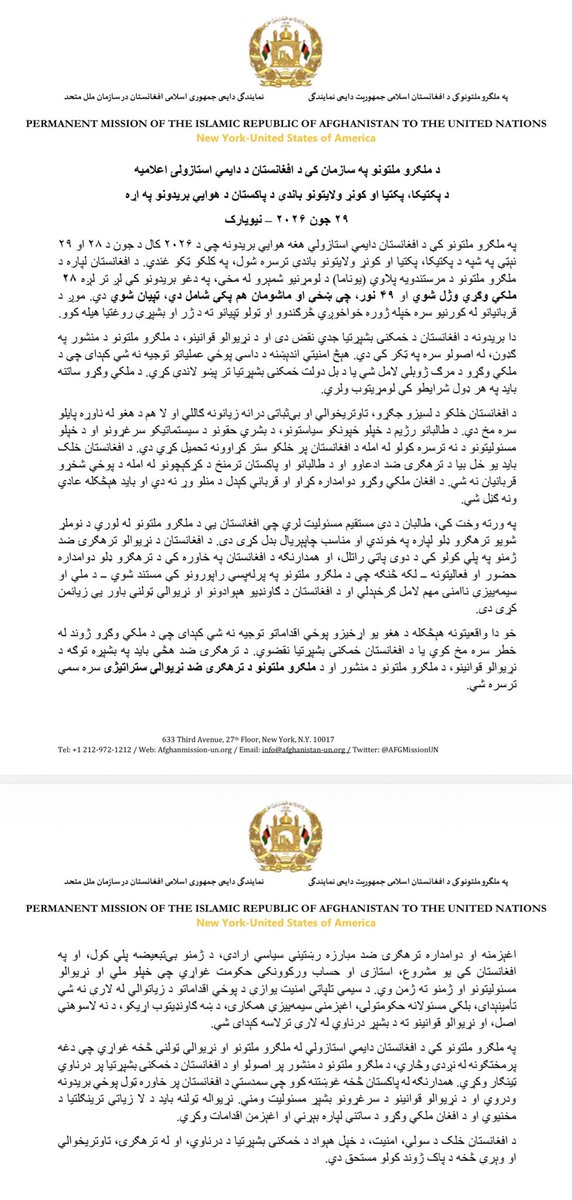
We strongly condemn the Pakistani airstrikes in #Paktika, #Paktia and #Kunar, which, according to a preliminary UNAMA report, killed at least 28 civilians and injured 49 others, including women and children.
No security concern can justify attacks that claim civilian lives or violate Afghanistan's territorial integrity. The Afghan people must not continue to pay the price for #terrorism, the #Taliban's provision of safe haven to terrorist groups, and military escalation. Our full statement: https://t.co/cr4jeQwjIU
Negotiations always reflect realities on the ground, so US efforts to impose peace terms on Iran were destined to fail. that said, the 1st round of talks always have a throat clearing quality, so chances of a breakthrough were negligible. the diplomatic dance is just beginning.
The president's speech on the Iran conflict last night is unlikely to persuade Americans, steady markets, reassure allies, or pressure Iran. He held off embracing either escalation or exit; instead, he punted. https://t.co/XS368yMgRK
Totally mystifying why Trump asked for 20 minutes in prime time on the first night of Passover to deliver a nothingburger of a speech that changed not a thing. Makes no sense.
"Finishing the job" did not serve the US well in either Korea or Iraq. It is unlikely to in Iran. The good news is the availability of viable alternatives. https://t.co/hPBRgQeiAl
Avraham Burg, former speaker of the Knesset and interim president of Israel, on why Netanyahu can never settle, only kill.
(0:00) Introduction
(3:16) What Is Israel's Strategy?
(9:21) What Does Victory Look Like for Israel?
(13:15) Does Israel Actually Want Peace?
(23:06) Was the US Forced Into This War?
(29:15) Is Netanyahu Afraid of Trump?
(33:09) What Will the US Gain From This War?
(36:19) How Do Israelis View Gaza?
(47:41) How Do Israelis View the US?
(53:59) Is This a Religious War?
(59:06) The Many Attempts to Rebuild the Third Temple
(1:05:25) How Netanyahu Has Changed Politics Forever
(1:13:11) How Real Is the Greater Israel Project?
(1:18:37) Will Israel Use Nuclear Weapons?
(1:30:37) The Response to Burg's Writings
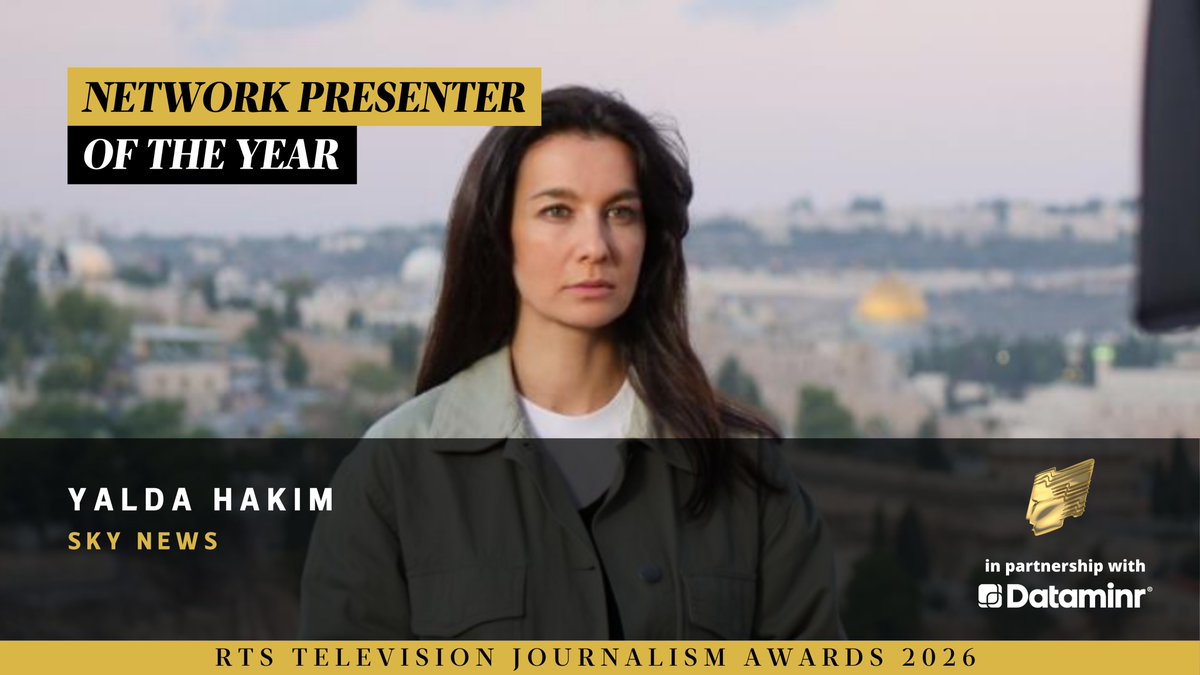
Network Presenter of the Year goes to @SkyNews’ @SkyYaldaHakim! “Calm, insightful and with a dazzling screen presence,” Yalda “had an exceptional year,” said the jury #RTSAwards
Good to see a degree of securitization of gender apartheid under the Taliban from @UN_PGA. The growing security threats stemming from the imprisonment of Afghan women in their homes and the radicalization of their children carry far-reaching implications for regional stability and international peace. @UN@UNAMAnews@SR_Afghanistan@UN_HRC et al must forcefully speak up against the status quo in Taliban-controlled Afghanistan because many relevant member-states refuse to do so for a variety of national-security-first reasons.
Two structural security challenges are directly responsible for the endless civilian killings in Afghanistan: 1) Indo-Pak rivalry at the strategic level; and 2) Indo-Pak proxy battles on Afghan soil at the tactical-operational level. Afghans unequivocally condemn this and call on the @UN to send a fact-finding mission to investigate these and other Pakistani strikes, as well as India’s proxy role in provoking indiscriminate attacks that violate Afghanistan’s sovereignty and take innocent lives.
To help avert such strikes, prevent Taliban-sponsored attacks in Pakistan, and end regional proxy warfare in Afghanistan, I recently wrote “A Regional Compact for Afghanistan: Why Neighbors Must Act Together to Secure Stability,” whose recommendations the UN could adopt to advance a win-win-win regional compact for Afghanistan’s stabilization. Read it here: https://t.co/8hKbYij7uh
@antonioguterres@UNAMAnews@BoardOfPeace@ForeignOfficePk@MEAIndia@KarzaiH@ashrafghani@AmrullahSaleh2@SR_Afghanistan@UN_HRC
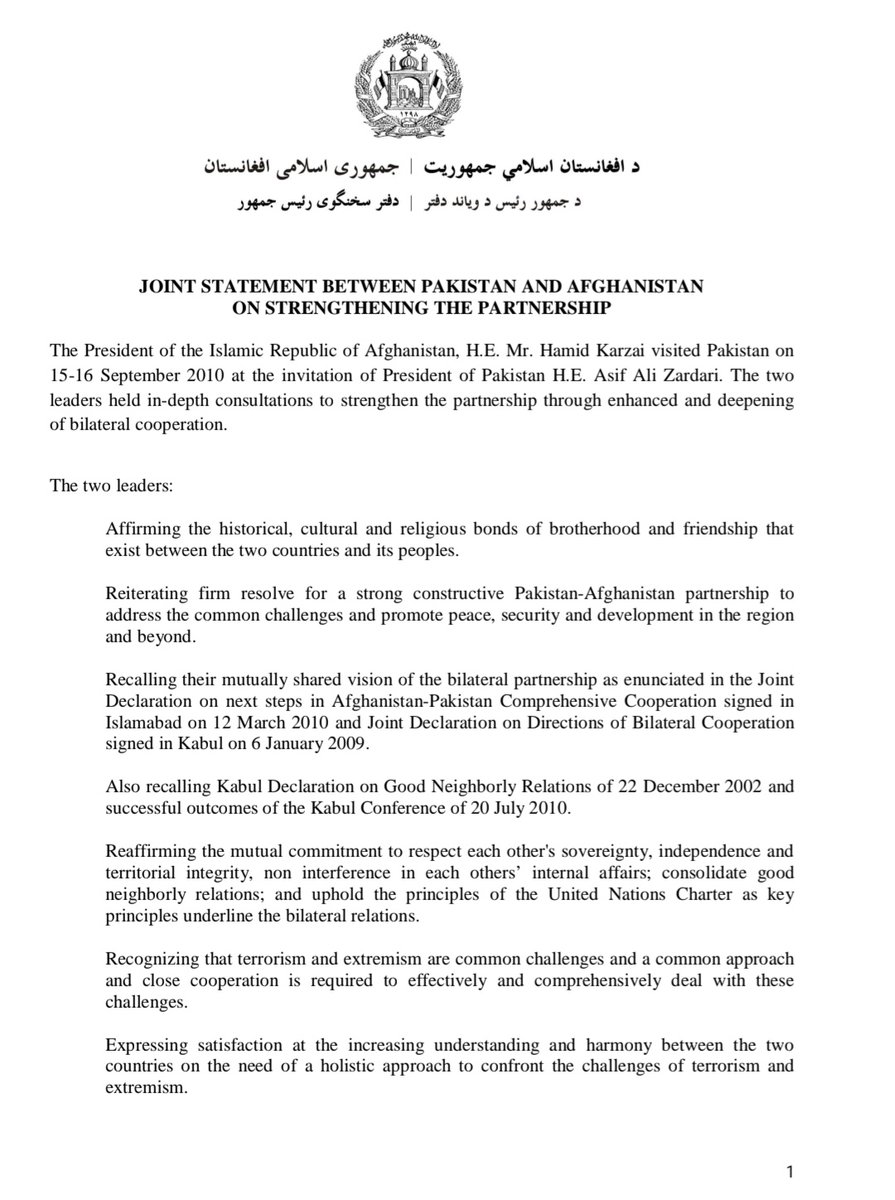
Many have forgotten, but in 2009 and 2010, Afghanistan under President @KarzaiH did its best to convince Pakistan to end institutional support for the Taliban, warning President @AAliZardari of what Pakistan's military is reaping today.
In a key Joint Statement, both sides called for long-term security cooperation in the fight against Taliban-led terrorism. Though Pakistan often agreed on the paper, it never stopped hedging and maintained relentless support for the Taliban, despite consistent warnings and appeals from the Afghan leadership.
A key section of the Joint Statement reads as follows:
"Security Cooperation: Strengthen interaction among the security and counter-terrorism institutions for promoting effective cooperation. Hold regular dialogue in the area of security and counter-terrorism cooperation through exchanges between the relevant institutions and greater information and intelligence sharing. Explore long term institutional arrangements for capacity building and joint training programmes for security institutions."
Read more: https://t.co/lli9pQVcwe
@ForeignOfficePk@PakistanPR_UN@PakinAfg@AmbassadorSadiq@a_siab@BBhuttoZardari@CMShehbaz
Deprived of their right to an education, this group of Afghan women living under the Taliban's gender apartheid has formed a clandestine reading group to further their understanding of the world. https://t.co/mvsmOGhLLz
Look, what Mr. Satar Sirat says about the Bonn Agreement doesn’t really matter. The point is what Bonn didn’t get right, and four gaps proved costly:
1. Inclusion: The Taliban should have been part of the political bargain early on, instead of being left outside the process.
2. Fair power-sharing: The post-2001 order needed a power arrangement that reflected Afghanistan’s major ethnic communities, so the new system could feel legitimate nationwide. But one little newly established province dominated and then miserably failed itself, let alone the rest of Afghanistan.
3. Pakistan’s role: Pakistan needed a clear mix of incentives and credible pressure to ensure it would never again treat the Taliban as a strategic option. Four US bipartisan administrations never really touched the mother of Afghanistan’s problems. My Georgetown graduate students and I repeatedly discussed this -- and why.
4. Real state-building: The international project should’ve focused on a long-term plan to move Afghanistan beyond aid dependence -- building institutions, growing domestic revenue, and helping the country use its young human and natural resources to achieve sustainable development.
Instead, external liberal peacebuilders glossed over these fundamentals for a variety of deliberate strategic reasons. That's why the fragility and 2021 failure that followed should surprise no one.
@TomTugendhat Yes evil, Trump did signed Doha deal to withdraw their troops without any condition peace settlement with Afghan government that they support for 20 years betrayed their allies all achievements blood and treasurer of 20 years of international and Afghan security forces lost