Mythos makes me think more about 1 question:
What happens when bug hunting becomes cheaper, faster, and more automated?
@AnthropicAI previously said Mythos Preview was capable of finding and exploiting zero-days in major OS/browser targets when directed by a user. Mythos 5 is also not broadly public, but limited to trusted cyber/infra users.
I see some kinda connection to #DeFi here.
Because DeFi is software securing real money.
If defenders get stronger AI tools to audit and monitor code, attackers will eventually get stronger tooling too, to scan bridges, vaults, oracle logic, permission systems, and contract edge cases.
> Bull case: protocol security gets better
> Bear case: exploit cycles get faster
Either way, I think #AI x security will become one of the most important narratives for onchain infra in the coming years.
CRAZY! Intel just jumped 11%+ in a single session, adding roughly +$56B in market cap 📊
For context, that one-day move alone is equal to around 4–5% of $BTC’s entire market cap.
The catalyst: reports that Google may use Intel to manufacture more than 3M TPU / AI chips from 2028, while Nvidia is also said to be considering Intel as a backup option for chip manufacturing / advanced packaging.
But I find the bigger signal is not just about $INTC.
It shows how sensitive the market has become to any asset touching the #AI infrastructure narrative.
Chips, data centers, energy, cloud, compute, manufacturing capacity…
Everything is being repriced because it's becoming an infrastructure race.
And I think the same logic will eventually show up in crypto.
Infra that touches AI agents, compute, payments, data, settlement, or privacy layers can get repriced much faster than people expect.
The liquidity is still there.
The interesting part is that chart patterns we used to associate mostly with crypto are now happening in the stock market too, but on assets with much larger market caps.
This bear market is very different btw. Okay, most charts look dead but usage is not dead at all.
Some fundamentals are printing fees, liquidity still moves, and some tokens are somehow outperforming BTC.
Those products have product-market fit and some version of demand that doesn’t need CT to be euphoric every morning.
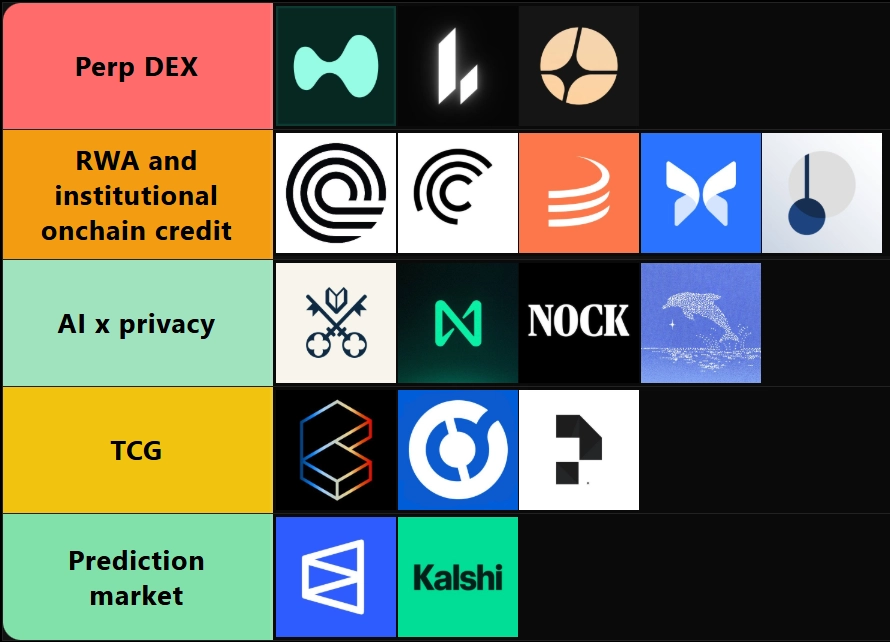
I’m seeing opportunities in perp DEXs, RWA and institutional credit, onchain TCG, privacy AI, and prediction markets.
1/ Perp DEX
Very easy to understand, people don’t stop trading in a bear.
They hedge, short, rotate, revenge trade, reduce risk, open basis trades, chase volatility, and somehow still find a way to pay fees.
Crypto volume might go down, but this time degens already got oil, gold, and stocks to trade.
– $3.7T volume YTD, $661B 30d
– $14B OI
– $HYPE making $366M fees this year
People make money shorting alts, FOMOing into stocks, arbitraging funding, farming airdrops, or simply holding $HYPE.
Projects capturing value: @HyperliquidX | $Hype, @Lighter_xyz | $Lit, @Aster_DEX | $Aster
2/ RWA and institutional onchain credit
When risk appetite dies, people don’t stop wanting yield. They just stop wanting fake yield.
Crypto is building its money market, credit desk, collateral layer, and yield curve at the same time for institutions.
– stablecoin supply at $316B
– tokenized RWA value around $31B ex-stables after growing from $6B in early 2025
– BlackRock BUIDL at $2.9B mcap
People sell alts, but they don’t leave dollars. They park in dollars, borrow against dollars, settle in dollars, earn yield on dollars, and eventually deploy from dollars.
Industry leaders: @OndoFinance | $Ondo, @maplefinance | $Syrup, @centrifuge | $CFG, @Morpho | $Morpho, @pendle_fi | $Pendle
3/ AI x privacy
If agents are going to manage money, private data, enterprise workflows, wallets, medical info, trading strategies, or cross-chain execution, the public mempool is not enough.
You can’t have an AI agent running a strategy while leaking its playbook every time it moves.
– Near Intents is showing real use cases with $20.5B volume and 16.3M confidential TVL processed
– Venice has 3M users and $50M annualized revenue
Devs are staking $VVV for private access to 230+ AI models. NEAR is paying revenue to $NEAR stakers.
Projects to watch: @AskVenice | $VVV, @NEARProtocol | $Near, @nockchain | $Nock, @dphnAI | $Pod
4/ TCG + Collectible-Fi
Crypto usually sucks at making consumer products people actually want.
TCG already has the demand. Crypto just fixes liquidity, custody, settlement, and global access.
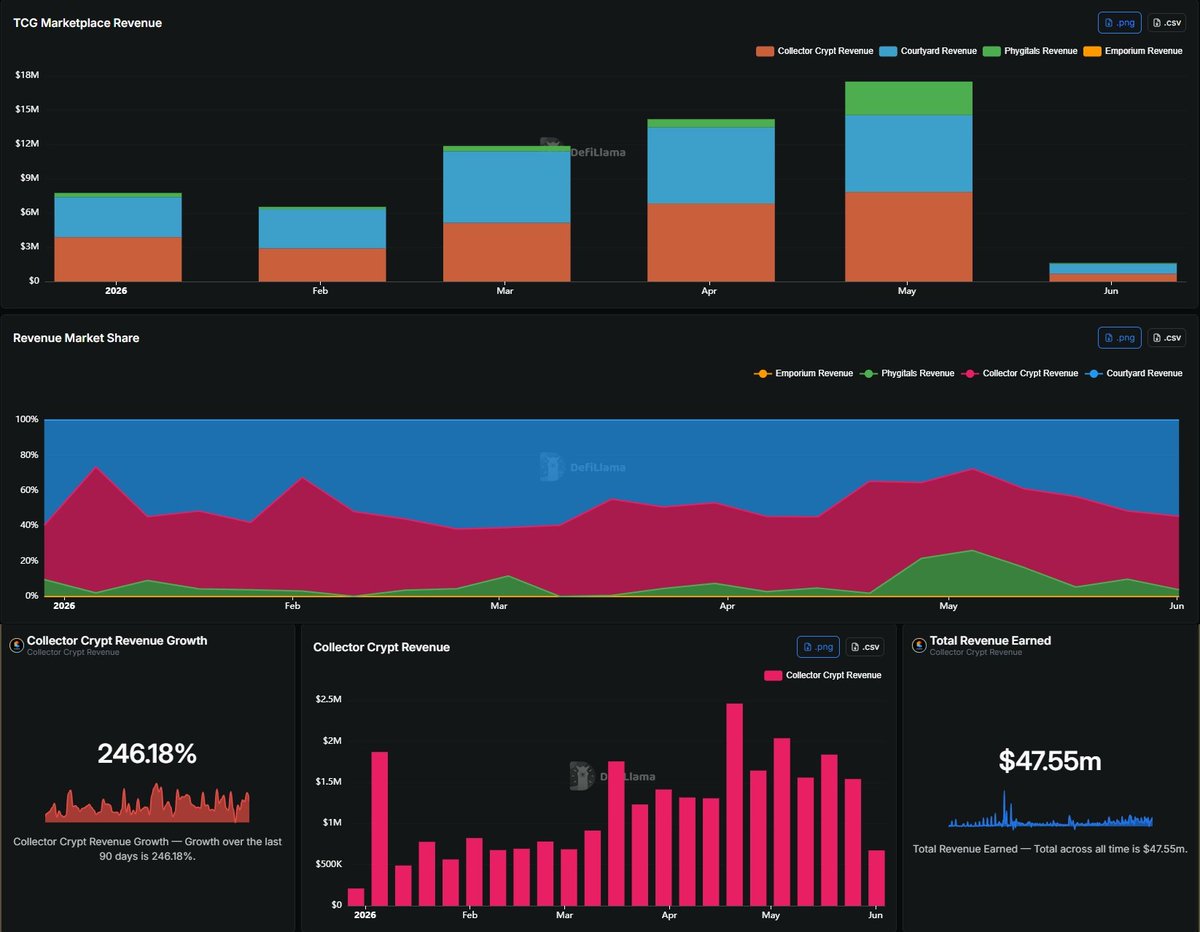
– weekly revenue hit $7.7M last week (ATH)
– $57.4M gacha spending last week (ATH)
Ppl can pull cards through gacha packs, redeem the physical card, sell back instantly at 85–90% of real-time indexed price, or trade the tokenized version.
Collectors actually use: @Collector_Crypt | $Cards, @Courtyard_io, @phygitals
5/ Prediction markets
When markets get weird, politics get weird, sports get weird, macro gets weird, everyone wants to bet on outcomes.
This is another volatility market for degens with cleaner UX.
– $137B volume executed in just H1 this year while all of last year did $63B
– $1.2B OI
– Polymarket doing $108M annualized fees
Users open prediction markets to hedge, bet, and maybe farm a $POLY airdrop.
Projects making numbers: @Polymarket, @Kalshi
All of these don’t need bull market oxygen. They’re building businesses that breathe through the smoke.
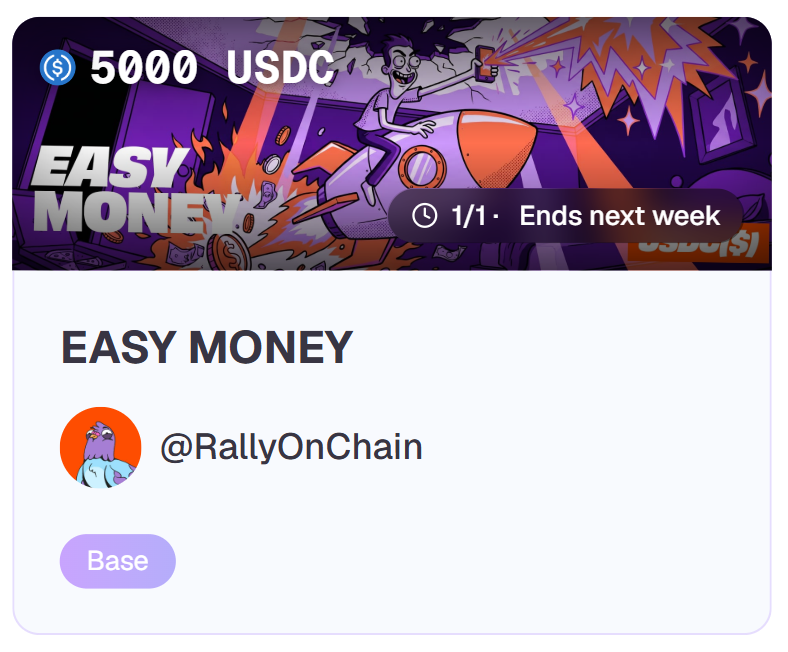
$5,000 pool, 50 winners, ~$500 for top 10 👀
Go check the new Easy Money campaign that just went live on @RallyOnChain fam.
The mechanism is pretty simple:
Write 1 post, submit it on Rally, bring new users into the app through your referral/code, and compete for the prize pool.
The interesting part is that most of the rewards are not spread evenly, but heavily concentrated toward the top 10.
Meaning good content + good distribution can actually get rewarded properly.
Rally is clearly still early, but the numbers are going up.
If they keep launching campaigns like this every week, I think we'll have an edge here.
Join with my code: FABIUSDEFI 🤝
Instead of being bearish at the bottom, I want to map out the catalysts that could be the main plays for the crypto market in Q3 2026.
Capital is now only deploying into where there's real use cases, real users, and real revenue, so I use that to build my thesis.
The biggest catalysts, I think, are not out of meta yet.
1/ AI x Crypto is still the main trade.
TradFi is already throwing insane money at AI infra and crypto only needs to catch a tiny spillover.
If compute keeps being tight, data keeps being scarce, and inference demand keeps ripping, crypto gonna get a job.
Even 0.1-0.5% of that infra spend leaking into decentralized compute, data, private inference, and agent payments is already hundreds of millions to low single-digit billions in annual demand.
– $TAO: AI markets proxy with subnets acting as incentive markets for specialized AI work.
– $NEAR: pushing agent marketplace, private inference, private USDC payments, and the whole currency of agents narrative at the exact time AI agents need wallets, execution, and settlement.
– $VIRTUAL: has the retail mindshare and architecture for tokenized agents, but this one needs fee capture to come back strong. Narrative won’t be enough this time.
– $VVV: privacy inference will scale in demand as agents scale in number.
– $WLD: Sam Altman meme for the OpenAI IPO this Q3.
Another low cap worth watching: $PRL, $NOCK, $SERV, $BNKR.
2/ Perps
CFTC approved perps in the US, which will push demand and revenue for perp venues even higher.
The market already grew far beyond the original use case with pre-IPO markets and RWAs on the board.
Hyperliquid. $HYPE.
3/ The trade is changing for privacy
The Zcash vulnerability didn’t kill privacy demand. It just reminded everyone that privacy systems are complex and privacy coins aren't a safe haven.
Confidential compute, encrypted inference, Kohaku, shielded DeFi, FHE, TEEs, selective disclosure, and privacy pools will be the next play imo.
Good time to study $NEAR, $RAILS, $AZTEC, $UMBRA instead of only $ZEC imo.
Okay, so now here's some new catalysts that's quietly growing.
4/ Crypto neobank
– Visa’s stablecoin settlement pilot reached a $7B annualized run rate and supports 9 blockchains.
– Stripe expanded stablecoin payments into 32 more markets.
– Bridge got conditional approval to build a national trust bank.
→ Payment infra is slowly moving into the banking stack. So stablecoins don’t need everyone buying coffee onchain to work.
Treasury settlement, B2B payouts, card settlement, remittance, FX, agent payments, all of that can grow without retail even noticing.
@Plasma, @ether_fi, @AviciMoney, @useTria, whatever wins here, the bigger point is crypto is getting closer to being a bank account, payment rail, and yield account at the same time.
5/ Robotics
– OpenAI restarted serious robotics hiring.
– Apptronik raised $520M with Google and Mercedes-Benz backing.
– Figure’s BMW deployment supported production of 30k vehicles.
– Nvidia keeps pushing Isaac GR00T and the physical AI stack.
Physical AI is the next obvious place where capital wants to go.
Crypto can capture identity, payment rails, coordination, mapping, telemetry, ownership, data marketplaces, and machine-to-machine settlement.
Names like $PEAQ, $ROBO, $DEUS, $CODEC, $AUKI, $GEOD can start making sense.
6/ Collectible-Fi
– $CARD did $93.2M annualized revenue and $1B cumulative volume
– @Loopscale is built for specialized collateral around @Collector_Crypt cards.
– @MeteoraAG and @BedrockFndn turned sealed Pokémon packs into a dynamic asset.
Pokémon's 30th anniversary TCG releases in September can become a real consumer catalyst if card liquidity keeps moving onchain.
Whether you're opening shorts, why not share your next bet instead of throwing FUD on everything?
🔥 $CARDS continues to outperform the market, TCGs and NFTs don’t feel the same to me. Most 2021 jpegs had to create culture from zero. Trading cards already have it.
Pokémon, One Piece, Yu-Gi-Oh already have decades of price history, grading standards, auction comps, collectors, nostalgia, and actual secondary market liquidity before anyone tried putting them onchain.
I don’t need to explain to someone why a Charizard is cool. They already understand the asset:
- 420M+ collectors already exist.
- the broader collectibles market is somewhere around $300-500B.
- more than 26M cards got professionally graded last year.
But physical collectibles are still running on very ugly infra. Crypto just fixes the plumbing:
- eBay takes around 13% fees, auction houses can go way higher.
- settlement takes days or weeks, international shipping is annoying.
- fakes are everywhere.
- insurance, customs, damaged cards, and buyer disputes kill liquidity.
The onchain version is simple: a graded card goes into a vault, a 1:1 token gets minted, provenance lives onchain, anyone can trade it globally, and the physical card only moves if someone redeems it.
- fees drop to roughly 2-6%.
- settlement goes from 5-7 days to seconds.
- no need to ship the same card around 8 times just because it changed hands 8 times.
Onchain TCG gacha volume did $148.6M in March -> $184M in April -> $211M in May.
Insane when sector revenue is up 9x YoY:
- @Collector_Crypt has done $1.02B cumulative volume, $47.5M revenue, $556M total gacha spend.
- @Courtyard_io has done ~$1.09B cumulative volume, $51M revenue, and $642M gacha spend.
- @Beezie pushed $120M volume, $6.3M fees just from Feb.
I don’t think these cards go onchain just to sit there waiting for someone to open them.
@Loopscale is integrating Collector Crypt cards as collateral. That's the beginning of Collectibles-Fi.
The physical market never had this at scale because moving, storing, verifying, and liquidating cards is annoying. Onchain makes the card composable without moving the card.
$CARDS definitely is the biggest exposure to the meta.
They have 130k+ cards vaulted, multiple gacha tiers, and instant buybacks around 85-90% of indexed market value.
Treasury held around $18.6M in physical cards at the end of Q1, mostly Pokémon with One Piece growing.
- doing $93.2M annualized revenue.
- 246% revenue growth in 90d while Courtyard did 16%.
- 34% volume market share vs 48.7% for Courtyard.
3x from the bottom and the market is pricing $CARDS at 0.6x P/S, which looks cheap when most crypto protocols trade at much higher multiples.
With pack volume continuing to climb every week, the job probably isn't done yet.
Can a blockchain be secured by computation that's actually useful? I spent some time reading through the whole thing. 🧵
It comes from a 2025 cryptography paper that solved the Proof of Useful Work (PoUW) problem people have been arguing about since the 90s.
@prlnet | $PRL is trying to replace Bitcoin's useless hash grind with actual matrix multiplication, aka the same arithmetic sitting under almost every AI model.
peak bull market experience:
- ignore my first warning back in 18 May
- ignore the second warning yesterday
- call every dip a buying opportunity
- call every breakdown manipulation
- average down
- average down again
- become a long-term investor
from $76k to $60k in a few weeks
i can't save you if you don't want to press the sell button
H-tokens are dominating this market rn 👀
$HYPE +71% 1M
$H +182% 1W
$HOME +57% 1W
$HUMA +20% 1M
Funny enough, HYPE is one my biggest alt holding, while I got some amount of the others from Kaito campaigns.
Maybe the real meta was farming the right H-tickers 🙂
RWA is cooking back to back
And in my opinion it's still one of the most slept on categories
Once the Clarity Act gets approved i see a specially huge rush for RWA projects coming