Tiger Management thought he was applying for IT support.
He launched his hedge fund in 1999. Months later, the Nasdaq fell 75%. Not exactly ideal timing.
Philippe Laffont wasn’t supposed to be a hedge fund manager. He studied computer science at MIT and wanted to work in tech. When Apple said no, he went to Chile for six months, learned Spanish, and basically fished all day.
Then he moved to Spain and ended up in a basement office at his wife’s family business with nothing to do. So he started reading stock listings in the International Herald Tribune.
He bought Microsoft, Intel, and Dell.
When he came back to the U.S., he had no finance background and no Wall Street network. He worked unpaid at mutual fund just to learn the language of finance.
He hustled for a shot and a friend got him two minutes with Julian Robertson and said exactly what he wanted: to pick tech stocks at Tiger.
That bet on himself worked.
After a few years at Tiger Management as the telco and tech analyst, Laffont started Coatue with $45M — without Julian backing him — right before the dot-com collapse.
The firm survived. Then it evolved. Then it became one of the most influential tech investors in the world.
Full story of Coatue Management: https://t.co/UH27PBugIB
essa é talvez a melhor entrevista com um trader que eu já vi, esse vídeo é só um trecho. é fácil encontrar a completa na internet. quem ainda não assistiu, recomendo muito!
China's AI strategy: 1. Government invests in Deepseek, subsidizing labs to open source everything. 2. Building nuclear and data centers everywhere fast to lower inference cost, regulating it like electricity. 3. Making sure people learn AI fast, especially government officials must know how to use AI. US's AI strategy: stock price going up and to the right. Export control. Takes forever to build a data center because of permits and regulation. It's time to change.
if US bans open source because China is leading, then
1. impossible to enforce(you just need to download a zip for weights)
2. Increases the cost of using AI for US companies and consumers, while China leads in enterprise and consumer adoption which drives GDP growth and productivity gains
3. Gives away market share to China for countries who don't follow the ban(which will be many)
Banning open-source might benefit labs, but only in the short-term, as they will lose long term regardless. It will harm independent neoclouds, enterprises and consumers. Because you forcefully drive up the cost of using intelligence by 100x compared to China, and if everyone in China and ROW can afford the good-enough intelligence but only not in the US, will this benefit US in the long run?
Last time this setup appeared on $NOW, price moved +44% in one month.
It is back again. And I am not taking this trade.
In today’s video I cover:
• The current setup using my rules based framework
• The exact levels I am watching
• Why I am standing aside here despite the same signal
Full breakdown here 👇
In the China tech space, Baidu is now a full-stack player in the AI industry. As the maker of its own chips, AI model (Ernie), cloud system and a self-driving car business (Apollo Go), the tech giant is a very desirable company to work for.
On this episode of the Odd Lots podcast, Baidu CFO Henry He joins @TheStalwart and @tracyalloway to discuss how the company uses AI to evolve its own organizational structure and attract new talent. Listen at https://t.co/RqFaugaTL4 or watch at https://t.co/fcjUvfje6d.
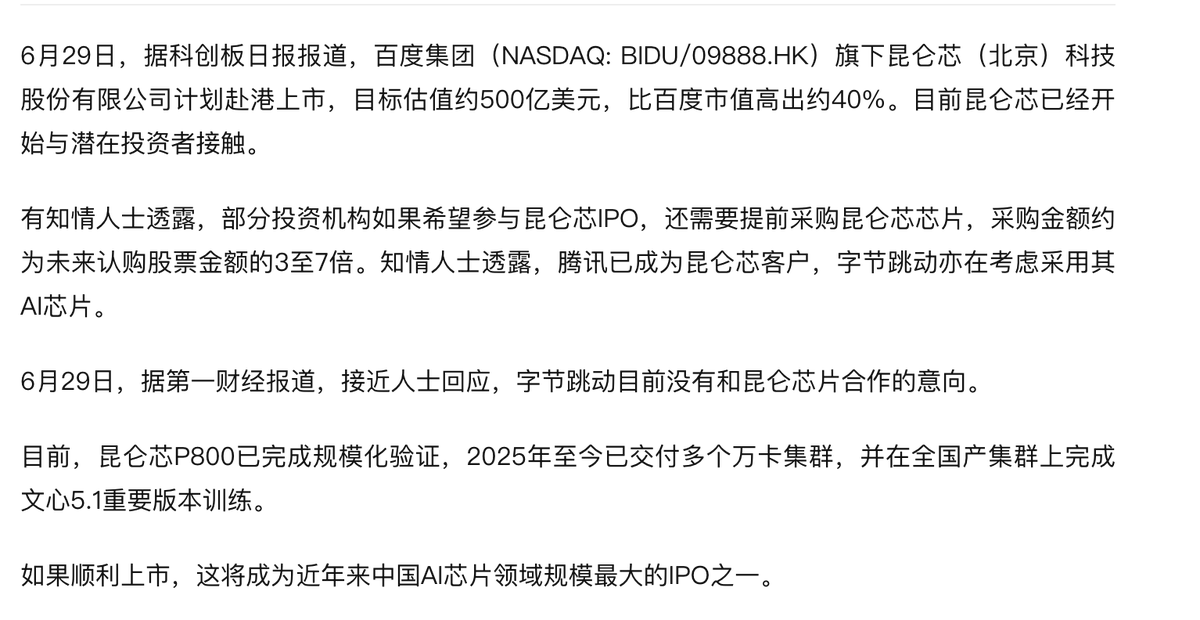
Baidu’s chip unit Kunlun is reportedly targeting a $50B valuation for its Hong Kong IPO.
$BIDU owns about 58% of it.
That stake alone would be worth roughly $29B, while Baidu’s entire market cap is only around $37B
https://t.co/7nTcb6mqH6
Larry Robbins, founder of Glenview Capital with around $5.6 billion in assets under management, presented nine companies across three market categories at the Sohn 2026 conference
"Forty-one stocks in the S&P doubled in a year, while almost a third fell in a rising market, we've never seen this kind of dichotomy"
The man who pitched Teva and Global Payments a year ago, and both worked out, explains in ten minutes which beaten-down stocks with turnaround potential to step into and which doubled names are still cheap
bookmark it and you'll learn how a manager of serious capital plays this fragmented market ↓
The worst-case scenario for the United States is becoming increasingly realistic, and I will briefly explain why.
@quxiaoyin raised many valid points, and I agree with her. First of all:
-China certainly does not place such strong emphasis on open source because it cares so deeply about humanism, but because it is a strategy to attract many users, gain market share, put pressure on US models, and also because the models are increasingly being trained on Huawei hardware (think of DeepSeek 4), allowing China to host the entire stack domestically.
-But the underlying logic is far more important: The United States is still building too few data centers to meet future demand. @ChrisGillett wrote an outstanding analysis on this, which I shared a week ago. In short, based on SemiAnalysis data, demand is greater than what is currently being built in terms of data centers.
-Even more importantly, however, the United States lacks sufficient energy and grid capacity. This is a problem that will become much more severe in the near future. China, by contrast, is addressing the issue through a massive expansion of its energy supply. Solar capacity: in 2025 alone, China installed as much solar capacity as the United States did in 10 to 15 years. China is also building 36 nuclear power plants, significantly more than the United States, and is installing them faster.
-In addition, China is managing to become more independent through Huawei chips, even though the country still lags far behind NVIDIA. But here, China is betting on quantity rather than quality.
In short: China is a real threat in the AI race, and the situation for the United States is becoming increasingly precarious. This is also the main reason why China is to be kept away from SOTA LLMs at all costs, so as not to jeopardize the lead under any circumstances.
Deepseek is funded by Chinese Government VC directly in their most recent funding round. Chinese models will continue to be better, faster, cheaper and open. Meanwhile US models are export controlled, expensive, and not open. Why do you think US will win with this strategy? It's time to change strategy.
Baidu's chip unit Kunlun is reportedly targeting a $50 billion valuation for its Hong Kong IPO. Baidu's total market cap is $36 billion. A subsidiary worth 40% more than the company that owns 58% of it.
The math creates a logical paradox. If Kunlun is worth $50 billion, Baidu's stake is worth $29 billion. That leaves the rest of Baidu -- search advertising, AI cloud, Apollo Go robotaxi, iQiyi, and $28 billion in cash -- with an implied value close to $7 billion. For a company generating $32 billion in quarterly revenue. The market is either wildly overpricing Kunlun or severely underpricing everything else inside Baidu.
Why do you think hosting Chinese open source models on your own GPUs is less trustworthy and secure than giving away your data to anthropic and being shut down access at any time because they think you are doing something they consider “not safe”?
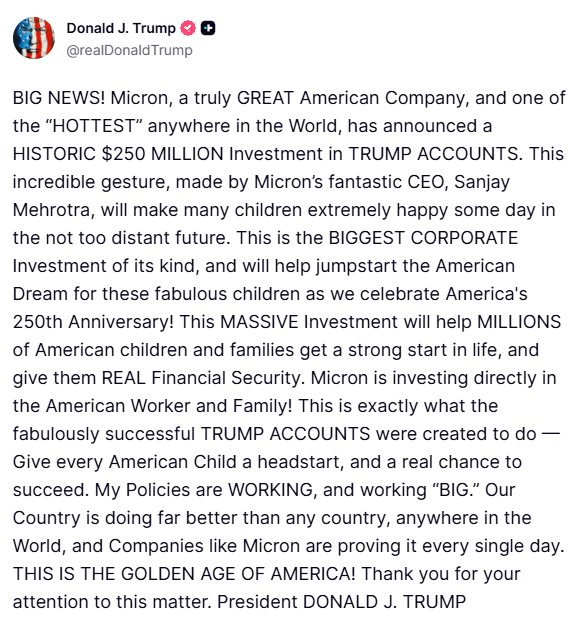
Micron at $60. Micron at $1,200. Visser is still buying.
Jordy Visser @jvisserlabs held this thesis from the start and still says the second derivative scares people who do not read the call.
Earnings growth slows from 400% to maybe 50% year-on-year. That is a slower rate of growth, not a reversal. Memory is the bottleneck, and the bottleneck commands the premium.
His call: Micron reaches a $2T market cap within a year. He sold too early and now holds Marvell as the adjacent play.
The full deceleration-vs-collapse case: https://t.co/3uBnyBSjWD
Source: Anthony Pompliano Podcast - https://t.co/2XyjaZKO6i
The relationship between the US and Israel is growing increasingly strained. Will it bounce back, or is it altered forever? I discussed with Jake Sullivan in part 2 of our conversation:
No paywalls!
Two free recent articles-
The Heretic’s Guide to AI’s Stars Part III:
(AI Demand, Offshore Financing, etc)
https://t.co/0QxhGcXbLT
Software & Payments Stocks Part II: Productivity Tools and Cybersecurity
(Part 2 of 6)
https://t.co/yEl65szBsM