#TexasTech’s Cody Campbell FIRES BACK at Texas coach Steve Sarkisian for comments made about the Red Raiders’ schedule 👀
“Schedule us then!”
https://t.co/lpvGVwvrSi
Anthropic just passed OpenAI in revenue run rate. OpenAI is at roughly $25B. Anthropic just crossed $30B. Sixteen months ago Anthropic was doing $1B.
You could add up the annual revenue of Snowflake, Datadog, Cloudflare, MongoDB, and HubSpot and you'd still be $15B short of where Anthropic sits today. Combined they do about $15.4B. Anthropic does double that. A company that didn't exist five years ago.
That $1B was December 2024. By end of 2025 it had hit $9B and people thought the growth would slow. It didn't slow. It doubled again to $14B by February. Then $19B by March. Then the number everyone is staring at today: $30B run rate in April. In a single month they added $11B in annualized revenue. That's an entire Atlassian appearing overnight.
They've 10x'd revenue every year for three straight years. If they do it again, Anthropic hits $100B run rate by end of next year. More revenue than IBM. More revenue than Nike. From a company that earned its first dollar less than three years ago.
Claude Code didn't exist 14 months ago. It's at $2.5B run rate. 4% of all GitHub commits on Earth are now written by Claude Code. That number doubled in a single month. Projected to hit 20% by December. One in five commits on the planet written by one model.
To serve this demand they just ordered $21B in custom chips through Broadcom. Nearly 1 million TPUs. Over a gigawatt of compute. That's enough electricity to power a city of 700,000 people. Just for inference. Not training the next model. Running the current one.
Anthropic pulls $211 per monthly user. OpenAI pulls $25 per weekly user. 8x monetization on a fraction of the audience. Two years ago 12 companies spent $1M+ a year with Anthropic. Today it's over 500. 8 of the Fortune 10 are customers.
The secondary market has already repriced what this is. $2B in buy-side demand chasing Anthropic shares. Almost no sellers. Bids implying a $600B valuation, up from the $380B primary round two months ago. Meanwhile $600M in OpenAI shares are sitting unsold. Goldman is charging 15-20% carry on Anthropic allocations. They're giving away OpenAI for free.
The IPO was originally targeting $500B. It will likely come in north of $800B. At 10x annual growth for three consecutive years, the question isn't whether Anthropic is overvalued. The question is what multiple you put on a company that might be doing $100B in revenue 18 months from now.
Sixteen months ago this was a research lab. They just passed OpenAI and the run-rate revenue of Netflix. And every number in this post will be outdated by next month.
𝗧𝗛𝗘 𝗦𝗔𝗩𝗘 𝗔𝗖𝗧 𝗙𝗟𝗢𝗢𝗥 𝗙𝗜𝗚𝗛𝗧 𝗜𝗦 𝗨𝗡𝗗𝗘𝗥𝗪𝗔𝗬
Fox is reporting the Senate will debate the SAVE America Act for several days. Senate Majority Leader John Thune will eventually force a cloture vote requiring 60 yeas to end debate — meaning Democrats will have to stand up and own their opposition publicly, on the record, for as long as this takes.
Trump is already posting about it. Thune put it simply: 𝘵𝘩𝘦 𝘰𝘯𝘭𝘺 𝘈𝘮𝘦𝘳𝘪𝘤𝘢𝘯𝘴 𝘯𝘰𝘵 𝘴𝘶𝘱𝘱𝘰𝘳𝘵𝘪𝘯𝘨 𝘵𝘩𝘪𝘴 𝘢𝘳𝘦 𝘵𝘩𝘦 𝘋𝘦𝘮𝘰𝘤𝘳𝘢𝘵𝘴 𝘪𝘯 𝘊𝘰𝗻𝘨𝘳𝘦𝘴𝘴. Poll the country — Democrats, Republicans, independents — and the majority supports proof of citizenship to vote and photo ID at the polls. The elected Democrats blocking it are out of step with their own voters.
This is the moment Senator Mike Lee has been calling for. No recesses. No weekends. No zombie filibusters where senators phone in their opposition from home. If Chuck Schumer wants to block the most common-sense election integrity legislation in a generation he can do it standing up, in front of cameras, for days on end.
Every hour of floor debate is another hour Democrats have to explain to the American people why verifying citizenship before voting is something worth going to the mat over.
𝗛𝗼𝗹𝗱 𝘁𝗵𝗲 𝗳𝗹𝗼𝗼𝗿. 𝗙𝗼𝗿𝗰𝗲 𝘁𝗵𝗲 𝘃𝗼𝘁𝗲. 𝗣𝗮𝘀𝘀 𝘁𝗵𝗲 𝗯𝗶𝗹𝗹.
El abogado Trey Wells explica el veredicto de un jurado federal en EE.UU., que concluyó que hubo acusaciones falsas y manipulación de testigos en los procesos anteriores contra la compañía.
https://t.co/uWEaef1908
For decades, the global silver market operated on a simple assumption:
Nobody would actually demand delivery of the metal they owned on paper.
That assumption just collapsed.
In the first seven days of January, 33.45 million ounces of silver were physically withdrawn from COMEX for delivery.
That's 26% of COMEX's registered inventory gone in a single week.
Traders who had March futures contracts were paying premiums to ROLL BACKWARDS to January, demanding immediate delivery weeks early.
They weren't willing to wait. They wanted metal in hand.
Here's the China problem you have to understand if you're buying silver:
On January 1, 2026, Beijing implemented export controls that fundamentally changed global silver supply.
This wasn't a minor tweak. They reclassified silver as a strategic material, putting it in the same category as rare earths.
To export silver from China now, companies need government licenses. Only 44 firms qualified.
They must have annual refining capacity of 80+ tonnes and credit lines exceeding $30 million.
Why does this matter? China controls 60-70% of global refined silver exports.
The world's dominant refining hub just effectively ring-fenced its supply for domestic use.
The physical-paper divergence:
Here's where it gets uncomfortable...
In Shanghai, physical silver trades at 12-13% premiums over Western paper prices.
In Dubai, premiums hit 40%.
In Japan, secondary market premiums reached 60%.
Meanwhile, the paper-to-physical ratio on COMEX sits at 356:1.
For every one ounce of deliverable silver, there are 356 ounces of paper claims.
The system worked because nobody called the bluff. But now they're calling it.
The supply deficit reality:
The silver market has been in structural deficit for five consecutive years.
Cumulative shortfalls from 2021-2025 total roughly 820 million ounces. Nearly an entire year of global mine production.
Mine production peaked in 2016. Roughly 71% of mined silver comes as a byproduct from gold, copper, lead, and zinc mines.
So even if silver prices double, miners can't easily ramp production. Their operations are driven by base-metal economics, not silver prices.
The industrial demand trap:
Unlike gold, silver isn't primarily a monetary metal. Industrial demand now represents 59% of total consumption.
Solar panels. EVs. AI data centers. Semiconductors.
This demand is price-inelastic.
Factories don't stop production because silver got expensive... They pay whatever it takes to keep lines running.
So what does this mean?
Silver is now in backwardation. Spot prices above futures prices.
That's rare. And it's significant.
Backwardation tells you buyers want metal NOW, not paper promises for later.
The last time silver showed this kind of sustained backwardation was before the 2011 spike to $49.
The gold-silver ratio has compressed from over 100:1 in recent years to around 50:1 now.
Historically, that ratio has traded as low as 15-20:1 in extreme moves.
If gold holds and the ratio compresses further, silver will go beyond $150.
It's math.
My take:
Silver is no longer just an industrial metal with monetary characteristics.
It's becoming a triple-identity asset: industrial input, monetary metal, and strategic material.
When China weaponizes export controls, when Western inventories drain, when paper claims vastly exceed physical supply, and when industrial demand is non-negotiable, you get exactly what we're seeing...
A structural repricing.
Pullbacks will be sharp. The CME has already raised margin requirements.
But the underlying dynamics aren't speculation. They're geology, geopolitics, and supply-demand math.
Physical silver in your possession has no counterparty risk.
Paper claims on silver that may or may not exist? That's a different bet entirely.
If you don't hold it, you don't own it.
ABC News’ Jonathan Karl: “What the Biden administration has actually said is that they did vet these people in third party countries before coming to the United States.”
DHS Secretary Kristi Noem: “How do we vet someone that comes from Afghanistan or Somalia or Yemen if they don't have a government that we can communicate with that will share information with us?”
“So that is one of the prerogatives and the — and one of the priorities that we're putting on these countries if they want to continue to send us people that want to claim asylum.”
Why does cut-off grade matter?
It's where geology meets money.
I've seen explorers abuse reporting to increase ounces.
If an explorer brags about having "X Moz at 0.Y g/t" ask them at which price, recovery, and costs, and then ask again.
If you can't trace the inputs, you can't price the risk. Demand the math, in units, with curves. Otherwise you're not speculating, you’re donating.
@fortunebaycorp $FOR.V recently published their PEA, so I asked them to explain how they determined the cut-off grade.
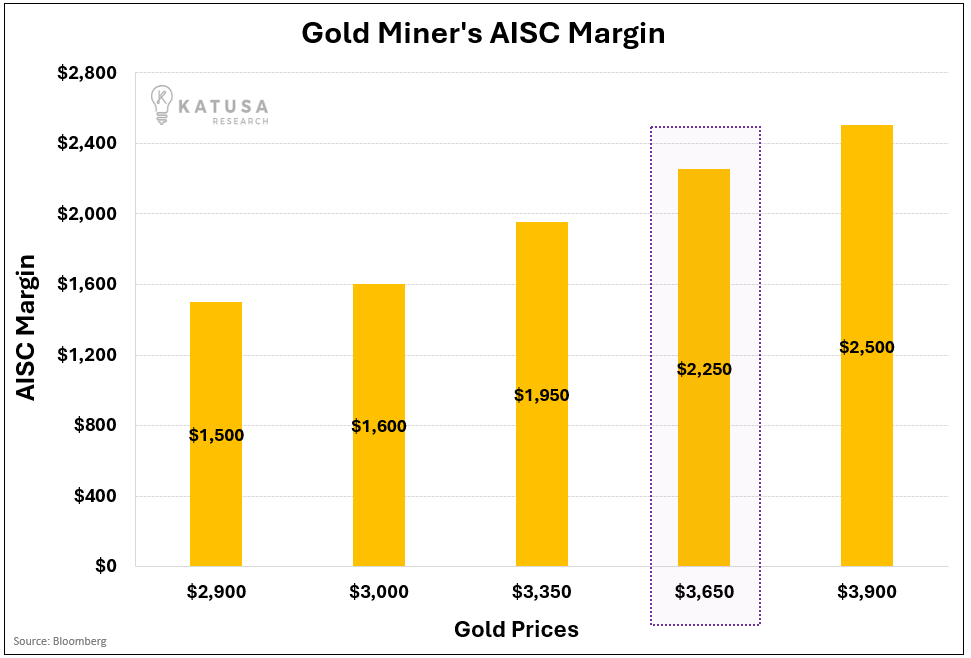
This is what operational leverage looks like
Gold miners are literally printing money:
▪️Gold at $2,900 → $1,500 profit per oz
◾️Gold at $3,650 → $2,250 profit per oz
Their margins just went up 50% while gold rose 26%
The Future Is Golden at Grey Fox
New Results Continue to Build on Resource Size
12.4 g/t gold over 10.7 m including 27.9 g/t gold over 4.5 m
Discovery of a New Exploration Corridor at Depth
6.2 g/t gold over 7.8 m CW and 4.4 g/t gold over 16.0 m CW
Exploration Driving Production Growth for the Future
https://t.co/VsNXcwmXjE
Thanks @SecRubio, @US_SrAdvisorAF, & @Presidence_RDC for opening doors for US investment. @KoBold_Metals & @AvzMinerals agreed on a framework for KoBold to buy AVZ’s interests in the Manono lithium deposit in the DRC. We’ll make America & DRC safer, stronger & more prosperous