People still argue for bigger blocks in 2026 as if they didn’t learn anything from the past
If Bitcoin had scaled to 8MB blocks in 2017 with current relative utilization, the chain would be at 2.88 TB today
Instead we settled for the signal at 720 GB
8MB blocks are a direct attack on sovereignty, forced bloat for no gain
The math is clear, do the work or stay lost
Huge progress update. We will soon have Cashu Ecash mints in secure enclaves that the mint operator can't steal the Bitcoin from, not can they inflate or manipulate the Ecash supply.
The operator has no access to the private keys of the mint. This is amazing news for users and operators alike.
It allows us to build tools for communities that allow them to run mints without being afraid of malicious actors, internally or externally, such as security threats from hackers.
We're building this for the Bitcoin community first but we're planning to expand this also for local currency communities outside of the crypto space that exist in pockets all around the world. Especially the local currency tech stack is old and antiquated. We're going to give them the most advanced ecash protocol they could ever dream of. For free!
Lots of moving parts here: servers, libraries, backend, wallets, and protocol extensions. Incredible work by the entire Cashu team.
@callebtc I have Proton VPN, but I also heavily rely on Tailscale for things like node connections. Switching between them all the time is annoying, so out of laziness, Tailscale is connected most of the time.
@glxyresearch he tail is the hard part. Migrating exposed P2PK and reused P2PKH coins is not the same task as protecting the largest value clusters. Blockspace makes that difference visible.
@theinstagibbs Dust is not a fixed number. At 50 sats per vbyte, about a quarter of the UTXO set is already economically dust. Policy tools matter because fee rates move the spendable boundary.
@TheBlueMatt The tail is the hard part. Migrating exposed P2PK and reused P2PKH coins is not the same task as protecting the largest value clusters. Blockspace makes that difference visible.
@DE_Compounder Dieselfahrzeuge die sich auf dem Prüfstand anders verhalten als im regulären Betrieb haben weltweit ziemlich viel Aufmerksamkeit bekommen
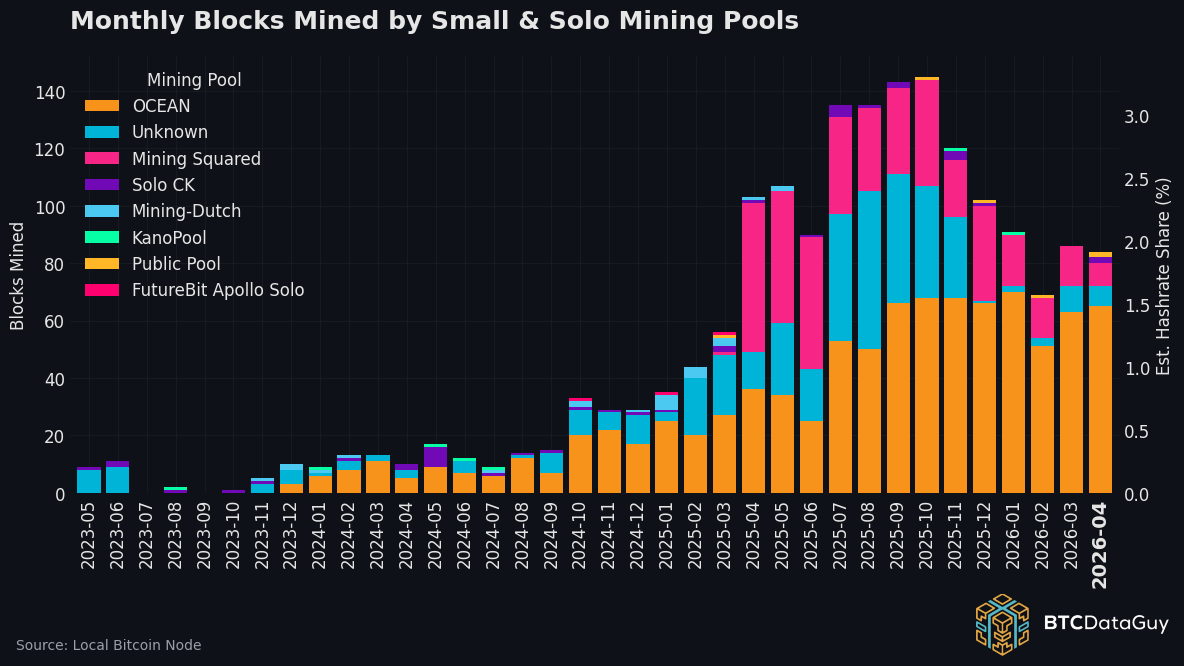
Small/solo mining is no longer just folklore.
Over the last 3 years, small & solo-labeled pools have become visibly measurable in block history — still tiny versus industrial pools, but not zero.
The fun part is variance: lottery wins make great tweets; full-month block share keeps it honest.
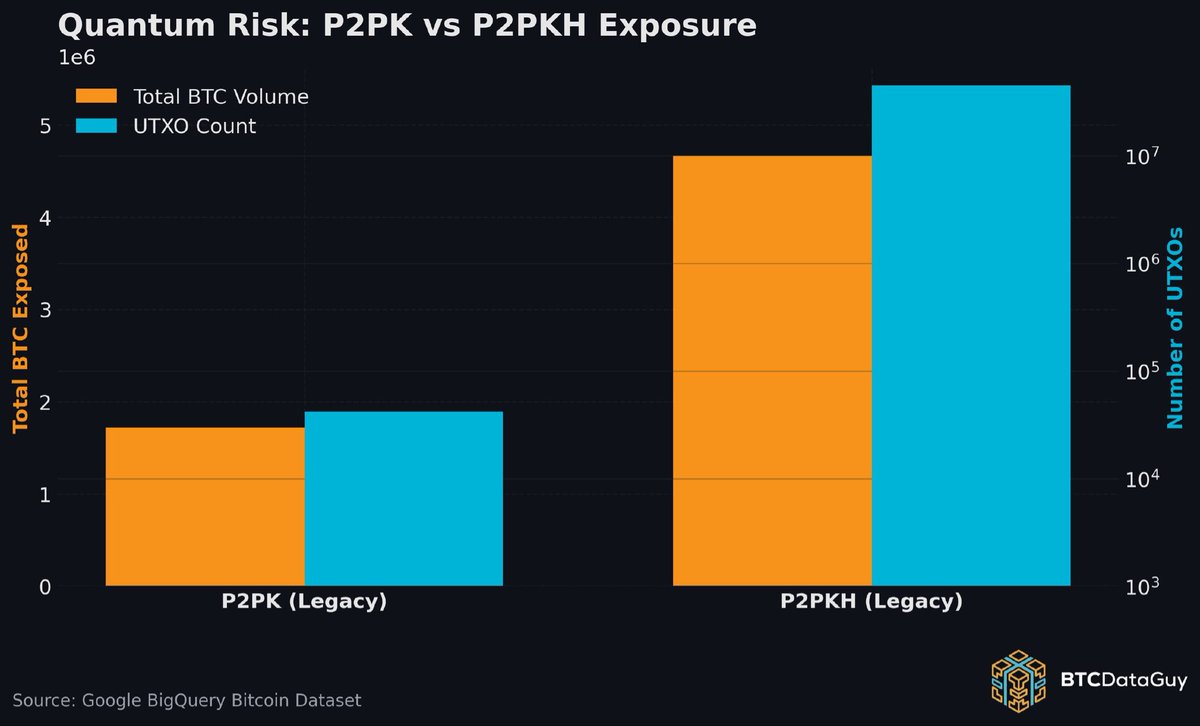
And the exposed set is not evenly distributed.
50% of exposed BTC sits in ~14k UTXOs.
80% in ~56k.
90% in ~153k.
95% in ~452k.
So mitigation does not start with “everyone moves at once.” A prioritized migration of high-value exposed UTXOs removes most of the systemic risk first.
The quantum debate doesn’t need to be “Bitcoin is doomed” vs “nothing to see here.”
The first measurable question is simpler:
How much BTC currently sits in outputs where the public key is already exposed?
That is the actual risk surface before arguing about freezes, migrations, or timelines.
@_checkonchain@_Checkmatey_ This is the clean on-chain check against the derivatives/manipulation narrative.
I bucketed every 2024+ spend by coin age and priced it on the spend day:
5y+ coins moved since Jan ’24:
• ~1.49M BTC
• ~$123B notional
Moved ≠ sold — but the footprint is real.