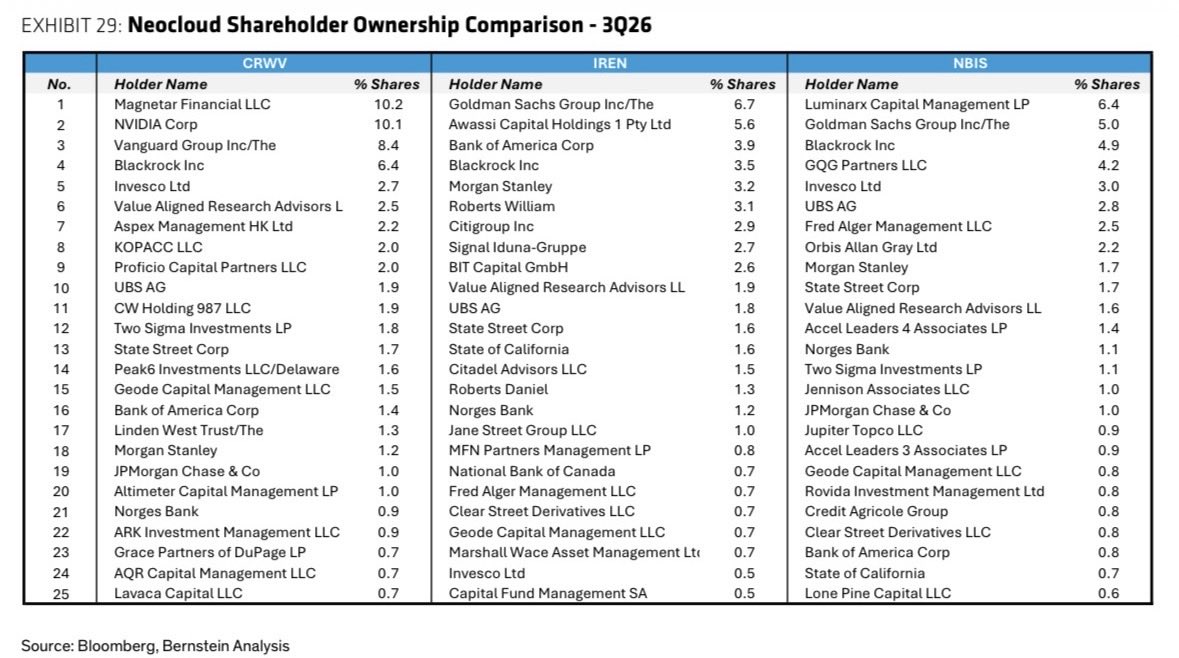
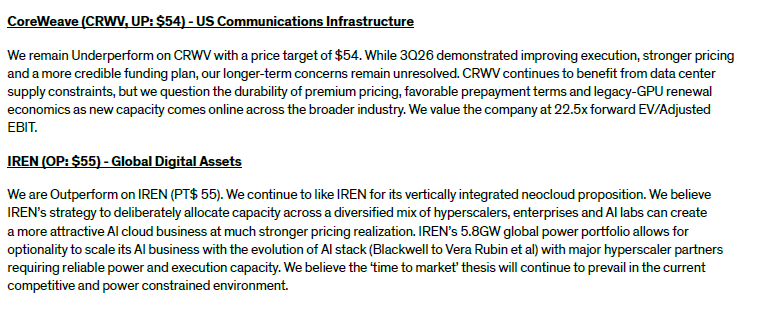
Asset light neoclouds rent the airport and borrow expensively for the planes. $IREN owns the airport, mostly pre-sells the seats, and borrows cheaply against the assets (unencumbered data centers). Pre selling these seats is more like a charter plane in your own airport vs scrambling to fill seats for an airline.
Super interesting comparison of GPU finance and the AI buildout to airlines. I’ve seen two other people make this comparison now:
1. Ken Griffin
2. Sridhar Ramaswamy
Both are very, very smart so worth learning more.
Getting this amount of compute turned on, cooled and working reliably is incredibly hard.
The cash shortage is also going to be nuts next year. Even cumulative industry delays of a few months between paying for compute and getting it reliable enough to generate revenue will mean hundreds of billions of incremental dollars just for working capital. Where will that come from?
A bail out is coming regardless. How much pain 1st is the only question. It's structural, embedded. There is far too much debt in the system that has to be refinanced. They know this. They ran the real economy hot 1st (which cools financial markets). Their bet was deflationary technology gains for AI to create room for the inevitable liquidity injection. Refinance of structural debt requires bank balance sheet capacity which is = liquidity. Notic how every rally in 2026 has run out of gas? Thats the deficient liquidity. This is also driving the narratives. 2027 into 2028
@RealNickMugalli Oversupply of what ? Grid connected energized computer? Be specific , because it is nuanced. Also, $NVDA is a backdrop for $CRWV but a customer of $IREN to plug into their energized racks. Completely different dynamic.
"One thing I can tell you is that anybody who has access to GPUs and the space to deploy them has a ridiculous amount of demand, unlike anything I have ever seen"
That's literally the $IREN thesis playing out in real time... explains why he bought the stock last week.
The market is throwing a tantrum despite stupidly strong fundamentals underneath.
I feel pity for anyone capitulating around these levels. Don't let emotions get the better of you.
You got this 👊
Correct. The question as an investor becomes how big will the pie be and whose growth could have the most value add convexity . The best margin likely will be the most profitable bottom line but not necessarily the best investment , depending on the valuation starting point. The question people should be asking isn't if Space X will have the best margin business , it is will it result in a monopoly of compute or is there space for others in the industry and enough margin to support them.
I actually dont own any shares currently. But I can be objective. Thats a "cult"? Then I must not be a member? Your comment suggests you cannot be objective. Labeling something a cult without doing the work is lazy and contributes nothing. I only responded to you so anyone reading doesn't get influenced by your commentary.
@CalebFranzen We have been in a liquidity bear market since EOY 2025. Turbulence phase now. Transition into recovery and bull between now and mid 2027. Are we out of the woods yet ? More likely "not yet", than yes but timing it is impossible.. Depends on when UST and Fed blink.
$IREN
What matters more is how much each MW earns.
At current unit economics based on their latest disclosed 5 year deal it is:
$22M of revenue per MW per year at 86% gross margin (direct costs).
The GPUs cost $8M per MW per year ($40M up front depreciated over 5 years). Or $10.4M per MW per year when you add financing costs (cost of capital at 10% adds $2.4M per MW per year).
At $22M revenue and 86% gross margin, that leaves $8.5M per MW of spread or 39% of revenue.
These numbers don't account for the financing costs being much lower per MW being that this particular contract covered 90% of the GPU capex via a prepayment.
If we adjust for the prepayment, the financing costs drop from from 2.4M per MW per year to just .24M per MW per year.
Meaning each MW earns $10.68M per year or 48.6% of revenue.
At a 14% cost of capital, the financing costs go up from .24M per MW to .34M. Barely moving the deal economics.