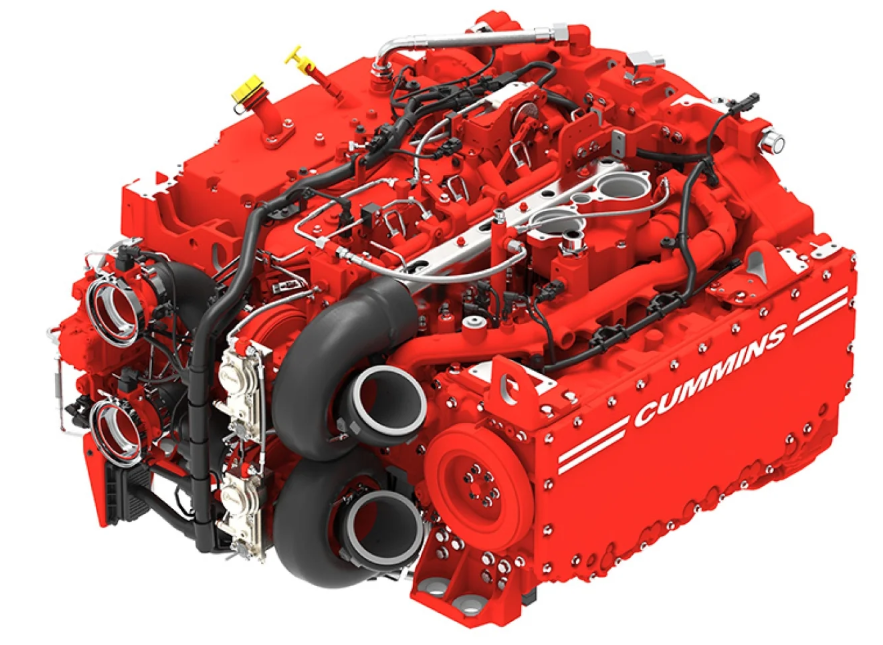
...And Cummins designed one too. An opposed-piston, 4-cylinder, 2-stroke diesel that makes 1,000 horsepower and it’s going in Army tanks.
Thanks to @Loggingmedia for bringing it to my attention.
It’s called the Advanced Combat Engine, or ACE, and Cummins built it with a San Diego outfit called Achates Power (from yesterdays post). It’s a 14.3 liter two-stroke diesel, and here’s where it gets weird. Four cylinders, but eight pistons. Each cylinder has two pistons facing each other, and they slam together in the middle to fire. Each row of pistons turns its own crankshaft, and the two cranks are geared together to put the power out.
No cylinder heads. No valves. No camshaft. Air comes in through ports in the cylinder walls, pushed by a gear-driven supercharger and two Holset turbos.
And it makes 1,000 horse and over 2,400 lb-ft of torque. Cummins says that’s 50 percent more power for its size than the combat engines out there now, with 13 percent better fuel economy. They can build it as a three, four or six cylinder, from 750 horse all the way up to 1,500.
The Army gave Cummins an $87 million contract in 2021 to finish developing it for the Bradley and the next generation of combat vehicles.
The idea goes way back. The Germans put opposed pistons in airplanes in the 1930s, and the Brits put them in trucks in the 50s. Now Cummins is putting them in tanks.
I’d still like to see one in a Pete someday. Just once. 🚛
“The world of the dealership (and most of our modern world) works off the assumption that any obstacle or friction should be minimized. It offers automatic high beams, automatic climate control, automatic braking, automatic lane guidance, and automatic thinking. You swipe a screen to change the radio or cabin temperature or interior lighting or level of happiness (coming in the next update). It promises to cancel all outside noise and to dampen all potholes. What is the Good Life here? A life with as little friction as possible.” @B__Daily
https://t.co/QqZXRYhEy6
“To remain human, to remain creatures capable of navigating meaningful distinctions in the world, we must resist the technological way of life and reject its languid uniformity. Personally, I resist the modern car, an example of overcomplicated tech that has flattened out the experience of driving and car ownership.” @B__Daily
https://t.co/rs0KksQHg7