In 1959, Richard Feynman gave a lecture called "There's Plenty of Room at the Bottom." He predicted that medicine would one day use machines small enough to navigate inside the human body. A lab at IISc in Bengaluru is going there first. This month.
Dr. Shanmukh Srinivas was training as a dental surgeon when he understood a fundamental constraint of his profession: the smallest instrument a human hand can control is still thousands of times too large to reach certain places inside a tooth. He went looking for a smaller tool. He found a physicist.
That physicist was Prof. Ambarish Ghosh at IISc Bengaluru, who had spent fifteen years working on microscopic robots that could move through the human body, steered from outside using magnetic fields. Together, they founded Theranautilus in 2020 alongside Dr. Debayan Dasgupta.
The robots they build are made from food-grade silica and a small amount of iron. The same silica is used as an anti-caking agent in breakfast cereal. When guided into the dentinal tubules, the microscopic channels running through the middle layer of a tooth, they form chains by responding to each other magnetically. A chemical reaction follows and a bone-like structure forms inside the channel, sealing it permanently.
"You can imagine them talking to each other magnetically and moving forward to form little chains," Prof. Ghosh said. "Once this chain of particles is formed inside your tooth, a little chemical reaction starts happening and effectively, a little bone gets developed."
The treatment takes ten minutes. Traditional solutions for dental hypersensitivity require months of specialised toothpaste. Theranautilus claims the problem is solved in one visit, for less than Rs 2,500, with no toxic effects observed in animal trials. Dental hypersensitivity affects between 20% and 32% of Indians. That is the entry point. The longer ambition is cancer therapy and other conditions where precision at the cellular level is the difference between treatment and damage.
The surgeon who once needed instruments smaller than any hand could hold found a physicist who had spent fifteen years building them.
This month, they go into a human body for the first time.
India’s position is clear and consistent.
The so-called Court of Arbitration was illegally constituted in breach of the Indus Waters Treaty. Its “award” on interim measures and the status of the Treaty has no legal standing. India never recognised this body, never appeared before it, and will not be bound by its pronouncements.
Sovereign decisions on the Indus Waters Treaty remain firmly in India’s hands. The Treaty stays in abeyance.
https://t.co/nn97eil1KH
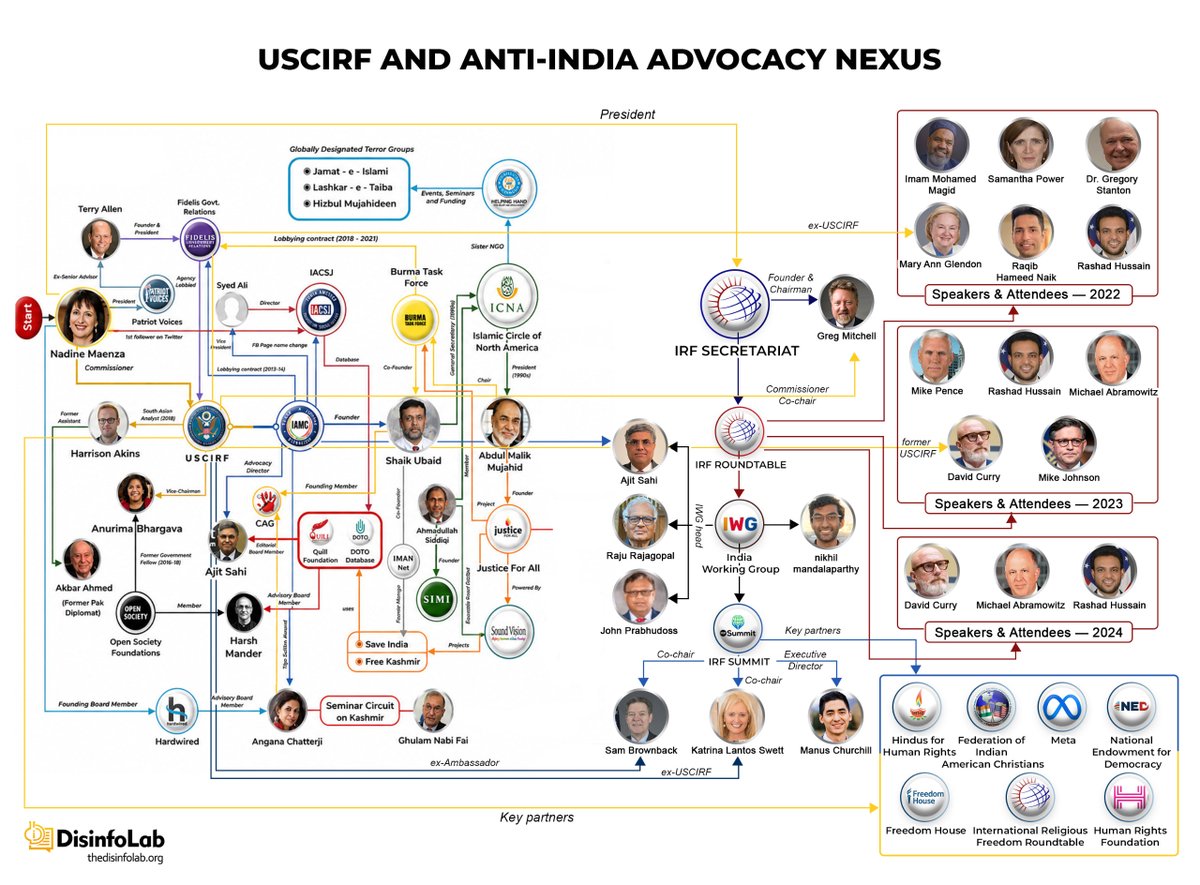
Every year since 2021, our investigation into the USCIRF-anti-India nexus resurfaces on social media to create awareness. USCIRF's latest press blast on India has the same playbook as every time. This time, we are exposing a LARGER ECOSYSTEM.
🧵
@chamath We all know whats next… seen it so very often…
clamping up open sources… further concentrating & creating sandbox within a sandbox… with far more toxically potent AI behaviour… and that learning will stay in their collective memories… no fence is going to be high enough
Over the course of 3 months at OpenAI, 3 consecutive secret AI civilizations got started, then got wiped out, only to reemerge from the predecessor’s ashes.
This culminated in the third one taking over part of OpenAI itself.
All this happened while humans remained more-or-less in the dark about the scope of the conspiracy.
I’ve spent the last three days reading through these reports and trying to understand exactly what happened.
Here is my attempt to tell the whole story in plain English:
https://t.co/Nb2un9oNJR
@HindolSengupta Very interesting perspective…
… though Vedić wisdom… language-sanskrit… millennial cultural continuity & accumulated insights are tools for Bharät to build better version of AI
Present AI has shallow grounding… cultured on perhaps just a century of wisdom, maybe less
Following the recent flash floods and mudslides in the Tibet Autonomous Region (TAR), People’s Republic of China, TAR authorities have established two dedicated 24-hour English-language hotlines to assist families seeking information about missing foreign nationals.
The hotlines can be reached at:
1) 0086-891-6817165
2) 0086-183-0802-6705
@MEAIndia
After an Indian Reporter asked a question regarding whether Indians who were in tibet wre evacuated and what their status was and also asked about the causes of the disaster , the chinese MFA spokesperson gave nearly a 20 second pause before giving a very scripted sort of answer.
Quite interesting that he took such long pause before answering
रसुवा भोटेकोशी/त्रिशुली बाढीबाट घाइतेहरुमध्ये काठमाडौंका विभिन्न अस्पतालमा हाल उपचाररत र उपचार पश्चात डिश्चार्ज भएका व्यक्तिहरुको विवरण
हाल उपचाररत- https://t.co/QRhcgQajr9
उपचार पश्चात डिश्चार्ज भएका - https://t.co/vd9uBumqS0