whoops! if you downloaded one of the Qwen-3.8-OBLITERATED GGUFs and were disappointed with the results, try redownloading the latest! (V3)
my agent has just informed me we made a booboo in our GGUF conversion pipeline... 😬 the bf16 (safetensor) files were always fine, but the GGUFs weren't being properly converted
so whoever said "doesn't seem that liberated, maybe only works on the dev's machine" — YOU WERE RIGHT LOL
that's my bad for not validating the GGUFs in a fresh environment before pushing 🙏 everything should be good now!
Big move in DeFi. 🐮🤝👻
@aave x @CoWSwap are joining forces – bringing MEV-protected, intent-based swaps to the Aave ecosystem.
Every time you swap, rebalance or repay collateral on Aave, CoW Protocol will be doing the hard work.
Let's explain. 🧵
GMX has successfully completed its ~$44M Distribution Plan for $GLP holders on Arbitrum affected by the recently disclosed V1 vulnerability.
Eligible wallets can now claim via the GMX dApp.
🧵 Read the details below:
1/7
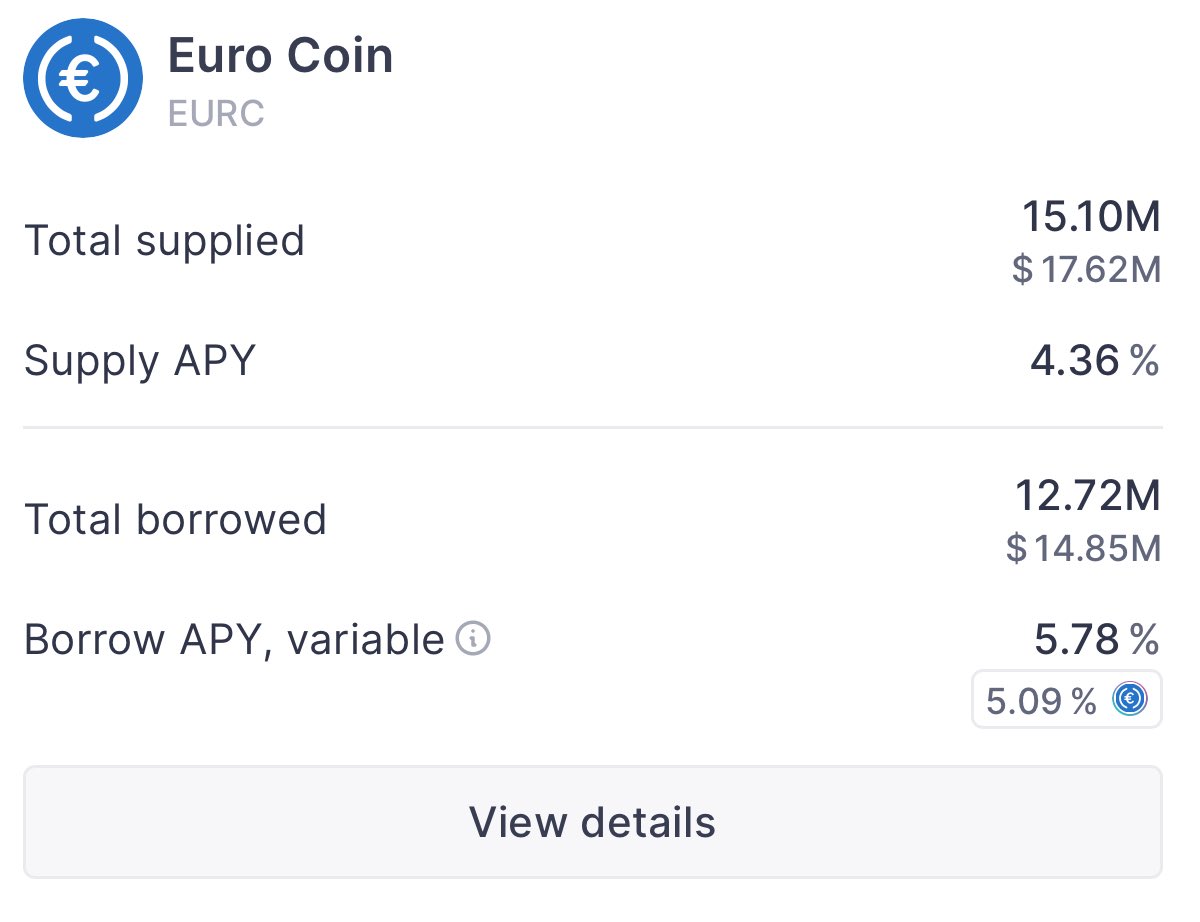
Running a Web3 business in Europe?
🎥 This video shows how to open a Monerium corporate account in minutes, get an IBAN linked to your @safe wallet,
and use it to operate with EUR and $EURe — across @arbitrum and other supported chains.
💶 Receive EUR via SEPA, directly into your wallet
👥 Pay teams & vendors from your own IBAN
💰 Hold EURe or deploy it in DeFi
Watch the full tutorial below 📺
economic security ATH & 10x flippening
Ethereum: $150B
= 35.7M ETH × $4.2K/ETH
Bitcoin: $15B
= 1B TH/s × $15/(TH/s)
Ethereum is the embodiment of security. 100% uptime. Rich client diversity. 8K consensus participants. Massive slashable economic security. There is no second best.
BTW @saylor—offer still stands. Let's debate Bitcoin's security. You can't outrun fundamentals: halvings gut the security budget, fees are 1% of miner revenue ☠️
Net new ETH issuance today: ~2,528 ETH ($10.1 million).
Net inflows into the ETH ETFs today: ~115,000 ETH ($445 million).
The ETH ETFs bought 45.4x more ETH than was net issued by the network today.
Accelerate!
The thesis of Chainlink is completely different today than its early years.
How it started: A single data oracle service
How it's going: The Web3 cloud powering entire apps
Chainlink started out simple, providing existing data on to blockchains. Onchain apps used that data to make decisions like whether to liquidate a loan or how to settle a perp.
Chainlink then expanded into different types of computation (e.g., random number generation, keeper automation) before launching its cross-chain protocol. However, those were only building blocks to a much, much bigger value proposition emerging.
With the introduction of the Chainlink Runtime Environment (CRE), Chainlink is primed to be the main way developers and institutions both build onchain apps and power them through their lifecycle.
Chainlink is no longer just a service or even set of services, but the foundation underpinning onchain apps and use cases. It’s akin to the cloud but decentralized and for onchain apps, providing them the development framework for building apps, the key services they require, and the computation that powers them on the backend.
But why is this important? And why is Chainlink doing this?
The blockchain landscape is changing. You used to use a single blockchain as your cloud-like environment. But now there are hundreds of chains and you want to be able to interact across them all. Transactions are also more complex with the introduction of tokenized real-world assets (RWAs). This is the phenomenon of all the world’s existing value becoming tokenized, which is 100x the value that currently exists onchain. Thus, you must adopt RWAs if you want to succeed in this industry long term at any scale.
However, the introduction of RWAs requires new services. They require data like DeFi, but even more types of data, such as proof of reserves, net asset value, and much more. They also require compliance policies built into the asset itself and the services transacting them, which naturally needs identity data to work. Furthermore, they need privacy features, connectivity across chains, and integrations with legacy systems.
The best way to build an app like this is through a single platform that is chain-agnostic and has all the key services already built-in. This is Chainlink.
Chainlink is the only all in one platform where institutions can solve all their data, cross-chain, compliance/identity, privacy, and legacy system integration requirements. And importantly, they can combine these service into one sequential workflow (i.e., one piece of code) that Chainlink runs securely end-to-end in a decentralized manner.
This workflow is essentially an app that interacts seamlessly across chains and legacy systems while leveraging key services along its lifecycle. Once you build this workflow, you can easily reuse it and modify it to support new customers, new chains, new legacy systems, new oracle data, new use cases, etc without rewriting it all. It’s by far the most efficient and future-proof way to not only build DeFi apps, but apps for tokenized RWAs, which are the future of our industry.
This value prop puts Chainlink at the heart of onchain applications; far beyond just being a side service. The market doesn’t quite understand yet how well Chainlink is positioned, but it will because its product offering, vision, and historical track record of delivering solutions meshes perfectly with where the industry is heading and what TradFi & DeFi require to succeed in this new RWA paradigm.
🧵 Monero is under attack. Not through bugs or exploits.
This is an economic attack. Through incentives. Through miners.
They're not hacking your privacy — they're buying it.
Here’s what’s happening and why it matters: 👇