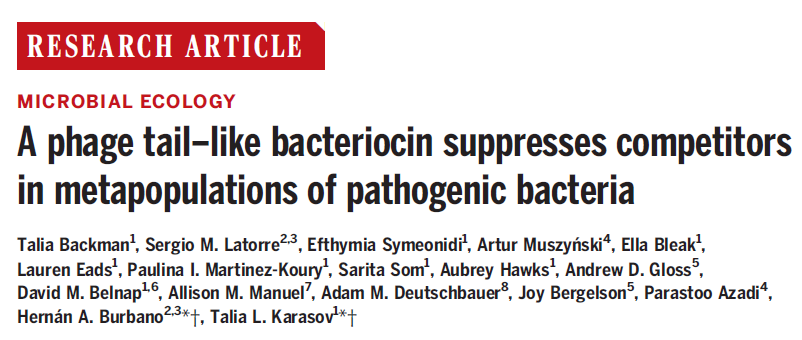
TWiM describes experiments to explore gut microbiota signatures of vulnerability to food addiction in mice & humans, and how a phage tail-like protein suppresses competitors in populations of bacteria of plants. 📺 https://t.co/ZIfzfUFRvZ
A beautiful work on one of my favorite biomolecules!! 😍 Phage-tail-like-bacteriocins or Tailocins are enigmatic.
So much to discover about how they function, evolve & play a role in ecology.
Very happy to have contributed to this great piece! Please check the thread by @hernanaburbano . Great job @BackmanTalia , T. Karasov and rest of the team.
My inital bacteriophage research ended up taking an exciting turn to researching something I had never heard of before studying them- tailocins :) Check out my PhD work thus far! @hernanaburbano@smlatorreo https://t.co/MnzCJYcNO2
https://t.co/9Nu7XSbgXH
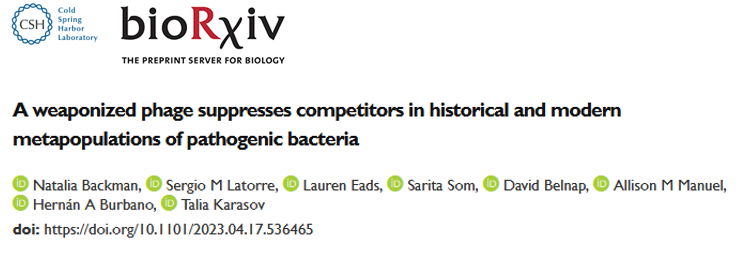
Our new collaborative work led by @BackmanTalia between my lab @uclbiosciences@CloeFor & the Karasov Lab @UofUBiology (https://t.co/7CP9Lp3TpR) in which we find that plant bacterial pathogens have repurposed #phages to compete with one another. https://t.co/rxaQDCZEzt
Congratulations!
The Karasov lab studies host-microbe evolution & the interplay between host genetic diversity & the evolution & spread of microbes. Focusing primarily on the microbes that colonize plants, they use a variety of tools including genomics & population genetics.
Hey everyone! In case you haven't heard, the Evergreen Phage Conference @EvergreenPhage is happening in Olympia, Washington, USA, Aug 2-5 (with workshops on Aug 1 & 6!) (option to attend online/in-person)!!
Here's the link for more info (https://t.co/Gw7unLWCzl)... 1/
This is the most detailed model of a human cell to date, obtained using x-ray, NMR and cryoelectron microscopy datasets.
“Cellular landscape cross-section through a eukaryotic cell.”
- by Evan Ingersoll and Gael McGill.
https://t.co/YERCmdIJXH