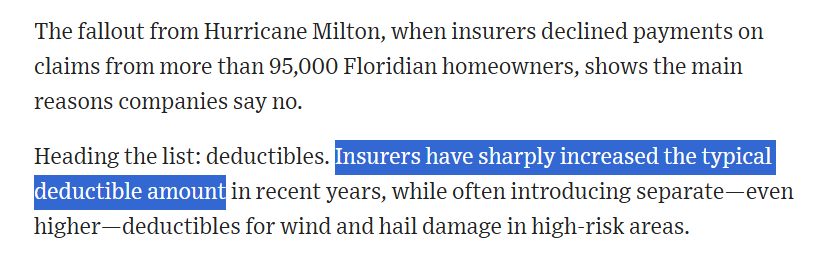
Noteworthy that even the most credible sources like the @WSJ get deductibles wrong, twice suggesting in this story that insurance companies (not consumers) choose deductibles. Another reason why it's smart to purchase through a local independent agent.
https://t.co/mjdTuuX5tY
And yet, these same folks wonder why insurance is so expensive.
"A third of all consumers would consider using AI to digitally alter an insurance claim image or document in their favor...that number rises to 55 percent for Gen Z."
https://t.co/zrxZdBTAva
It's easy to buy share, but hard to do so profitably.
"On the loss ratio front, Tesla’s insurance carriers reported an overall direct loss ratio of 100.4...the gap between Tesla and the P/C industry as a whole has stayed near 40 points for the last three"
https://t.co/UrncYLktDV
This feels accurate to me: "Somewhere in the last fifty years the cultural goal inverted and a child stopped being what life is for and became a line item competing with the lifestyle."
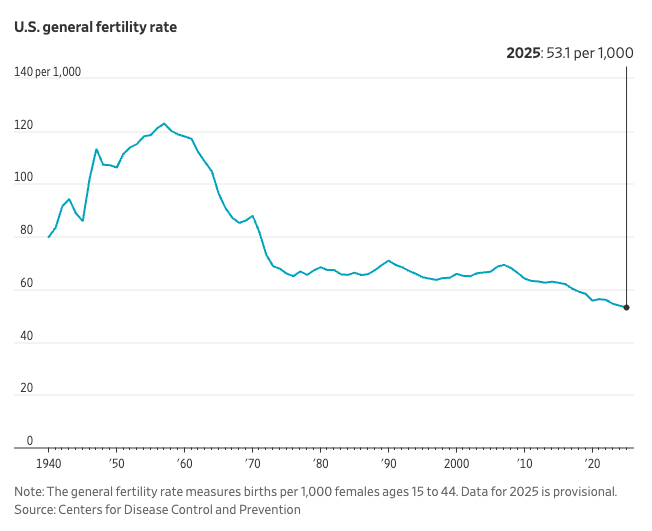
US fertility reached 1.57 last year, the lowest ever recorded, and the WSJ explanation is "uncertainty about finances, relationship stability, and the political climate"
my great grandma had eleven children during the second world war, in a country being bombed, in a house with no running water, on rations.
poor people have always had kids. the poorest people on earth right now still have kids and the financial excuse is a story we tell ourselves because it makes us feel good and the real one is unbearable
the real mechanism is that we got rich enough to redefine children as an expense instead of the point. somewhere in the last fifty years the cultural goal inverted and a child stopped being what life is for and became a line item competing with the lifestyle. once you frame it that way the math never works, because the math isnt supposed to work. that's the point
we are living in the richest moment in human history and we decided to use the surplus to buy ourselves out of the future. the most prosperous civilization that has ever existed is committing demographic suicide at the altar of personal optimization and comfort, and the official line is that we cant afford it
the birthrate is a lagging indicator of a civilization that forgot why it was alive
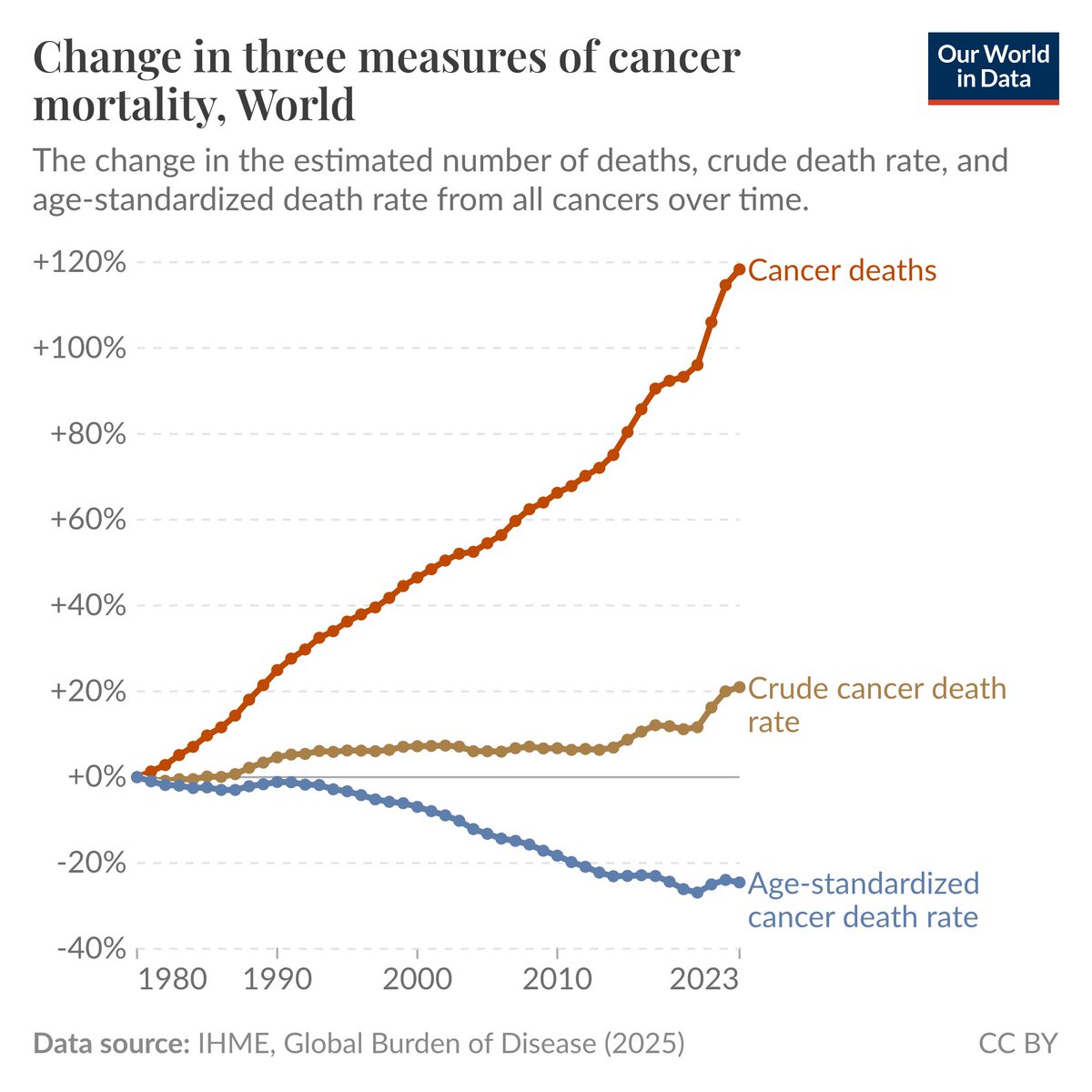
The number of cancer deaths worldwide has more than doubled since the 1980s. Does that mean we're losing the fight against cancer? Not necessarily, because it depends on how you measure it. On this chart, you can see three ways to look at the same data.
The red line shows the total number of cancer deaths. It has increased by about 120%, but this measure doesn't account for the fact that the world's population has also grown enormously over this period.
Another approach is to look at the death rate: the number of cancer deaths divided by the total population. That's the brown line, called the crude cancer death rate. It has increased too, but much less — around 20%.
But there's still a problem: the world's population has been getting older. Cancer is mostly a disease of old age, so even per capita, we'd expect more cancer deaths simply because there are more older people than before.
That's where the method of “age standardization” comes in. It's a way of asking: what would the cancer death rate look like if the age structure of the population hadn't changed?
The blue line shows this age-standardized rate: it's fallen by about 25%. At any given age, people are now less likely to die of cancer than they were in the 1980s.
The same underlying data gives us three different pictures. The absolute number of deaths is up; the crude rate is up slightly; the age-standardized rate is down. None of these are inaccurate, but they answer different questions.
Age standardization is one of the most important statistical methods for making sense of health data. Without it, population aging can hide progress or mask problems.
Meanwhile, in March #TheBrotherhood will not be present in Durham. No Cooper Flagg, no Zion, no Paolo Banchero, no Kyrie Irving, Jayson Tatum, Bagley, Okafor, Grayson Allen, Austin Rivers, Elton Brand...and on and on.#CarolinaFamily
Hey @Marketplace , why only consider quarterly vs moving to biannual earnings reports for transparency? Why not solve the transparency problem by reporting financials monthly? Progressive Insurance has been doing that for decades.
https://t.co/B8SpIQWl1X
How much does having data matter in the insurance world? For sure, some.
GM insurance - now in 14 states at an annualized DWP rate of just ~$40M & unprofitable.
It's hard to beat the incumbents, and maybe even harder for an elephant to do so than for a unicorn.