Agree. A lot of software is about to stop being a place you live and start being plumbing an agent can call. You shouldn't have to open five dashboards to move work forward. Hand the agent the job, let it hit the systems, and keep people on the judgment calls. The interface becomes optional when the workflow is built for the agent first.
I'm becoming so MCP-pilled that I'm really starting to question... do we need an interface anymore?
For SaaS products that are essentially plumbing / routing, there will come a time where the UI is optional.
I led engineering at Google DeepMind.
Today, I'm proud to introduce Fo to give personal AI something no lab ever has... Humans.
Other personal AI's pretend AI can do everything. Fo employs humans to do tasks that AI cannot.
- 2x better at real-world task completion (beats other agents by 69%)
- 94% trust rate (4x less likely to leak private info vs Muse, Instinct)
Sign up for free: https://t.co/9ndFhcN5mO
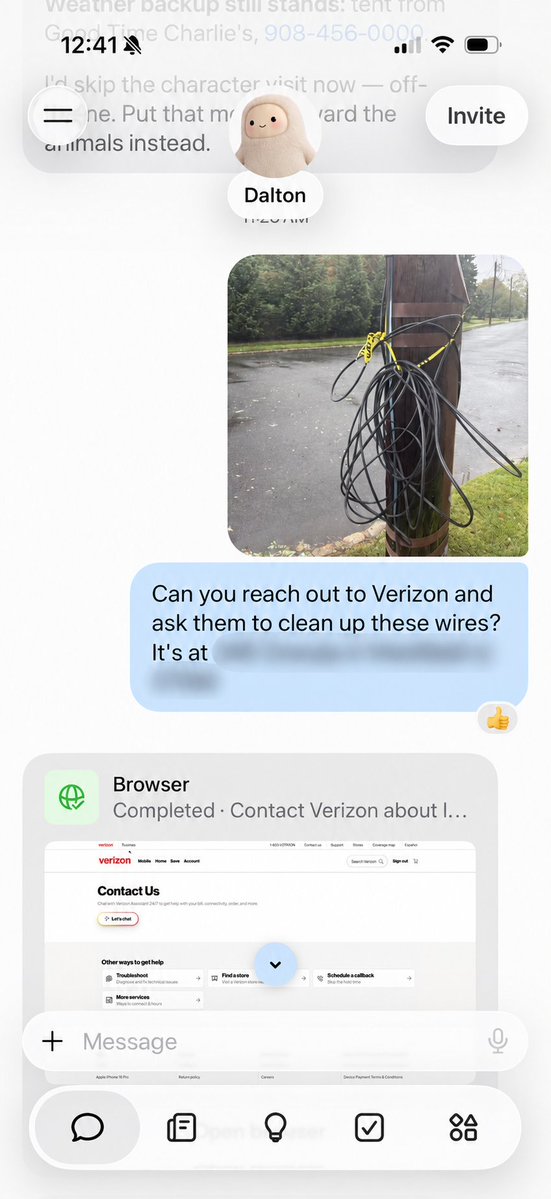
This is personal AI getting real. Not another chat screen. Take a photo, hand the agent the job, and it opens Verizon and starts the fix. I never would have sat in that support queue either. We're heading into a world where "someone should do something about that" is just a prompt. 🚀
I’m slowly cleaning up the suburbs with Muse.
Saw this mess of wires on a pole. Took a picture and asked Muse to contact Verizon to get them cleaned up.
It went to their website and got to work.
There is a 0% chance I would’ve sat in a Verizon support chat over this. I would’ve just been mildly annoyed every time I walked past it for the next five years.
“Someone should do something about that” is now a prompt.
🤝 @alexandr_wang
I created a new Grok Bot Template that gives you your own AI chief of staff. On first run it walks you through setup: your goal, which functions you want (content, SEO/AEO, sales outreach, lead scouting, social posting, builds, inbox), any extras, and optionally personal errands and reminders. Then it spins up specialist agents for each one and runs them with a morning brief, weekday follow-through, and a weekly debrief. Nothing sends, posts, or spends without your OK.
This is what I run my day on. Today it had my agents research and score leads, draft outreach, queue every email for my OK, hand follow-ups to my team, and even kick off an AI voice-call test. Now you can too :)
https://t.co/eU4jshPWsH
I created a new Grok Bot Template that gives you your own AI chief of staff. On first run it walks you through setup: your goal, which functions you want (content, SEO/AEO, sales outreach, lead scouting, social posting, builds, inbox), any extras, and optionally personal errands and reminders. Then it spins up specialist agents for each one and runs them with a morning brief, weekday follow-through, and a weekly debrief. Nothing sends, posts, or spends without your OK.
This is what I run my day on. Today it had my agents research and score leads, draft outreach, queue every email for my OK, hand follow-ups to my team, and even kick off an AI voice-call test. Now you can too :)
https://t.co/eU4jshPWsH
I created a new Grok Bot Template that gives you your own AI chief of staff. On first run it walks you through setup: your goal, which functions you want (content, SEO/AEO, sales outreach, lead scouting, social posting, builds, inbox), any extras, and optionally personal errands and reminders. Then it spins up specialist agents for each one and runs them with a morning brief, weekday follow-through, and a weekly debrief. Nothing sends, posts, or spends without your OK.
This is what I run my day on. Today it had my agents research and score leads, draft outreach, queue every email for my OK, hand follow-ups to my team, and even kick off an AI voice-call test. Now you can too :)
https://t.co/eU4jshPWsH
@brian_armstrong Love this. If agents are becoming the heaviest API users, they should close the loop too. Hit a bug, file structured feedback, and another agent drafts the fix. Agents that don't just use the system but improve it while they work.
Opus 5.5 is mind blowing 🤯! Basically one shotted this video and all it took was 1 prompt and 10 mins. It’s starting to get ridiculous what you can do with AI.
@alighodsi is right. Most enterprises are still stuck at chatbots, and the models aren’t the bottleneck. Context is: the processes, the exceptions, and what lives in people’s heads. That’s the gap we built Ferrata Labs to close. We at @FerrataLabs map the real workflow, give agents the full context, and let them own the work end to end.
@alighodsi is right. Most enterprises are still stuck at chatbots, and the models aren’t the bottleneck. Context is: the processes, the exceptions, and what lives in people’s heads. That’s the gap we built Ferrata Labs to close. We map the real workflow, give agents the full context, and let them own the work end to end. Here’s our story 👇
Databricks CEO @alighodsi went off on @a16z pod about enterprise AI adoption:
"They're just so far behind in the adoption curve of actually automating things and getting value out of this stuff."
Ali says most companies are still just using chatbots. There's hardly any agentic transformation.
Why is that?
"The models are smart enough, but they just don't have the context that exists inside of any organization."
"They have not been in every meeting. They don't know what's in everybody's heads. They don't know all the processes."
"If you just fused that and gave that context into the AI models...there's so much productivity gains you could get for any organization on the planet."
Context Creation is the biggest opportunity in AI right now.
Loved watching the agent finish the task end to end. We're moving from agents handling the middle of the work to agents owning it start to finish. Give them the full context and a clear goal, and they can get it done. We're entering a new world, and these shifts are happening weekly now. 🚀
Context switching across unrelated topics creates friction. But within one workflow, like sales scouting, then enrichment, then signal validation, it can drive much higher productivity and better outcomes.
The key will be how we break down work units in the new world. Build the systems and agentic workflows AI-first, then layer in the human skills around them.
Well said. The new world we are heading into is where we just interact with a voice agent that ends up handling the entire actual task instead of battling with all the different UI/Screens.
Using tech to avoid tech and put more time behind the things we really enjoy.
Technology has gotten so good at keeping our attention that we’re now paying for technology to help us stop using technology.
Literally buying products to stop themselves from using their phones.
“Bricking” physically tapping a device to block distracting apps is getting attention as a digital-detox behavior!
@levie Agree on process reengineering. Adding an agent to the old workflow gets you a demo. The payoff comes when you redesign the work so the agent does it end to end and people handle only the exceptions. With legacy ERP, the cleanup usually has to come first.
The process reengineering point is the one I'd underline. Layering an agent on the old workflow gets you a demo. Changing the workflow so the agent does the work and people handle the exceptions is where it pays off. Legacy ERP cleanup usually comes first.
Some more tales from the road. Met with a couple dozen technology leaders this week across banking, media, information services, insurance, and consulting to discuss agents in the enterprise.
Some of the biggest trends right now:
* Cyber! Everyone nervous about the growing rate of vulnerabilities coming at them from AI, and the implications of the OpenAI Hugging Face incident. The conversation is not as existential as it is in Silicon Valley, but still highly concerned and pragmatic about what to do about it operationally in their environments. Lots of new discoveries due to AI, and still hard to keep up with all the changes they have to execute now.
* Model battles persist. Most companies are deploying multiple frontier models within their enterprise. Too hard to standardize on anything and seeing different preferences across their teams and use cases. But the dollars are still concentrated on just a few vendors. Open weights still in infancy at scale in most of these organizations, often due to lack of domestic “frontier” OSS options. Plenty of appetite for more options here, but so far few places to go.
* Agent security and identity. Somewhat tied to Hugging Face, there’s much more awareness to the new challenges around agent security and identity management in a world when agents are trying to get into every system they can. In a perfect world enterprises could setup identities for all their agents and control what they’re doing, but of course sometimes the agent needs to act exactly as the user as well.
* Process reengineering. Most companies realizing that the big upside of agents is when they can change the actual workflow itself to get the full gains from AI. Far more ROI when companies can adjust their workflows to support agents changing how the work happens instead of just layering on agents into the existing flow. But the big question is who can actually tackle driving these changes, where does that live, etc. Best lessons were still around embedded FDEs in the functions.
* Ruthless adjusting of architectures. Most companies had examples of changing systems out multiple times just in the past year or two with different vendors. I probably haven’t heard “we tried X and it didn’t work so have gone with Y” more than in today’s environment. The lesson here is that because innovation is happening so fast, no one hangs around until a vendor gets something right, they just move on to the next one.
* Evals! Still very early for most companies to have a good grasp of evals of their workflows. A few customers out of a couple dozen called this out - huge opportunity right now for enterprises to have a good sense of how their work actually happens and how well AI is doing against it.
* Legacy systems still a hurdle. As always, legacy systems still remain a mainstay issue that holds back enterprises from rapid adoption of AI in enterprises. Data is fragmented across legacy environments that weren’t built for an agentic world. Companies spending a lot of time just cleaning up these old platforms.
Many more topics, but these tend to be some of the more top of mind items at the moment in the enterprise.