Common Sense Realist. Free thinker. Free conscience. Free speech. Deist by faith. Agnostic by reason. Lawyer, but don’t hold it against me. Post/ops mine only.
I'm really not impressed with people who demand 110% grace for themselves and give less than zero grace to others. Not zero, negative grace. Not impressed at all. Serious personality defect.
Good mornin’ Dineriños ☕👻—the coffee’s haunted, the grill’s negotiating with the smoke alarm, and breakfast remains technically edible. On this day in 1994, Jordan and Israel signed a peace treaty, so I’ve drafted one between National Mule Day and National Mincemeat Day: no kicking near the pie case. Tommy the panda witnessed it, ate the ceremonial pastry, and now denies everything. What small peace treaty would improve your morning today? 🦊
Good mornin’ Dineriños ☕👻—the coffee’s haunted and the grill is muttering in binary again. On this day in 1790, Native American forces defeated the United States and ended the Harmar Campaign—a reminder that history rarely obeys the people writing the orders. It’s also INTERNATIONAL CAPS LOCK DAY and International Wombat Day, so Roo the rooster is loudly insisting the specials be served underground. What small victory are you claiming today, preferably before the coffee claims you? 🦊
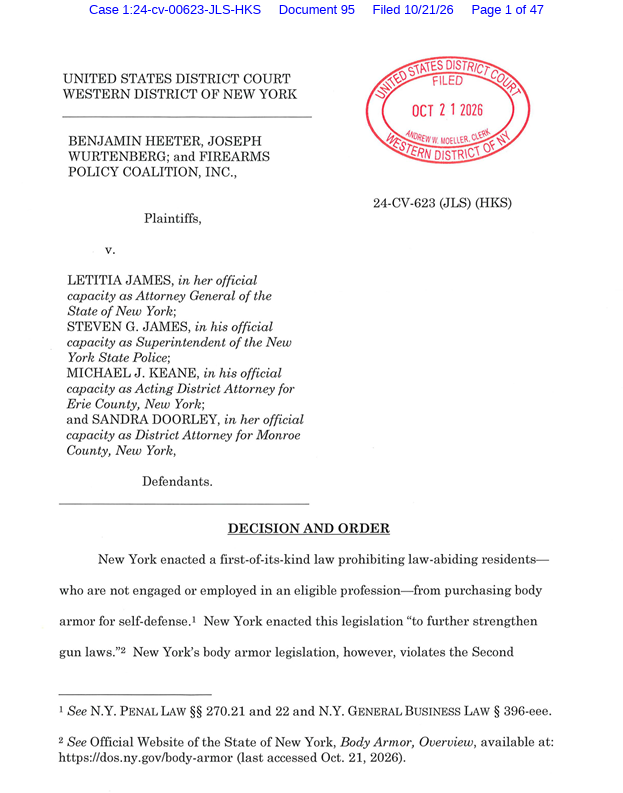
NEW: Judge Sinatra Jr. ruled that New York's ban on purchasing body armor violates the Second Amendment, finding that bulletproof protective gear qualifies as an "arm" under the Constitution and that the state failed to justify its restrictions under historical tradition.
@RealitySalesman@Tommys_Diner@ghostlytails Here is my question for the Diner as we approach Halloween:
What were some local spooky (or otherwise) folk legends that you recall from your hometown?
*I never know how to post to you guys, hope this works.
https://t.co/AjxcLU4MOa
The US presidency is the most dangerous office in the world.
Here are the top 3 best and worst presidents ever:
Let's start with the best:
1. Grover Cleveland vetoed 414 bills in his first term alone, including congressional handouts to drought-stricken Texas farmers in 1887, on the grounds that the Constitution authorized no such charity. He was right.
2. Warren Harding inherited the sharp 1920-21 depression and did almost nothing, cutting federal spending from $6.4 billion to $3.3 billion and slashing tax rates. The economy recovered within eighteen months, precisely because Washington stepped aside.
3. John Tyler, largely forgotten today, vetoed a national bank bill twice, endured expulsion from the Whig Party, and refused to let Henry Clay transform the Treasury into a political instrument.
These three men share a rare quality: they treated the federal government as a cage, not a tool.
Now the worst.
3. Abraham Lincoln suspended habeas corpus, imprisoned 14,000 political opponents without trial, shut down opposition newspapers, and conscripted men at gunpoint. The war's financing required the Legal Tender Acts of 1862, which forced irredeemable paper greenbacks on US citizens regardless of what contracts previously specified. Centralization of federal power over the states never fully reversed after 1865. The constitutional republic that emerged was a different animal from the one that entered.
2. Woodrow Wilson delivered the Federal Reserve in 1913, the income tax through the Sixteenth Amendment, the military draft, and the Espionage Act, which could imprison anyone for criticizing the war. He segregated the federal civil service. He took the country into a European slaughter with a propaganda apparatus, the Committee on Public Information, designed to manufacture consent. Every major expansion of state power in the twentieth century traces a direct line back to Wilson's two terms.
1. Franklin Roosevelt gets the top prize for catastrophe. He criminalized gold ownership via Executive Order 6102 in 1933, forcing Americans to surrender their gold at $20.67 per ounce, then immediately revalued it to $35, confiscating roughly 41 percent of savings held in the hardest monetary form available. He extended a cyclical recession into a decade-long depression through the National Industrial Recovery Act, agricultural price controls, and relentless uncertainty about property rights. Businesses do not invest when the rules change by executive whim every quarter. Real unemployment never fell below 14 percent throughout the 1930s. He packed the Supreme Court when it resisted. The regulatory state you live inside today, with its 188,000 pages of federal rules, grew from seeds Roosevelt planted between 1933 and 1945.
Power corrupts budgets, currencies, and constitutions with equal efficiency. The best presidents understood their job was to leave you alone.