This account has one job. Find setups that people might miss.
A few a day when the market allows. Not more for the sake of volume.
Screening for patterns and reading charts is not work for me. It is a hobby. It is a passion. I would be doing this even if nobody was watching.
My screening covers small caps, mid caps, and large caps. Most scanners lean one way or the other. Mine does not. A quiet base can show up anywhere on the market cap spectrum and I want to catch it wherever it forms.
I show up here rain or shine. Winners get posted. Losers get posted too.
The goal is not to hand you a trade. Glance at the chart and let it spark your own idea. Your setup does not need to look like mine. If we are both seeing the same thing forming, that is worth something.
Reaching the end goal is great. But the journey along the way is where the real work happens. I want to bounce ideas off people who see the market differently than I do (And have some fun too!). Disagreement is welcome here. We might both learn something from it.
Let's do this together. Base by base.
The headlines focused on the 25bps Fed rate hike but I believe the projections were the bigger story.
Normally, higher rates are used to cool an economy that is running too hot. Borrowing gets more expensive and companies have to pay more to refinance debt. Consumers tend to spend a little less as well.
But the Fed is doing this while it still expects the economy to hold up reasonably well. Latest projections have 2026 GDP growth around 2.3%, unemployment around 4.1% and inflation still well above the 2% target.
In my opinion, this is an important distinction. Higher rates are much easier for the stock market to handle when companies are still growing and consumers are still spending. The bigger problem would be rates staying high while growth starts weakening.
I am also monitoring the 10Y Treasury yield, which recently moved above 5%. In simple terms, this rate influences how expensive longer term borrowing is across the economy. When it stays high, mortgages and business loans stay expensive too. Investors are less willing to pay very high prices for companies whose profits are expected far into the future.
So my rough view is:
1) Rates up + strong economy = manageable
2) Rates up + borrowing costs keep rising + slowing growth = much more headwind for stocks
Having said that, there are companies that may actually benefit from this environment too.
$IBKR Brokers hold a lot of customer cash and lend money to clients who trade on margin. When interest rates rise, they can generally earn more interest on those balances. Interactive Brokers already earns a meaningful amount of revenue this way.
$CME Runs markets where institutions trade things like interest rate futures. The more uncertainty there is around where rates go next, the more companies and investors tend to hedge or trade that risk.
$JPM The big banks benefit too because they can charge more on loans. Some of them already raised their prime lending rates after the Fed hike. The catch is that higher rates can also mean fewer people borrowing and more borrowers struggling to repay. So I would not treat it as simple as "Rates up = banks up”.
My guess is the next phase of this market becomes less about whether the Fed moves another 25bps and more about who can actually live with higher borrowing costs for longer.
The market reaction tells us something too. Stocks initially sold off after the hike but recovered quickly. The 25bps itself was really not the surprise and investors all saw it was coming. The key focus is whether the Fed can get inflation under control without doing too much damage to growth.
For now, the market seems willing to believe the economy can handle higher rates.
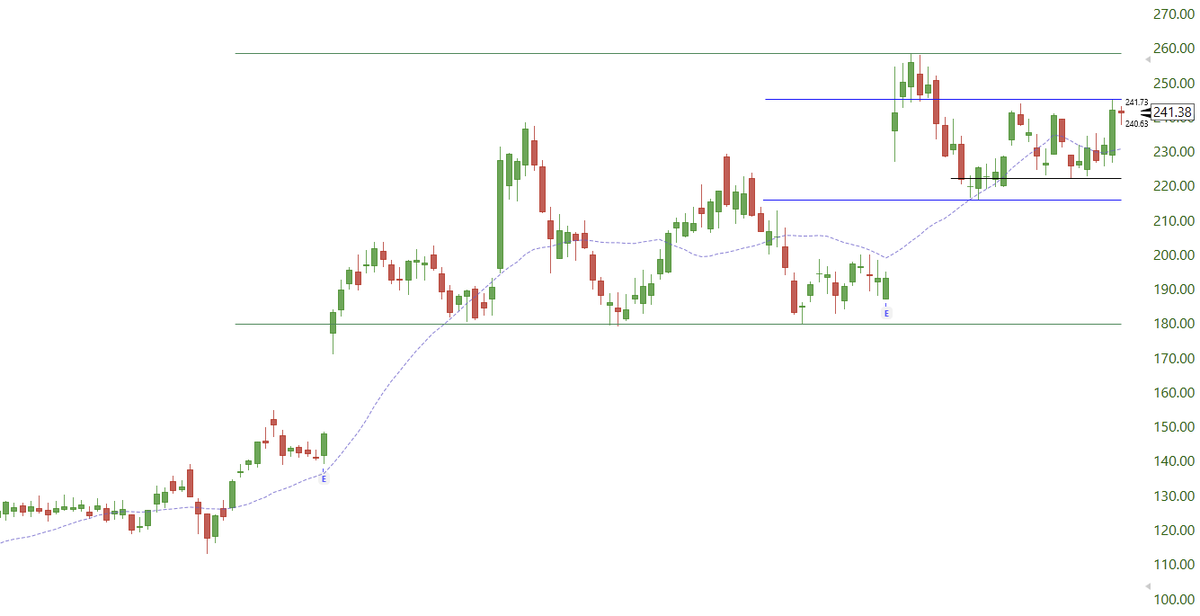
$TWLO has spent the last few weeks cleaning up the move into the mid $250s.
The pullback held around $218–220 and the 20 day MA has caught up underneath. Price is pressing back into the $243–245 area with the lows gradually moving higher.
I like this much more than the first push into $258. The range is getting tighter and the structure is starting to rebuild.
Would be good if it keeps compressing under $245 for a bit longer. A clean move through there would put the prior ~$258 high back into play. Lose the $218 area and the base starts to loosen again.
@jimcramer The mood around AI has definitely changed. A few months ago the market rewarded the spend first and asked questions later. Now people want to see the returns.
$CDNA is tightening near the highs after a strong run.
The recent contraction is what stands out. The 20 day range has pulled in and the 10 day range is tighter again around roughly $46.50 to $52.50.
Price is holding above a rising 20 day and 50 day while sitting just below the prior high around $54.
I like the fact that it is spending time up here instead of giving back the move. The higher lows are still intact and the base is getting cleaner.
A little more compression under $53 to $54 would improve it further. Losing the mid $40 would start to weaken the structure.
@KobeissiLetter Hard to get excited about housing while the 10Y is still pressing higher. Mortgage rates above 7% keep affordability under pressure even if home prices cool off
$CRWD is starting to look more like a Base Hunter setup again. The prior move was strong. What matters now is how well it is holding onto it.
Pullbacks keep finding buyers around the rising 20 and 50 day moving averages, and the recent lows are generally stepping higher.
The base still needs more tightening though. I want to see the daily ranges contract and volume dry up while price keeps holding above roughly $205 to $210.
$228 to $232 is the obvious overhead supply. Give me more compression under that level and I get a lot more interested.
Software infrastructure is doing a lot of the heavy lifting today.
$SAIL +11%
$NTSK +9%
$CRWD +8%
$S +7%
$TENB +7%
$RBRK +6%
$OKTA +6%
Now I want to see which names can hold the move and start building tight bases instead of giving it all back. Sector strength is useful. The better trade usually comes from the stock that can absorb the excitement and stay tight afterward.
Basehunter | Sep 11
Market first. SPY fell 0.60% and QQQ 1.06% on Thursday. That extended the broader pullback to four straight losing sessions. CPI lands Friday at 8:30 ET, so the tape still has a major macro event directly ahead.
This is not the easiest backdrop for growth stocks. I am paying more attention to names that are still holding their structure and tightening while the indexes pull back.
Healthcare: $OSCR $TGTX $OMER
Technology: $BILL $SDGR
Consumer Defensive: $DAR
High shelves near the top of larger bases:
$OMER has moved into a narrow shelf around 18 to 19.5 after the August expansion. The 20 day is catching up underneath and recent volume has quietened down. I want to see that shelf keep getting tighter rather than another wide shakeout.
$OSCR is working through a much longer base. Price has repeatedly found supply around 33 to 34, but each recovery has brought it back toward the top of the range. The 20 and 50 day remain constructive underneath. Around 29 still looks like the important line separating a high shelf from a looser base.
$DAR has spent months building between roughly 59 and 69. It recovered quickly from the August pullback and is back in the upper part of the range. The recent closes are getting tighter again. A few more quiet sessions under the highs would improve it.
Mature bases that still have some range to absorb:
$TGTX has been building between roughly 46 and 59 since June. The August flush did not break the larger structure and price has recovered toward the upper half of the base. The base is mature, but the swings are still wider than I would like. More compression around 54 to 57 would make the setup much cleaner.
$BILL is holding the 46 area after a strong run from the low 30s. The 50 and 200 day are now underneath price, which is a much better structure than earlier in the year. I would rather see the current 46 to 51 range tighten further before treating the upper end as a real trigger.
Younger post expansion setups:
$SDGR broke out of the 15 to 17 area and ran toward 21 before pulling back. It is now testing the upper part of the old range. Holding around 18 to 19 would turn this from a pullback into a much more useful continuation base.
$SPCX up around 2.7% this morning. The push off the open has carried price back toward the top of the recent range.
The part I like is that the base has kept tightening while the 20 day has started turning higher underneath price. Now it is pressing into the $155 area that has capped the last few attempts.
Still not a breakout. I want to see whether price can keep compressing up here rather than getting rejected and falling back into the middle of the base.
$SPCX went from 225 to ~100 in about 6 weeks, heavy volume the whole way down. So a real flush and not just a pullback.
Since then it's been basing right under that old 150 level now. Volume has basically dried up but money flow is still climbing, which is the part I care about. Less volume overall but what's trading is closing strong. Feels like sellers are tapped out and someone's quietly building a position underneath.
Also reclaimed the 100 low and just held there, didn't fade back down. That matters to me more than the bounce itself. Right now it's knocking on 150 again, same level it broke down from back in July. If it gets through that with some real volume I think it can run back toward 225.
I'm in small already. Stop under the base, below 130ish. Not financial advice, just where my head's at with this one.
Basehunter | Sept 10
SPY fell 0.46% and QQQ slipped 0.29%. Both are pulling back from recent highs, although QQQ is still holding up better. Oil moving above $100 and rising Treasury yields kept pressure on the broader tape. Energy was the only S&P 500 sector to finish higher.
Today’s screen:
Energy: $NESR , $PARR
Technology: $ENTG , $CRSR , $DXC
Healthcare: $TXG , $TGTX
Industrials: $ATRO , $CXW
Basic Materials: $CDE
Consumer Defensive: $DAR
The cleaner high shelves are TXG, NESR and CXW. TXG has barely surrendered the August move and is already pressing the top of its 50 day range again. CXW keeps building higher lows underneath the highs around 35. NESR had a much sharper expansion in August. Since then price has settled into a fairly tight shelf around 32 to 36 and the volume has cooled. I would rather see that contraction continue than chase the original move.
CDE, PARR, DAR and TGTX have more developed bases but there is still some work left on the right side. CDE has recovered above its major moving averages and the recent range is getting smaller. DAR has repaired the late August shakeout quickly and is back underneath the 69 to 70 area. PARR is sitting near the upper end of its base, but the swings inside that base are still noticeably wider. TGTX has spent a long time between roughly 47 and 59. The recent action is tighter, but I would like to see more compression underneath 59.
CRSR, ATRO, ENTG and DXC look more like base repair than finished bases. CRSR is settling down after the August expansion but still has supply sitting above the current range. ATRO is trying to stabilize after the sharp drop from the 90s. ENTG remains much looser and its 20 and 50 day averages are still tangled together. DXC has tightened considerably from its summer lows, but the declining 200 day around 12 is still sitting directly overhead.
Quite a few names passed the contraction screen today. The charts show why passing the screen is only the first step.
The screener finds the stocks. The chart decides whether they stay.