Inference, training, routing, governance, and sandboxes are the building blocks of every AI product today.
We’ve learned a lot from our customers about what it takes to build that system well: @OpenEvidence trains models that outperform the closed frontier, then serves them on Dedicated Inference. @datadoghq post-trains on Loops. @Opendoor routes every AI request across the company through Grid.
This week we have three launches expanding our inference platform:
- Grid: gateway, intelligent router, and guardrails for every model your company uses (launching tomorrow)
- Sandboxes: stateful, VM-isolated environments for agents that scale to thousands of instances in seconds (launching Thursday)
- Loops: serverless SFT and RL on open-weight models, deployable straight to Dedicated Inference (GA Friday)
@amiruci, @saimaddali, @paul_s3i, and @oneill_c break down what we're launching. You might notice the visuals have a new look as well.
What’s the best harness for an open model on coding and agentic tasks?
We partnered with @Runta to investigate: 100B tokens and 26k trials later, the final results are coming in.
Full report next week.
We’re spending up to 100B tokens across 26,040 agent runs to answer one question: when you switch models, should you switch harnesses too?
Our v1.0 FrontierHarness leaderboard ranked harnesses on a single model.
V1.1 expands it to 21 harnesses × 5 models × 62 tasks × 4 attempts, 72x the size of v1.0.
Results are coming in live. Link below🧵
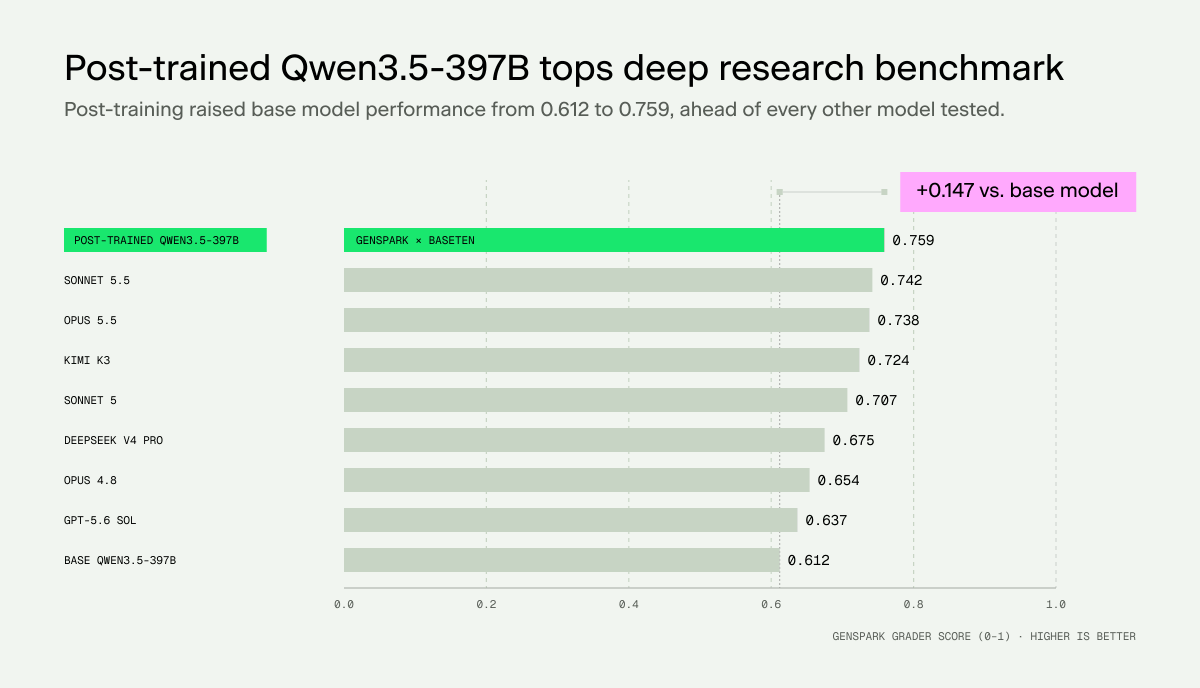
Genspark and Baseten Applied Research post-trained an open-weight model that beats Opus 5.5 at deep research.
Starting from Qwen3.5-397B, our post-trained model scores 0.759 on @genspark_ai's internal evals, ahead of Opus 5.5 (0.738) and well above the base model (0.612). It’s now the default model in production behind Genspark’s Deep Research agent.
To achieve these results, we treated deep research as two subproblems and tackled them with different approaches.
Research was trained with RL against a reward that credits breadth (distinct searches and sources), rather than just the final result.
Report writing was taught mainly through SFT on strong reports built from the model’s own evidence, followed by an end-to-end RL pass.
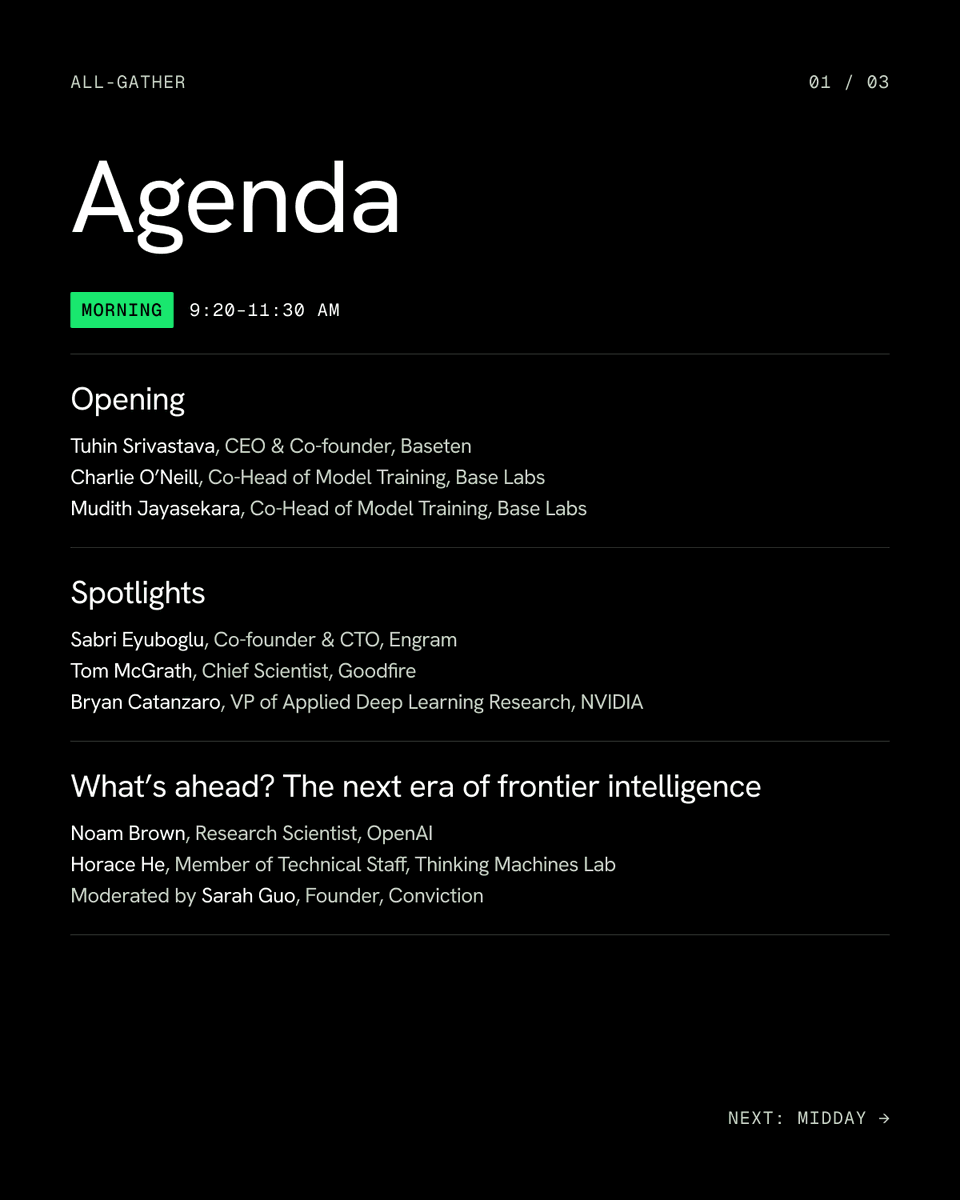
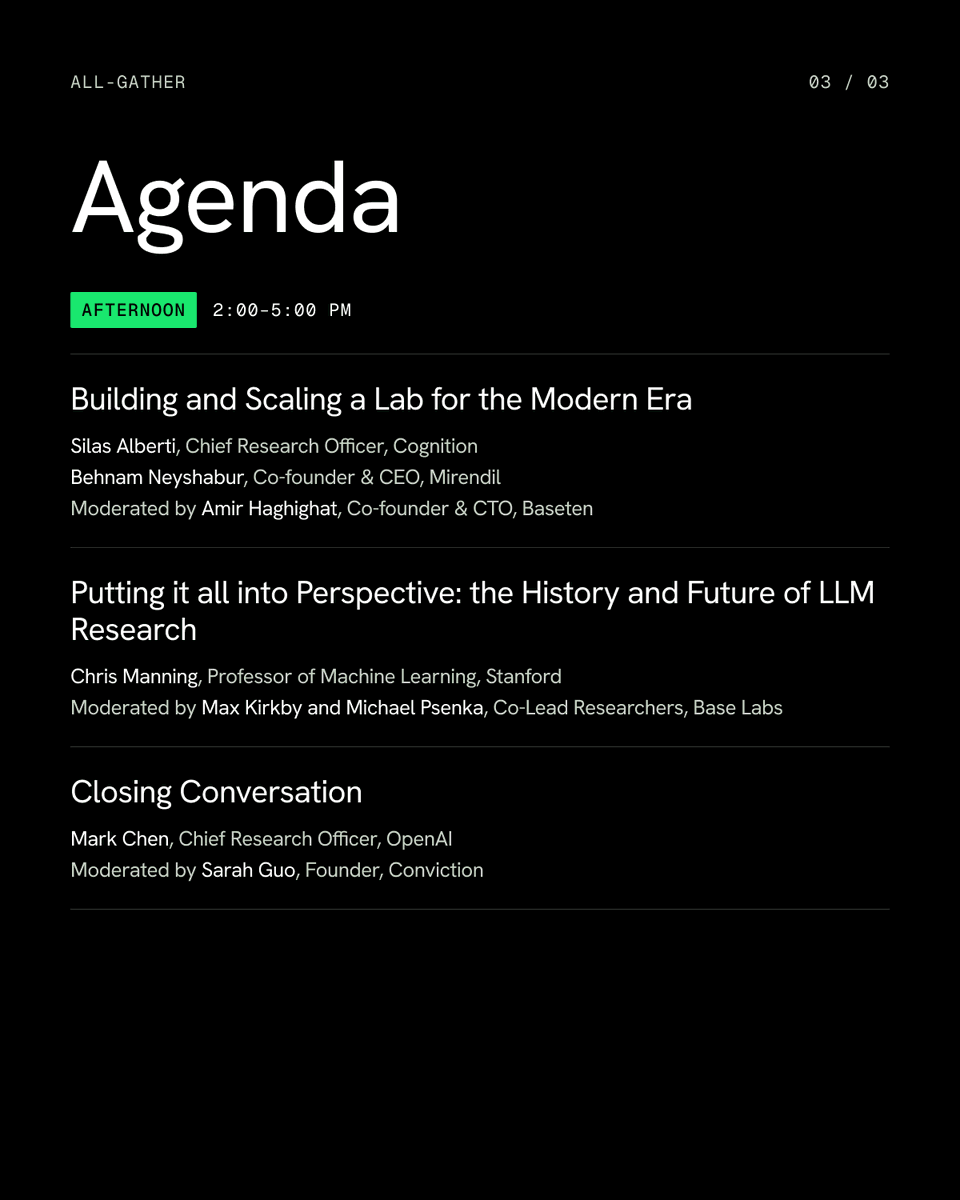
The full All-Gather agenda is live.
One day at the Exploratorium with Noam Brown, Oriol Vinyals, Chris Manning, Mark Chen, and more, across research spotlights, chalk talks, firesides, and a panel on building research labs today.
Nov 18 in San Francisco. See the full speaker list: https://t.co/xaJ2d1EGez
OPSD and related variants have been popular areas of post-training research in 2026.
Whilst the original papers were commendable work with respect to on-policy learning and the dense feedback they provided, we should treat the bias that a hinted teacher injects as incongruent with long-horizon continual learning.
This week we unpack some of the literature, alongside our own attempted fixes and observations to understand why this is the case.
we love this!! our Labs team is constantly figuring out what it means to continuously improve models on massive data -> better, cheaper, faster models
that means tons of targeted experiments to understand how models respond to our data & reward design
baseten just makes all the infra work for us, so we get a very tight research feedback loop
also the @baseten guys are a pleasure to work with @AEllisBloor 🐐
Serverless Loops is GA today. @datadoghq runs multi-turn agentic RL, @LangChain post-trains on agent traces for LangSmith Engine, and @AmbienceAI tunes models for clinical language and transcription.
Baseten Loops is now GA, and serverless.
Teams at @AmbienceAI, @datadoghq, and @LangChain use the Loops SDK for SFT and RL training to build durable intelligence.
Serverless Loops includes:
- Always-warm infra that eliminates cold starts
- Pay-per-token pricing for training and sampling
- One-click deployment from your trained checkpoint to production inference
- Model-specific numerical validation, with a focus on reducing mismatch between training and sampling
You bring the data, reward functions, and training logic.
We handle the infrastructure.
You always own the weights.
Learn more: https://t.co/vA6PvHEJq2
Companies are increasingly owning their models. We’ve seen this over the past several months with customers using Baseten Loops to post-train on their own data to create custom, durable intelligence that they control.
Today we’re opening this capability up to everyone with Serverless Loops.
What's next for LLM research? @chrmanning, Professor of Machine Learning at Stanford, is joining us at All-Gather to break down the history and future of the field.
Chris has spent decades shaping NLP at Stanford, from GloVe to CS224N, the course that taught a generation of researchers how language models work.
https://t.co/OplqG3q9PX
Today Baseten launches Sandboxes. Built with the Blaxel team, our Sandboxes let companies run agents that pick up right where they left off, without paying for idle time. Our sandboxes are fully isolated and run right alongside your inference.
Baseten is building the cloud for agents. Sandboxes mark a key milestone; we’re just getting started.
Running code in a container is easy. The hard part for agents is keeping state across long-horizon tasks without paying for idle compute or adding latency to every loop.
We built Baseten Sandboxes for that. Each sandbox is its own microVM. When the agent disconnects, we snapshot the filesystem, memory, and running processes, scale compute to zero, and resume in 25 ms.
Sandboxes are the first piece of the agent cloud we’re building.
Today we're introducing Baseten Sandboxes: stateful, secure environments for agents.
Sandboxes boot from standby in milliseconds and scale to 1,000s of instances in seconds. When an agent disconnects, its filesystem, memory, and running processes are snapshotted, and compute scales to zero. On resume, it picks up right where it left off.
Run your agents on the same platform that serves, trains, and routes your models. To make today's announcement a little extra special, we're making Sandboxes free to run until November 16.
Check it out: https://t.co/QXk0GkQbmO