My remarks published in @FT by @cornishft:
Mohammed al-Basha, founder of the Basha Report, a US-based risk advisory, says al-Houthi — who communicates his messages through lengthy video statements — has morphed into a “megalomaniac”, increasingly isolated from the outside world, but who “genuinely believes he’s going to liberate Palestine”. He describes “Houthism” as a mixture of Zaydism and jihadism, laced with “the secrecy of the Muslim Brotherhood”.
https://t.co/TM4hI6VWt4
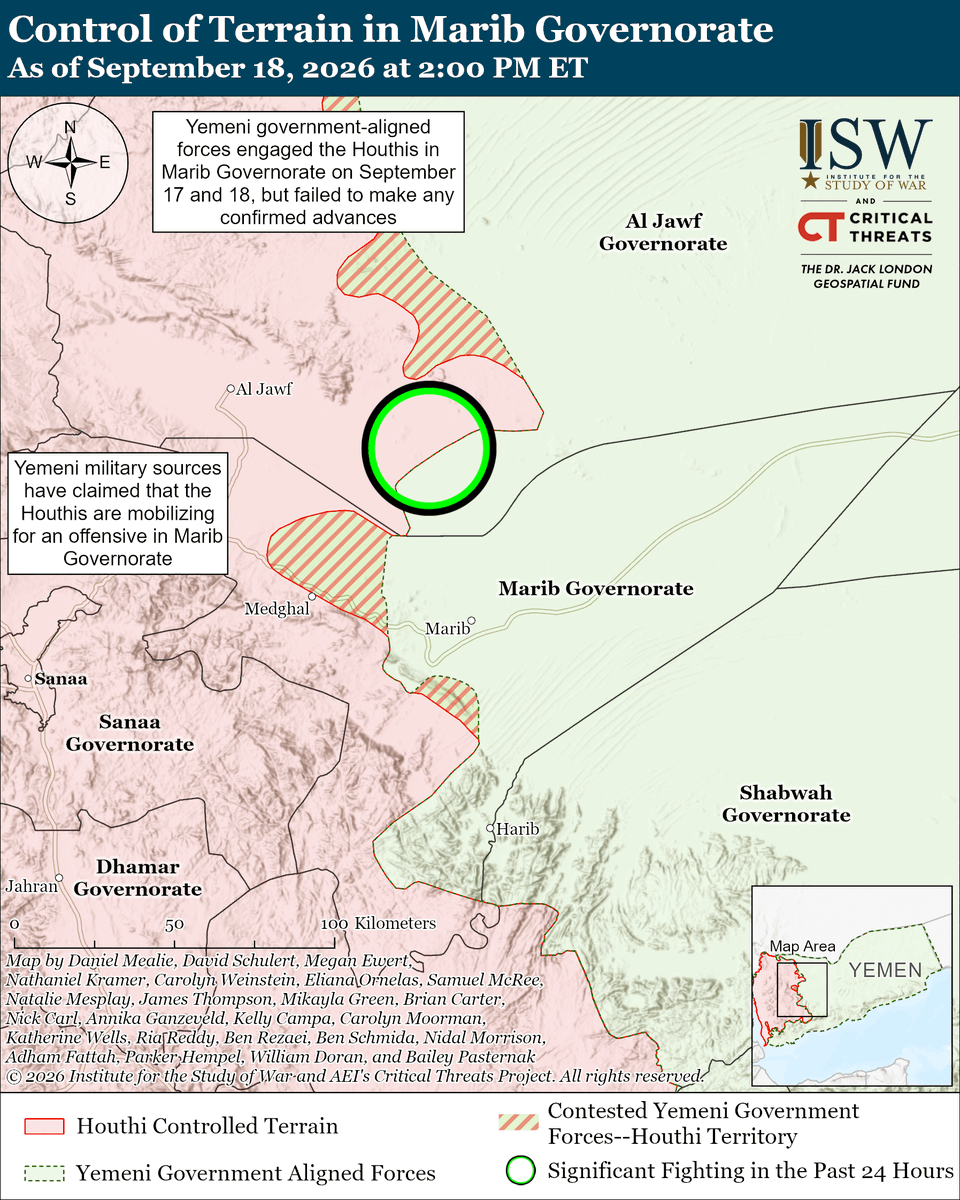
War in Yemen #SITREP | Yemeni government forces reported fresh clashes with Houthi fighters across the western and southern Marib fronts, with artillery units targeting Houthi military vehicles in western Marib and multiple-launch rocket systems destroying Houthi artillery positions in the south.
Artillery units from the Bayhan Military Axis also struck Houthi troop concentrations, reportedly killing and wounding several fighters and disabling a 23mm anti-aircraft gun.
Major General Mansour bin Abdullah Thawaba, commander of the Third Military Region, said government forces had shifted from defensive to offensive operations, declaring that Marib was now advancing with its sights set on Sana'a. He reaffirmed that military operations would continue until Houthi-controlled territory was retaken and state institutions restored. Thawaba also reported that government forces had repelled recent Houthi assaults on military positions south of Marib, inflicting heavy personnel and equipment losses, with dozens of Houthi fighters reportedly killed, wounded or captured. He said government forces across Marib and other fronts were operating under a unified command and joint operations room, highlighting coordination between ground and air units and continued military cooperation with the Saudi-led coalition.
Meanwhile, on the Kahbub front near the Bab al-Mandab Strait, the National Shield Forces reported that a support company from the First Brigade of its First Division, commanded by Raafat al-Awaji, shot down a Houthi drone. Local sources also reported the death of Houthi commander Saddam Ghallab, known as Abu Attan, who previously served as security director in Yarim and reportedly held a district security position in Amran governorate.
Separately, Brigadier General Adnan Raziq al-Qumayshi, commander of the National Shield Forces' Third Division, visited wounded personnel in hospital, including division chief of staff Brigadier General Jamal Ahmed Musaddas, and reaffirmed the command's commitment to their medical treatment and recovery.
The latest reports indicate continued fighting across the Marib and Kahbub fronts, although no new territorial gains have been confirmed.
War in #Yemen#SITREP | September 19, 2026 | One week after the collapse of the West Coast front, the rapid territorial losses previously seen in Taiz, Lahij, and Hudaydah appear to have slowed. Fighting has shifted into a grinding battle for hilltops and strategic positions, with neither side reporting major advances.
The Houthis claim Saudi @modgovksa aircraft have carried out more than 700 airstrikes, while reported Houthi losses exceed 400 killed in action. For now, the front lines appear to be stabilizing, with both sides exchanging strikes and launching limited attacks rather than making significant territorial gains.
Yemeni government forces @Yem_army_media report intensified operations across southern Ma'rib. The Third Military Region Command (MRC) has used artillery and drones against Houthi positions, troop concentrations, and vehicles.
In the Al-Fulayhah sector, government forces say they repelled a Houthi infiltration attempt, killing 12 fighters and wounding others. Government aircraft also reportedly struck Houthi concentrations and vehicles at Umm Rish camp and Aqabat Mal'a.
Meanwhile, the Southern Giants Brigades @SouthArmed@alamalikah report strikes on Houthi vehicles, barracks, and trenches along the Al-Bayda front, as well as troop concentrations and military positions in Kahbub, near Bab al-Mandab.
The fighting has become a war of attrition, with both sides trading strikes and contesting individual positions. There are NO confirmed major breakthroughs at this stage.
Speaking to @FoxNews@TreyYingst, @POTUS@realDonaldTrump said, “The United States is in constant communication with the Houthis and that they've agreed not to fight the United States.”
Thank you for trusting me!
CNN did not report this story, yet multiple platforms promoted the clickbait content. The coordinated appearance of these posts raises questions about whether they are part of a broader information operation.
Another Yemen Podcast from my favorite podcaster @osamaalqutaibi, with two prominent journalists, @YemenShababNet’s @dubalh and @BelqeesTV’s @AhmadALzurqa, to discuss how the Houthis won on the West Coast.
Ahmed: “We defeated ourselves before Iran defeated us.”
Abdullah: “Iran turned the Houthi militia into a state, while our allies turned us from a state into something resembling a militia.”
Part I.
The podcast asks three connected questions. Why did Mocha and Bab al-Mandab fall? What are the Houthis doing with their gains? And what would have to change for their opponents to recover?
Abdullah and Ahmed do not offer a single explanation for the collapse. They describe a combination of battlefield pressure, divided command, political competition, dependence on outside support, and decisions that were not made when the front was still holding. They also discuss allegations of betrayal and deliberate Saudi inaction. Those allegations are part of the conversation, but neither journalist establishes them as solid facts.
Abdullah draws the distinction at the outset. “We said it was not a handover or betrayal. But it was not normal either. It was incapacity and failure.”
His account begins before the final Houthi breakthrough. He says the West Coast had been under sustained attack for weeks, with missiles and drones inflicting losses that were not fully disclosed. The Houthis initially pressed the northern positions around Hays and Al-Khokha before breaking through at Al-Barh. The loss of Al-Barh junction was followed by the fall of Khalid bin al-Walid camp. Once Houthi forces reached a command-and-control center behind the forward positions, the danger of encirclement spread across the defensive line.
The withdrawals that followed made the collapse look sudden, but Abdullah argues that its causes were much older. “There was incapacity and failure more than betrayal.”
The West Coast @NRFYemen forces had been assembled under @modgovae sponsorship from three main components: southern fighters @SouthArmed@alamalikah, Tihami resistance forces, and Tariq Saleh @tarikyemen's National Resistance. The UAE provided a common authority and much of the organization that allowed these formations to operate together. When it withdrew, the forces remained, but their separate loyalties, command arrangements, and political interests did not disappear.
Abdullah credits the Emiratis with earlier military gains. His criticism is that they moved from building a fighting force to building political influence before the military project was complete. He points to the Southern Transitional Council @STCSouthArabia and the National Resistance Political Bureau @P_B_N_R as examples of political ambitions overtaking military priorities. “Rushing the transition from military work to political work ruined both,” he says.
Ahmed is equally critical of what happened after the UAE’s departure. He argues that the Houthi attack was foreseeable, yet the government, Tariq Saleh, and Saudi Arabia @modgovksa failed to prepare a coordinated defense. The Taiz and West Coast fronts were connected geographically but divided operationally. Forces holding positions around Jabal Habashi and other areas answered to different commands from those farther west.
The claim that the armed forces @YemenMOD had been unified does not convince him. “Perhaps on paper. Administratively, they were integrated. Operationally, there was a very serious failure.”
That is one of the clearest explanations in the discussion. The problem was not simply whether there were enough brigades or enough fighters. It was whether anyone could direct them as a single force when the Houthis attacked.
Ahmed raises allegations about personnel records, undisclosed military facilities, and the deterioration of trust between Saudi officers and Tariq Saleh.
Abdullah describes the Houthis concentrating fighters and firepower against weak points along an extended defensive line. He says Houthi drones targeted artillery crews and supporting Multiple Launch Rocket System (MLRS) units, weakening the infantry’s ability to hold its positions. Abdullah also argues that Saudi air cover was largely absent during crucial periods. Ahmed agrees that air support mattered but insists that its absence cannot explain away the failures of preparation and command.
The discussion then turns to the allegation that Saudi Arabia deliberately allowed the West Coast to fall. The journalists consider whether Riyadh distrusted Tariq because of his Emirati ties and whether Saudi decision-makers wanted to reduce his military independence. Ahmed raises a further theory: that a Houthi advance to Bab al-Mandab might force the international community to confront the group and shift some of the burden away from Saudi Arabia.
Abdullah places more emphasis on indecision and failure. “If Saudi Arabia had been serious about preventing Mocha’s fall, it could have done so with its own capabilities, without American intervention,” he argues. That is his assessment of what Saudi Arabia could have done, not proof that intervention would necessarily have changed the outcome.
The journalists are particularly angry about what happened to the men left behind. They describe fighters stranded during the withdrawal, personnel on the islands without adequate evacuation arrangements, and soldiers who were captured or abandoned. They accuse the government and military leadership of failing to take responsibility for those who had fought under their command.
Ahmed asks where the operations room was and who was responsible for the men left exposed. He argues that leaders were preoccupied with explaining the defeat instead of accounting for their forces and rebuilding them. In his telling, the loss cannot be assigned to Tariq alone. Responsibility extends to the government and the coalition because all had a role in the military structure that collapsed.
The podcast also discusses large numbers of dead, captured, and displaced people. These figures are estimates given during the conversation rather than independently established totals. Abdullah describes the effect on Tihami communities whose members had fought for years and on families forced to flee yet again. The human consequences make the debate about command and responsibility more than an argument between political factions.
The first part of the conversation ultimately challenges the idea that the fall of Mocha can be explained by one dramatic moment. The Houthi breakthrough mattered, but the journalists argue that the military system had been weakened by years of divided authority and unfinished institution-building. The retreat revealed those weaknesses all at once.
Part II.
The second part of the conversation turns from the collapse to the territory the Houthis have gained. Abdullah describes a coastal strip running through Hays, Al-Khokha, Mocha, and Dhubab toward Bab al-Mandab. He says the Houthis reached the strait and moved onto islands, including Perim, also known as Mayyun. His description is a claim about the battlefield at the time of the recording, not an independently verified map of control.
Abdullah is careful about the Kahbub mountains, which overlook the strait from the landward side. He says the Houthis are fighting the Southern Giants Brigades there and have not secured the entire area. “It is still a contested area, with advances and retreats between them and the government forces,” he explains. Abdullah considers the heights more consequential than simply occupying exposed coastal ground because of the military leverage they could provide over the passage.
He also cautions against confusing a dramatic territorial announcement with the completion of a military operation. Abdullah describes the initial Houthi presence in parts of the newly captured territory as relatively light and suggests that publicity surrounding the advance may have run ahead of consolidation. His concern is what happens if the Houthis are given time to entrench themselves.
The discussion then widens to Taiz and Ma'rib. Abdullah believes the Houthis will first try to secure their gains around Mocha and Bab al-Mandab. He then describes possible pressure eastward from Kahbub toward Al-Turbah and the routes serving Taiz, alongside pressure toward the Safer oil facilities in Ma'rib. These are the objectives he anticipates, not confirmed plans. His argument is that the West Coast cannot be understood in isolation from the other fronts.
Ahmed makes the same point through the contrast in command structures. He says the Houthis have “one operations room, one decision, one movement,” allowing them to apply pressure from Taiz to Al-Bayda while their opponents remain divided. He also argues that the Houthis benefit from Iranian military support and from their opponents' inability to build an equally coherent force. His criticism is directed as much at the government and its allies as at the Houthis themselves.
One of the sharpest exchanges comes when the journalists compare the two sides' military development. Abdullah says, “Iran turned the Houthi militia into a state, while our allies turned us from a state into something resembling a militia.” It is a deliberately stark criticism of the way outside powers have supported competing Yemeni formations. He argues that the Houthis have developed missiles and drones while government-aligned forces have remained constrained by decisions made in Riyadh and Abu Dhabi.
The conversation also examines the Houthis' attempt to reassure foreign governments after reaching Bab al-Mandab. The speakers discuss statements suggesting that navigation would remain open and that the Houthis' immediate dispute was with Saudi Arabia. Abdullah compares this approach to the group's earlier assurances to tribes in Amran, arguing that limited promises can help a force consolidate control before its position changes. He sums up his skepticism in one sentence. “Whoever can permit passage can also prevent it.”
The podcast does not establish that the Houthis have made a secret deal with Washington or any other government. The journalists discuss reported communications and speculate about what the Houthis may be offering in exchange for international restraint. They also consider whether pressure at Bab al-Mandab is connected to Iran's confrontation with the United States around the Strait of Hormuz. Those are interpretations of regional strategy, not demonstrated agreements.
For Abdullah, the broader cost is that each territorial gain makes the next confrontation harder. “Every time the Houthis take a commanding or strategic area, their appetite grows, and they begin working on the next area,” he argues. He says recapturing lost territory is possible but becomes more costly the longer the Houthis are allowed to consolidate it.
Ahmed also worries about the psychological effect of the defeat. The idea that the Houthis cannot be beaten becomes stronger with each collapse, while accusations of betrayal spread among the forces opposing them. The journalists connect this loss of confidence to a much wider failure of government. They describe unpaid salaries, poor treatment of displaced families, and armed formations organized around increasingly narrow regional identities. In their account, these divisions undermine the very idea of a national army.
Part III.
That leads naturally to the final question. What would have to change?
The journalists agree that another round of recruitment or another collection of brigades would not, by itself, address the problem. They argue that the government needs a clear political decision, an effective command structure, reliable support, and an end to the competition between military factions. Ahmed puts it simply. “The problem is not the men. The problem is the political decision, the management of the battle, and the clarity of the vision.”
They disagree, however, over how quickly lost territory could be recovered. Abdullah argues that the West Coast could be retaken if there were a genuine decision, effective air support, professional management, and a reorganized force. But he also warns against promises of an immediate march on Sana'a. “Anyone who tells you we are ready to liberate Sana'a is lying,” he says. He describes the available forces as exhausted and demoralized, requiring time to rebuild their capabilities and confidence.
The disagreement is important because the podcast is not simply a call for an immediate offensive. Its speakers recognize the damage caused by the retreat. Abdullah recounts seeing a video of a fighter who apologized to the people of Al-Khokha for withdrawing. He contrasts that individual apology with the absence of accountability from senior officials. His point is that a soldier who lost his position showed a sense of responsibility that he believes was missing among the people who directed the war.
Ahmed argues that the leadership itself must change if the government wants to restore confidence. He calls for officials, commanders, and security institutions to operate from inside Yemen rather than remaining abroad. Ahmed also wants an end to political quota-sharing and a clearer division of responsibility between political leaders, military professionals, and government institutions. He asks how people can trust promises about the future when the government cannot provide a convincing answer about the present.
The discussion repeatedly returns to the danger of fighting disconnected battles without an overarching political objective. Ahmed criticizes the pattern of sending men to capture individual hilltops only to order them to withdraw shortly afterward. He argues that military decisions should be made by professionals and that the government must consider the people displaced by its operations.
The journalists also question whether Saudi Arabia has a clear long-term vision for Yemen. Ahmed asks whether Riyadh sees Yemen as part of its strategic security and therefore needs a strong Yemeni state, or whether it sees the country primarily as a sphere of influence. He argues that the current leadership arrangements have failed to produce a functioning state. Abdullah similarly insists that Yemeni and Saudi interests should be treated as shared interests, not as favors one side grants the other.
Their discussion of the United States and other regional powers is less certain. Abdullah predicts a wider confrontation between Washington and Tehran after the November mid-term elections, while Ahmed considers the possibility of international involvement over maritime security. These are their forecasts, not established future events. Both speakers nevertheless question the assumption that Yemen's government can wait for foreign intervention to solve its problems.
The final minutes bring the conversation back to responsibility. Ahmed says Yemen has experienced enough improvisation, fragmented decisions, and costly mistakes. He argues that political leaders should make political decisions, military experts should manage military affairs, and officials should be accountable for the consequences. Ahmed closes with a line that captures his interpretation of the entire war. “We defeated ourselves before Iran defeated us.”
That is the central argument running through the episode. Abdullah and Ahmed see the Houthi victory on the West Coast as a military success made possible by the failures of their opponents. They disagree on some details and speculate about the calculations of foreign governments, but both return to the same unresolved problem. The forces that lost Mocha were never made into a unified, accountable institution capable of fighting independently of their sponsors. Until that problem is addressed, the podcast argues, recovering territory and holding it are two very different challenges.
https://t.co/Ntu9Wu2TPd
Middle East: Due to tensions in the Middle East, the security environment remains complex with the potential for unforeseen escalation. Americans currently in the Middle East should exercise heightened vigilance and be aware of potential flight cancellations, airspace closures, and travel disruptions. Iranian-supported Houthis have engaged in hostilities against Saudi Arabia, including civilian airports. This military conflict has the potential to escalate rapidly. Americans outside the Middle East should seriously reconsider travel to and through the region. Those who do travel to or from the region should monitor information about airport and airline operations. U.S. diplomatic facilities, including outside the Middle East, have been targeted. Iran and groups supportive of Iran may target other U.S. interests overseas or at locations associated with the United States and Americans throughout the world, including U.S. businesses and other institutions. Read the latest country-specific alerts at: https://t.co/ouQakQVHet
Four senior regional sources have firmly denied to @BashaReport a report by the pro-Hezbollah Lebanese newspaper @AlakhbarNews, and was cited by @Jerusalem_Post, alleging that a two-week truce had been proposed between the Houthis and Saudi Arabia.
Report: Saudi Arabia has conveyed through the Sultanate of Oman a new proposal to the Houthis in Yemen, including a two-week ceasefire and the opening of direct talks between Riyadh and the Houthi leadership.
https://t.co/iS2LYEO186
NEW: The Houthis exploited a window of opportunity in July 2026 to resume their war with Saudi Arabia and secure concessions from Saudi Arabia that would alleviate the group’s dire economic situation. The Houthis, with Iranian backing and encouragement, sought to impose economic pressure on Saudi Arabia to accomplish their objectives because the group sees economic pressure as a useful lever that has previously forced Saudi capitulation to Houthi demands. (1/2)
Other Key Takeaways:
The Houthis may decide to cease their present offensives in exchange for Saudi economic concessions. Addressing these concerns will not, however, satiate or moderate the Houthis. The Houthis view solidifying control over northern Yemen as a prerequisite to controlling at least all of Yemen.
Pakistan may seek to exert leverage over Iran to restrain Houthi offensive activity against Saudi Arabia. The Houthis are an independent partner of Iran and may resist potential Iranian pressure to halt their campaigns, however.
The Houthis likely seek to capture Marib Governorate in order to extract and export oil through the Red Sea, which could fund Houthi political and military activities, assuming export is possible.
Iran has continued its efforts to disrupt regional shipping and pressure the global economy to impose costs on the United States and its allies, even as transits through the strait have increased relatively and oil prices remain low relative to Iranian hopes.
Reposting this old video from six months ago.
In it, Brigadier General Amjad Khaled Farhan openly aligns with the Houthis, calling them “our brothers in the Sana’a government,” and saying, “alliances change, but principles are fixed.” He openly urged southerners to join his armed movement, claiming that dozens of officers and tribal elders are already on board and that they will be funded and armed.
Khaled, a former southern Yemeni commander of the Lahj-based Transport Brigade appointed in 2017, has long been an opponent of the UAE-backedSouthern Transitional Council and was sentenced to death in absentia by a court in Aden in late 2024. His current status remains unclear, with conflicting reports about his whereabouts in North Yemen.
The video frames this shift as a response to “ten years of absurdity… violations… and corruption,” arguing that it became “natural to speak with the brothers in Sana’a [Houthis],” with the message that “we extend our hands to them, and they extend their hands to us.”
It goes further, claiming support was offered directly, “we can help you, supply you with weapons, and then you liberate your country and govern it yourselves,” presenting the relationship as active coordination rather than just political alignment.
There are also references to broader planning, stating, “we spoke, arranged things, and invited our brothers in all the southern regions,” alongside a warning that “a roadmap agreement is about to be signed… if it is not signed, there will be war.”
The justification centers on conditions in the south, raising questions like, “is there electricity? are there salaries? is there security and stability?” and concluding that “people have the right to politically ally with whoever they want.”
The message also suggests future pressure on Saudi-backed rivals, saying, “you will be forced to sit with the brothers in the Sana’a government [Houthis] at the dialogue table,” and describing Sana’a as “a component that cannot be eliminated.”
https://t.co/hc0qVlDl6w
بروفايل: عبد الملك الحوثي
فايننشال تايمز البريطانية
+++++++
لم يظهر عبد الملك الحوثي علناً منذ سنوات، ولا يعرف مكانه سوى أكثر معاونيه ثقة؛ ويسود اعتقاد بين اليمنيين بأنه يدير عملياته من شبكة واسعة من الأنفاق والكهوف في جبال صعدة الوعرة، المحافظة الريفية في شمال اليمن التي ينحدر منها، لكنه نجح في توجيه ضربات موجعة إلى السعودية من مخبئه خلال الأسابيع الأخيرة، وفتح جبهة جديدة في صراع الشرق الأوسط، وأربك أسواق النفط، وعزز مساعي إيران للإبقاء على الضغط على أسعار الطاقة العالمية في مواجهتها مع الولايات المتحدة.
لقد بقيت حركة الحوثيين التي يقودها إلى حد كبير على هامش الحرب التي تقودها الولايات المتحدة وإسرائيل ضد إيران، الداعم الرئيسي للمتمردين اليمنيين، لكن عبد الملك الحوثي قرر المجازفة بإشعال الحرب المستمرة منذ عقد مع السعودية من جديد في يوليو، منهياً هدنة عام 2022، بعدما أعلنت قواته الإسلامية حصاراً على موانئ المملكة وشنّت هجمات على ناقلات سعودية.
لقد صعّد الحوثيون هجماتهم إلى مستوى بالغ الشراسة الأسبوع الماضي، فأطلقوا وابلاً شبه يومي من الطائرات المسيّرة والصواريخ على منشآت النفط السعودية، بالتزامن مع شنّ هجوم خاطف جنوباً على امتدا�� ساحل اليمن المطل على البحر الأحمر، ما عزز قبضتهم على مضيق باب المندب، أحد أهم الممرات البحرية للتجارة العالمية.
وساهم هذا الهجوم في دفع أسعار النفط إلى أعلى مستوياتها منذ منتصف مايو، كما عزز مكانة الحوثي بوصفه واحداً من أقوى قادة ما تسميه إيران (محور المقاومة).
تتبنى حركة الحوثيين عقيدة شديدة العداء للولايات المتحدة وإسرائيل ومؤيدة للفلسطينيين منذ تأسيسها على يد حسين الحوثي شقيق عبد الملك في تسعينيات القرن الماضي، ويتبع أنصارها الأساسيون تفسيراً متشدداً للمذهب الزيدي، أحد فروع الإسلام الشيعي.
وكان منتقدو الحوثيين يسخرون منهم ولسنوات باعتبارهم مقاتلين قبليين جبليين محدودي التعليم، معروفين بملابسهم التقليدية وتفضيلهم الصنادل المفتوحة على الأحذية العسكرية، لكن عبد الملك نجح في تحويل المسلحين إلى قوة قوية، متمرسة في القتال ومندفعة أيديول��جياً، منذ توليه قيادة الجماعة بعد مقتل شقيقه في القتال عام 2004.
وخاض الحوثيون تحت قيادته حروباً متعددة ضد الرئيس اليمني الراحل علي عبد الله صالح، فضلاً عن اشتباكات حدودية مع القوات السعودية، بينما كانوا يديرون "مخيمات صيفية" في الشمال لتنفيذ مشاريع اجتماعية، ونشر أفكارهم، واستقطاب الأنصار.
نال الحوثيون فرصة الانتقال إلى الساحة الوطنية عام 2011، عندما خرج اليمنيون إلى الشوارع احتجاجاً على حكم صالح، في خضم الانتفاضات الشعبية التي اجتاحت العالم العربي.
وانضم الحوثيون، الذين اتهموا صالح منذ فترة طويلة بالفساد، إلى المحتجين وجماعات المعارضة التي أجبرت الرئيس المخضرم في نهاية المطاف على التنحي.
رحّب بهم كثير من اليمنيين في البداية، الذين رأوا فيهم قوة تدافع عن شعب عانى طويلاً، لكن مع تعثر الإدارة الانتقالية الضعيفة، استغل المتمردون الفرصة، وسيطروا على العاصمة صنعاء في أواخر عام 2014، وأطاحوا بالحكومة، ثم تقدموا جنوباً باتجاه عدن.
وأمام انهيار النظام الذي كانت تدعمه، وقلقها من صلات الحوثيين بإيران، تدخلت السعودية على رأس تحالف عربي بهدف دحر المتمردين وإعادة الحكومة، ومنذ ذلك الحين، وجدت المملكة نفسها عالقة في حرب كارثية باهظة الكلفة، في حين صمد الحوثيون أمام سنوات من القصف الذي شنّه التحالف بقيادة السعودية، وكذلك أمام موجات من الغارات الجوية الأمريكية والإسرائيلية.
وأصبح الحوثيون أكثر تشدداً أيضاً منذ هجوم حماس على إسرائيل في أكتوبر 2023 والحرب التي أعقبته في غزة، إذ بات حكمهم أكثر قمعاً، فيما ازدادت لهجتهم تجاه إسرائيل والولايات المتحدة عدائية، وأطلقوا صواريخ وطائرات مسيّرة على إسرائيل، وبدأوا مهاجمة السفن في البحر الأحمر، قائلين إنهم يتحركون تضامناً مع الفلسطينيين.
وردت الولايات المتحدة وإسرائيل بغارات جوية على اليمن، لكن الحوثيين صمدوا، بل إن الرئيس الأمريكي دونالد ترامب امتدح الجماعة، التي صنفها منظمة إرهابية، م��يداً بـ"شجاعتها" وقدرتها على "تحمل العقاب"، وذلك بعدما أوقف حملة قصف ضدها العام الماضي.
ويقول دبلوماسي سابق عمل في اليمن إن عبد الملك الحوثي لن يكون في مزاج يسمح له بتقديم تنازلات، بعد المكاسب الميدانية الأخيرة للمتمردين، ويقول الدبلوماسي السابق: "لديه فهم جيد للغاية لما يتمتع به من أفضلية، عسكرياً وسياسياً".
ويقول محمد الباشا، مؤسس (تقرير الباشا) وهي شركة استشارات للمخاطر مقرها الولايات المتحدة، إن الحوثي، الذي يوجّه رسائله من خلال بيانات مصورة مطولة، تحوّل إلى شخص "مصاب بجنون العظمة"، وأصبح أكثر عزلة عن العالم الخارجي، لكنه "يؤمن فعلاً بأنه سيحرر فلسطين"، ويصف الباشا "الحوثية٠ بأنها مزيج من الزيدية والجهادية، تضاف إليه "سرية الإخوان المسلمين".
وعلى الرغم من أن الحوثيين أقل ارتباطاً أيديولوجياً بإيران من جماعات شيعية مسلحة أخرى، فإن علاقتهم بالجمه��رية الإسلامية تمتد إلى سنوات، وتطورت بعد الانتفاضات الشعبية عام 2011، حين سعت طهران إلى استغلال الفوضى لاستقطاب يمنيين من مختلف التوجهات السياسية.
غير أن التدخل السعودي في الحرب اليمنية، الذي جاء أساساً بسبب مخاوف الرياض من أن تكون إيران قد باتت تمتلك حليفاً مسلحاً يسيطر على بلد يقع في الفناء الخلفي للمملكة، هو الذي عمّق تلك الروابط، إذ بدأت طهران تزوّد الحوثيين بالتدريب والأسلحة والتكنولوجيا.
ويقول الدبلوماسي السابق: "لقد كانت نبوءة تحقق ذاتها، لأن العلاقة في ذلك الوقت كانت لا تزال في بداياتها إلى حد ما".
ويقول محللون يمنيون إنه رغم أن تحركات الحوثيي�� تخدم مصالح إيران، فإن عبد الملك الحوثي لا يتلقى أوامره من طهران، ولا من أي جهة أخرى، وداخل صفوف الجماعة، هناك من يدفع باتجاه توثيق العلاقات مع إيران، في مقابل آخرين يتبنون توجهاً قومياً يمنياً بدرجة أكبر.
وتهدف هجمات الحوثيين على السعودية وهجومهم على امتداد ساحل البحر الأحمر، إلى حد كبير، إلى إرغام الرياض على تقديم تنازلات وفق شروط الحوثيين، في وقت تتزايد فيه الضغوط الاقتصادية في مناطق الشمال.
لكن الحوثي وإيران يشتركان في هدف واحد: استخدام اليمن لاستعراض القوة وبناء شبكات نفوذ في البحر الأحمر، ومواجهة الولايات المتحدة، بحسب الدبلوماسي السابق، ويقول: "الأمر مدفوع بالتأكيد بأجندة داخلية… لأن الحوثيين يريدون إنهاء الحرب وفق شروطهم".
I joined Pakistan Global TV @PakTVGlobal live to discuss the latest developments in Yemen’s war, the Houthis’ territorial gains, and the growing risk of military escalation. “The Iranian threat network, axis of resistance, and the Houthis are very confident this week. They did get a big win in the west coast of Yemen, seizing Mocha port, seizing Bab al-Mandab.” The Houthis have also begun digging trenches and constructing berms along Bab al-Mandab’s eastern flank toward the Kahbub mountains, suggesting they intend to consolidate their gains and potentially push east toward Taiz, cut the road linking Taiz to southern Yemen, and advance toward Ma’rib.
However, the anti-Houthi coalition is pushing back, with fighting continuing in Taiz and Ma’rib. “Yes, now the anti-Houthi coalition in Yemen appears demoralized, but it’s not over.” I pointed to the historical precedent of the Saudi-led intervention, which pushed back the Houthis after their rapid expansion across Yemen in 2014 and 2015.
The Houthis have acknowledged more than 400 Saudi-led airstrikes over the past week, although Riyadh has not confirmed the figure. I also discussed reports of delta-wing, one-way attack drones striking Sana’a, most likely from the Ma’rib front. “So slowly but surely we’re seeing an increase in the conflict.” Saudi Arabia has not formally declared a new military campaign against the Houthis, but “I think we are inching, or getting closer, to seeing the Saudis declare military operations to help the government and push back against the Houthis.”
War in #Yemen#SITREP | September 19, 2026 | One week after the collapse of the West Coast front, the rapid territorial losses previously seen in Taiz, Lahij, and Hudaydah appear to have slowed. Fighting has shifted into a grinding battle for hilltops and strategic positions, with neither side reporting major advances.
The Houthis claim Saudi @modgovksa aircraft have carried out more than 700 airstrikes, while reported Houthi losses exceed 400 killed in action. For now, the front lines appear to be stabilizing, with both sides exchanging strikes and launching limited attacks rather than making significant territorial gains.
Yemeni government forces @Yem_army_media report intensified operations across southern Ma'rib. The Third Military Region Command (MRC) has used artillery and drones against Houthi positions, troop concentrations, and vehicles.
In the Al-Fulayhah sector, government forces say they repelled a Houthi infiltration attempt, killing 12 fighters and wounding others. Government aircraft also reportedly struck Houthi concentrations and vehicles at Umm Rish camp and Aqabat Mal'a.
Meanwhile, the Southern Giants Brigades @SouthArmed@alamalikah report strikes on Houthi vehicles, barracks, and trenches along the Al-Bayda front, as well as troop concentrations and military positions in Kahbub, near Bab al-Mandab.
The fighting has become a war of attrition, with both sides trading strikes and contesting individual positions. There are NO confirmed major breakthroughs at this stage.
War in #Yemen#SITREP | Yemeni government forces reported a series of drone strikes, artillery attacks and ground engagements against Houthi forces across Marib, Taiz and the Kahbub–Bab al-Mandab front.
According to the @Yem_army_media , the Seventh Military Region’s drone unit targeted Houthi personnel concentrations on Marib’s northern fronts, while artillery units on the western fronts reportedly destroyed nine Houthi combat vehicles, killing all personnel aboard. The Third Military Region Command (MRC) also reported a drone strike against Houthi vehicles, although it did not disclose the precise location, number of vehicles hit or resulting casualties.
In western Taiz, the Taiz Military Axis reported that government forces engaged Houthi fighters in Al-Wazi'iyah District, with fighting concentrated around the Al-Dharifah junction. A military source said the clashes were accompanied by airstrikes against Houthi vehicles and personnel concentrations in and around the combat area. According to the source, the combined ground and air operations killed 30 Houthi fighters, wounded more than 60 others and destroyed six combat vehicles and two tanks during a 24-hour period.
The Southern Giants Brigades @alamalikah separately reported conducting airstrikes against Houthi vehicles and personnel concentrations on the Kahbub front near Bab al-Mandab, claiming personnel and equipment losses without providing figures.
From Saudi daily @OKAZ_online: Yemeni army drones struck two Houthi military sites in Sana'a on Friday, September 18, killing four commanders, including alleged Iranian IRGC experts. The targets were a security command center in Dhahr Humayr, Azal District, and an intelligence facility on Mount Nuqum. Houthi security official Abu Ahmed al-Madani was reportedly among those killed, with three others seriously wounded.
#عاجل |
مقتل أربعة قيادات حوثية بينهم خبراء من الحرس الثوري
«مسيرات الشرعية» في سماء صنعاء.. والحوثي يتخبط
@a_shmeri
للاطلاع على التفاصيل:
https://t.co/oms75dDe87
An older video showing military preparations by the Houthi-backed Al Hasm Brigades in Sirwah, west of the Yemeni government-controlled Ma’rib city, under the command of Brigadier General Mohammed Al-Hamdani.
Read more about Al Hasm Brigades in @Bashareport’s @Substack article, Houthi Military Evolution.
https://t.co/w5aMT39XGg
Houthi-backed Major General Bakil Al-Wahbi, commander of the Al-Wahbi Brigades and a key field commander in the fighting against the Southern Giants Brigades @SouthArmed@alamalikah and tribal resistance forces, visited Houthi fighters stationed in Al-Zahir District, Al-Bayda Governorate, to assess their conditions.
Read more about Al-Wahbi in @Bashareport’s @Substack article, Houthi Military Evolution.
https://t.co/w5aMT39XGg