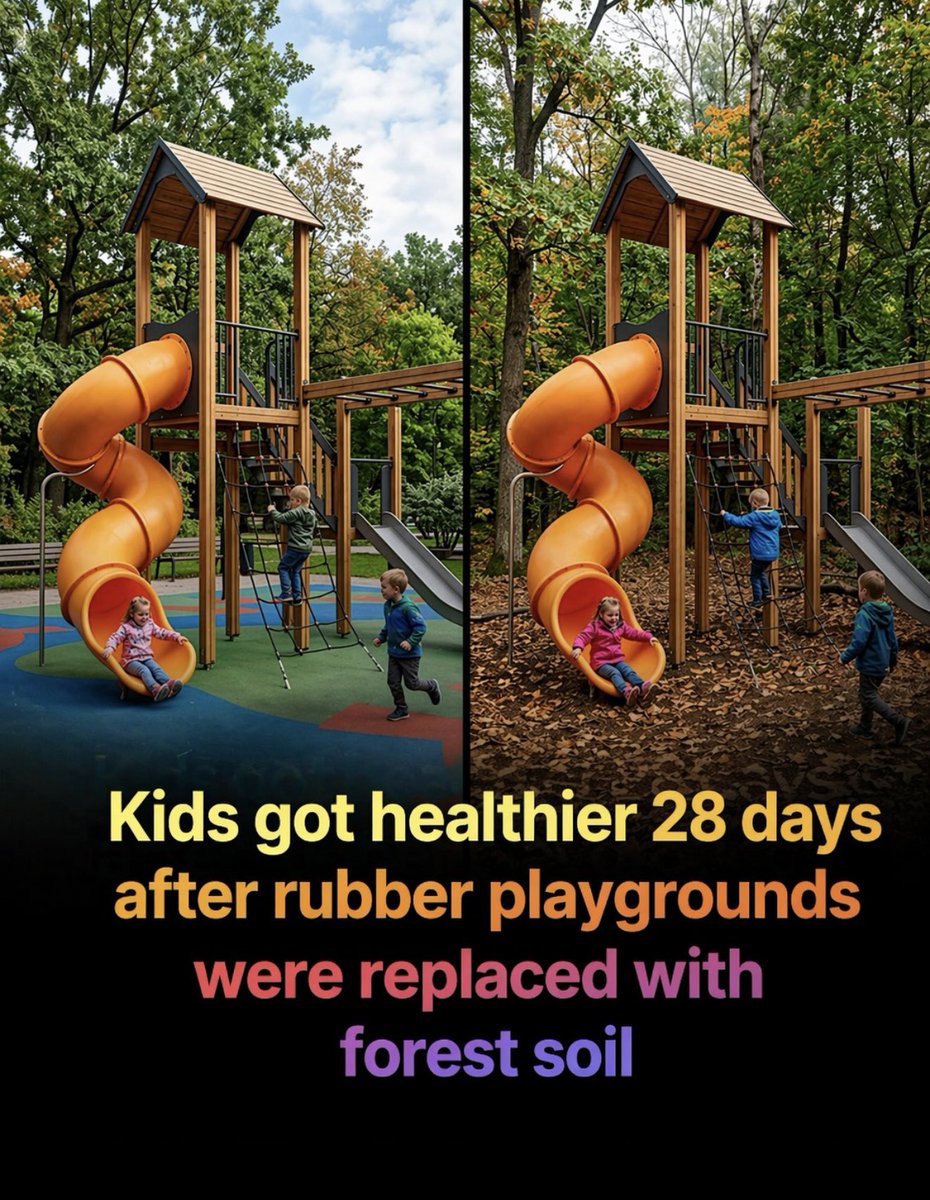
Research in Finland found that simply changing what children play on can quickly influence their immune system.
Scientists redesigned parts of nursery playgrounds by swapping gravel and asphalt for natural forest materials, soil, moss, leaf litter, and native plants, so kids would be exposed to the microbes found in nature. After just 28 days, clear biological differences emerged.
Children who played in these “rewilded” spaces developed a richer mix of microbes on their skin and in their gut. They also showed higher levels of regulatory T-cells, which help the body manage inflammation and reduce the risk of immune overreactions like allergies. These changes were not observed in children who stayed on conventional playground surfaces.
The findings support the biodiversity hypothesis, the idea that limited contact with natural environments, especially in urban life, may be linked to rising allergies and autoimmune conditions.
What stands out is how simple the intervention was. This wasn’t extreme outdoor exposure-just everyday play in a more natural setting. Even small, regular contact with soil and vegetation appears to shape the body’s internal ecosystem and how the immune system develops.
Learn more:
"Dirty Playgrounds: How Rewilding Finnish Schools Transformed
Children's Health." LettsSafari
A groundbreaking recent study has revealed that eating just one or more eggs per week can significantly reduce the risk of developing Alzheimer’s disease — by nearly 47%.
Researchers found that eggs are rich in choline, an essential nutrient that supports brain health, strengthens memory, and helps build cell membranes. Choline is a key ingredient for producing acetylcholine, a neurotransmitter involved in learning and focus. Lower levels of this compound have long been linked to cognitive decline.
While no food can guarantee protection from Alzheimer’s, this discovery highlights how small dietary choices can have profound effects on long-term mental health. One humble egg may hold part of the answer to keeping our memories alive — a simple breakfast with extraordinary potential.
[Pan, Y., Wallace, T. C., Kroska, T., Bennett, D. A., Agarwal, P., et Chung, M. (2025). Association of egg intake with Alzheimer’s dementia risk in older adults: The Rush Memory and Aging Project. The Journal of Nutrition]
Bees lives less than 40 days, visit at least 1000 flowers and produces less than a teaspoon of honey. For us it is only a teaspoon of honey, but for the bee it is a lifetime of work.
Thank You Bees!
Colombia has become the first Amazonian nation to fully protect its share of the rainforest from future fossil fuel extraction and large-scale industrial mining.
In a landmark environmental decision announced in November 2025 (during COP30), the Colombian government declared its entire Amazon biome a reserve zone for renewable natural resources. This policy explicitly prohibits the approval of any new oil exploration, hydrocarbon production, or large-scale mining projects across the region.
The protected area spans approximately 483,000 square kilometers (about 186,000 square miles)—roughly the size of Sweden—and encompasses 42% of Colombia's continental territory, while representing around 7% of the total Amazon rainforest basin.
By implementing this ban, Colombia halts progress on dozens of pending concessions, including 43 oil blocks and 286 mining requests that had not yet begun operations. The move prioritizes long-term ecosystem preservation, biodiversity protection, and the rainforest's critical role in global carbon sequestration and climate regulation over short-term resource exploitation.
Environmental groups and advocates have praised the policy as a historic conservation milestone, safeguarding irreplaceable habitats, indigenous territories, and vital ecological services amid the escalating climate crisis. Acting Environment Minister Irene Vélez Torres described it as a pioneering step, urging other Amazonian countries to follow suit through initiatives like the proposed Alianza Amazónica por la Vida (Amazon Alliance for Life).
This bold action sets a powerful precedent for balancing economic development with planetary health, demonstrating that nations can lead in protecting shared global heritage like the Amazon.
The polyphenol EGCG in green tea is responsible for the increased activation of the longevity gene FOX03.
Green tea also helps to reduce inflammation, fight cancer, promote calmness, improve brain health, improves fat loss and much more.
Lifestyle choices can either enhance or diminish the gene's beneficial effects.
Always look for organic. 🍵
RESEARCH: Fertility rates will 'continue to decline in all almost all countries and territories' up to the year 2100 and 'civilisation is converging on a sustained low-fertility reality', according to a study published in The Lancet.
Eating more fat can sometimes reduce your LDL cholesterol, total cholesterol, and triglycerides.
Shocking... I know.
Thanks for sharing these results, @Pl4ntbased!
Ditch the cords and embrace the freedom of Wireless #CarPlay and Android Auto on the #AlpineHalo9 and #AlpineHalo11 displays. Effortlessly access your apps, music, and navigation for a seamless and connected driving experience.


![Rainmaker1973's tweet photo. A groundbreaking recent study has revealed that eating just one or more eggs per week can significantly reduce the risk of developing Alzheimer’s disease — by nearly 47%.
Researchers found that eggs are rich in choline, an essential nutrient that supports brain health, strengthens memory, and helps build cell membranes. Choline is a key ingredient for producing acetylcholine, a neurotransmitter involved in learning and focus. Lower levels of this compound have long been linked to cognitive decline.
While no food can guarantee protection from Alzheimer’s, this discovery highlights how small dietary choices can have profound effects on long-term mental health. One humble egg may hold part of the answer to keeping our memories alive — a simple breakfast with extraordinary potential.
[Pan, Y., Wallace, T. C., Kroska, T., Bennett, D. A., Agarwal, P., et Chung, M. (2025). Association of egg intake with Alzheimer’s dementia risk in older adults: The Rush Memory and Aging Project. The Journal of Nutrition]](https://pbs.twimg.com/media/HGvO6xoaUAA5kEZ.png)