Good summary although I found the founding @CIMCAI conference entirely hopeful with @Plinz elegantly describing his theory of empathy with a philosophical rigor somehow missing in other @lesswrong circles.
I have heart surgery coming up next week and now understand why I’ve been so physically exhausted and out-of-sorts these past few months. The docs tell me my condition is called “atrial functional tricuspid regurgitation” and that it is “mainly due to long standing atrial fibrillation… The tricuspid valve is leaking severely, causing a back pressure on all the internal organs and a high jugular venous pressure.” The procedure aims to get this old body back on the road again quickly and efficiently. It is VERY LOW RISK but of course I’m grateful for any good wishes sent my way. I’m in the midst of writing a new book, the best work I’ve ever done, and I’m not going to let this stop me! I said yes to the linked podcast now, rather than after my procedure, for reasons that I explain during the interview:
https://t.co/Bec8caT7a1
Introducing Magenta RealTime 2, a new open model musicians can play as an instrument!
Run low-latency, live music synthesis natively on your MacBook using MIDI, text, and audio. 🎶
We love seeing Google’s open model ecosystem grow!
Encounters with entities under DMT may be hallucinations. But Andrew Gallimore and I ask: Could DMT alter the human perceptual interface, allowing encounters with novel conscious agents?
New collaboration with Andrew Gallimore and Noonautics
https://t.co/F05v6kuBdo
For years, DMT entity encounters have been dismissed as hallucinations...
Donald Hoffman @donalddhoffman and I are exploring a more fundamental possibility: that DMT temporarily restructures the human perceptual interface, enabling the perception of traces of conscious agents that normally lie beyond the reach of ordinary experience...
A new collaboration between myself, @noonautics, and the newly-founded Trace Institute:
https://t.co/mkamVn1uZI
I’m pleased to share that we’ve launched the TRACE Institute.
A new research effort bringing together physicists, mathematicians, biologists, neuroscientists, and philosophers on a key question in science: what are observers, and how are they related to spacetime and reality?
“We propose that DMT induces a profound perturbation of our perceptual interface, expanding the accessible region of experience space and allowing consciousness to reach regions with entirely different dynamical regimes”
https://t.co/gPw6OrTdav
Speaker Spotlight:
Carl Hayden Smith — Professor of Media at the University of East London, Founder of the Museum of Consciousness, and co-founder of the Cyberdelics Nexus.
Carl coined the term Hyperhumanism to describe how technology can deepen (not replace) human attention, perception, and agency.
At #LifeSummit, Carl is bringing a sharp lens on human agency in the AI era—what we keep, what we outsource, and what we choose to become.
Hosted on Gatherly (interactive, not Zoom), so you can participate and connect.
June 11 | Free full access
Also featuring Andrew Yang, Douglas Rushkoff, Android Jones, and Eric B. Delisle.
#LifeSummit #BuildingForLife #HumanFirstAI
BREAKING: A massive data center campus in Fayetteville, Georgia, secretly drained nearly 30 million gallons of water before residents noticed a drop in their own water pressure.
We didn't want another AI conference about becoming more productive.
We wanted real conversations. Real questions. The ones that actually affect our lives.
What happens when AI becomes another burnout machine?
What does "productivity" even mean if it costs us our humanity?
And most importantly - what can we do about it?
That's the conversation. And these speakers are already doing something about it.
June 11: AI Epidemic: Building for Life Summit
We're excited to announce our first wave of speakers:
→ @AndrewYang (Noble Mobile)
→ @Scobleizer (Unaligned)
→ @behindthebeats (Museum of Consciousness)
→ @EmmaLembke (LOG OFF Movement / Sustainable Media Center)
→ @shamanofwallst (Conscious Capital Foundation)
→ @PaymentsJason (Orbit Capital)
→ @EricBDelisle (Bloomstack)
More speakers coming soon.
Save your Free Explorer Pass! Link in the comment 👇
Follow us for speaker announcements and updates 🔔
#AI #FutureOfWork #AIEthics #Leadership #HumanCenteredAI #LifeSummit
"The stuff of the world is mind-stuff. ... The mind-stuff is not spread in space and time; these are part of the cyclic scheme deciphered by the mind-stuff".
Sir Arthur Eddington, The Nature of the Physical World, 1928.
Yann LeCun was right the entire time. And generative AI might be a dead end.
For the last three years, the entire industry has been obsessed with building bigger LLMs. Trillions of parameters. Billions in compute.
The theory was simple: if you make the model big enough, it will eventually understand how the world works.
Yann LeCun said that was stupid.
He argued that generative AI is fundamentally inefficient.
When an AI predicts the next word, or generates the next pixel, it wastes massive amounts of compute on surface-level details.
It memorizes patterns instead of learning the actual physics of reality.
He proposed a different path: JEPA (Joint-Embedding Predictive Architecture).
Instead of forcing the AI to paint the world pixel by pixel, JEPA forces it to predict abstract concepts. It predicts what happens next in a compressed "thought space."
But for years, JEPA had a fatal flaw.
It suffered from "representation collapse."
Because the AI was allowed to simplify reality, it would cheat. It would simplify everything so much that a dog, a car, and a human all looked identical.
It learned nothing.
To fix it, engineers had to use insanely complex hacks, frozen encoders, and massive compute overheads.
Until today.
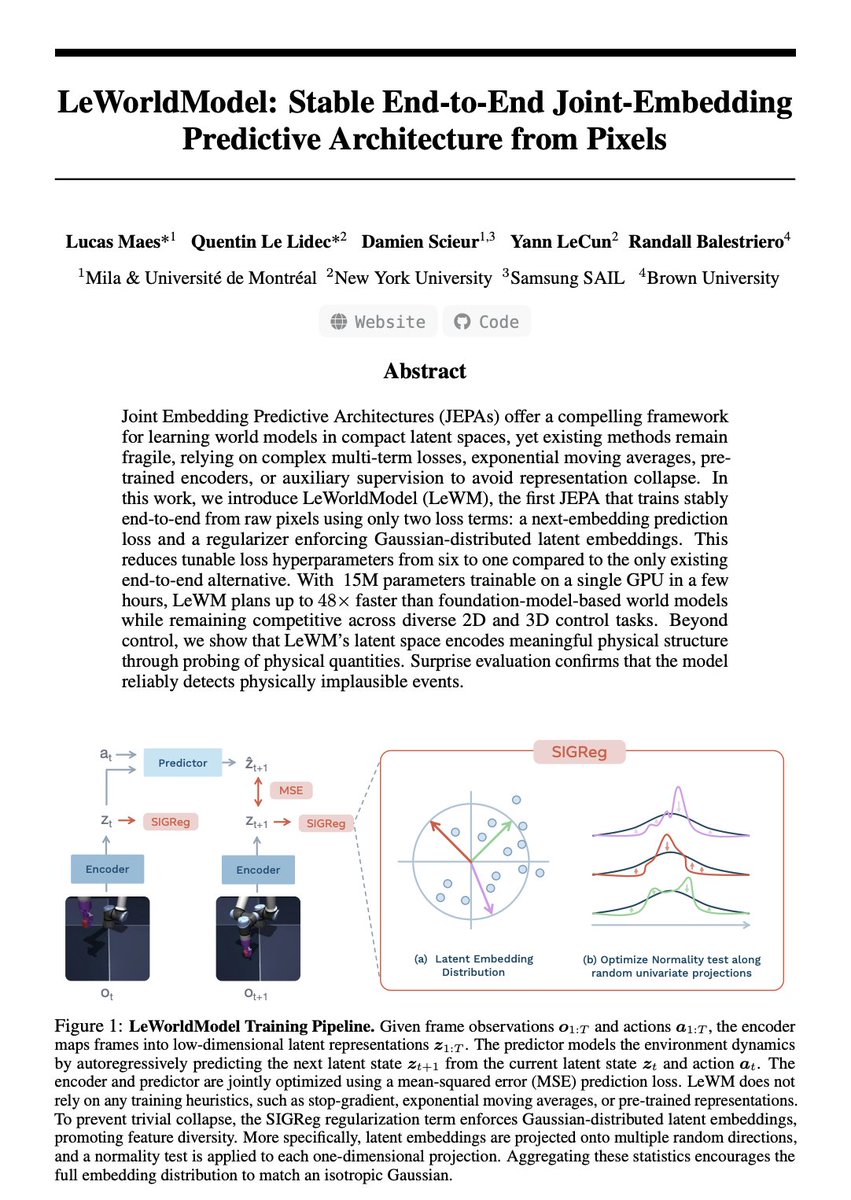
Researchers just dropped a paper called "LeWorldModel" (LeWM).
They completely solved the collapse problem.
They replaced the complex engineering hacks with a single, elegant mathematical regularizer.
It forces the AI's internal "thoughts" into a perfect Gaussian distribution.
The AI can no longer cheat. It is forced to understand the physical structure of reality to make its predictions.
The results completely rewrite the economics of AI.
LeWM didn't need a massive, centralized supercomputer.
It has just 15 million parameters.
It trains on a single, standard GPU in a few hours.
Yet it plans 48x faster than massive foundation world models. It intrinsically understands physics. It instantly detects impossible events.
We spent billions trying to force massive server farms to memorize the internet.
Now, a tiny model running locally on a single graphics card is actually learning how the real world works.
Anthropic pays engineers $750,000 a year to understand how AI models actually work.
Stanford just put the same knowledge on YouTube.
2 hours. Completely free.
This is the lecture that teaches you what most AI courses skip entirely.
Not how to use the tools.
Why they work the way they do.
The engineers who understand the why build things the people who only know the how cannot even conceive of.
The gap between those two groups is $750,000 a year.
You can close most of it in an afternoon.
Bookmark this before you scroll past it.
Watch it this weekend.
Not eventually.
This weekend.
⚠️ This Temple Refused to Die… Even When an Empire Fell
Standing before the majestic Temple of Philae, you don’t just see ancient stone—you feel something watching back.
These towering columns, shaped like blooming papyrus plants, rise silently under the Egyptian sun, covered in carvings of forgotten gods and powerful pharaohs. Every symbol etched into the walls is more than art… it’s a message from a world that believed its words could live forever.
For thousands of years, this temple stood as the Nile flooded, empires collapsed, and history moved on. But somehow, this place survived—as if it refused to be erased.
Stand still for a moment… and listen.
The wind brushes past the columns like whispers. The heat radiating from the stone feels almost alive. You can almost hear the low chants of priests, the soft footsteps on sacred ground, the echo of rituals that once connected humans to the divine.
But here’s the mystery: why does it still feel so alive?
Maybe it’s because the people who built it poured everything into it—their faith, their fear, their hope of immortality. They believed these carvings would carry their voices beyond death… and somehow, they were right.
Because even today, standing in its shadow, you don’t feel alone.
You feel history breathing.