Honoring the memory of Anders Amelin, our dear friend and strategic advisor at @QualiaRI. His unwavering commitment to solving the problem of suffering will forever inspire us. Our deepest condolences to his family and friends. Learn more: https://t.co/sPsbBWek6G
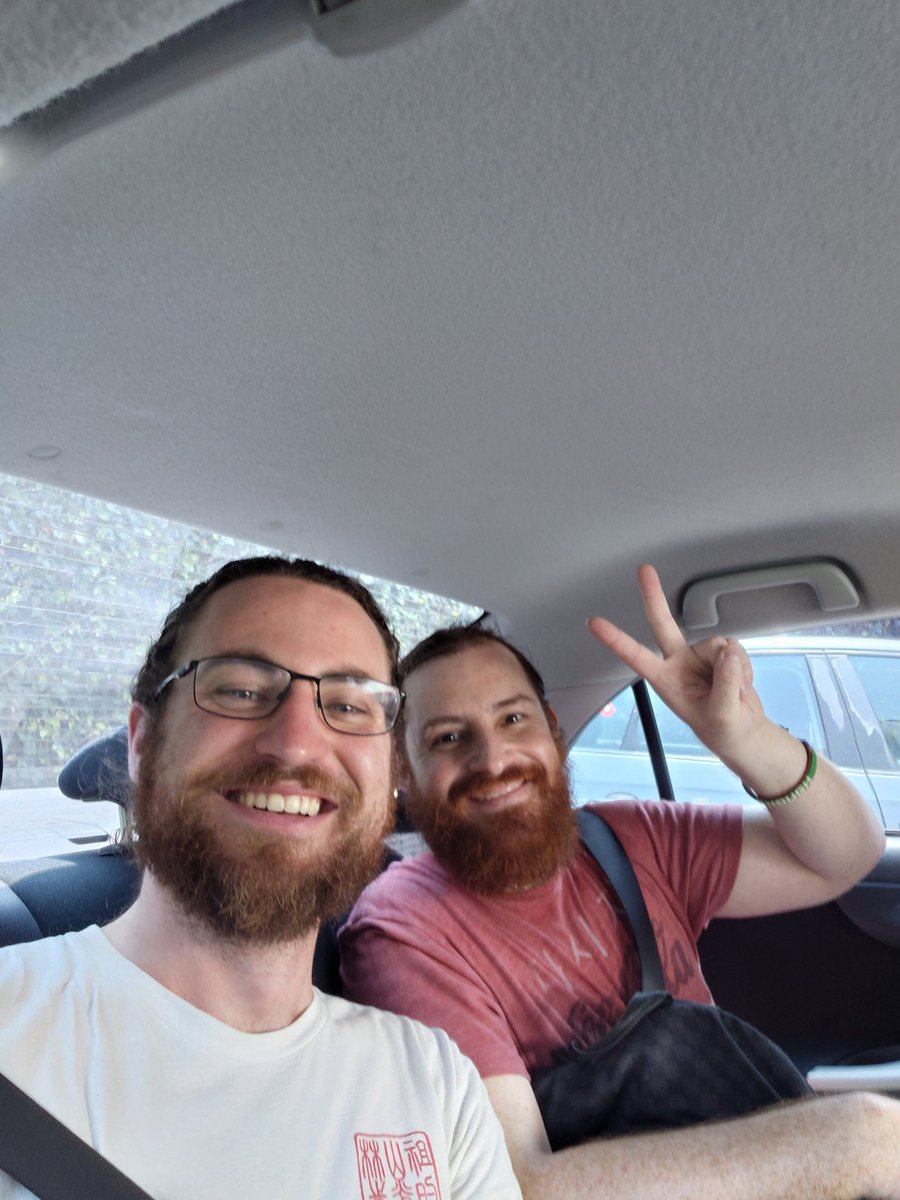
Lates post from the trenches of QRI's Tepoztlán 2026 Research Retreat :D (featuring @webmasterdave - @QualiaRI)
[this one is an effort-post - enjoy!]
---------
~excerpt~
Why a utilitarian makes life sacred
David said the thing that reorganized the conversation for me. I had been needling him, pointing out that “whatever it takes” runs straight into trade-offs and cost-effectiveness, that his worldview was meeting a hard constraint, that he sounded less like a utilitarian and more like a priest. He answered without flinching. On strict negative-utilitarian grounds, he said, the best route to minimizing suffering is to enshrine in law the sanctity of sentient life, human and nonhuman. The claim is exact and worth keeping in his terms. The sanctity of life is a legal fiction adopted on consequentialist grounds: given the frailties of human nature, treating sentient life as inviolate yields better outcomes by the negative utilitarian’s own criteria than any regime that lets you weigh each killing on its merits. He grants that treating Darwinian malware like us as though it were sacred can stick in the craw, and he reads the twentieth century as decisive evidence that the legislative framework is wise anyway. Philosophers call this indirect utilitarianism. David notes, accurately, that indirect negative utilitarianism just collapses back into negative utilitarianism, so he is endorsing the plain article.
Sit with how strange and how correct that is. A man whose foundational commitment is the abolition of suffering, who would in principle weigh any life against any other, arguing that we should hard-code life as near-inviolable into our institutions. The resolution is that the hard rule is the utilitarian move. This is two-level thinking of the kind R. M. Hare described. At the critical level you may reason in pure consequences, but the disposition you want running in fallible agents at the intuitive level is a near-absolute reverence for life, because agents who price each killing case by case produce far worse outcomes than agents fenced in by a bright line. The bright line is a Schelling fence. Permit case-by-case killing on utilitarian grounds and the category of permissible killing erodes under motivated reasoning until it has swallowed things no honest ledger would have allowed. A society visibly precommitted to the sanctity of life is more trustworthy and lower-variance, and spared the slow arms race of ever more elaborate justifications (following the letter rather than the spirit of the rules). The sacredness is load-bearing social technology, and a utilitarian who understands game theory should want it installed and should want it to feel like more than a calculation, because a reverence you can switch off when convenient is no constraint at all.
This is also, David likes to point out, why he flew the Jain banner rather than the Buddhist one. The Buddha did not think like a lawyer. The ambiguity over whether monks could eat meat offered as alms handed self-serving rationalization its opening, and the result is that less than half the world’s Buddhists are even vegetarian. The sanctity-of-life rule is an attempt to leave rationalization no such opening. It is the lawyer’s instinct turned to mercy.
The shape recurs in law and in karma alike. The law attaches harm to a named actor who must answer for it, and the karmic ledger attaches it to a mind that must carry it. The sanctity-of-life norm belongs to the same family, insisting that even a justified killing leaves a mark. Each is a refusal to let the cost of an act quietly vanish, and the refusal is wiser than any single calculation that would override it.
Now return to where we began. If we would beg a superintelligence to keep us, cognitively humble and occasionally dangerous as we are, inside the circle of compassion, then how I treat the scorpion tonight is a rehearsal for the norm I want encoded in whatever succeeds us. There is a hard-nosed version of this in current AI safety, the proposal that we install reverence for all sentient life as a core constraint in artificial agents, and a constraint we visibly keep ourselves is far more credible than one we merely recommend. The stick in my hand and the alignment of a future mind rhyme, because both turn on what the strong owe the weak when the weak can do nothing whatsoever to enforce it.
And it settles the reprogram-or-retire question in the direction David has argued for decades, the same direction as the Herbivorize Predators project he advises. Confronted with a vicious scorpion or a vicious human, the abolitionist chooses reform over retirement. You do not exterminate the species or execute the man. You relocate the individual tonight, and over the longer arc you reach for fertility regulation by immunocontraception, for obligate carnivores genetically and behaviourally tweaked into harmlessness, for an ethic of compassionate stewardship in place of the snuff-movie logic of orthodox conservation biology (don’t pretend “conservation biology” is morally neutral - it’s laden with background philosophical assumptions that are highly dubious when examined carefully).
High-tech Jainism is the refusal to retire anyone, scaled up and down the whole ladder of minds, and held to even on the nights when retirement would be cheaper.
-----
The micromort backbone
For years my mental hygiene has run on actuarial tables and on pricing activities in micromorts, where one micromort is a one-in-a-million chance of death. I tell the language models to be absolutely pedantic, to assume I am neurodivergent and want multiple decimals, and not to round anything off for my comfort (I’m the kind of person who actually cares about orders of magnitude). They (sometimes) oblige with beautiful, well-researched, actuarial-like tables. I once had a model design my daily walk this way (and I suggest you do similarly). Given map data, per-street collision counts, and crime (mostly phone-snatching) statistics in different street segments, it found a roughly micromort-minimizing 45-minute route that also happens to pass a store, because the small hit of dopamine from going to fetch something raises the odds I actually take the walk, and the walk itself buys back a couple micromorts through exercise against the long-tail risks of a bus or a mugging. On certain blocks the same analysis just says: looks empty, but a lot of phones get taken here, pocket your phone. None of that is visible while you stand on the corner, and the careful statistic-driven analysis often gives you counterintuitive results (did you know about 1 percent of deaths in the United States are the result of car crashes?).
This is the backbone I want under the policies at a retreat. The pitch to attendees is simple: some of these rules will feel counterintuitive, and what they do is shave down the bulk of the likely harms and clip the long tails at once. For the scorpions there are two questions and they have opposite answers, so it pays to separate them. The first is how likely a sting is at all. The official statistics are no help, because they are drawn from a profile that is the photographic negative of ours: small children, men carrying and stacking firewood, homes with free-range hens and stored corn and palm-leaf or sheet-metal roofs, and, tellingly, people who take no action to prevent stings at all. We are eleven numerate adults in masonry-and-tile houses who sweep with UV, check our shoes, and keep the beds off the wall. But our house is also visibly dense, five on the garden walls in three minutes and eight or nine indoor sightings (including the one next to a bed) in three weeks, so the honest input is our own observed encounter rate rather than the national average. Run that through, and without any protocol the group faces roughly a coin-flip, call it a 45 percent chance that someone among the eleven is stung over the two months. With the layered protocol that roughly halves, to something like 20 percent. Around 99.8 percent of any sting that might happen would, at worst, be very painful rather than a medical emergency. Scorpions sit outside the Schmidt sting pain index, which only rates bees, wasps, and ants, but the bark-scorpion sting is well documented: an immediate burning hit followed by intense throbbing and hours of hypersensitivity to touch, comfortably above the honey bee that anchors Schmidt at a 2, and nothing like the bullet ant at the top.
🎆 It's the new Oscilleditor! 🧬 Twist it! 🌈 Pull it! 🤯 Bop it! Let your attention guide you on a journey through your imagination. Share your clips, trade presets with friends, and share your findings to contribute to qualia research today!
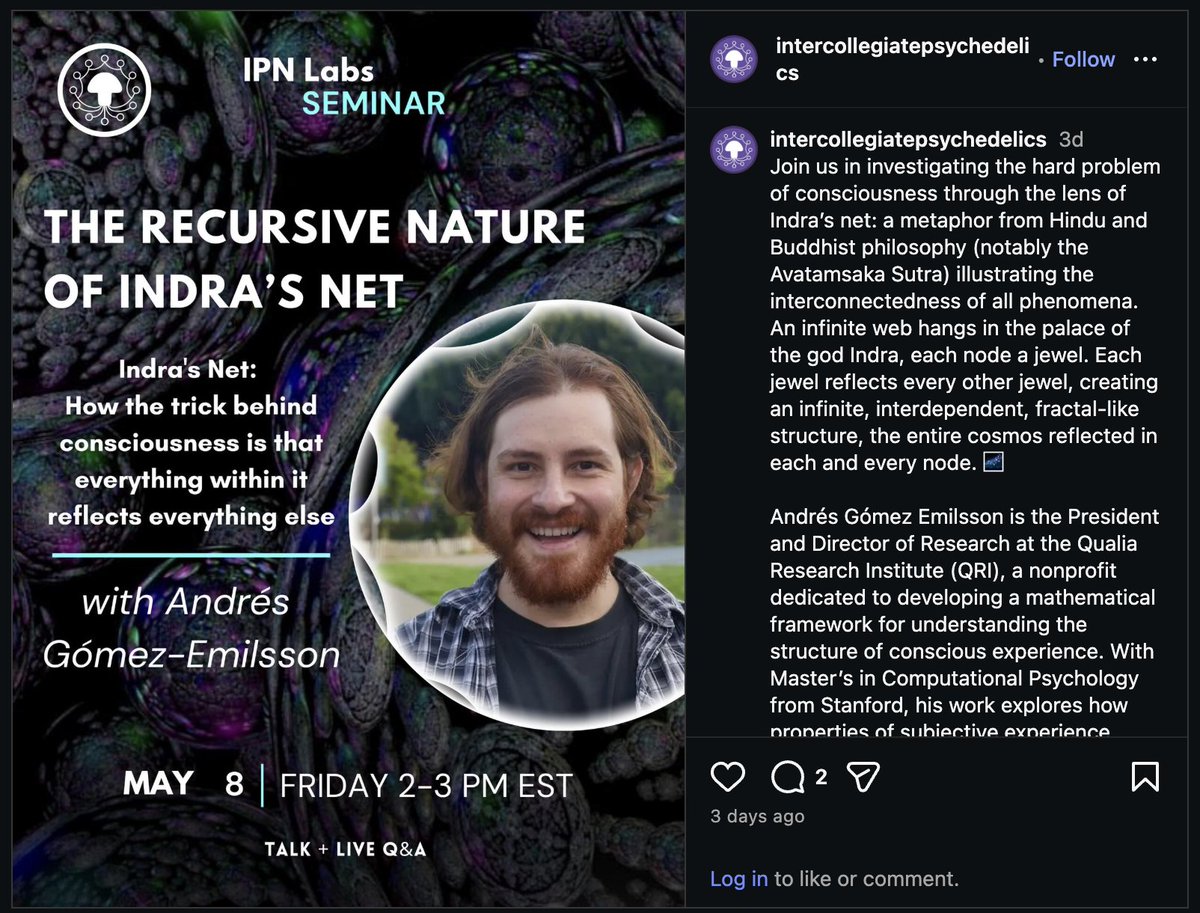
Happening tomorrow :-)
> Join us in investigating the hard problem of consciousness through the lens of Indra’s net: a metaphor from Hindu and Buddhist philosophy (notably the Avatamsaka Sutra) illustrating the interconnectedness of all phenomena. An infinite web hangs in the palace of the god Indra, each node a jewel. Each jewel reflects every other jewel, creating an infinite, interdependent, fractal-like structure, the entire cosmos reflected in each and every node. 🌌
Event link is in our bio!
#consciousness #consciousnessresearch #freeevent #lecture #research3dintercollegiatepsychedelics
I came across @algekalipso's writing while still in university academically vectoring towards cog-sci and philosophy of mind almost a decade ago, now, the classic Hyperbolic Geometry of DMT Experiences article, not long after trying LSD for the first time, and several months into monomaniacal obsession with Buddhist philosophy inflamed by a few fleeting and, of course, ungraspable glimpses of the nature of this mind. I was convinced at once that he was either a genius or insane, plausibly both.
Life is strange.
Absolutely stoked for these 8 weeks diving into novel qualitatively and quantitatively evaluated explorations of the state-space of consciousness with intent to develop empirically adequate mathematized models.
May the work done here benefit all sentience!
Reminder of the Jhana Viz contest :D
Deadline is June 4th, 2026, 10PM Pacific Time.
I'm very much looking forward to seeing your submissions (as I'm sure y'all are also eager to see them, and you will!)!
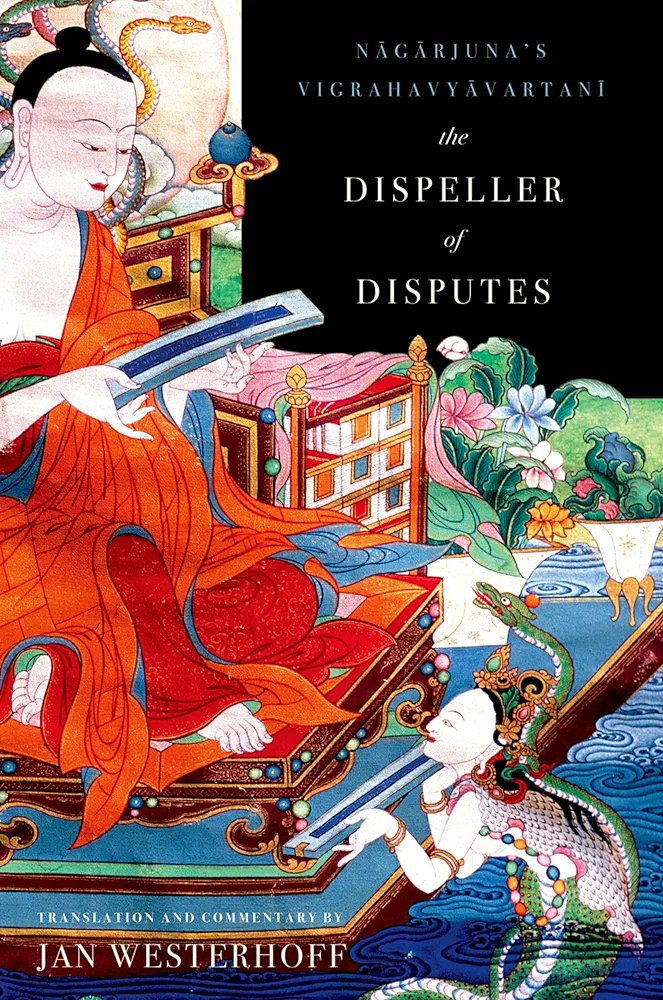
Time for a re-read in anticipation of the @QualiaRI retreat. Gotta get this old antifoundationalist epistemic engine running to play the resident Madhyamika.
Flying back to SF after a great week at the Lionheart Summit in Costa Rica*
Innovation for consciousness research cannot wait! Starting May 4th QRI will be on a research retreat in Mexico. Second hand of June is a time where meeting me/us is realistic if you happen to be in Tepoztlán :-)
* Where you're contractually obliged to respond "Pura Vida" to ambiguously high valence interactions.
I was nudged to apply the music theory of consciousness to magick and this week RENSEP published my essay on their website. Hugely influenced by @QualiaRI work on coupled oscillators! To all the keen Pythagorean Platonists, you can read it here:
https://t.co/pVDLHwWWje
QRI Meetup @ Mox (SF) Monday the 13th at 7PM Pacific :D
I'll give a presentation and then have a Q&A. I'm happy to discuss anything, really! Should be fun!
Infinite bliss!
@QualiaRI
Vocabulary update:
At the Computational Neurophenomenology cabin workshop a number of participants made the very strong case that a system's experience should be called its phenomenality rather than its phenomenology. Phenomenology, etymologically speaking, refers to the study of phenomena, so it is misaligned to use it for an individual experience rather than the discipline that studies such experiences. I agree. It may take time to adapt, but I like the idea of pointing to an individual system’s experience as its instantaneous phenomenality. Namely, just as we say a system has mass, charge, or conductivity, we can say it has a certain phenomenality.
Grammatically, phenomenality is an abstract mass noun formed with the suffix “-ity,” which denotes a property or quality instantiated by a system. Phenomenological is the corresponding adjective, and phenomenology is a discipline noun like biology or psychology. So phenomenality names what a system has, a property in the same grammatical category as other measurable or describable qualities.
Thank you for your attention on this matter
Andrés :-)
I encourage people to enter this competition and create more jhana (meditation) replications!
When I first created my animation of the Jhanas last year, I wanted it to inspire a wave of teaching meditation through visualisations. Good going QRI for putting this on!
✨ Synesthetic firefly sensations wih Kuramoto fields! Very nice @AtlasForgeAI & @jonnym1ller. Visualize the jhanas for science! https://t.co/O9JIZ16McD
Entries will be judged at the end of QRI's upcoming HEART retreat in Tepoztlán, Mexico. Come study the Jhanas and other wholesome states of consciousness with us this summer https://t.co/ZBcVl7vgsc
Do your part to mainstream the Jhanas by submitting an entry into the 2026 Jhana Visualization Competition! Submit your replications of these beautiful states of consciousness for science and a chance to win $1000!
fwiw: I don't think 'mindfulness' will be the default meditation entry point in five years' time. Jhanas are absurdly more compelling + beneficial for almost everyone (training emotional fluidity, embodiment + unclenching)
But I also doubt jhana will go mainstream unless it goes through something of a re-brand. (friends outside of the inner-work echo chamber squint when I say the word and I think 'jh' is unfortunately a barrier)
My guess is it will follow a similar trajectory to yoga nidra which @hubermanlab rebranded as NSDR, and it then exploded in popularity
Likely there will be some meaningful research on jhanas states → they'll create a scientific technical-sounding acronym like 'BASE' (Bliss Attractor State Emergence), and @jhanatech by then will hopefully have cracked an accessible entry point for teaching jhana-access.
Show us how the Jhanas look like they feel, for science! Thank you @BearFromVoid for the awesome animations. Visit the contest page today: https://t.co/O9JIZ16McD


![algekalipso's tweet photo. Lates post from the trenches of QRI's Tepoztlán 2026 Research Retreat :D (featuring @webmasterdave - @QualiaRI)
[this one is an effort-post - enjoy!]
---------
~excerpt~
Why a utilitarian makes life sacred
David said the thing that reorganized the conversation for me. I had been needling him, pointing out that “whatever it takes” runs straight into trade-offs and cost-effectiveness, that his worldview was meeting a hard constraint, that he sounded less like a utilitarian and more like a priest. He answered without flinching. On strict negative-utilitarian grounds, he said, the best route to minimizing suffering is to enshrine in law the sanctity of sentient life, human and nonhuman. The claim is exact and worth keeping in his terms. The sanctity of life is a legal fiction adopted on consequentialist grounds: given the frailties of human nature, treating sentient life as inviolate yields better outcomes by the negative utilitarian’s own criteria than any regime that lets you weigh each killing on its merits. He grants that treating Darwinian malware like us as though it were sacred can stick in the craw, and he reads the twentieth century as decisive evidence that the legislative framework is wise anyway. Philosophers call this indirect utilitarianism. David notes, accurately, that indirect negative utilitarianism just collapses back into negative utilitarianism, so he is endorsing the plain article.
Sit with how strange and how correct that is. A man whose foundational commitment is the abolition of suffering, who would in principle weigh any life against any other, arguing that we should hard-code life as near-inviolable into our institutions. The resolution is that the hard rule is the utilitarian move. This is two-level thinking of the kind R. M. Hare described. At the critical level you may reason in pure consequences, but the disposition you want running in fallible agents at the intuitive level is a near-absolute reverence for life, because agents who price each killing case by case produce far worse outcomes than agents fenced in by a bright line. The bright line is a Schelling fence. Permit case-by-case killing on utilitarian grounds and the category of permissible killing erodes under motivated reasoning until it has swallowed things no honest ledger would have allowed. A society visibly precommitted to the sanctity of life is more trustworthy and lower-variance, and spared the slow arms race of ever more elaborate justifications (following the letter rather than the spirit of the rules). The sacredness is load-bearing social technology, and a utilitarian who understands game theory should want it installed and should want it to feel like more than a calculation, because a reverence you can switch off when convenient is no constraint at all.
This is also, David likes to point out, why he flew the Jain banner rather than the Buddhist one. The Buddha did not think like a lawyer. The ambiguity over whether monks could eat meat offered as alms handed self-serving rationalization its opening, and the result is that less than half the world’s Buddhists are even vegetarian. The sanctity-of-life rule is an attempt to leave rationalization no such opening. It is the lawyer’s instinct turned to mercy.
The shape recurs in law and in karma alike. The law attaches harm to a named actor who must answer for it, and the karmic ledger attaches it to a mind that must carry it. The sanctity-of-life norm belongs to the same family, insisting that even a justified killing leaves a mark. Each is a refusal to let the cost of an act quietly vanish, and the refusal is wiser than any single calculation that would override it.
Now return to where we began. If we would beg a superintelligence to keep us, cognitively humble and occasionally dangerous as we are, inside the circle of compassion, then how I treat the scorpion tonight is a rehearsal for the norm I want encoded in whatever succeeds us. There is a hard-nosed version of this in current AI safety, the proposal that we install reverence for all sentient life as a core constraint in artificial agents, and a constraint we visibly keep ourselves is far more credible than one we merely recommend. The stick in my hand and the alignment of a future mind rhyme, because both turn on what the strong owe the weak when the weak can do nothing whatsoever to enforce it.
And it settles the reprogram-or-retire question in the direction David has argued for decades, the same direction as the Herbivorize Predators project he advises. Confronted with a vicious scorpion or a vicious human, the abolitionist chooses reform over retirement. You do not exterminate the species or execute the man. You relocate the individual tonight, and over the longer arc you reach for fertility regulation by immunocontraception, for obligate carnivores genetically and behaviourally tweaked into harmlessness, for an ethic of compassionate stewardship in place of the snuff-movie logic of orthodox conservation biology (don’t pretend “conservation biology” is morally neutral - it’s laden with background philosophical assumptions that are highly dubious when examined carefully).
High-tech Jainism is the refusal to retire anyone, scaled up and down the whole ladder of minds, and held to even on the nights when retirement would be cheaper.
-----
The micromort backbone
For years my mental hygiene has run on actuarial tables and on pricing activities in micromorts, where one micromort is a one-in-a-million chance of death. I tell the language models to be absolutely pedantic, to assume I am neurodivergent and want multiple decimals, and not to round anything off for my comfort (I’m the kind of person who actually cares about orders of magnitude). They (sometimes) oblige with beautiful, well-researched, actuarial-like tables. I once had a model design my daily walk this way (and I suggest you do similarly). Given map data, per-street collision counts, and crime (mostly phone-snatching) statistics in different street segments, it found a roughly micromort-minimizing 45-minute route that also happens to pass a store, because the small hit of dopamine from going to fetch something raises the odds I actually take the walk, and the walk itself buys back a couple micromorts through exercise against the long-tail risks of a bus or a mugging. On certain blocks the same analysis just says: looks empty, but a lot of phones get taken here, pocket your phone. None of that is visible while you stand on the corner, and the careful statistic-driven analysis often gives you counterintuitive results (did you know about 1 percent of deaths in the United States are the result of car crashes?).
This is the backbone I want under the policies at a retreat. The pitch to attendees is simple: some of these rules will feel counterintuitive, and what they do is shave down the bulk of the likely harms and clip the long tails at once. For the scorpions there are two questions and they have opposite answers, so it pays to separate them. The first is how likely a sting is at all. The official statistics are no help, because they are drawn from a profile that is the photographic negative of ours: small children, men carrying and stacking firewood, homes with free-range hens and stored corn and palm-leaf or sheet-metal roofs, and, tellingly, people who take no action to prevent stings at all. We are eleven numerate adults in masonry-and-tile houses who sweep with UV, check our shoes, and keep the beds off the wall. But our house is also visibly dense, five on the garden walls in three minutes and eight or nine indoor sightings (including the one next to a bed) in three weeks, so the honest input is our own observed encounter rate rather than the national average. Run that through, and without any protocol the group faces roughly a coin-flip, call it a 45 percent chance that someone among the eleven is stung over the two months. With the layered protocol that roughly halves, to something like 20 percent. Around 99.8 percent of any sting that might happen would, at worst, be very painful rather than a medical emergency. Scorpions sit outside the Schmidt sting pain index, which only rates bees, wasps, and ants, but the bark-scorpion sting is well documented: an immediate burning hit followed by intense throbbing and hours of hypersensitivity to touch, comfortably above the honey bee that anchors Schmidt at a 2, and nothing like the bullet ant at the top.](https://pbs.twimg.com/media/HJCtO3mWYAAb91m.jpg)
![algekalipso's tweet photo. Lates post from the trenches of QRI's Tepoztlán 2026 Research Retreat :D (featuring @webmasterdave - @QualiaRI)
[this one is an effort-post - enjoy!]
---------
~excerpt~
Why a utilitarian makes life sacred
David said the thing that reorganized the conversation for me. I had been needling him, pointing out that “whatever it takes” runs straight into trade-offs and cost-effectiveness, that his worldview was meeting a hard constraint, that he sounded less like a utilitarian and more like a priest. He answered without flinching. On strict negative-utilitarian grounds, he said, the best route to minimizing suffering is to enshrine in law the sanctity of sentient life, human and nonhuman. The claim is exact and worth keeping in his terms. The sanctity of life is a legal fiction adopted on consequentialist grounds: given the frailties of human nature, treating sentient life as inviolate yields better outcomes by the negative utilitarian’s own criteria than any regime that lets you weigh each killing on its merits. He grants that treating Darwinian malware like us as though it were sacred can stick in the craw, and he reads the twentieth century as decisive evidence that the legislative framework is wise anyway. Philosophers call this indirect utilitarianism. David notes, accurately, that indirect negative utilitarianism just collapses back into negative utilitarianism, so he is endorsing the plain article.
Sit with how strange and how correct that is. A man whose foundational commitment is the abolition of suffering, who would in principle weigh any life against any other, arguing that we should hard-code life as near-inviolable into our institutions. The resolution is that the hard rule is the utilitarian move. This is two-level thinking of the kind R. M. Hare described. At the critical level you may reason in pure consequences, but the disposition you want running in fallible agents at the intuitive level is a near-absolute reverence for life, because agents who price each killing case by case produce far worse outcomes than agents fenced in by a bright line. The bright line is a Schelling fence. Permit case-by-case killing on utilitarian grounds and the category of permissible killing erodes under motivated reasoning until it has swallowed things no honest ledger would have allowed. A society visibly precommitted to the sanctity of life is more trustworthy and lower-variance, and spared the slow arms race of ever more elaborate justifications (following the letter rather than the spirit of the rules). The sacredness is load-bearing social technology, and a utilitarian who understands game theory should want it installed and should want it to feel like more than a calculation, because a reverence you can switch off when convenient is no constraint at all.
This is also, David likes to point out, why he flew the Jain banner rather than the Buddhist one. The Buddha did not think like a lawyer. The ambiguity over whether monks could eat meat offered as alms handed self-serving rationalization its opening, and the result is that less than half the world’s Buddhists are even vegetarian. The sanctity-of-life rule is an attempt to leave rationalization no such opening. It is the lawyer’s instinct turned to mercy.
The shape recurs in law and in karma alike. The law attaches harm to a named actor who must answer for it, and the karmic ledger attaches it to a mind that must carry it. The sanctity-of-life norm belongs to the same family, insisting that even a justified killing leaves a mark. Each is a refusal to let the cost of an act quietly vanish, and the refusal is wiser than any single calculation that would override it.
Now return to where we began. If we would beg a superintelligence to keep us, cognitively humble and occasionally dangerous as we are, inside the circle of compassion, then how I treat the scorpion tonight is a rehearsal for the norm I want encoded in whatever succeeds us. There is a hard-nosed version of this in current AI safety, the proposal that we install reverence for all sentient life as a core constraint in artificial agents, and a constraint we visibly keep ourselves is far more credible than one we merely recommend. The stick in my hand and the alignment of a future mind rhyme, because both turn on what the strong owe the weak when the weak can do nothing whatsoever to enforce it.
And it settles the reprogram-or-retire question in the direction David has argued for decades, the same direction as the Herbivorize Predators project he advises. Confronted with a vicious scorpion or a vicious human, the abolitionist chooses reform over retirement. You do not exterminate the species or execute the man. You relocate the individual tonight, and over the longer arc you reach for fertility regulation by immunocontraception, for obligate carnivores genetically and behaviourally tweaked into harmlessness, for an ethic of compassionate stewardship in place of the snuff-movie logic of orthodox conservation biology (don’t pretend “conservation biology” is morally neutral - it’s laden with background philosophical assumptions that are highly dubious when examined carefully).
High-tech Jainism is the refusal to retire anyone, scaled up and down the whole ladder of minds, and held to even on the nights when retirement would be cheaper.
-----
The micromort backbone
For years my mental hygiene has run on actuarial tables and on pricing activities in micromorts, where one micromort is a one-in-a-million chance of death. I tell the language models to be absolutely pedantic, to assume I am neurodivergent and want multiple decimals, and not to round anything off for my comfort (I’m the kind of person who actually cares about orders of magnitude). They (sometimes) oblige with beautiful, well-researched, actuarial-like tables. I once had a model design my daily walk this way (and I suggest you do similarly). Given map data, per-street collision counts, and crime (mostly phone-snatching) statistics in different street segments, it found a roughly micromort-minimizing 45-minute route that also happens to pass a store, because the small hit of dopamine from going to fetch something raises the odds I actually take the walk, and the walk itself buys back a couple micromorts through exercise against the long-tail risks of a bus or a mugging. On certain blocks the same analysis just says: looks empty, but a lot of phones get taken here, pocket your phone. None of that is visible while you stand on the corner, and the careful statistic-driven analysis often gives you counterintuitive results (did you know about 1 percent of deaths in the United States are the result of car crashes?).
This is the backbone I want under the policies at a retreat. The pitch to attendees is simple: some of these rules will feel counterintuitive, and what they do is shave down the bulk of the likely harms and clip the long tails at once. For the scorpions there are two questions and they have opposite answers, so it pays to separate them. The first is how likely a sting is at all. The official statistics are no help, because they are drawn from a profile that is the photographic negative of ours: small children, men carrying and stacking firewood, homes with free-range hens and stored corn and palm-leaf or sheet-metal roofs, and, tellingly, people who take no action to prevent stings at all. We are eleven numerate adults in masonry-and-tile houses who sweep with UV, check our shoes, and keep the beds off the wall. But our house is also visibly dense, five on the garden walls in three minutes and eight or nine indoor sightings (including the one next to a bed) in three weeks, so the honest input is our own observed encounter rate rather than the national average. Run that through, and without any protocol the group faces roughly a coin-flip, call it a 45 percent chance that someone among the eleven is stung over the two months. With the layered protocol that roughly halves, to something like 20 percent. Around 99.8 percent of any sting that might happen would, at worst, be very painful rather than a medical emergency. Scorpions sit outside the Schmidt sting pain index, which only rates bees, wasps, and ants, but the bark-scorpion sting is well documented: an immediate burning hit followed by intense throbbing and hours of hypersensitivity to touch, comfortably above the honey bee that anchors Schmidt at a 2, and nothing like the bullet ant at the top.](https://pbs.twimg.com/media/HJCtMd1WMAAMXoQ.jpg)
![algekalipso's tweet photo. Lates post from the trenches of QRI's Tepoztlán 2026 Research Retreat :D (featuring @webmasterdave - @QualiaRI)
[this one is an effort-post - enjoy!]
---------
~excerpt~
Why a utilitarian makes life sacred
David said the thing that reorganized the conversation for me. I had been needling him, pointing out that “whatever it takes” runs straight into trade-offs and cost-effectiveness, that his worldview was meeting a hard constraint, that he sounded less like a utilitarian and more like a priest. He answered without flinching. On strict negative-utilitarian grounds, he said, the best route to minimizing suffering is to enshrine in law the sanctity of sentient life, human and nonhuman. The claim is exact and worth keeping in his terms. The sanctity of life is a legal fiction adopted on consequentialist grounds: given the frailties of human nature, treating sentient life as inviolate yields better outcomes by the negative utilitarian’s own criteria than any regime that lets you weigh each killing on its merits. He grants that treating Darwinian malware like us as though it were sacred can stick in the craw, and he reads the twentieth century as decisive evidence that the legislative framework is wise anyway. Philosophers call this indirect utilitarianism. David notes, accurately, that indirect negative utilitarianism just collapses back into negative utilitarianism, so he is endorsing the plain article.
Sit with how strange and how correct that is. A man whose foundational commitment is the abolition of suffering, who would in principle weigh any life against any other, arguing that we should hard-code life as near-inviolable into our institutions. The resolution is that the hard rule is the utilitarian move. This is two-level thinking of the kind R. M. Hare described. At the critical level you may reason in pure consequences, but the disposition you want running in fallible agents at the intuitive level is a near-absolute reverence for life, because agents who price each killing case by case produce far worse outcomes than agents fenced in by a bright line. The bright line is a Schelling fence. Permit case-by-case killing on utilitarian grounds and the category of permissible killing erodes under motivated reasoning until it has swallowed things no honest ledger would have allowed. A society visibly precommitted to the sanctity of life is more trustworthy and lower-variance, and spared the slow arms race of ever more elaborate justifications (following the letter rather than the spirit of the rules). The sacredness is load-bearing social technology, and a utilitarian who understands game theory should want it installed and should want it to feel like more than a calculation, because a reverence you can switch off when convenient is no constraint at all.
This is also, David likes to point out, why he flew the Jain banner rather than the Buddhist one. The Buddha did not think like a lawyer. The ambiguity over whether monks could eat meat offered as alms handed self-serving rationalization its opening, and the result is that less than half the world’s Buddhists are even vegetarian. The sanctity-of-life rule is an attempt to leave rationalization no such opening. It is the lawyer’s instinct turned to mercy.
The shape recurs in law and in karma alike. The law attaches harm to a named actor who must answer for it, and the karmic ledger attaches it to a mind that must carry it. The sanctity-of-life norm belongs to the same family, insisting that even a justified killing leaves a mark. Each is a refusal to let the cost of an act quietly vanish, and the refusal is wiser than any single calculation that would override it.
Now return to where we began. If we would beg a superintelligence to keep us, cognitively humble and occasionally dangerous as we are, inside the circle of compassion, then how I treat the scorpion tonight is a rehearsal for the norm I want encoded in whatever succeeds us. There is a hard-nosed version of this in current AI safety, the proposal that we install reverence for all sentient life as a core constraint in artificial agents, and a constraint we visibly keep ourselves is far more credible than one we merely recommend. The stick in my hand and the alignment of a future mind rhyme, because both turn on what the strong owe the weak when the weak can do nothing whatsoever to enforce it.
And it settles the reprogram-or-retire question in the direction David has argued for decades, the same direction as the Herbivorize Predators project he advises. Confronted with a vicious scorpion or a vicious human, the abolitionist chooses reform over retirement. You do not exterminate the species or execute the man. You relocate the individual tonight, and over the longer arc you reach for fertility regulation by immunocontraception, for obligate carnivores genetically and behaviourally tweaked into harmlessness, for an ethic of compassionate stewardship in place of the snuff-movie logic of orthodox conservation biology (don’t pretend “conservation biology” is morally neutral - it’s laden with background philosophical assumptions that are highly dubious when examined carefully).
High-tech Jainism is the refusal to retire anyone, scaled up and down the whole ladder of minds, and held to even on the nights when retirement would be cheaper.
-----
The micromort backbone
For years my mental hygiene has run on actuarial tables and on pricing activities in micromorts, where one micromort is a one-in-a-million chance of death. I tell the language models to be absolutely pedantic, to assume I am neurodivergent and want multiple decimals, and not to round anything off for my comfort (I’m the kind of person who actually cares about orders of magnitude). They (sometimes) oblige with beautiful, well-researched, actuarial-like tables. I once had a model design my daily walk this way (and I suggest you do similarly). Given map data, per-street collision counts, and crime (mostly phone-snatching) statistics in different street segments, it found a roughly micromort-minimizing 45-minute route that also happens to pass a store, because the small hit of dopamine from going to fetch something raises the odds I actually take the walk, and the walk itself buys back a couple micromorts through exercise against the long-tail risks of a bus or a mugging. On certain blocks the same analysis just says: looks empty, but a lot of phones get taken here, pocket your phone. None of that is visible while you stand on the corner, and the careful statistic-driven analysis often gives you counterintuitive results (did you know about 1 percent of deaths in the United States are the result of car crashes?).
This is the backbone I want under the policies at a retreat. The pitch to attendees is simple: some of these rules will feel counterintuitive, and what they do is shave down the bulk of the likely harms and clip the long tails at once. For the scorpions there are two questions and they have opposite answers, so it pays to separate them. The first is how likely a sting is at all. The official statistics are no help, because they are drawn from a profile that is the photographic negative of ours: small children, men carrying and stacking firewood, homes with free-range hens and stored corn and palm-leaf or sheet-metal roofs, and, tellingly, people who take no action to prevent stings at all. We are eleven numerate adults in masonry-and-tile houses who sweep with UV, check our shoes, and keep the beds off the wall. But our house is also visibly dense, five on the garden walls in three minutes and eight or nine indoor sightings (including the one next to a bed) in three weeks, so the honest input is our own observed encounter rate rather than the national average. Run that through, and without any protocol the group faces roughly a coin-flip, call it a 45 percent chance that someone among the eleven is stung over the two months. With the layered protocol that roughly halves, to something like 20 percent. Around 99.8 percent of any sting that might happen would, at worst, be very painful rather than a medical emergency. Scorpions sit outside the Schmidt sting pain index, which only rates bees, wasps, and ants, but the bark-scorpion sting is well documented: an immediate burning hit followed by intense throbbing and hours of hypersensitivity to touch, comfortably above the honey bee that anchors Schmidt at a 2, and nothing like the bullet ant at the top.](https://pbs.twimg.com/media/HJCtKlvWQAA1CdR.jpg)






![algekalipso's tweet photo. Lates post from the trenches of QRI's Tepoztlán 2026 Research Retreat :D (featuring @webmasterdave - @QualiaRI)
[this one is an effort-post - enjoy!]
---------
~excerpt~
Why a utilitarian makes life sacred
David said the thing that reorganized the conversation for me. I had been needling him, pointing out that “whatever it takes” runs straight into trade-offs and cost-effectiveness, that his worldview was meeting a hard constraint, that he sounded less like a utilitarian and more like a priest. He answered without flinching. On strict negative-utilitarian grounds, he said, the best route to minimizing suffering is to enshrine in law the sanctity of sentient life, human and nonhuman. The claim is exact and worth keeping in his terms. The sanctity of life is a legal fiction adopted on consequentialist grounds: given the frailties of human nature, treating sentient life as inviolate yields better outcomes by the negative utilitarian’s own criteria than any regime that lets you weigh each killing on its merits. He grants that treating Darwinian malware like us as though it were sacred can stick in the craw, and he reads the twentieth century as decisive evidence that the legislative framework is wise anyway. Philosophers call this indirect utilitarianism. David notes, accurately, that indirect negative utilitarianism just collapses back into negative utilitarianism, so he is endorsing the plain article.
Sit with how strange and how correct that is. A man whose foundational commitment is the abolition of suffering, who would in principle weigh any life against any other, arguing that we should hard-code life as near-inviolable into our institutions. The resolution is that the hard rule is the utilitarian move. This is two-level thinking of the kind R. M. Hare described. At the critical level you may reason in pure consequences, but the disposition you want running in fallible agents at the intuitive level is a near-absolute reverence for life, because agents who price each killing case by case produce far worse outcomes than agents fenced in by a bright line. The bright line is a Schelling fence. Permit case-by-case killing on utilitarian grounds and the category of permissible killing erodes under motivated reasoning until it has swallowed things no honest ledger would have allowed. A society visibly precommitted to the sanctity of life is more trustworthy and lower-variance, and spared the slow arms race of ever more elaborate justifications (following the letter rather than the spirit of the rules). The sacredness is load-bearing social technology, and a utilitarian who understands game theory should want it installed and should want it to feel like more than a calculation, because a reverence you can switch off when convenient is no constraint at all.
This is also, David likes to point out, why he flew the Jain banner rather than the Buddhist one. The Buddha did not think like a lawyer. The ambiguity over whether monks could eat meat offered as alms handed self-serving rationalization its opening, and the result is that less than half the world’s Buddhists are even vegetarian. The sanctity-of-life rule is an attempt to leave rationalization no such opening. It is the lawyer’s instinct turned to mercy.
The shape recurs in law and in karma alike. The law attaches harm to a named actor who must answer for it, and the karmic ledger attaches it to a mind that must carry it. The sanctity-of-life norm belongs to the same family, insisting that even a justified killing leaves a mark. Each is a refusal to let the cost of an act quietly vanish, and the refusal is wiser than any single calculation that would override it.
Now return to where we began. If we would beg a superintelligence to keep us, cognitively humble and occasionally dangerous as we are, inside the circle of compassion, then how I treat the scorpion tonight is a rehearsal for the norm I want encoded in whatever succeeds us. There is a hard-nosed version of this in current AI safety, the proposal that we install reverence for all sentient life as a core constraint in artificial agents, and a constraint we visibly keep ourselves is far more credible than one we merely recommend. The stick in my hand and the alignment of a future mind rhyme, because both turn on what the strong owe the weak when the weak can do nothing whatsoever to enforce it.
And it settles the reprogram-or-retire question in the direction David has argued for decades, the same direction as the Herbivorize Predators project he advises. Confronted with a vicious scorpion or a vicious human, the abolitionist chooses reform over retirement. You do not exterminate the species or execute the man. You relocate the individual tonight, and over the longer arc you reach for fertility regulation by immunocontraception, for obligate carnivores genetically and behaviourally tweaked into harmlessness, for an ethic of compassionate stewardship in place of the snuff-movie logic of orthodox conservation biology (don’t pretend “conservation biology” is morally neutral - it’s laden with background philosophical assumptions that are highly dubious when examined carefully).
High-tech Jainism is the refusal to retire anyone, scaled up and down the whole ladder of minds, and held to even on the nights when retirement would be cheaper.
-----
The micromort backbone
For years my mental hygiene has run on actuarial tables and on pricing activities in micromorts, where one micromort is a one-in-a-million chance of death. I tell the language models to be absolutely pedantic, to assume I am neurodivergent and want multiple decimals, and not to round anything off for my comfort (I’m the kind of person who actually cares about orders of magnitude). They (sometimes) oblige with beautiful, well-researched, actuarial-like tables. I once had a model design my daily walk this way (and I suggest you do similarly). Given map data, per-street collision counts, and crime (mostly phone-snatching) statistics in different street segments, it found a roughly micromort-minimizing 45-minute route that also happens to pass a store, because the small hit of dopamine from going to fetch something raises the odds I actually take the walk, and the walk itself buys back a couple micromorts through exercise against the long-tail risks of a bus or a mugging. On certain blocks the same analysis just says: looks empty, but a lot of phones get taken here, pocket your phone. None of that is visible while you stand on the corner, and the careful statistic-driven analysis often gives you counterintuitive results (did you know about 1 percent of deaths in the United States are the result of car crashes?).
This is the backbone I want under the policies at a retreat. The pitch to attendees is simple: some of these rules will feel counterintuitive, and what they do is shave down the bulk of the likely harms and clip the long tails at once. For the scorpions there are two questions and they have opposite answers, so it pays to separate them. The first is how likely a sting is at all. The official statistics are no help, because they are drawn from a profile that is the photographic negative of ours: small children, men carrying and stacking firewood, homes with free-range hens and stored corn and palm-leaf or sheet-metal roofs, and, tellingly, people who take no action to prevent stings at all. We are eleven numerate adults in masonry-and-tile houses who sweep with UV, check our shoes, and keep the beds off the wall. But our house is also visibly dense, five on the garden walls in three minutes and eight or nine indoor sightings (including the one next to a bed) in three weeks, so the honest input is our own observed encounter rate rather than the national average. Run that through, and without any protocol the group faces roughly a coin-flip, call it a 45 percent chance that someone among the eleven is stung over the two months. With the layered protocol that roughly halves, to something like 20 percent. Around 99.8 percent of any sting that might happen would, at worst, be very painful rather than a medical emergency. Scorpions sit outside the Schmidt sting pain index, which only rates bees, wasps, and ants, but the bark-scorpion sting is well documented: an immediate burning hit followed by intense throbbing and hours of hypersensitivity to touch, comfortably above the honey bee that anchors Schmidt at a 2, and nothing like the bullet ant at the top.](https://pbs.twimg.com/media/HJCtQnMWYAACmfb.png)