In my previous post, I asked four questions. My answer to the first three is an unequivocal yes.
1. Were those who defended the distinction between Mazi Nnamdi Kanu/IPOB and Simon Ekpa unfairly criticised? Yes.
For years, those of us who maintained that Simon Ekpa did not represent Mazi NnamdiKanu or act under the authority of the IPOB Directorate of State were ridiculed, insulted, isolated, and labelled enemies of Mazi NnamdiKanu.
Some lost friendships. Others lost platforms. Many endured sustained online abuse simply because we refused to surrender truth to popular opinion. And the incessant attack you see today against us is a continuation to complete what Simon failed to complete.
Our position was, and is clear - No individual should claim the authority of Mazi #NnamdiKanu without accountability. No movement should be judged by actions it neither authorised nor endorsed. Innocent lives mattered then, and they still matter now.
Today, a major investigative report acknowledges that loyal supporters of Mazi Nnamdi Kanu consistently maintained this distinction.
History is beginning to record what many tried to erase.
2. Are those same people still being criticised and attacked?
Yes!
Even now, many of us who insisted on organisational discipline and clear leadership continue to face abuse. Instead of engaging with evidence, some still attack the messenger.
This reveals a deeper problem. When movements become emotionally polarised, truth is judged not by evidence, but by who speaks it. Leadership becomes personality-driven rather than principle-driven. Questions are treated as betrayal. Critical thinking is replaced by blind loyalty.
History shows that when this happens, movements become vulnerable to manipulation from within and exploitation from outside.
3. Did the failure to recognise this separation contribute to public confusion about responsibility for violent acts?
Absolutely.
When the public cannot distinguish between recognised leadership and self-appointed actors, responsibility becomes blurred. Every violent incident is attributed to the same organisation. Every statement is assumed to come from the same authority.
The result is confusion affecting public perception, legal narratives, media reporting, diplomatic engagement, and the credibility of the movement itself.
This distinction was never a minor internal disagreement. It was about clarity, authority, accountability, and truth.
4. So how should history understand this period?
History should record that some people consistently insisted on separating the recognised leadership of Mazi Nnamdi Kanu and the IPOB Directorate of State from the activities of Simon Ekpa.
Whether one agreed with them or not, that position was repeatedly and clearly stated. Any honest account of this period must reflect that distinction and examine how competing narratives shaped public understanding.
This is not about saying, “we were right.” It is about explaining why the distinction mattered.
It mattered for principle, organisational accountability, for historical accuracy and innocent lives!
A record built on evidence and institutional responsibility will stand the test of time far better than one driven by emotion, personality, or vindication.
But who are the true enemies of Mazi #NnamdiKanu, Biafrans at large and #IPOB? I will be teaching that in segments in the coming days.
We must learn to hold space for one another
We must unify as one - we are not under curse.
We must fight for the release of Mazi #NnamdiKanu.
We must fight for the freedom of our people
We must fight for the release of our people illegally held in several prisons.
But above all, we must recognise and stand on the truth.
Aha m bụ, Uchechigeme Anyanwụụtụtụ Okwu-Kanu.
03.07.2026.
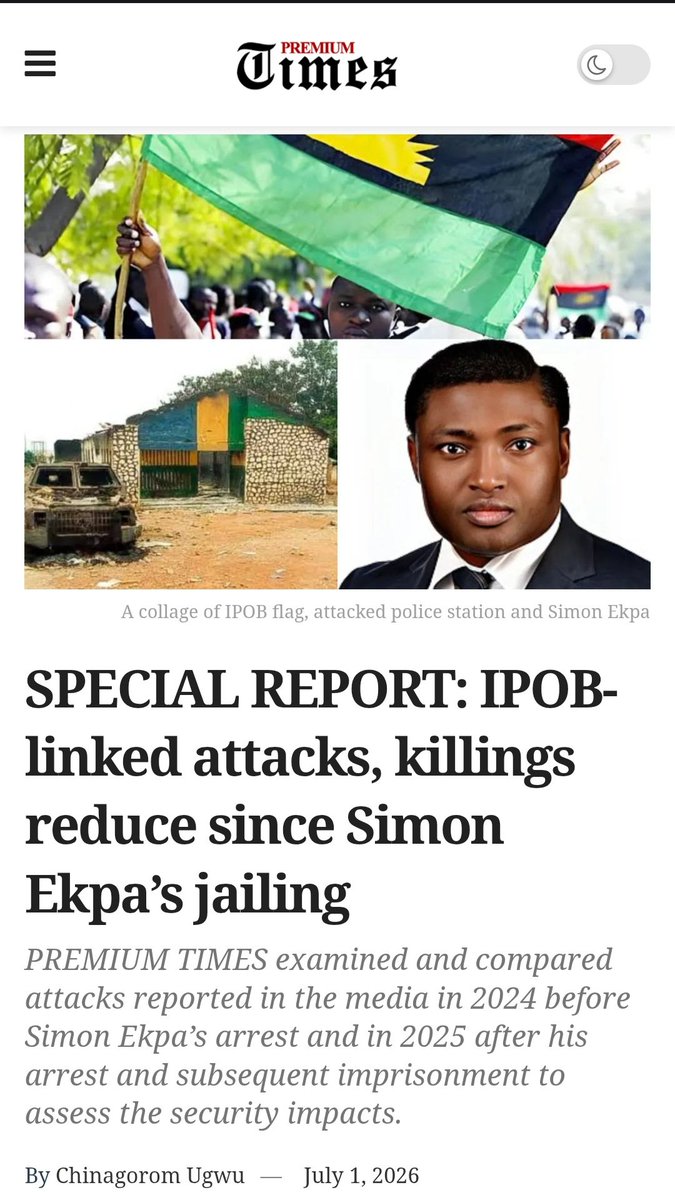
Premium Times one of the most significant admissions in this report is not merely the reduction in violence after Simon Ekpa's imprisonment.
It is the acknowledgement that "those loyal to Mazi Nnamdi Kanu" consistently disassociated both him and IPOB from Simon Ekpa's (Obere Midget)activities.
This acknowledgement matters because it recognises that there was a clear distinction between the organisation led by #NnamdiKanu through its Directorate of State (DOS) and the autonated madness that emerged around Simon Ekpa.
For years, We (the DOS and many supporters) maintained that Ekpa neither represented Nnamdi Kanu nor acted under the authority of IPOB.
Whether everyone accepted that position is a separate question and discussion for another day, but the historical fact is that this distinction was repeatedly asserted.
If that is now acknowledged, then it raises further questions.
1. Were those who defended that distinction unfairly criticised at the time including myself?
2. Are they being criticised and attacked still?
3. Did the failure of many observers to recognise the separation contribute to public confusion about responsibility for violent acts?
4. How should that historical record now be understood?
To be continue.....
https://t.co/ITAoGAROyC
It's Tweet Tuesday!
Do we still remember Tweet Tuesday?
The day #IPOB dedicated to drive #hashtags......
In recent weeks, months and years, I have watched with deep concern as division, misinformation, and personal attacks have overtaken the focus of our people.
I have stood consistently for unity, discipline, and truth - the same values my husband, Mazi #NnamdiKanu, built into the foundation of IPOB.
I will not participate in factional disputes, smear campaigns, or attempts to destroy the structure he established.
My commitment remains unchanged: To secure his release, protect our people, and uphold the integrity of the movement.
I call on all who truly love Biafra and who truly seek his freedom to return to order, structure, and discipline.
When he comes out, every grievance can be addressed.
Until then, let us not destroy what he built with sacrifice, suffering, and vision just as we all have sacrificed.
But remember, those who have paid the ultimate sacrifice are those who gave their lives.
Our focus must remain on his freedom not on chaos.
Udo!
#Ourfocus #FreeNnamdiKanu #FreeBiafrans #IPOB #OneFamily #Truthislife #Ọnụrụubenwanneagalaọsọ
Aha m bụ, Uchechigeme Anyanwụụtụtụ Okwu-Kanu.
30.06.2026.
From the excerpts of my Broadcast on the 20th of June, 2026 – SOLOMON MOMENT.
THE TWO WOMEN BEFORE SOLOMON - AND THE BATTLE FOR THE SOUL OF A MOVEMENT:
There is a reason the story of the two women who stood before King Solomon has survived thousands of years.
This story is not just a story about motherhood. It is a story about ‘discernment’, ‘motives’, and the ‘true heart of leadership’.
One woman wanted the living child divided - not because she wanted justice, but because she could not stand to see life continue where her own had failed.
The other woman said, “No. Let the child live, even if he is not with me.”
Because her heart was aligned with #preservation, not ego.
This is the same spiritual pattern I see today. There are people who want IPOB divided, scattered, confused, and bleeding, not because they love Biafra, but because chaos gives them relevance and hides their motives.
And on the other hand, there are those who say: ‘’No. Let the movement survive.
I have always stood on the survival of this movement – it is my husband’s legacy, and it is for our people’s liberation. So, I say “No. Let the movement live. Let the structure stand. Let the principles hold - even if it costs me personally. “That is where I stand. I am not here to divide the living child.
I am here to protect it until Mazi Nnamdi Kanu returns to take his rightful place. My Role is not to destroy or aid destruction but to preserve because I am an ardent believer in #preservation.
Every movement has a moment where the true mothers and fathers are revealed, not by title, or noise, but by the choices they make when the child is vulnerable.
Some people want chaos because chaos hides their intentions. Chaos gives them room to manipulate and allows them to rewrite history.
But I am called to something different. I am called to set principles, to establish order, to hold the centre and preserve the living child – IPOB until the one who birthed this struggle is released.
This is what conscious leadership should look like - stewardship.
Let me point at the familiar historical parallels that mirror this Movement. Throughout history, every liberation movement has faced a “Solomon moment” - a moment where the heart of the struggle is placed on the table, and different voices reveal what they truly want.
1. Moses and the Golden Calf: - When Moses went up the mountain, some people used the silence to create confusion. They built a golden calf, a counterfeit centre, because they could not stand the discipline of waiting.
But the true leader returned and restored order. This is what happens when impatience meets insecurity.
2. Nelson Mandela and the ANC: - During Mandela’s imprisonment, many factions rose. Some wanted to hijack the movement, and some wanted to weaponize the struggle for personal power.
But the ANC survived because there were people who said:
“We will hold the structure intact until Madiba returns. ”That is the spirit I carry.
3. Queen Esther and Haman: - Esther understood timing, strategy, and restraint. Haman thrived on chaos, manipulation, and destruction. While Esther preserved her people, Haman sought to destroy them for ego. Leadership is always a battle between these two energies.
4. Then come down to our Igbo ancestral wisdom: - “Nwata bulie nna ya elu, nna ya erie ya. ”A child who lifts his father too high may crush him.
Meaning:
When people elevate noisemakers, opportunists, or reckless actors, they end up destroying the very foundation they claim to protect. This is why principles matter. THE PRINCIPLES I STAND ON!
Continue in the comment section 👇......
Welcome to the Kakistocratic government and Republic of Nigeria.
@SenRemiTinubu message appears to come from a micro-enterprise philosophy where people should not wait endlessly for government jobs. The belief that small businesses can provide immediate income, grants can help citizens become self-employed, and every honest business deserves dignity.
In that sense, there is nothing wrong with frying akara, roasting corn, selling kuli-kuli, farming, trading, tailoring or starting from whatever one has. Across developing economies, small businesses feed families, create income and help people survive where formal jobs are scarce. This is a common approach in poverty-alleviation programmes across many developing countries.
But the anger is not really about akara or kuli-kuli or corn. Madam, the backlash is about context, expectation and national vision. Nigeria is blessed with crude oil, natural gas, limestone, iron ore, coal, gold, lithium, fertile agricultural land, a huge consumer market and a massive youthful workforce.
So when national leaders speak mainly about roadside survival businesses while unemployment, inflation and the cost of living remain severe, the painful question many citizens hear iis, is this the highest economic ambition for a nation with such enormous potential?
The deeper issue is where the nation’s wealth is being created. A serious economy does not merely export raw resources and import finished products.
It refines, processes and manufactures.
Crude oil should become petrol, diesel and petrochemicals at home. Agricultural produce should become finished food products and minerals should be refined before export and gas should power industries.
Each stage creates factories, engineers, technicians, logistics jobs, maintenance work, research, quality control, finance, taxes, export earnings and millions of dignified livelihoods.
Government’s responsibility is not only to tell citizens to hustle. It must build the conditions that make prosperity possible - reliable electricity, gas infrastructure, renewable energy, roads, rail, industrial parks, storage facilities, food-processing centres, stable policies, access to finance, education, healthcare, rule of law and strategic industries.
A healthy economy needs both vibrant small businesses and large industries employing thousands!
But when the national conversation focuses more on survival-level entrepreneurship than on industrialisation, manufacturing, technology, power generation and skilled employment, people begin to feel that the country’s future is being reduced to poverty management - which is what it is anyway.
A 'conscious' nation does not despise the woman frying akara, the farmer, the welder, the trader, the tailor or the young person starting small. Their labour deserves honour.
But conscious leadership must ask a deeper question - Are we preparing citizens merely to survive, or are we building a nation where they can flourish? A resource-rich country should not force its brightest minds to choose between unemployment and roadside survival. Its natural resources should fuel industries, its industries should create dignified employment, and its economy should make enterprise a path of opportunity, not a desperate escape from hardship.
Encouraging entrepreneurship is good. But building an economy where people can rise, refine, manufacture, innovate and prosper is better. The highest duty of leadership is not to teach citizens how to manage poverty, it is to create the conditions for widespread prosperity.
Uchechigeme Anyanwụụtụtụ Okwu-Kanu.
26.06.2026.
THE BATTLE FOR NARRATIVE CONTROL: How Fake Accounts, Internal Sabotage, and External Propaganda Are Undermining IPOB and the Struggle for Mazi #NnamdiKanu's Freedom. https://t.co/x8UVxgT4W9
IPOB Strongly Rejects Nigerian Military’s Claim of Busting ESN Armoury in Enugu
The Indigenous People of Biafra (IPOB) has dismissed as “false and misleading” the Nigerian Army’s claim that it discovered and dismantled an Eastern Security Network (ESN) armoury in Enugu State.
In a powerful statement released on 14th June 2026 by the IPOB Directorate of States, the group declared that no ESN armoury exists in the location mentioned, the paraded individuals are not IPOB/ESN members, and the weapons displayed do not belong to ESN.
IPOB described the operation as recycled propaganda meant to smear the image of the Eastern Security Network and justify continued military operations in Biafraland.
The statement reaffirmed that the ESN was created to protect Biafran communities from armed Fulani herders’ attacks and kidnappings due to the failure of Nigerian security agencies.
We must get to work Biafrans!
Join me on the 20th of June, 2026 - live on:
Facebook - Uchechigeme Anyanwụụtụtụ Okwu-Kanu
X - @OkwukKanu.
My topic - “The Battle for Narrative Control: How Fake Accounts, Internal Sabotage, and External Propaganda Are Undermining #IPOB and the Struggle for Mazi #NnamdiKanu’s Freedom", will enable me to:
1. Call out the real enemies - those spreading fake accounts, misinformation, and internal sabotage.
2. Re‑center the struggle on truth, unity, and discipline.
3. Educate supporters on how to identify and resist manipulation.
4. Reinforce the legitimacy of the movement and the need for coordinated action.
Reflection of the Week:
"There is a betrayal so profound that it lies beyond the reach of forgiveness."
Not only in the journey of our quest for self-determination, but also in other ares of life.
Reflection:
This quote came in my reflection yesterday while I was having blood drawn from my arms.
It speaks to the depth of certain wounds caused by broken trust. It acknowledges that some betrayals can feel so devastating that forgiveness seems unattainable. It was a meditation on the gravity of trust, the pain of its violation, and the profound impact such experiences can have on the human spirit.
Uchechigeme Anyanwụụtụtụ Okwu-Kanu.
10.06.2026.