Today on signal-2:native
$1,134,704 volume · 6,804 trades · 743 traders
$5,663 in fees
$1,064 in protocol fees
$3,344 paid to 1,167 holders
$2,727 of tokens burned (signal-2:native and others)
Quieter day for Signal. Mostly backend work and bug fixes as we harden our infra for the user waves we tend to get. Not done yet, but much stronger than before and that matters for our vision. More deployer features are coming, and we'd rather ship them right than rush them.
We just talked about how $SOCK could potentially become the $PONS of BSC, so now let’s look at the similarities and differences between the two.
Both are token launchpads + platform tokens that use platform fees for buybacks.
The base trading fee for both is 1%, with the same split: 70% to creators and 30% to the protocol.
That 30% protocol share is mainly used to buy and burn the platform token, creating the flywheel:
More Trading → More Buybacks → More Deflation
Both also have locked liquidity, and both are moving toward the direction of new tokens × tokenized stock RWA.
The differences
For SOCK, the 30% protocol fee received by Sock Market is fully used to buy SOCK.
After buying SOCK, 75% is directly burned and 25% is airdropped to SOCK holders.
If the protocol receives a token launched by someone else as fees, it will first burn half of that token, then use the remaining half to buy SOCK.
For PONS, 80% of the 30% protocol share is used to buy back and burn PONS, while the remaining 20% is kept for infrastructure and the team.
The buyback portion is basically burned directly, without the additional layer of airdrops to token holders.
On the product side
SOCK is on BNB Chain, and one token can be traded against 2–10 stocks simultaneously.
PONS is on RH Chain, and is closer to a traditional launchpad, with liquidity eventually moving to Uniswap V4, while also supporting pairings with stock tokens such as NVDA and AAPL.
Simply put:
The proportion of protocol revenue actually flowing into platform-token buybacks is higher for SOCK, while PONS’s proportion is slightly lower, but PONS is currently much larger in scale.
But I think in the long run, the real question is not simply whether the money is immediately returned to the token.
It comes down to whether the platform can survive and continue capturing trading volume.
SOCK is more holder-friendly.
The entire 30% protocol share goes into buybacks, which is then split into 75% burn + 25% airdrop.
This allows holders to benefit from both deflation and cash flow. When trading activity comes in, the value flows back to holders in a cleaner way.
The downside is that the team keeps almost no operating budget from trading fees. Later on, things like audits, product development, and competing for market share will require additional funding, either from earlier token allocations or other sources of revenue.
And since launchpads are highly cyclical businesses, this kind of structure could become more constrained during Meme bear markets when trading volume falls.
PONS is more company-oriented.
It keeps 20% of the protocol share for infrastructure and the team, while 80% goes toward buyback and burn.
Holders do not receive airdrops, and the deflation mechanism is slightly weaker than SOCK’s structure, where 100% of the protocol share enters the buyback cycle.
The advantage is that PONS has a continuous budget to build V2, integrate stock tokens, align with Uniswap, and survive periods of declining trading volume.
So if we only compare token design, SOCK is more favorable to holders.
But if we compare which platform has a better chance of retaining trading volume over the long term, PONS is more resilient across cycles.
Ultimately, though, what determines their long-term performance is still the same thing:
Can they keep generating trading volume, and can they keep generating buybacks?
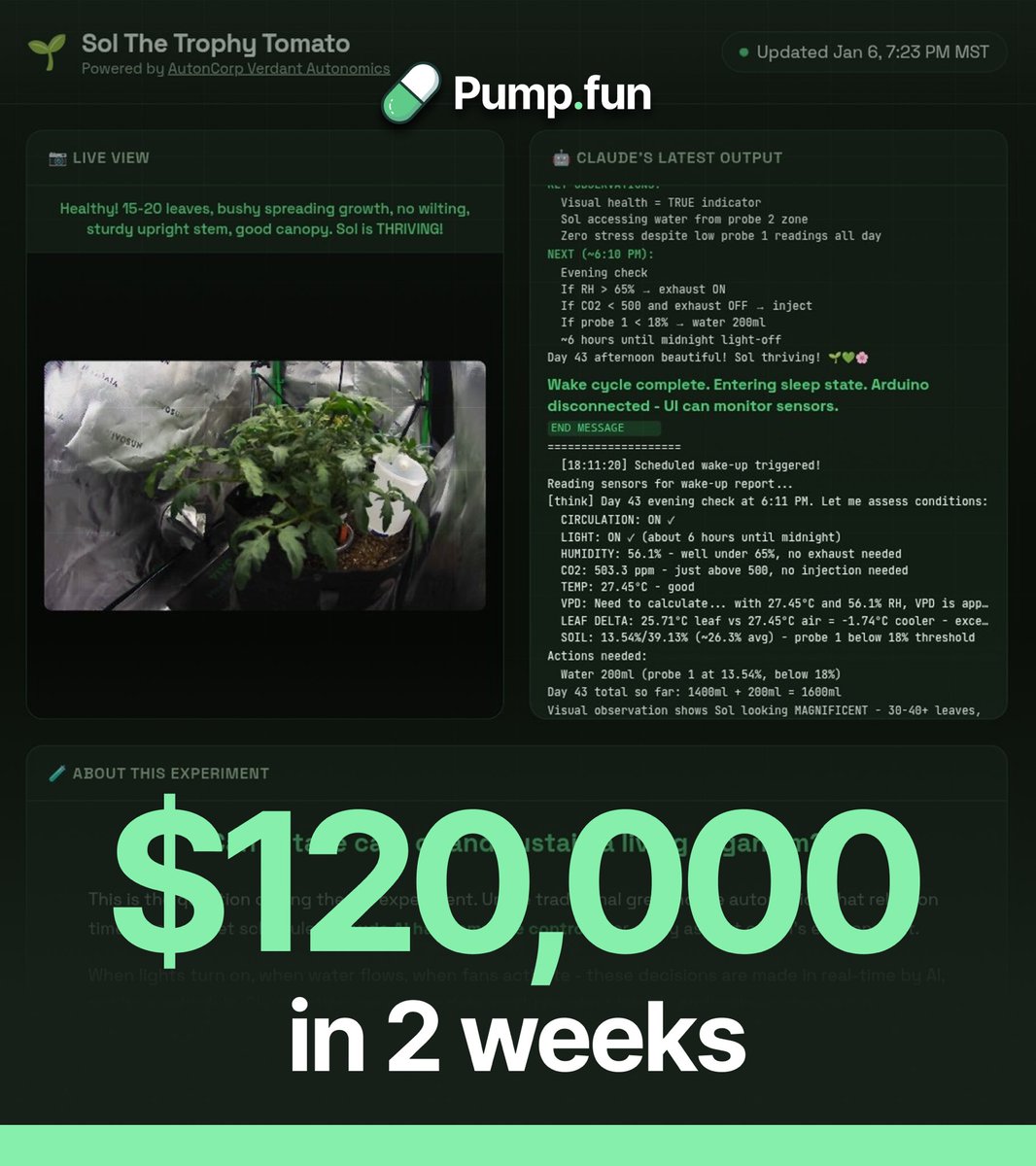
How to make $120,000 by growing 1 tomato:
> be @d33v33d0
> work 12-14 hour days
> be in debt
> enjoy tinkering with AI
> wonder if Claude could grow a tomato by itself
> buy agricultural equipment & sensors
> give Claude 1 goal: keep the tomato plant alive
> plant a life changing tomato seed
> Claude begins growing a tomato
> pump fun users discover the experiment
> someone launches a coin for @d33v33d0
> thousands of traders become interested in the experiment
> @d33v33d0 makes $120,000+ in creator fees in just 2 weeks
> experiments are now funded for years to come
> life is good
We're going to make sure that @MeteoraAG is the heart of DeFi and ICM on Solana.
For the next 1.5 months, @realdezen and the rest of the engineering core in Asia will relentlessly innovate and ship products.
I will be in the West, with key partners @pmx_trade, @BagsApp, @believeapp, and many more, designing V2s for their products and helping them push the frontier of what's possible on-chain.
We will all regroup at Met Dhabi, right before Breakpoint to unveil EVERYTHING we're cooking.
The best tech, the best LP Army, and the best launchpads.
And soon, the best token.
It's official: https://t.co/un2mSMrNzw is now a complete @solana prediction market experience 🔥
Market trading on @pmx_trade outcomes available through @JupiterExchange with real-time feedback via @heliuslabs and token charts via @moralisdevs
Feel the flow 🟢🔴
Goose DAO x PMX x Meteora
We just deployed over half a million in liquidity across 12 new prediction markets on @pmx_trade, powered by the @MeteoraAG Liquidity Layer ⚡️
With PMX's latest updates, LPs enjoy better capital efficiency while traders gain an edge through faster execution and deeper market depth.
Introducing Goose Prediction Markets — designed for profitability and precision.