@GNesca Love this, Giuseppe. Similar road here. Loss prevention, then security tech, now building with AI for the sector. Which work are you hand to an agent first, and which do you keep for yourself?
On my way to the office this morning, I passed a group of young people protesting, a Palestinian flag draped over their shoulders.
And I asked myself a question I can't shake: why does this generation always fall into the same trap? No matter the history. No matter the context. Even the ones from wealthy families, who went to the best schools, who were dealt every good card. Always the same trap.
I don't think it's stupidity. I think it's a mechanism. And a mechanism can be taken apart, piece by piece.
A. The observation: everything the state touches becomes unaffordable.
Look at economist Mark Perry's famous chart, the one people call "the chart of the century." It tracks US prices since 2000.
At the top, what explodes: hospital services, college tuition, textbooks, childcare, housing. Increases of +100%, +150%, up to +250%, far above general inflation.
At the bottom, what collapses: TVs, software, phones, toys, clothing. A TV today costs a fraction of what it did in 2000, for an infinitely better product.
Look at what separates the two groups. It isn't technology. It isn't complexity. It's one variable: how much the state is involved.
At the top, sectors that are subsidized, regulated, shielded from competition, where the state funds demand and blocks supply. At the bottom, sectors where companies fight every single morning to serve you better and cheaper.
B. The mechanism: why it's systematic.
When the state subsidizes demand without freeing supply, prices rise. Every time. Guaranteed student loans, and universities raise tuition. Housing aid plus blocked building permits, and rents skyrocket. Administered healthcare, and bureaucracy eats the budget before it ever reaches the patient.
In France it's even more vicious, because the price doesn't disappear: it hides. You never see the hospital bill, you pay it through payroll contributions. You never see the cost of school, you pay it through taxes. Public spending at 57% of GDP, one of the heaviest tax burdens in the world, more than €3.4 trillion in debt. And the result? Overflowing ERs, falling PISA scores, young people who can't afford to live in the city where they work.
The market didn't fail in these sectors. It was never allowed in.
C. Suffering demands a culprit.
A 22-year-old lives all of this in their bones. They can't find a place to live. Their degree either buries them in debt or opens no doors. The future feels blocked. That suffering is real, and I don't deny it for a second.
But human beings can't stand suffering without a culprit. They need a face. A scapegoat.
And this is where everything is decided: who taught them how to read the world?
D. Whoever tells the story picks the villain.
Schools are public. Universities are public. Culture runs on grants. Film goes through funding committees. Public broadcasting shapes the narratives. The people handing down the interpretive framework are, overwhelmingly, paid by the very system that creates the problem.
Do you really think that system is going to name itself as the culprit?
No. It names the capitalist. The boss. The landlord. "The rich." The multinational. The commercial West. Same role, same casting, every time.
E. One lens, a thousand causes.
And this brings me back to that flag. A generation taught to read every situation through a single lens, oppressor on one side, rich, Western, capitalist, oppressed on the other, will apply that lens everywhere. To housing. To climate. To conflicts on the other side of the world. The cause changes, the lens stays. That's why the trap is always the same: it's not the cause that draws them in, it's the way of thinking that was installed in them.
F. The perfect inversion.
Here's the irony. Capitalism is the force that drove down the price of almost everything it touched. The state is the force that blew up the price of almost everything it captured. And young people blame the first for the crimes of the second.
It's like blaming the firefighter for the fire because you saw him at the scene.
G. The ballot box confirms it.
In the US, a few weeks out from the midterms, a large share of urban young voters is getting ready to vote Democrat for more state, more spending, more regulation. New York elected a self-described socialist mayor, carried by young voters, on promises of rent freezes and city-run grocery stores. Rent freezes, the policy that has made housing scarcer everywhere it's been tried. The cure that worsens the disease.
In France, it's the same play in two acts. Part of the youth votes for the radical left, which promises more state. Another part votes for the center, which promises to "manage" the state well, and has dug the debt deeper than ever. Two different ballots, one shared assumption: the problem is the market, the solution is the state.
H. The way out.
These young people aren't stupid. They're right to be angry. They're just aiming at the wrong target.
The day they understand that their rent, their tuition and their hospital are expensive precisely because the state runs them, their anger will change direction. They'll stop protesting against those who create. They'll start protesting against those who capture.
That day, the greatest intellectual scam of our time will be over.
The excitement of using ai in 2026 can be so overwhelming but so exciting.
The feeling you can pretty much do want you want with computers.
What a time to be alive.
Also being inspired by @dhh and @omarchy
Using ChatGPT is not an AI strategy.
Tool access is not a business capability. A capability means a workflow has changed, someone owns the result, and there is evidence it works better.
Ask three questions. Who owns it? Which workflow changed? What evidence shows it is working?
This is absolutely what I'd be doing if I wasn't doing what I'm doing.
In fact, I've fantasy-flirted with 37signals getting back into client work because building new stuff and improving existing stuff has never been more fun! EVERYTHING can be better quickly, but it's still a secret, plenty have no idea, and even those who do need a lot of help and direction to see what needs to be improved.
I love to fix. I love to make stuff easier on people. I love to show people a better way. I love to blow away the fog. I love to untangle.
Yes, we could just make more products ourselves, but rapidly improving Basecamp and HEY keep us plenty occupied there. And I'm less interested in the selling, servicing, marketing, and maintaining of brand new products, and more interested in reorienting, fixing, and helping dozens of companies with their own tangle of stuff, and then setting them free.
What do they got?
A big team, lots of money, a strong brand, seemingly unlimited resources, panache, reputation, all that. They’re established.
They’re your competitors.
You want to look away, but you see them everywhere. Their ads on your social, their name in the media, your dream clients on their website.
But you know what else they got?
Bigger company bloat. Overflowing obligations. Narratives to uphold. Appearances to maintain. Entitlement. Too much overhead.
They’re slow. They’re conservative. They talk too much. They’ve stopped taking risks. They’re resting on their laurels, gliding on their reputation. They’re on defense.
What they’ve really got is a lot to lose.
What do you got?
Hunger. Drive. Grit. Scrappiness. Independence. You’re on offense.
You don’t have enough, which is why you’re dangerous. You have no choice but to be clever and creative. To make up for what you don’t have with something they can’t have: The underdog spirit.
You can move. You can adjust. You can adapt. You can get it done while they’re still stuck deciding what to do.
Small is not a stepping stone. Small is not less than. It’s greater than. It’s faster than. It’s better than.
Savor your position. You don’t get to be the underdog forever. The baton will be passed. But for now, it’s your magic wand. Use it.
We stand with the underdogs.
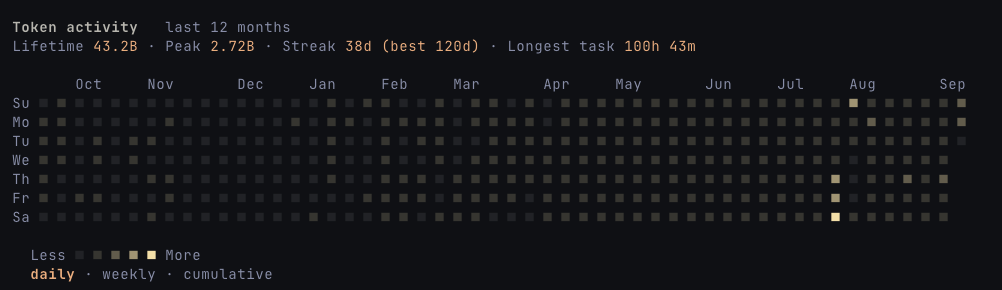
How many AI tokens is your business using?
One of my agent tasks ran for 100hrs
43billion tokens
and this is just codex (chatgpt) - not including my other agents of claude and opencode models.
thats a lot of AI lol
For anyone with endless ideas, this agent age is nirvana as those ideas are met with endless execution, endless exploration. I've never had has much fun working with computers as I do right now. What a time to be alive.
AI agents are not scary because they might give a bad answer.
They are scary because they might take a bad action.
That is the bit too many demos skip.
A chatbot saying something daft is annoying. An agent updating a CRM, emailing a customer, moving money, changing access, or sending data to the wrong place is a different animal.
Today's research had the Bank of England warning about agents acting at speed, Microsoft warning about tool poisoning, and security researchers showing models can trust writing style more than labels.
Lovely little cocktail.
So here is my unpopular view.
Most small firms should not start by making agents more powerful.
They should start by making them less powerful.
Read-only first.
Draft second.
Action last.
Give every agent three boring things before it touches real work.
A named owner.
A clear leash.
A log of what it did.
If it cannot show who approved the action, what data it used, and where the result went, it should not be acting yet.
This is not being anti-AI.
It is how you make AI boring enough to trust.
And boring enough to trust is where the money usually starts.
Voice AI will make bad AI rollouts feel nicer.
That is the uncomfortable bit.
When AI moves from a prompt box to a natural conversation, more people will use it. Less friction. Less typing. Less feeling like you are operating software.
Good.
But the interface getting easier does not make the judgement better.
If the business does not know what data can go in, who checks the answer, what gets logged, and when a human must confirm the action, voice just makes the weak process faster.
A bad workflow spoken out loud is still a bad workflow.
That is why I am far more interested in the boring layer around the shiny launch.
What tool was used?
Why that one?
What data did it touch?
Who owns the result?
What proof says it helped?
What is the rollback rule?
Most businesses do not need another excited post about AI moving fast.
They need a change log.
The future is not just easier AI.
It is accountable AI.
Less magic wand.
More receipt printer.
Tragic for the demo crowd. Useful for everyone else.
I do not think most small businesses need an AI agent.
Not yet.
They need a leak fixed.
The market is getting very excited about agents being the new SaaS. Lovely. That will sell a lot of demos and a lot of fear.
But the useful question is still boring.
Which task happens every week, wastes senior time, has clean inputs, and has a clear output?
If you cannot answer that, an agent just gives your mess a nicer interface.
The research keeps saying the same thing. Average AI gains are modest. The bigger gains come when a business automates one repeated workflow end to end, measures it, then moves to the next one.
That is not magic. It is operations.
So no, I would not start with an agent.
I would start with one leak, one owner, one metric, one human approval point, and a 30 day kill date.
Less exciting. More likely to work.
Most AI advice is backwards.
It starts with tools.
Buy this agent. Try this model. Add this bot. Automate the inbox. Connect the CRM. Wave hands. Invoice follows.
Nice work if you can get it.
The better question is duller.
Which bit of work is costing money every week?
Lead response. Quote follow-up. Invoice chasing. Support triage. Meeting notes. Stock checks. Cash reporting.
Pick one.
Name the owner. Write the current steps in plain English. Mark where work waits, gets copied, needs judgement, or leaks money.
Then, and only then, ask where AI belongs.
The UK research this week says most businesses still are not using AI properly. That is not a reason to panic. It is an opening.
The edge will not go to the firm with the most subscriptions.
It will go to the firm that fixes one painful workflow, measures the result, and keeps humans in charge where it matters.
Boring? Yes.
Profitable? Also yes.
If your AI plan starts with a tool list, it is probably not a plan yet.
AI is not a marketing strategy.
It is a spending engine with a smiley face.
Shopify, Meta, Google and TikTok all want to make campaigns easier. More automatic budgets. More automatic creative. More automatic testing. More automatic everything.
Fine.
But faster spend is still spend.
If your offer is fuzzy, your tracking is weak, and nobody owns approval, AI will not fix your marketing.
It will help you waste money with better grammar.
The consultants will talk about scale.
The grown-up question is control.
Who owns the workflow?
What is it allowed to spend?
What data can it touch?
What needs approval?
Where is the stop button?
That is not anti-AI.
That is how you use it without waking up to a very clever mess.
Speed is useful.
Controlled speed is the actual edge.
Before you build an AI agent, give it an induction.
Most businesses skip this.
They go straight to the tool.
Then the tool guesses the offer, guesses the process, guesses the tone, guesses the next step, and everyone acts surprised when the output feels a bit off.
Start smaller.
Create four plain text files.
Company facts.
What you do, who you help, what you never claim, and how you describe the business.
Offer list.
What you sell, rough price bands, what is included, what needs a human decision.
Process list.
The simple steps for one workflow, from trigger to outcome.
Human approval rules.
What AI can draft, what it can sort, and what it must never send, change, delete, promise or approve.
Then test one workflow.
A new lead arrives.
AI reads it.
AI scores it.
AI drafts the first reply.
A person checks it.
Only then does anything go out.
That is not slow.
That is sane.
Do not start with autonomy.
Start by giving the AI something true to work from.
Before you connect an AI agent to a real business system, write its management card.
One page. Plain English. No theatre.
Start with the job.
Not “help with sales”. That is vague soup.
Use verbs.
Read new enquiries.
Classify lead type.
Draft a reply.
Update CRM notes.
Create a follow-up task.
Then set the boundaries.
What can it read?
What can it change?
What must it never touch?
Can it see client folders?
Can it use customer data for training?
Can it send anything without approval?
Now add the human control point.
Approve before send.
Review before publish.
Check before quote.
Escalate before risk.
Log after action.
Last bit: write the kill rule.
If confidence is low, stop.
If pricing is involved, stop.
If a customer is angry, stop.
If data is missing, stop.
This is not slowing AI down.
It is stopping it speeding into a wall.
If your business uses more than one AI tool, build an AI Tool Change Control Register.
Do not overcomplicate it.
One page is enough to start.
Tool or model used.
Workflow it supports.
Owner.
Data touched.
Reason for choosing it.
Monthly cost band.
Human review point.
Proof metric.
Review date.
Rollback rule.
That is it.
The point is not paperwork. It is control.
If someone swaps a model, adds a meeting bot, turns on a CRM AI feature, tests a local tool, or starts using voice AI with customer notes, the business should know.
Not because every change needs a committee.
Because invisible changes become invisible risk.
The register gives you three useful conversations.
Are we using the right tool for the job?
Is the data safe enough for that tool?
Did anything actually improve?
Start with the tools you already pay for.
Then ask the brutal question.
If this disappeared tomorrow, what would break?
If nobody can answer, you have clutter wearing an AI badge.
Most AI consultants are still selling tool lists.
That is lazy.
Nobody needs another tour of ChatGPT, Claude, Gemini, Zapier, and whatever shiny agent demo is doing the rounds this week.
A business needs one boring workflow fixed.
Lead comes in. It gets scored. The right follow-up goes out. The task lands with the right person. The owner can see what happened.
That is not sexy.
Good.
Sexy demos fall apart when the customer asks where the data went, who approved the action, and how you undo it.
The work is not picking the cleverest model.
The work is designing the rails around it.
Human-led. AI-powered. Audit trail included.
Less magic. More margin.
The first question before automating work is not “How?”
It is “Should this work exist at all?”
AI consultants rarely say that because dead work is hard to invoice against.
But automating a low-value task does not make it useful. It just makes the waste faster, cheaper and harder to notice.
Before I approve an automation, I want one verdict.
Essential now.
Useful later.
Stop.
Only the first one gets built.
Then I want to know what the saved time is for. Faster replies? Better service? More sales calls? Less admin after hours?
If the answer is vague, the business case is vague.
AI can remove a lot of friction. Good.
It can also help a business become very efficient at doing things nobody needs.
Less theatre. Fewer clever demos.
Decide what matters first.
Then automate the boring middle.