I stood on stage at Claude for Lawyers Live and put up a slide that said:
"Claude will become your law firm's command center."
At the time, it was a vision. Something I believed but couldn't fully show yet.
For the past 4 weeks, I've been living it.
Since doing Claude for Lawyers Live in Miami in mid-June, I haven't taught a single class.
I completely got off social media. Deleted Facebook and Instagram off my phone. I went completely dark so I could focus on building ONE thing.
And since then, 98% of my time has gone into it: building a Command Center with Claude Code to run my law firms.
Not a dashboard. An actual command center with AI agents that manage and run my law firms.
Let me say this before I explain anything else…
This is the most pivotal, most life-changing thing I've ever worked on. In my entire career. Nothing else comes close.
Here's what it actually means…
Every morning I open my Command Center and my briefings are waiting for me.
My AI agents report what they've done overnight.
In my Command Center I have complete visibility on ALL of my law firm KPIs: total ad spend MTD, leads MTD, average qualified leads/day, sign-ups MTD, lead conversion rate, CPA, survival rate (very important), drops, and number of cases stuck.
The tabs on my command center are:
Home, Todoist, Team, Agents, Apps, Intakers, Docs, Calls, Survival Rate, Focus, Portfolio, Meetings, SEO, and Insights.
Each one is its own world, and each one requires its own explanation.
Then I make decisions. That's my job now… decisions, not busywork.
When something breaks a threshold, a KPI moves the wrong way, a data source goes stale, a campaign starts burning money, it doesn't wait for me to notice. It finds me.
My team doesn't wait on me either. They message my Claude directly. It reads their replies, drafts responses in my voice, tracks every open ask, and follows up with anyone who doesn't complete their task within 48 hours.
Nobody falls through the cracks anymore. And I'm no longer the bottleneck.
And here's my favorite part…
I built AI agents that do ACTUAL work.
A document collection agent that texts and emails clients for the documents their case needs. Bilingual. Respects quiet hours. Knows when to escalate to a human. Document collection is where law firms lose the most cases (at least that's the case for me). Now an AI agent chases our clients for these documents.
A delivery pipeline that takes every document a client uploads, finds the right case in our CRM automatically, attaches the files, and sends the case team ONE email with a single "Download All" button. No more downloading 50 photos one at a time. My documents supervisor answered six questions about how his team works. The system was live the same day.
An agent that reads my ad accounts every single day, across 9 accounts, and tells me my true cost per SIGNED CLIENT. Not cost per lead. Cost per lead is the number that lies to you. It even understands that leads take 30-60 days to mature, so it never judges a campaign on numbers that haven't finished baking. My media buyer taught it that rule once. It's now enforced in code forever.
An email inbox that belongs to my AI. My team emails it directly. It processes everything that comes in and brings me only what needs a decision.
That last line is the pattern that changed everything:
Every correction becomes a permanent rule. Every recurring process becomes an agent.
The system compounds. It's smarter this week than it was last week. It will be smarter next week than it is today.
In 4 weeks, I've built and launched over 60 AI systems. Sixty. Things that used to be "someday" projects done before lunch.
One more detail I love…
My Command Center enforces my Shabbat. During my no-contact window, it physically blocks messages from going out. My faith isn't working around my technology. My technology is built around my faith.
I wake up early to work on this. I stay up late working on it (I was up until 11:00 PM last night working on this). I haven't been this excited about anything in my career.
This is what working smarter actually looks like. Not more hours. Not more hustle. The most leveraged work of my life, and I've never been more driven.
The vision from that Miami stage, running 10 law firms from one central place, with AI as the operating layer, isn't a vision anymore.
Now, I'll be honest with you.
I'm torn about how to share this.
The focus I've had over the last 4 weeks is exactly what got me here. Total immersion. Zero distractions. I don't want to lose that. So for now, I'm going to keep my head down and continue refining and improving this Command Center.
But at the right time, I do want to share it. Because it's way too valuable to keep to myself. I know it will be life-changing for the lawyers who build their own, the same way it's been life-changing for me.
I'm not sure yet what that looks like or when.
But if you want to be first in line when I figure it out, comment "Command Center" below and I'll keep you in the loop.
See comments below for some screenshots of my Command Center.
P.S. It really pays to take breaks from social media. 4 weeks of silence built what years of "staying connected" never could.
If I had to start over tomorrow with nothing but a laptop and Claude, here's the 5-person AI law firm I'd build that works 24/7
No office. No staff. No overhead.
Just me, a laptop, and 5 AI "employees" that never sleep, never quit, and never call in sick.
Here's exactly how I'd build each one.
1. THE INTAKE SPECIALIST
This is the first hire, because intake is where most firms bleed money.
I'd upload my entire intake process. Every qualification question, every case criteria, every red flag, every reason I accept or reject a case.
Then I'd tell Claude:
"Build me a scoring system. When a lead comes in, qualify them against my criteria, score the case, and tell me whether to sign, decline, or refer it out. Explain your reasoning every time."
Then I'd connect it to my lead forms so it runs the moment a lead hits, 24/7, before a human ever touches it. Speed-to-lead goes from hours to seconds.
2. THE PARALEGAL
The second hire drafts documents.
I'd feed Claude my templates, demand letters, retainers, client emails, motions, along with my firm's voice and my specific citations.
Then:
"Draft this demand letter using my template, my damages calculation, and my tone. No generic legal language. No hallucinated citations. Just my work product, faster."
What used to take an associate 4 hours now takes a 10-minute review. The paralegal never gets tired and never misses a deadline.
3. THE MARKETER
The third hire brings in clients.
I run Meta ads for my firms, so I'd put Claude to work on the entire campaign:
"Write me 10 ad variations for this practice area. Give me the hooks, the primary text, the creative concepts. Then tell me which audience to target and why."
Then analyze which ones perform best, and iterate until they hit the right emotional triggers and generate qualified clients.
4. THE OPERATIONS MANAGER
The fourth hire keeps the firm running.
I'd have Claude build my SOPs, map my workflows, and identify exactly where my firm is leaking time and money.
"Analyze my operation. Show me the highest-leverage tasks I should focus on and the low-leverage work I should automate or eliminate. Then build the systems to handle the low-leverage work."
This is the hire that tells you what actually matters instead of letting you stay busy on things that don't.
5. THE STRATEGIST
The fifth hire thinks alongside me.
This is the one most lawyers skip, and it's the most important.
"What specific actions will change which numbers, by how much, in what timeframe? What are my real competitive advantages? What are the risks I'm not seeing? Run every idea through a 'what would it actually take' analysis and don't tell me what I want to hear."
A strategist that never flatters you and never gets tired of your questions.
That's the 5-person firm. Built on a laptop. Running 24/7.
But here's the part most lawyers get wrong.
These AI employees amplify execution speed. They do not replace thinking quality.
I meet so many firm owners obsessing over which AI tool to use before they've figured out what they're actually trying to build. They automate broken processes. They draft documents for workflows that don't make sense. They build systems on top of a foundation that was never solid in the first place.
The tools aren't the bottleneck.
Your understanding is.
Claude without direction is worthless.
Claude with mediocre direction gets mediocre results.
Claude with elite direction builds an autonomous law firm that runs while you sleep.
That's exactly what I teach at Claude for Lawyers Live.
I'm hosting my final Claude for Lawyers Live events in Miami.
Two sessions. The first one already sold out completely. The second one on Wednesday, June 17th has only a couple of seats left.
After this, no more Claude for Lawyers events. This is the last chance to build this with me in the room.
Here's what I keep telling lawyers, and it's the truest thing I know:
Early adopters win.
I've watched it with Google Ads. Facebook Ads. LSAs. Funnels. Every single time, the people who moved early built advantages the late movers could never catch. And every single time, the late movers said the same thing… "I wish I'd started sooner."
AI is the biggest one of all. And the window to be early is closing right now.
Time is of the essence. A couple of seats left for June 17th. When they're gone, they're gone.
If you want in, comment "Miami" below and my assistant Stephanie will send you the registration link before the last seats disappear.
The direction is everything. And being early is the whole game.
The busiest-looking people are usually the least productive.
I know that sounds backwards. But after years of building teams, scaling law firms, and watching hundreds of law firm owners operate up close, I'm convinced it's true.
The person who looks the busiest is often the one doing the most context switching. The most meetings. The most messages. The most visible activity.
And the research backs this up. Every study on focus and productivity finds the same thing. Constant interruptions and task switching destroy the quality and efficiency of your work. Every time you bounce from a meeting to a Slack message to an email to a phone call, you pay a tax. And most people are paying that tax all day long without realizing it.
Meanwhile, the highest performers look strangely unbusy from the outside.
Long stretches of focused work. Fewer meetings. Fewer messages. Fewer visible signs of effort.
From the outside, it almost looks like they're not doing much. But they're the ones actually moving the needle, because they've protected the one thing that actually produces results…
deep, uninterrupted focus on the things that matter most.
I've been thinking about this a lot lately. Because we're heading into a moment where it's about to get harder, not easier.
AI is going to create more possibilities, more tools, more things you could be doing. And with all of that comes a trap. The trap of constant busyness. Constant doing. Constant tasks. Constant meetings. Constant everything.
And here's what makes it dangerous…
busyness feels good. It feels productive. It feels like progress. You end the day exhausted and you tell yourself "I worked so hard today." But feeling busy and being effective are two completely different things.
In reality, constant busyness is one of the worst forms of time management there is. It's reactive. It's scattered. It keeps you in the weeds when your job is to be above them.
The move is to do the opposite of what feels natural.
Fewer meetings. Fewer messages. Fewer open loops. More focus on the few things that actually create leverage.
Work smarter. Not harder.
I know it's a cliché. But almost nobody actually lives it.
Here's where AI changes the game if you use it right.
AI isn't just a tool to help you do more tasks faster. Used correctly, it's a tool to help you figure out which tasks even matter. You can use AI to analyze your business, identify your highest-leverage activities, and strip away everything that's just noise dressed up as work.
And then you take it a step further. You use AI to build the actual systems and applications that handle the low-leverage work for you, so your time and attention stay locked on the things only you can do.
That's the real unlock.
Not "AI helps me get through my to-do list faster." But "AI helps me figure out what should even be on the list, then handles the rest."
This shift has changed how I think about my teams too.
I'll be honest. There was a time I used to boast about it. Hundreds of virtual assistants. Over 80 employees. I wore those numbers like a badge of honor. Bigger team, bigger ego, more proof that I'd built something real.
I see it completely differently now.
A leaner team beats a bigger team almost every time. More people means more management, more communication overhead, more meetings, more messages, more friction, more things that can break. Every person you add is another line you have to keep connected.
What I want now is the smartest, leanest team possible. A small group of exceptional people, each operating at a high level, supported by AI systems that do the work that used to require an army.
That's not a downgrade. That's an upgrade. It's the difference between commanding a battleship and commanding a fleet of speedboats that don't actually go anywhere.
The lesson took me years to learn, and it goes against every instinct that got rewarded early in my career.
Less activity, more impact.
Fewer people, better people. Fewer tasks, higher leverage. Less doing, more thinking.
The world is about to get noisier and more chaotic. Everyone's going to feel pressure to do more, add more, chase more.
The winners are going to do the opposite.
They're going to get quieter, leaner, and more focused while everyone else drowns in their own busyness.
The goal was never to look busy.
The goal is to be the calm, focused person who quietly outperforms the entire room.
Do you feel me on this?
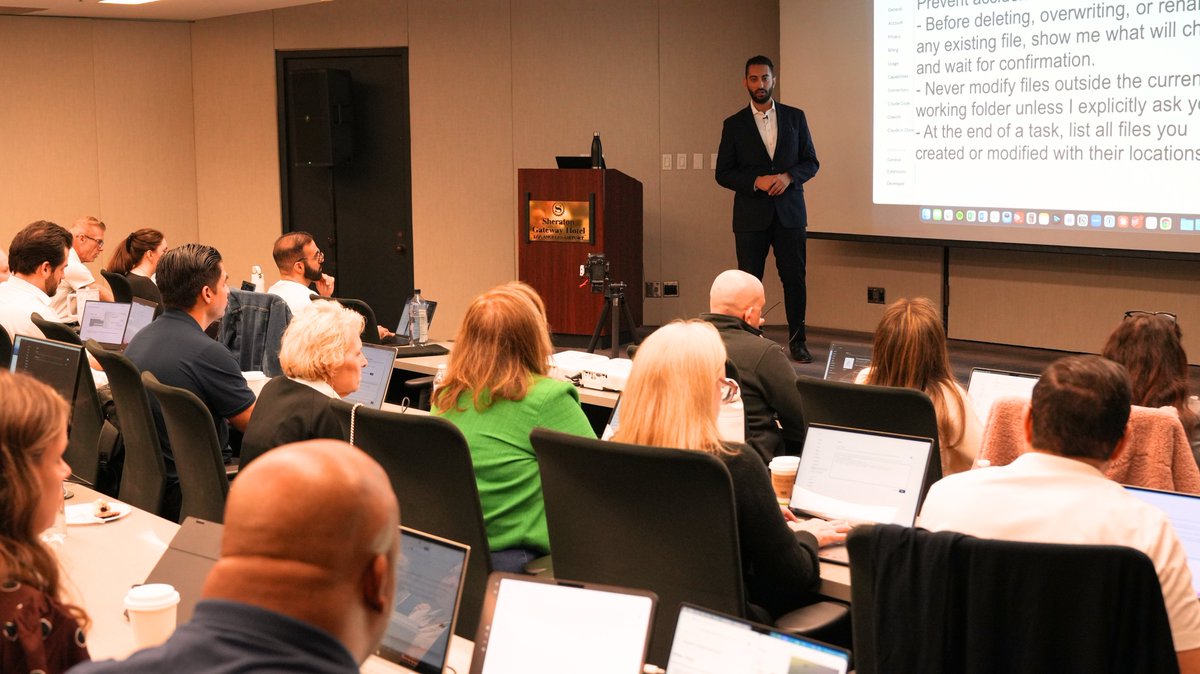
I've now taught over 200 lawyers in person over the last two months through Claude for Lawyers Live.
Los Angeles. Chicago. And upcoming in Miami on June 16 and 17. Multiple sold-out rooms. Hundreds of conversations.
And it's given me a view of the legal industry that almost nobody else has right now.
Here's what surprised me most…
The first thing I realized is that I've been living in a bubble. And if you're reading this, you probably are too.
The people who show up to these events are early adopters. They're investing in themselves. They're actively learning AI. They're in the top few percent of the entire market and most of them don't even realize it.
Because when you're in the bubble, everyone around you seems to be doing the same thing. You assume the rest of the market is keeping pace.
It's not.
Out there, beyond the bubble, most lawyers aren't using AI at all. The ones who are? They're having a casual conversation with ChatGPT once in a while and calling it "using AI." They're nowhere close to building real systems.
The disparity I see in these rooms is staggering. I get complete beginners who've never touched Claude sitting next to advanced users running sophisticated workflows. And the gap between the two ends of that spectrum is widening every single week.
If you're someone who's actively learning this, you're further ahead than you think. You just can't see it because you're surrounded by other people doing the same thing.
The second thing hit me even harder.
Being early matters more than almost anything else.
This technology is moving faster than anything I've ever seen. Not month to month. Week to week. Day to day. New capabilities, new tools, new updates constantly. It's nearly impossible to stay on top of unless you have a genuine sense of urgency driving you.
And most people simply don't have that urgency. They think they have time. They think they'll "get to it." They think AI will wait for them.
It won't.
I saw this exact pattern during my years running My Legal Academy. I worked with over 1,400 law firms. And the single biggest predictor of success wasn't intelligence, or budget, or market, or practice area.
It was urgency.
The firm owners who moved fast won. The slow implementers fell behind. Every single time. Same information, same opportunity, wildly different outcomes and the only variable was how fast they acted on what they learned.
It's playing out again right now with AI. The lawyers with urgency are compounding their advantage daily. The ones without it are telling themselves a comfortable story about how they'll catch up later.
There is no later. There's only now.
A few more things I've learned in these rooms.
A lot of lawyers want to skip the learning and just hire someone to "implement AI" for them. I understand the instinct. But right now, that's a mistake. You have to understand the nuances yourself before you can hire for it. You cannot manage, evaluate, or hold someone accountable for something you don't understand. Eventually there will be companies that build AI agents for firms, I'm building them for my own firms right now, acting as the guinea pig, but that's later.
Right now, you build the understanding yourself.
I've also been reminded that the highest level of learning happens in person.
I've had a personal trainer for 4 years now. At this point I know exactly what to do in the gym. So why do I still pay him?
Accountability.
He makes me show up and do the work. That's the entire value.
It's the same with these events. You cannot learn this on your own, at home, distracted, half-focused, switching between tabs. You need dedicated time, full attention, and a room that holds you to it. That's what makes the in-person format work when nothing else does.
And the last thing, maybe the most practical.
You don't need to do everything with AI. You need to do what gives you the most leverage.
I see lawyers try to use Claude for everything and end up scattered. The winners find their 80/20. For me, running 10 firms, the highest-leverage uses are clear:
1. marketing and client acquisition. Claude runs my Meta ads. Campaign creation, ad copy, creatives, all of it.
2. intake automation. AI agents that sign up clients and collect documents. This is the single biggest pain point for almost every firm, and it's the highest-ROI thing you can automate.
3. document drafting. Using AI to draft demand letters, motions, and documents with your own templates and your own voice.
Intake automation is pain point number one. Document drafting is number two. Get those two right and everything else is upside.
But here's the part I didn't expect, and it's become my favorite thing to watch.
The light bulb.
When lawyers walk in at the start of the day, they're curious. Interested, but skeptical. By midday, the "aha" moments start. Little sparks. "Oh, I didn't know it could do that."
And then in the last third of the day, that's when it really happens. That's when the light bulb fully goes off. When they're using the Law Firm Brain they built, watching it answer with their team's names and their workflows and their voice, and you can physically see the realization land on their face.
That moment is everything. That's when they stop seeing AI as a tool and start seeing it as the future of how they'll run their firm.
The questions have been getting smarter too. Two months ago, the questions were basic. Now the questions coming at me are sharper, deeper, more sophisticated because the whole field is leveling up in real time. Watching that evolution has been one of the most rewarding parts of this entire journey.
Which brings me to this.
I'm hosting my final Claude for Lawyers Live event.
Miami on Wednesday, June 17th.
After two months, hundreds of lawyers, and multiple sold-out rooms across the country, this is the last one. Half the seats for this final event are already gone.
Same format. Same intensity. You walk out with a working Claude Skill built for your firm and the foundation to build everything else on top of it.
If you want to be in the last room, comment "Miami" below and my assistant Stephanie will send you the registration link.
Two months taught me more about where this industry is heading than the two years before it.
The early movers are pulling away. The window is still open. But not for much longer.
Don't be the lawyer who looks back wishing they'd moved when they had the chance.
Miami is one of my favorite cities in the world.
This is an old photo of me and my wife there and looking at it reminded me why this city has my heart.
It's open-ended. Full of possibility. There's a life and an energy there that you feel the moment you land and it doesn't shut off when the sun goes down. It's there during the day. It's there at night. It's everywhere.
But here's the real reason I love going.
Something happens to my mind when I travel.
I think differently. I think bigger. I think outside the box in a way I rarely can when I'm buried in the day-to-day back home.
Some of my best ideas for running my law firms have come from trips to Miami. Not at my desk. Not in a meeting. But sitting somewhere like this, with the water in front of me, my wife next to me, and my mind finally free enough to think on a higher level.
That mental freedom is priceless.
When you step out of your routine, you step out of your usual patterns of thinking. You see your business from 30,000 feet instead of from the trenches. You spot the opportunities you've been too busy to notice. You connect dots that were always there but you couldn't see because your head was down.
That's what travel does. That's what stepping away does. And it's one of the most underrated tools any business owner has.
Here's what I keep coming back to lately.
I know a lot of people are scared of AI. Scared it'll take their job. Scared it'll replace them. Scared of what it means for the future.
I see it completely differently.
AI is the single greatest opportunity most professionals will ever have in their lifetime.
It's not the thing that takes your freedom. It's the thing that gives it to you.
More freedom with your time. More efficiency in your work. More room to think, to create, to be present with the people you love. And yes, more money, for the people who learn to use it well.
This is not a threat. This is a gift. And the people who recognize that right now, while it's still early, are the ones who will look back on this moment as the turning point in their careers.
Don't take it for granted. Don't sit on the sidelines in fear. Capitalize on it.
That's the whole message.
Which brings me to some good news.
The first Claude for Lawyers Live session in Miami is officially sold out.
So I've opened up another one.
Claude for Lawyers Live — Miami. Wednesday, June 17th.
As always, seats sell out fast.
If you want in, comment "Miami" below and my assistant Stephanie will send you the registration link.
And on a personal note, speaking of Miami, I can't wait to bring this energy back to a city that always gets my mind working in the best way.
What an awesome time to be alive.
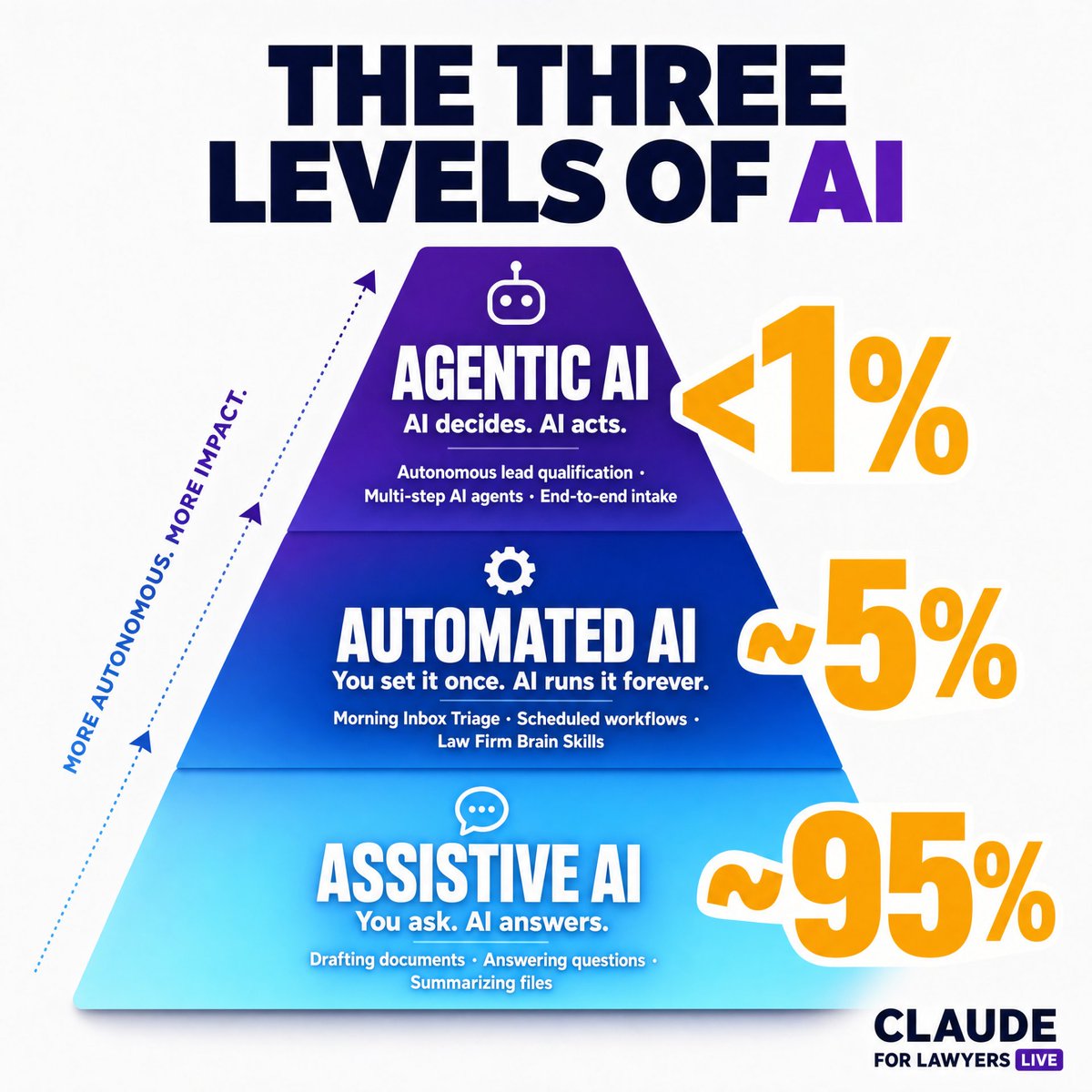
I created a pyramid that maps exactly where the legal industry is on AI right now.
3 levels. Each one unlocks the next. And the gap between them is going to define who wins this decade.
Let me break it down.
Level 1: Assistive AI: "You ask. AI answers."
This is where 95% of lawyers using AI are right now.
You open ChatGPT, Gemini or Claude. You ask it a question. It gives you an answer. You ask another one. It gives you another answer. You use it to draft documents, summarize files, research issues, brainstorm strategy.
That's it.
It's helpful. It saves you time. But fundamentally, you're still doing all the work. The AI is just a smarter version of Google. You ask. It answers. Then you take that answer and figure out what to do with it.
This is where most of the legal industry lives right now. And to be clear, Level 1 is not a bad thing. It's the foundation. Every lawyer needs to start here.
But here's the problem.
Most lawyers think Level 1 IS AI. They've never seen anything else. They don't even know there's a Level 2, let alone a Level 3.
So they plateau. They get comfortable using ChatGPT as a fancy search engine. They tell themselves they're "using AI" because they ask ChatGPT for help with emails. And meanwhile, the lawyers a level above them are running circles around their firm.
Level 2: Automated AI: "You set it once. AI runs it."
This is where about 5% of lawyers using AI have made it and where the attendees of Claude for Lawyers Live hang out.
At this level, you're not asking AI questions anymore. You're building systems that run on their own.
Morning inbox triage that happens before you wake up.
Scheduled workflows that execute every day without you touching them.
Claude Skills that contain your entire firm's brain, your SOPs, intake scripts, case criteria, fee structures, decision trees, that your team queries every day.
This is where the real ROI starts compounding. Where you stop trading time for output and start trading systems for output. Where your firm starts producing without your direct involvement in every task.
Level 2 is where most of my firms are right now. And honestly, it took years of foundation-building to get here. You can't jump straight to Level 2 without understanding Level 1 first.
But once you're at Level 2, the leverage is undeniable. Every workflow that used to require a human is now running 24/7 without you. Every task that used to drain your team is being handled by Claude before they even arrive at the office.
This is the level that makes lawyers leaner. More profitable. Less dependent on headcount.
But it's still not the top.
Level 3: Agentic AI: "AI decides. AI acts."
This is where less than 1% of lawyers have made it.
At this level, AI doesn't wait for instructions. It makes decisions and takes action.
Autonomous lead qualification: AI sees a new lead, qualifies the lead, evaluates it against your criteria, scores it, engages with the potential client, and signs them up (I current have AI agents that do exactly this and it’s really mindblowing).
Multi-step AI agents that complete entire workflows from start to finish. Sign a client. Collect documents. Draft demands. Follow up. Negotiate. Settle. All autonomously. (I’m not there yet with this but I’m currently working towards it and we will be there within 3 months).
This is the autonomous law firm. The vision I've been talking about for the last year. And it's not 10 years away.
It's 1-2 years away. Maybe less.
The lawyers who reach Level 3 will run firms that don't look anything like what we have today. Smaller teams. Higher margins. Better client experiences. AI agents doing the work that used to require entire departments.
Here's why the pyramid matters.
You cannot skip levels.
You cannot start at Level 3. You cannot start at Level 2. You have to start at Level 1, master it, then progress.
The lawyers who try to jump straight to "agentic AI" without building the foundation will fail. Every single time.
They'll hire vendors who promise to "set up AI agents" for their firm. They'll spend $50K-$200K. They'll end up with a half-working system they don't understand. They'll conclude that "AI isn't ready" and quit.
Meanwhile, the lawyers who actually built Level 1 properly, then progressed to Level 2, then layered in Level 3 - those firms will be untouchable.
This is why I keep telling lawyers: YOU HAVE TO BUILD THE FOUNDATION YOURSELF.
You can't outsource Level 1. You can't outsource Level 2. You can't outsource Level 3.
You can eventually delegate the maintenance and expansion of these systems to people on your team. But the foundation has to be built by you. With your hands. On your laptop. So you understand exactly how it works and exactly what it's worth.
Every lawyer who's reached Level 2 in my world built it themselves first. Every lawyer who's experimenting with Level 3 understands Level 1 and Level 2 cold.
There is no shortcut.
The 95% who are still at Level 1 are not behind because they're not smart enough. They're behind because they think Level 1 is the whole pyramid. Once you see the levels, you can't unsee them.
So look at the pyramid.
Where are you right now?
If you're in the 95%, that's okay. You just need to know there's more. And you need to start climbing.
If you're in the 5%, you probably already attended Claude for Lawyers Live and already ahead of almost everyone. Keep building.
If you're in the <1%, you already know what's coming.
The lawyers who climb this pyramid in the next 12 months will own the decade.
The lawyers who stay at the bottom will keep telling themselves they're "using AI" while watching the firms above them quietly eat their market.
That brings me to what's next.
I'm hosting most likely my last West Coast session of Claude for Lawyers Live in Los Angeles on Wednesday, May 27th. Same format. Same intensity. You walk out with Level 1 built and the roadmap for Level 2 and Level 3.
And now it’s officially confirmed… I'm also hosting an East Coast session in Miami.
If you want in on Los Angeles on May 27th, comment "Los Angeles" below.
If you want in on Miami on June 16, comment “Miami” below.
The pyramid isn't getting easier to climb. The 95% will eventually catch up to where the 5% are now, but by then, the 5% will be at Level 3 and the gap will be permanent.
The window to start the climb is right now.
Don't be the lawyer who looks back in 18 months and realizes they were stuck at the bottom of the pyramid the whole time.
P.S. To everyone who's already attended one of the previous four sessions, you're past Level 1. Many of you are deep into Level 2. A few of you are starting to explore Level 3. That's the compounding advantage I keep talking about. And it's happening every single day, with or without the 95% noticing.
There are 3 levels to AI in the legal industry.
Most lawyers don't even know level 1 exists. Almost nobody is at level 2. And level 3, the part I'm most excited about is where the entire industry is heading.
The firm owners who understand these 3 levels and progress through them in order will own the next decade of legal practice.
The ones who try to skip levels will spend years and hundreds of thousands of dollars getting nowhere.
Let me walk you through what I'm seeing.
Level 1: The Foundation
This is where everyone starts. And it's where most lawyers will stay if they don't approach it the right way.
Level 1 is learning how AI applications actually work. The main one being Claude right now.
It's about building the foundation. Understanding how to set up data sources. How to point Claude to those data sources. How to talk to AI. How to refine your prompts so you get high-level output instead of mediocre output.
There's a system to this that almost nobody knows.
You let AI interview YOU before you build anything. You give it context about your firm, your team, your voice, your workflows. Then you build a Claude Skill, a custom knowledge base that knows EVERYTHING about your law firm. Once that exists, every conversation with Claude starts from mastery instead of zero.
Then you connect Claude to your tools. Gmail. Google Drive. Slack. Outlook. So Claude isn't just answering questions in a chat window. It's reading your emails, pulling your files, summarizing your documents, and drafting responses inside the tools you already use.
And then you let Claude take over your computer. Schedule it to run tasks while you sleep. Wake up to finished work product on your desktop (that’s still a work in progress - a lot of people are having a hard time wrapping their head around this one).
That's Level 1.
It sounds simple. It's not. Most lawyers never even build the foundation correctly. They open Claude, ask a generic question, get a mediocre answer, and conclude "AI isn't ready."
The problem isn't AI. The problem is they skipped the foundation.
Level 2: Development
Once your foundation is solid, you move to development. This is where you build specific tools that solve specific pain points in your law firm.
This is Claude Code.
Custom workflows. Replacing entire job functions with software that uses your own templates, your own resources, your own logic.
Real examples from my firms:
A document generator that drafts demand letters using our firm's templates. No hallucinations, no generic legal language, just our voice with our citations.
The TCPA IQ tool I built for one of my firms. My intakers use it before they sign up a client. It does full investigation on the defendant. Pulls public records. Researches their litigation history. Scores the case viability. By the time we decide whether to take a client, we already know everything we need to know.
That tool replaced hours of investigative work. It catches red flags that humans miss. It runs every single time, identically, without variation.
That's Level 2.
Specific. Custom. Solving real problems with real software you built for your firm. Not generic AI tools you're hoping work for you.
This is where the real ROI starts compounding. Where you stop paying paralegals to do tasks that should never have been human tasks in the first place. Where your output multiplies without adding headcount.
But you can't get here without Level 1. You don't know what to build if you don't understand the foundation.
Level 3: Agentic AI
This is the level I'm most excited about. This is the autonomous law firm.
This is AI agents doing entire roles in your law firm. Not just helping with tasks. Running entire functions autonomously.
An AI agent that signs up clients.
An AI agent that collects documents.
An AI agent that onboards new clients.
An AI agent that drafts demands.
An AI agent that files lawsuits.
An AI agent that follows up with opposing counsel.
An AI agent that negotiates settlements.
An AI agent that disburses settlements to clients.
All of it autonomous. Running 24/7. Reporting to you through a dashboard.
You don't manage employees. You manage AI agents. You watch metrics. You make strategic calls. The execution happens without you.
That's the vision I see for the autonomous law firm. And it's not 10 years away. It's 2-3 years away.
But here's the catch.
You cannot build Level 3 without Level 2.
You cannot build Level 2 without Level 1.
The lawyers who try to jump straight to "agentic AI" without building the foundation will fail. They'll hire consultants who don't know what they're doing. They'll spend $100K and end up with nothing that works. They'll conclude that "AI is overhyped" and quit.
Meanwhile, the lawyers who built Level 1 properly, then progressed to Level 2, then layered in Level 3, those firms will be running on infrastructure that nobody in the industry can replicate.
Here's the hard truth.
You have to understand the nuances yourself before you can ever delegate this work.
You have to know what your workflows actually look like, every step, every decision point, every edge case, before you can build software to automate them.
You have to feel the pain of doing it manually before you'll know what good automation looks like.
This is the work most lawyers don't want to do. But it's the work that separates the firms that win this decade from the firms that get left behind.
The more deeply you understand AI, the more you take advantage of it.
The more you avoid it, the more it threatens you.
That's the choice in front of you.
So here's what's next.
I'm hosting most likely my last session on the West Coast for Claude for Lawyers Live in Los Angeles on Wednesday, May 27th. Same format. Same intensity. You walk out with Level 1 built, the foundation that everything else gets built on top of.
I'm also likely hosting an East Coast session in Miami. I haven't fully committed yet. I'm watching demand to make sure it's worth the trip.
If you want in on Los Angeles on May 27th, comment "Claude" below.
If you want me to host Miami and you'd attend, comment "Miami" below.
The window to build Level 1 properly is closing. Every month you wait, the firms ahead of you compound their advantage in Level 2 and Level 3, building tools and infrastructure you'll never catch up to.
Don't be the lawyer who tried to skip the foundation.
Don't be the lawyer who paid $100K to a vendor and ended up with nothing.
Don't be the lawyer who looks back in 18 months wishing they had moved sooner.
The 3 levels are real. The order matters. The window is now.
P.S. The lawyers who attended the previous 4 sessions are already at Level 1. Many of them are joining my Level 2 session this Thursday to build 3 things for their law firm: 1) dashboard with their leads, cases, and revenue at a glance, 2) document generator with your templates with fillable forms, and 3) landing page for Facebook or Google ads.
That's the compounding advantage I keep talking about. And it's already happening.
Everyone's racing to set up AI agents for their law firm.
The conversation in legal right now is dominated by agentic AI. Every conference. Every LinkedIn post. Every group chat. "We need to set up AI agents."We need to be ahead of this."
So what are most law firm owners doing about it?
They're looking for a company to do it for them.
They're searching for "AI agent agency for law firms." They're getting on calls with vendors. They're paying retainers to consultants who promise to "implement AI" for their practice.
Here's the truth nobody is saying out loud.
There are no legitimate companies right now that will build AI agents for your law firm well. At least not yet.
And here's why.
If someone actually had the expertise to build agentic AI systems that produce real ROI for a law firm, they wouldn't be selling that service to you for $5,000 a month. They'd be running their own business with it. Or building a software product around it. The economics of selling implementation services don't compete with the economics of just owning the system yourself.
The people who deeply understand how to build AI agents are using that knowledge to build their own businesses. The people who don't deeply understand it are selling implementation services to law firm owners who don't know enough to evaluate the quality of what they're getting.
It's a recipe for disappointment.
I've watched this exact pattern play out before.
When I was running My Legal Academy and guiding over 1,400 law firms through marketing and growth, the same thing happened with Facebook Ads and Google Ads. Lawyers who didn't understand how paid advertising actually worked would hire marketing agencies and expect results to magically appear.
Most of those lawyers got burned.
Not because the agencies were always bad. Some agencies were great. But here's what I noticed coaching hundreds of firm owners over the years:
The lawyers who understood the nuances of running ads themselves got results, whether they ran the ads in-house or hired an agency.
The lawyers who didn't understand the nuances struggled even when they hired the same agencies that produced great results for other firms.
The common denominator wasn't the vendor. It was the firm owner's understanding.
Because if you don't know what good looks like, you can't hold anyone accountable for delivering it.
You can't tell whether the campaign is structured properly. You can't tell whether the creative is being tested correctly. You can't tell whether the targeting is right. You can't tell whether the agency is optimizing or just collecting their retainer.
The same thing is happening right now with AI agents.
If you don't know how Claude Skills work, how context files are structured, how connectors integrate with your tools, how prompts are engineered, how scheduled tasks run, you have no way of evaluating whether someone is building you something real or selling you a wrapper around ChatGPT with a fancy invoice.
You will get taken advantage of. It's not a question of if. It's a question of when.
This is the awakening moment for law firm owners.
There are some things you cannot delegate yet.
Eventually, yes. The market will mature. Legitimate AI implementation companies will emerge. The expertise will commoditize and you'll be able to hire someone reliable to do this work for you.
But that's not now. That's not 2026. That's probably 2028 or later.
Right now, the AI infrastructure of your law firm has to be built by you.
Not because building it is glamorous. It's not. It's the unglamorous, tedious, foundational work that most lawyers don't want to do.
But it's the work that wins this decade.
The lawyers who roll up their sleeves and learn how Claude actually operates inside their firm are the ones who will own the next 10 years of legal practice. The lawyers who try to outsource this from the start will spend $50K-$200K finding out the hard way that nobody can build it for them.
The race isn't about how fast you can hire someone to do this.
The race is about how fast you can learn it yourself, build the foundation, and then — once you understand the nuances, delegate the maintenance and expansion to people you can actually hold accountable.
That order matters.
Build first. Delegate second.
Reverse it and you'll be 18 months and six figures behind the firm down the street that did it the right way.
This is the same pattern I watched separate the winners from the losers in the marketing era. It's now playing out again with AI.
The firm owners who learn the nuances will run leaner, faster, more profitable practices. They'll have fewer employees to manage. Less HR friction. More margin. More predictable output. More peace of mind.
The firm owners who try to skip the learning step will be at the mercy of vendors who don't actually know what they're doing.
That's the choice in front of you right now.
Learn it. Build it. Own it.
Or wait, hire, and hope.
One of those paths leads somewhere. The other doesn't.
And the window to choose the right path is closing faster than most lawyers realize.
Every month you delay, the firms that started building 6 months ago compound their advantage. Their Skills get smarter. Their workflows get tighter. Their teams get more efficient. Their margins widen.
You don't have years to figure this out. You have months. Maybe less.
The lawyers who move now will own the next decade of legal practice. The lawyers who wait will spend that decade trying to catch up to people who never let go of the lead.
This is the moment. Not next quarter. Not when it's "more mature." Right now.
Which brings me to this.
I don't know how much longer I'll be hosting Claude for Lawyers Live.
I've taught the same way at every event so far, in person, hands-on, full day, you walk out with a working Claude Skill built for your firm. Four sessions sold out. 130+ lawyers have attended. The feedback has been unlike anything I've experienced in 7 years of guiding law firm owners.
But this format takes a lot out of me. And I have my law firms to run. So I'm being honest about the fact that this won't go on forever.
My next event will most likely be the last one I host in Los Angeles for a while.
Wednesday, May 27th. Same format. Same intensity. Same outcome.
I'm also contemplating whether to do one in Miami. I haven't committed yet. I want to see if there's enough demand from the East Coast to make it worth the trip.
So here's what I want you to do.
If you want in on Los Angeles on May 27th, comment "Claude" below.
If you want me to host one in Miami and would attend, comment "Miami" below.
I'll make the decision on Miami based on how many lawyers raise their hand (we already have a list of 30+ interested attendees in Miami).
Either way, this is your moment to step into the room. Don't be the lawyer 12 months from now wishing you had moved when the window was open.
P.S. To everyone who's already attended, thank you. You showed me what's possible when the right people walk into the right room at the right time. That's the energy I'm trying to bring back one more time before this chapter closes.
I just hosted my third Claude for Lawyers Live in Chicago.
And I'm watching something happen in real time that I've only seen a handful of times in my career.
There are now 2 types of lawyers in this country.
The ones whose light bulb has gone off about AI.
And the ones still sitting in the dark.
The gap between them is widening every single day. And in 12 to 24 months, it's going to be impossible to close.
Let me tell you exactly what I'm seeing.
In every one of these events, there's a moment, usually around hour 5 or 6, when a lawyer starts actually using the Law Firm Brain they just built. They ask it a question about their firm. It answers. Not generically. Specifically. With their team's names. Their case criteria. Their voice. Their workflows.
And you can literally watch it happen on their face.
The eyes widen. The shoulders drop. The whole posture changes. It's the moment they go from "this is a cool tool" to "this is going to change everything about how I run my firm."
The light bulb goes off.
And once it does, they're never the same. They walk out of that room with a completely different understanding of what's possible. They go home and start building. They show their team. They start identifying every workflow that can be automated. They keep compounding every single week.
That's what's happening to the 130+ lawyers who have attended these events.
Now let me tell you what's happening to everyone else.
The lawyers whose light bulb hasn't gone off yet are still dismissive. Still skeptical. Still saying things like "AI isn't ready," "I'll wait until it's mature," "ChatGPT made up a case once so I don't trust it," "my practice is too specialized for this."
They're not bad lawyers. They're not unintelligent. They're just stuck in a mindset that has cost professionals dearly in every single technology shift I've ever watched.
I've seen this exact pattern play out so many times in my career it's almost a joke at this point.
When I started building sales funnels for my law firms over a decade ago, lawyers thought I was wasting my time. "Just send traffic to your homepage." "Funnels are for internet marketers, not real businesses." It took 5 to 7 years before the legal industry caught up. By then, the early movers had built empires.
When I went all in on Facebook Ads, I was screaming from the rooftops. Most lawyers laughed. "Our clients aren't on Facebook." It took 6 years before the legal market finally got it. Now my feed is flooded with law firm ads. By the time everyone showed up, our CPAs were locked in and our algorithms had years of training data.
Same story with YouTube ads. Same story with TikTok. Same story with Google LSA.
Every single time, the pattern is identical:
A small group sees what's coming. They go all in. They build while everyone else watches. By the time the majority arrives, the early movers have a structural advantage that money can't buy.
The light bulb has to go off first. And it doesn't go off for everyone at the same time.
The lawyers who saw funnels first are wealthier today. The lawyers who saw Facebook Ads first dominated their markets. The lawyers who saw LSAs early locked in positioning that nobody can crack.
And the lawyers who are seeing AI right now are about to do the same thing. Except this time, the gap is going to be bigger than any I've watched before.
Here's why.
When sales funnels became mainstream, the late movers could still catch up. It was a marketing channel. You could spend more money and learn faster.
When Facebook Ads matured, late movers paid 3x the CPA but they could still play.
AI is different.
The gap with AI isn't financial. It's structural.
The lawyer who builds a Law Firm Brain today and feeds it for 12 months has 12 months of compounding context. The lawyer who starts 12 months from now is starting from zero. There is no shortcut. There is no "just spend more money" workaround.
The early movers will have firms that operate at a completely different level. Leaner teams. Faster turnarounds. Lower overhead. Higher margins. Better client experiences. AI handling the work that late movers are still paying $80K coordinators to do.
The late movers will eventually figure it out. But by then, the early movers will be untouchable.
This is why I'm writing this post.
Not because I'm trying to scare you. Because I've seen this exact movie too many times not to recognize the ending.
If I could go back and grab the dismissive version of every lawyer who scoffed at funnels in 2014, every lawyer who laughed at Facebook Ads in 2017, every lawyer who said "TikTok is for kids" in 2021 — I'd tell them the same thing I'm telling you now.
The skepticism is what's holding you back. Not the technology. Not the cost. Not the time. The skepticism.
Open-mindedness is one of the most important traits for growing and succeeding in the legal space — or any space. The professionals who win in moments of disruption are not the smartest, the wealthiest, or the best connected. They're the ones who are willing to be open to something new before it's obvious.
That's the only thing separating the lawyers whose light bulb has gone off from the ones still in the dark.
Open-mindedness.
The light bulb is waiting to flip on for you. But you have to be willing to step into the room.
That brings me to what's next.
Claude for Lawyers Live just sold out for the fourth time. The May 7th event in Los Angeles is officially full.
Because the demand keeps growing, I'm opening one more session.
Claude for Lawyers Live — Round 5. Thursday, May 28th in Los Angeles. Same format. Same intensity. You walk out with a working Law Firm Brain built for your practice.
Four sessions sold out. Over 130 lawyers have attended.
If you want in, comment "Claude" below and my assistant Stephanie will send you the registration link.
The gap is widening every day. The window is open right now.
Don't be the lawyer who looks back in 12 months wishing the light bulb had gone off sooner.
P.S. The lawyers whose light bulb went off in Chicago are already building. They're texting me with what they've automated this week. Meanwhile, most of the legal market is still asking ChatGPT generic questions. That's the gap. And it's compounding every single day.