Ha, thanks @SoumayaKeynes for digging up this golden oldie!
Council tax is regressive by design and increasingly so. In 2019 people in £100k homes paid £700 a year on average (0.7%), even after council tax support, whereas those in £1m homes paid only £2,500 (0.25%).
Join IFS as a Research Assistant for TaxDev!
The successful applicant will work with IFS and @ODI_Global researchers on tax, social protection, and public finances in low- and middle-income countries.
More info and apply here by 23:59, Monday 28 October: https://t.co/pL2CPIE4PG
I have no idea if this is legit, but if they hike the rate without doing anything else that is a terrible idea. It would be easy to avoid and be bad for growth. Need to also:
🔸add investment allowance to support investment
🔸close leaks via death and emigration
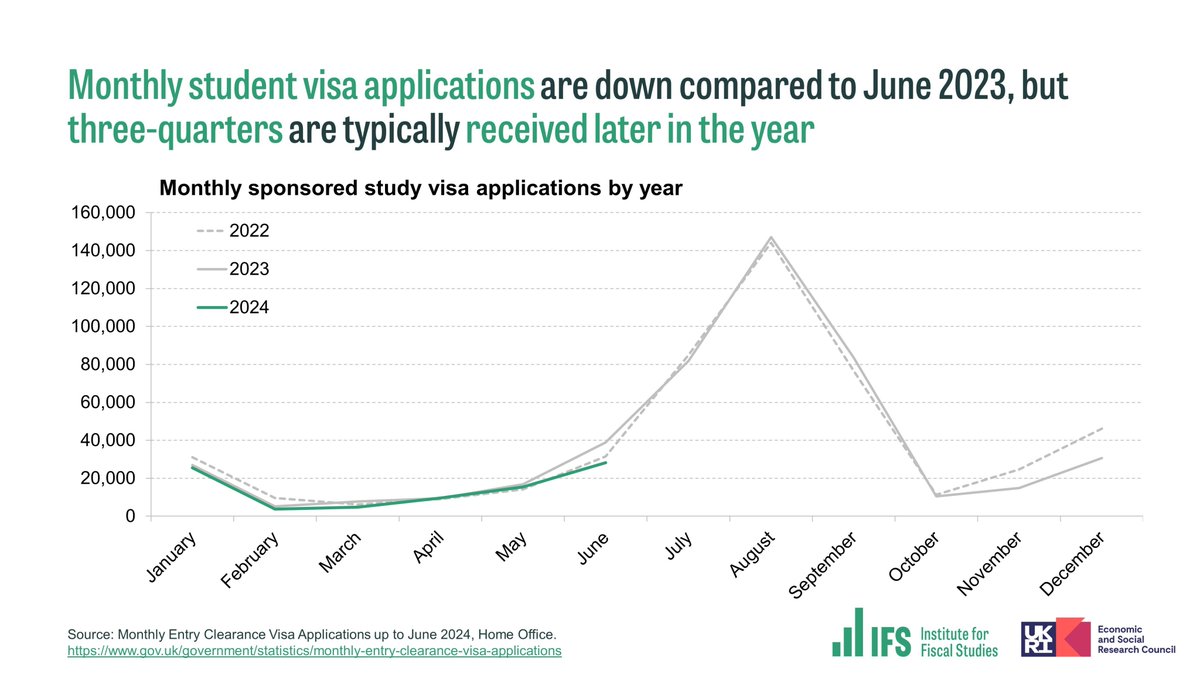
NEW: Applications for visas to study in the UK are down a sixth compared to last year.
Read @KateOgdenEcon's response to the latest Home Office statistics and on the implications for university finances here: https://t.co/J7fJtNEhbR
Let's have a serious conversation about the phrase "unskilled labor".
Economists have used that phrase for as long as I've studied economics. At some point I became inured to it falsely thinking it's no judgment, just trying to classify workers. That's wrong. It's horrible. 🧵
Home Office statistics released yesterday showed 10,700 (28%) fewer applications for study visas in June than the same month in 2023.
But most are received over the summer, so it’s the next few months that will really matter for student numbers, and for university finances.
NEW: A new government faces tough choices on higher education finance, with a funding model that looks unsustainable in the long run.
@KateOgdenEcon and @BenWaltmann’s new report, funded by @NuffieldFound, looks at English universities’ finances and policy options: [THREAD: 1/8]
NEW TOOL: Think you've got what it takes to be the Chancellor?
Try our brand new interactive tool, created by @TheIFS researchers in partnership with @nesta_uk.
Be the Chancellor and share your results > https://t.co/buEqEkY3yy
📗 Last chance to submit papers!
The @wb_research/ IFS /@ODI_Global Public Finance Conference is inviting paper submissions on "Public Finance and Structural Transformation" for this year's conference in Washington DC.
Submit here by Monday 15 April: https://t.co/LDa2TRDSeG
New @TheIFS report out today on Sure Start, which I've been working on since I started here.
We've found Sure Start had a big positive effect on disadvantaged children's grades throughout school, with much larger effects coming from centres with more funding.
Have a read 👇
Today is International Women’s Day. Despite improvements in women’s economic wellbeing, opportunities and rights, there remain significant and persistent gender gaps.
Can tax and spending policies work better for women and help close these gaps? The answer is yes, BUT: 👇🏻
Today we launch our IFS student finance calculator for Scotland!
Use the calculator to model the impact of different policies on funding for teaching and living costs, government spending, student loan repayments and loan write-offs.
📊 Find out more: https://t.co/vFaVaHoE8o
Lots of focus on NHS student loan forgiveness recently, with the Times commission adopting this proposal
This rests on a strong assumption that higher pay in 10yrs time+lower psychological burden of the debt has more impact than just spending the same money on higher NHS pay now
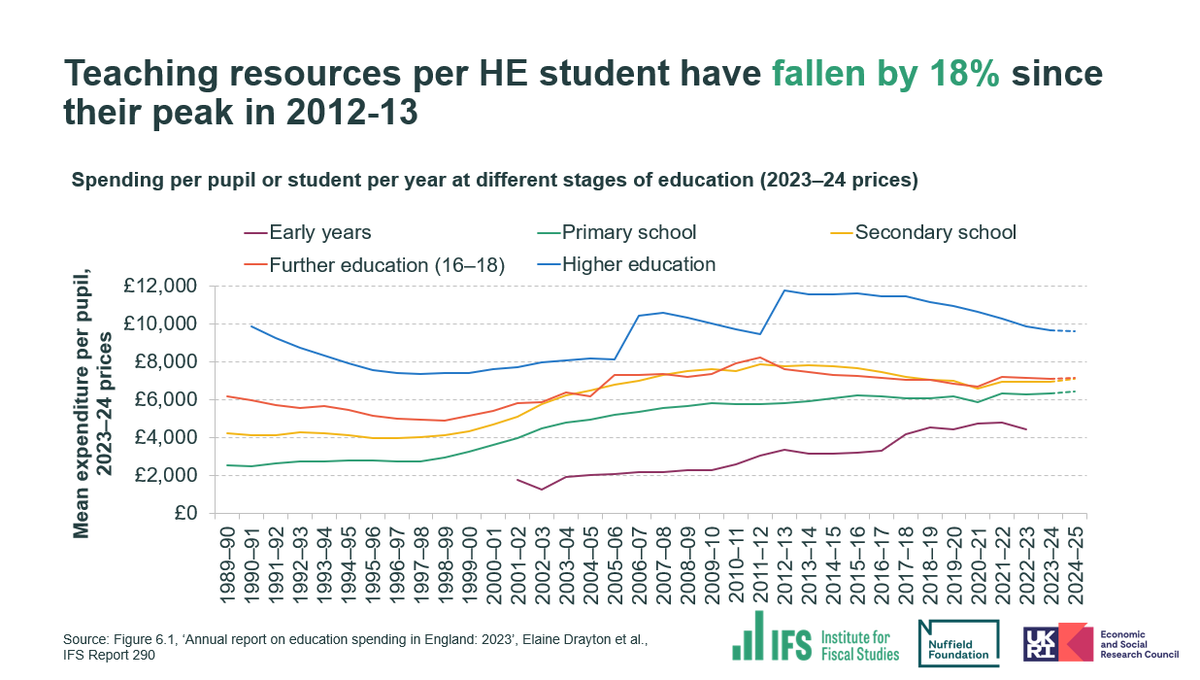
The crucial background to this morning's Sunday Times story about int'l students: real-terms cuts to tuition fees and teaching grants mean resources per HE student are down nearly a fifth since 2012.
NEW: Higher borrowing costs mean that student loans are now £10.5 billion more expensive for the government, a change not reflected anywhere in official government measures.
THREAD on @KateOgdenEcon, Nick Ridpath & @BenWaltmann's new report, funded by @NuffieldFound: [1/6]
NEW: Schools serving disadvantaged children have faced the biggest funding cuts.
Our annual education spending report, funded by @NuffieldFound and with a special focus on geographical differences in spending, launches today.
Read the report ⬇️https://t.co/BtXakWxXrZ
NEW: Using October 2023 rather than September 2023 inflation to uprate benefits in April 2024 would amount to a £3 billion cut, and a permanent cut to the size of the benefits system.
Read @TomWatersEcon and Sam Ray-Chaudhuri’s briefing: https://t.co/2GXMUR2oty
If that was the aim, it is still not obvious that loan forgiveness would be the best instrument. For example, a general pay rise could be counterbalanced with higher visa fees, which are currently lower for doctors than for skilled workers in non-health professions.
In response to my @theIFS Comment on the NHS bursary (https://t.co/TLObKsjSPM), several people have suggested student debt forgiveness as an alternative way to retain doctors.
This would help, but I’m not convinced it beats higher pay.
A thread:
In any case, if the aim was to benefit English-domiciled doctors only – perhaps out of concern about high immigration – then this should be made explicit. I have not seen that argument being made.





![TheIFS's tweet photo. NEW: A new government faces tough choices on higher education finance, with a funding model that looks unsustainable in the long run.
@KateOgdenEcon and @BenWaltmann’s new report, funded by @NuffieldFound, looks at English universities’ finances and policy options: [THREAD: 1/8] https://t.co/NXkyESM88i](https://pbs.twimg.com/media/GQqNjnLXsAACXPG.jpg)


![TheIFS's tweet photo. NEW: Higher borrowing costs mean that student loans are now £10.5 billion more expensive for the government, a change not reflected anywhere in official government measures.
THREAD on @KateOgdenEcon, Nick Ridpath & @BenWaltmann's new report, funded by @NuffieldFound: [1/6] https://t.co/UQ9UD3uwpR](https://pbs.twimg.com/media/GDY4SzDW0AAx-ZA.jpg)


