Benchmark Canada is live!
A country has to finance, build, govern, and secure. We measure all four against comparable peers, and against a single test: is the nation elevating the lives of its people?
44 metrics. Each names its peer set, its source, and carries a verdict.
“Benchmark Canada makes relevant data available to stakeholders, offering comparative statistics across five economic pillars and evaluating Canada’s ability to finance, build, govern, secure, and elevate its citizens’ living standards. The platform offers benchmarked data and insights on 44 distinct metrics, including mortgage delinquencies, which contributed to this commentary,” write Murtaza Haider (@regionomics) and Stephen Moranis in the National Post (@nationalpost).
https://t.co/iUx22gvXA7
Check out MLI’s latest project @Benchmark_Cda by @KevinVuongxMP⬇️
https://t.co/AxtML6HjTa
Canada’s bureaucracy is very good at “self-diagnosis of its problems” but “what it's very bad at is treating those symptoms,” says a retired veteran public servant who spent years working at the centre of government.
Jean-Guy Forgeron, who served as chief of staff to the clerk of the privacy council, and held key roles in other ministries like Fisheries and Oceans, says this means that when it comes to reforming the public service, the initiative must come from “the top.”
“And when I mean the top, I mean the prime minister of Canada,” says Forgeron.
Public service reform is a critical issue at a time when the federal bureaucracy has ballooned, and Ottawa is also being called on to play a key role in initiatives like getting major national infrastructure projects across the finish line.
The federal public service went from about 257,000 employees in 2015 to a peak of almost 368,000 in 2024. It has subsequently fallen. Treasury Board put the number at roughly 345,000 in March 2026, and Ottawa says it aims to drop it to around 330,000 by 2029.
To discuss where the public service is headed, and if it’s well positioned to deliver on the key national projects presently on its radar, Forgeron joins Inside Policy Talks.
On the podcast, he tells Peter Copeland (@CopelanPeter), acting director of domestic policy at MLI, that these staffing numbers are “a symptom of a disease that we should be worried about.”
He said the best way to address this challenge is with a program review like the one carried out in the 1990s by the government of then-prime minister Jean Chrétien. Instead of levelling across-the-board cuts, such a review would focus on determining what government should and should not be doing, says Forgeron. Reductions could then be made accordingly.
Watch the full episode: https://t.co/PGPgI8DYvA
Mark Norman: Canada's defence-spending quagmire
We must never lose sight of the fact that spending the money is actually easier than rebuilding the Armed Forces
https://t.co/erM8cImdPI
Kevin Vuong: How Canada stacks up against its peers
A new resource seeks to break down how this country is doing based on a variety of metrics, and how we compare to our peer nations https://t.co/9rUuBRY2Wu
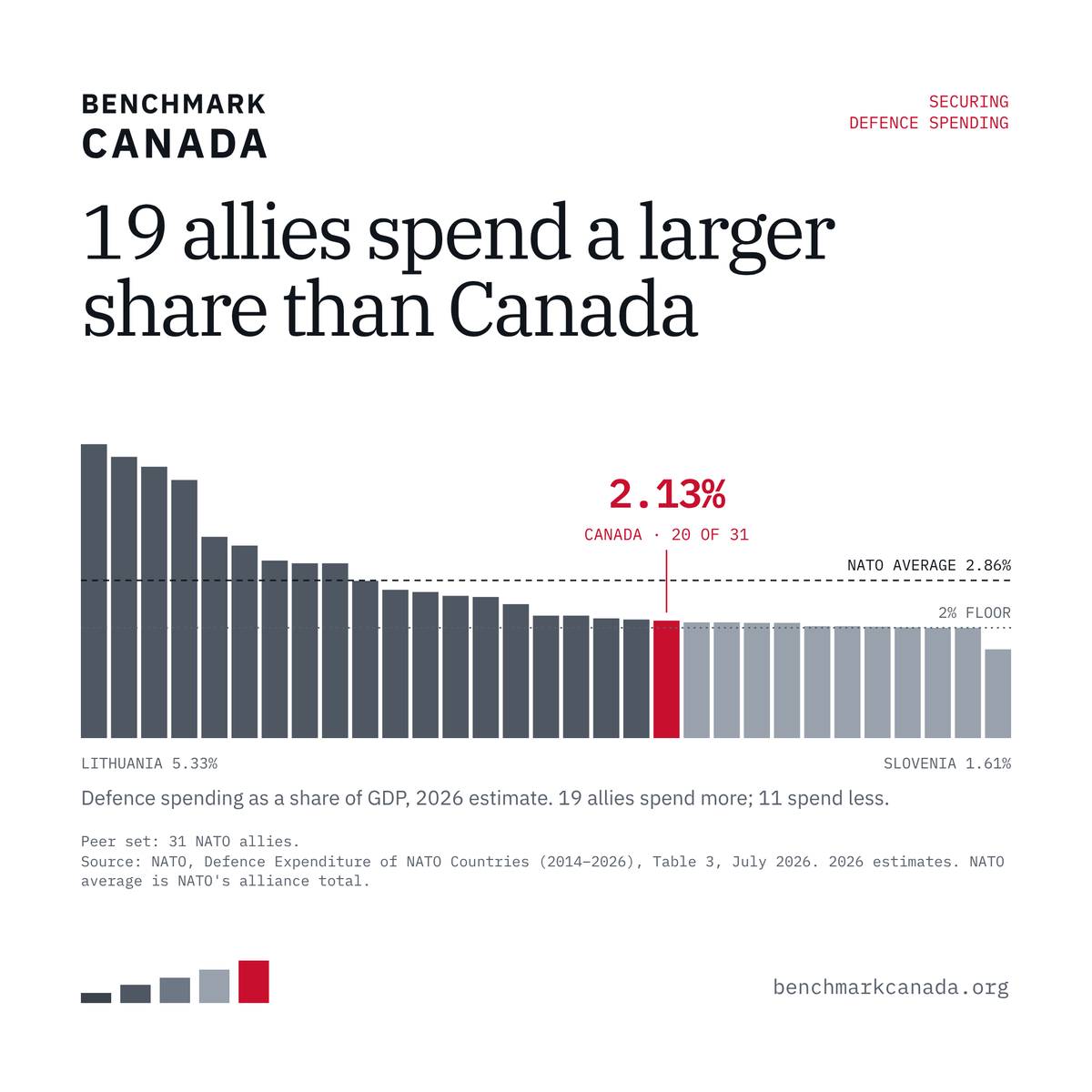
Canada cleared @NATO's 2% guideline for the first time in 2025, after eleven years below it, and an estimated 2.13% in 2026.
On that estimate, Canada ranks 20th of 31 allies, and is 0.73 points below the #NATO average.
Learn more about this metric at: https://t.co/Y32XjT6LBD
A new resource seeks to break down how this country is doing based on a variety of metrics, and how we compare to our peer nations, writes Kevin Vuong
https://t.co/RgSGC9E5hP
Kevin Vuong: A new resource seeks to break down how this country is doing based on a variety of metrics, and how we compare to our peer nations
https://t.co/RgSGC9E5hP
How Canada stacks up against its peers.
A new resource seeks to break down how this country is doing based on a variety of metrics, and how we compare to our peer nations, writes former MP and senior fellow at the Macdonald-Laurier Institute, Kevin Vuong https://t.co/o31pm6yg5j
It brings together more than 40 measures comparing Canada with peer countries, from defence spending to service delivery and more.
Over the coming weeks, the @NationalPost will work through the findings, starting with defence. Read @itsdgc’s story: https://t.co/gGaC9Goa3l
“If you grow by 12 per cent, which sounds great, but the rest of the industry grew by 25 per cent, you didn’t actually do well,” @KevinVuongxMP told the @NationalPost.
Benchmark Canada applies that test to the country.
“It’s hard to improve when you don’t know what your deficiencies are. It is even harder when nobody has told you that you have any. Benchmark Canada was created so that Canadians can judge our country the way that any serious organization judges itself — against its peers, on the evidence and starting from the number, rather than the press release,” writes MLI Senior Fellow Kevin Vuong (@KevinVuongxMP) in the @nationalpost⬇️
https://t.co/PGN4fR4HNK
Vuong's latest project “Benchmark Canada” (@Benchmark_Cda) is a new resource that seeks to break down how this country is doing based on a variety of metrics, and how we compare to our peer nations.
Take a look for yourself here⬇️
https://t.co/b2exRdH8a1
A ten-part series with the @NationalPost starts today and runs every Tuesday to 15 December to elevate the discourse of how Canada is actually doing beyond political rhetoric.
A project of the @MLInstitute, led by Senior Fellow @KevinVuongxMP. https://t.co/ErEZa9UGZo
Benchmark Canada is live!
A country has to finance, build, govern, and secure. We measure all four against comparable peers, and against a single test: is the nation elevating the lives of its people?
44 metrics. Each names its peer set, its source, and carries a verdict.