As the parameters of the US-Iran deal come into focus, it appears that the outcome for Iran from this war consists of a series of strategic swaps:
➖ What they lost: SL Ali Khamenei
➖ A series of first-generation leaders hardened by the war with Iraq and the ‘79 Revolutionary ethos
➖ A significant (though not game-changing) chunk of their ballistic missile stockpile
➖ Air deterrence and defense capabilities (for now)
➖ What remained of any diplomatic and economic goodwill with GCC states (again, also perhaps temporary?)
➕ What they gained: Gatekeeping power over Hormuz
➕ Ability to maintain repressive control over the public while simultaneously fighting a war for regime survival (no easy feat)
➕ Possibly closer relationship with China
➕ Making it difficult for US and Israel to align on fighting Iran going forward, and further weakening Israel’s diplomatic standing elsewhere
➕ New cadre of leadership that seems better positioned to lead Iran in the drone/AI/propaganda warfare age
➕ A “new deal” that seems weaker than the previous JCPOA (though this remains to be seen)
Hard to see how, for the Islamic regime, this doesn’t turn out to be a net positive outcome, all things considered. But much can change in the months to come.
Made my debut on Piers Morgan's show today. One point I made was that, as bad as the IRI's chokehold on the Strait of Hormuz is, it goes both ways and is a card that can only be played once. Eventually, Gulf States and the broader international community will figure out ways to bypass it, and then what is the regime left with?
I've been reading a lot commentary and analysis since the start of the war that goes along the lines of what @citrinowicz posits, here: Targeted killings do not necessarily bring the US/Israel closer to objectives and long-term goals because, although the target may die, the underlying ideology endures. Therefore, it's a fool's errand to pursue such tactics.
But maybe it's also about strategy and not just tactics? There are only a finite cadre of IRGC and other ideological diehards who can trace their roots back to 1979 or the Iran-Iraq War. In a NYT piece today, @farnazfassihi brings up a few of them. What unites these types -- and their consolidation of support around Mojtaba -- is that their ideology and fealty to the Revolution were collectively forged in the fires of Mt Doom -- ie, the events and shared experiences of 1979-1989. Vahedi and his ilk (Zolghadr, Safavi, and especially Rezai) are of that kind. These are men with blood on their hands and alleged complicity in international acts of terror. They have proven their revolutionary bona fides and are prepared to die defending them, the Iranian "vatan" and "melat" be damned.
But beyond them, who else is left? At some point, the well of revolutionary fervor and zealotry runs dry. Take out enough of these veterans of 1979, and the political calculus for the remaining IRGC leaders -- those without 1979-1989 bonds -- may change. Can anyone, including @citrinowicz , discount that possibility? There is much we don't know, and that should temper our judgement and analysis.
Targeted Killings Won’t Change Iran’s Strategic Calculus
Ahmad Vahidi is a despicable figure, with a long record tied to deadly attacks. There is no ambiguity about that.
But it is important to separate moral judgment from strategic impact.
The elimination of Vahidi is undoubtedly operationally significant, but it is unlikely to alter the regime’s strategic calculus
Eliminating individuals like Vahidi same as his predecessors Salami and Pakpour, will not compel the Iranian regime to accept U.S. negotiating terms.
Why? Because the issue is not tactical it is ideological.
What the United States is effectively asking for today goes beyond policy adjustments. It touches the core pillars of the regime’s identity: its regional posture, its deterrence model, and ultimately its revolutionary worldview. These are not assets the regime can trade away without undermining its own foundation.
This is the key strategic reality:
Targeted killings like Vahidi, however justified or operationally successful, do not alter the regime’s fundamental calculus. They may disrupt, delay, or impose costs, but they do not change intent.
If U.S. policy is premised on the assumption that increased pressure, military or otherwise, will eventually force Iran to concede on core ideological positions, it risks misreading the nature of the regime.
A meaningful shift in Iranian policy would likely require a change at the systemic level, not the removal of individual figures, however senior they may be. We just need to see what has changed in the Iranian policy since February 28th - almost nothing.
The desire for a single game-changing move is tempting, but the Iranian arena is far more complex than that.
In other words, there is a critical distinction between degrading capabilities and changing behavior. The former is achievable through force and decapitations. The latter, in this case, is far more elusive.
#IranWar
Here is one possibility of the parameters of US-Iran deal that gives both sides an offramp and allows leadership to "save face" (which is, like, 90% of the challenge given this cast of characters):
1. Iran agrees to 10- or 15-year zero-enrichment ban, giving Trump a win on his stated goal of "no enrichment". This would be more onerous than what JCPOA had (and Trump can say "it's a better deal than Obama's").
2. Iran gets sanctions relief, unfreezing of funds, and most importantly — a guarantee, in the form of a Senate-ratified treaty or agreement, that a future POTUS can't unilaterally withdraw.
This helps both sides overcome the "trust" issues that have been an obstacle so far.
Not surprising that nothing came out of the Islamabad talks. It took years of diplomacy to reach the 2015 JCPOA — and that was a narrower agreement!
A more complex deal, now layered with the Strait of Hormuz issue, was never going to materialize quickly.
The real question: who has more to lose as the ceasefire window closes, and whether Iran has overplayed its hand.
While all eyes are on Islamabad and the upcoming talks between Vance + Ghalibaf, the massive gulf (pun intended) between the two sides persists! Especially because Ghalibaf is not the political center of gravity in Iran — that would be the IRGC's top-level cadre. The key will be what statements and positions emerge in the coming hours from those senior officials. If there is any daylight between them and Ghalibaf, hard to see anything enduring coming from these talks.
The ruler is beefing with the pope, his legions have fought to a stalemate with Persia, now typhus is breaking out in a major city, oh yeah it’s late antiquity out there
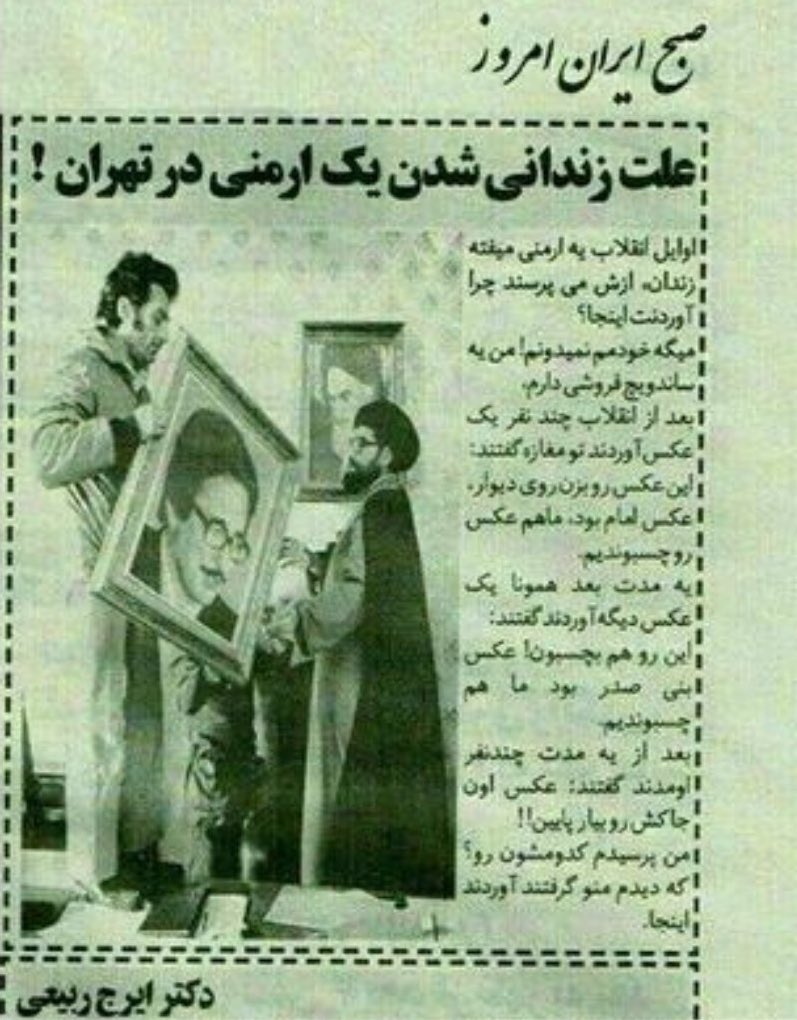
Shortly after the 1979 revolution, an Armenian sandwich-shop owner in Tehran was imprisoned.
Revolutionary enforcers ordered him to hang portraits of Khomeini, which he complied with, and at a later time of president Bani Sadr, which he also complied with.
After Bani Sadr fell out with the clerics and was impeached, the men returned and demanded, “Take down that bastard’s picture!!”
The shop owner calmly asked, “Which one?”
His reply, spoken out of political indifference, was taken as implying that Khomeini could be the bastard, and that unintentional implication had him arrested!
👀: @UCLA Iran expert @BenjaminRadd thinks a U.S. military strike on Iran is "imminent."
"The buildup is there. Pres. Trump made an offer for Iran he knows they can't accept...it's literally gunboat diplomacy."
He says Israeli strikes on Hezbollah are another indication.
Via @CNNTheStoryIs
Trump is offering a deal he knows Khamenei can't/won't accept, setting up scenario where diplomacy was "offered and attempted but rejected," and opening path towards a kinetic strike (I imagine in the coming days). https://t.co/GLKLBBATJs