Meet Kevin says you need $8,000,000 to $10,000,000 to retire with a family of four👀
“8M to 10M In assets. Whether it's real estate, stocks... I think anything lower than that if you're 40 years old you're going to run out.”
Stanley Druckenmiller averaged 30% a year for 30 years without a single losing year
Paul Tudor Jones asked him on stage what made him different from everyone else - his answer: size
"I put 350% long into one bond trade - 200 to 300% of my fund into a single currency - put all your eggs in one basket and watch the basket carefully"
"I've never used a stop loss in 40 years - I exit when the reason I bought changes, not when the price is down"
"the world changed on 9/11, the world changed when the wall came down, the world changed election night - these moments set in place two to four-year trends you can play"
bookmark and watch it today ↓
If you don't think $10M is enough to be set for life, what you're really announcing to the world is how boring and terrible you are to be around
Every single guy who says this is ultra boring and nerdy. And worse. Doesn't even have $10M
the anthropic claude for finance lecture is the best free hour in quant AI right now.
bookmark & watch today. It's the most valuable 1 hour in quant AI right now. Then read article below.
If you actually make it big what happens is simple:
1) $25M is completely game over, no chance your life improves when you can spend $1M forever
2) you look back and realize $4-5M + paid off home was the biggest QOL cliff
3) $10M is more than enough unless redacted
What does running $600M instead of $100M cost you in crypto? Half your Sharpe:
Leigh Drogen, CIO of Starkiller Capital. Runs a crypto market-neutral book at Sharpe ~4.
Drogen:
"We want to run 15 to 20% net at a four Sharpe, with very minimal drawdown."
"At today's liquidity, capacity for those returns is only about $100 million."
"Just shoving enough money into this space without getting caught in hacks, rugs, and depegs is difficult."
"We'd rather run a smaller book than just accumulate assets."
"We have peers running 4, 5, $600 million — at 8 or 9% net, more like a two Sharpe."
A 4-Sharpe crypto fund. 27 of 28 months positive.
Leigh Drogen (@LDrogen) is CIO of Starkiller Capital, a crypto quant fund running momentum and market-neutral crypto strategies.
His edge is diligence — and a "never lose more than 1%" position rule.
We cover:
- Why block space is worthless — and the fiber-optics-in-1999 analogy that explains every L1 collapse since blobs launched on Ethereum
- Starkiller's "never lose more than 1%" position sizing rule (how it compounds into 27 of 28 positive months)
- The Ripple / RLUSD / USCC trade — borrowing at 2.5% against a 5-8% yielding tokenized basis fund, hidden in plain sight on Aave Horizon
- How Starkiller dodged the Kelp DAO hack, lending USDC at 17-18% APR while the rest of DeFi was on fire
- Why momentum is the only actual persistent alpha (it's the only persistent behavioral characteristic of humans)
- "F*ckery risk" on the short book — why Drogen runs a more diversified short book than long book, even when his thesis screams short
- Why "sales is way overcompensated" relative to the difficulty of the job — and what that means for ambitious young quants
- The 2019 DM from a 21-year-old that became Drogen's biggest career miss — and how Polymarket's Shane Coplin (@shayne_coplan) actually solved the SEC problem ("USDC and VPNs")
Highlights:
00:00 Intro
01:09 Mechanics of a 4 Sharpe market neutral DeFi strategy
03:24 Quantifying protocol risk and code provenance
06:40 Case study: Exploiting incentivized spreads in carry trades
10:53 Three primary sources of alpha in liquid crypto markets
14:28 Capacity constraints and institutional yield compression
18:54 Position sizing via the 1% max loss rule
21:38 Pro-cyclical returns and the risk modulation framework
26:44 Compounding capital through trend following and cross-sectional momentum
33:35 Why momentum is the only persistent behavioral alpha
48:39 Extracting alpha from token unlock schedules and market structure
51:20 Lessons from building Estimize and the SEC/ForceRank fight
55:00 The Polymarket origin story: Arbitraging regulatory hurdles
01:01:45 Career risk premia and the value of "eating sh*t"
01:05:34 Table selection: Positioning your career on the right macro curve
Growing into the winning relationship
Holding period and pyramiding/doubling down into a winner or loser have the biggest impact for the aspired master trader.
These are not small variables. For the trader who aspires to the top, they are the only true variables.
People like to begin with entries. Fine. Entries matter. But the first real work is finding the pockets of edge: small caps, mid caps, large caps, each one becoming over time a liquidity-driven sliding scale forcing the growing trader to shift into a new version of himself. What worked at one size stops working at another. What looked like skill at one level becomes noise at the next.
Then comes compounding. Usually through an R system, whether you fully systematize it or compound naturally. Directly or indirectly, you are always measuring risk. You are always deciding how much of yourself to put behind the idea.
Then comes noise reduction.
Seeing less. Focusing more. Finding structure inside chaos. Learning what not to look at. Learning what not to care about. Putting structural elements (like scanners, prep, automated systems) in place. This is harder than people think, because most traders are not defeated by what they miss. They are defeated by what they cannot stop seeing.
Only after that do you earn the right to size exponentially.
Adding to winners. Averaging in. Pressing when the trade improves. Holding when the easy exit appears. Accepting that win rate and risk/reward live on a sliding scale, and that every serious trader must eventually decide where he belongs on it.
At the end, the game becomes judgment.
Can you grade the setup as it moves from bucket to bucket? Can you recognize when a B has become an A, when an A has become an A++, or when the thing you thought was elite was only dressed that way for a few candles?
This is most true in deep value. It is also true in parabolic shorts. The opportunity does not arrive fully formed. It reveals itself. Then your sizing and your holding period must adjust to the reality in front of you.
So here is the question.
Should you wait for the A++ entry when the A is already available?
Or would you rather miss the first entry so you can pyramid with greater certainty once the trade begins to prove itself?
There is no free answer. There is only the trade-off you can actually live with.
Win rates are easy to manipulate. You can raise them by taking profits too early, sizing too small, avoiding discomfort, and calling cowardice discipline.
But risk/reward and dynamic sizing are where the real alpha hides.
That is where the market wizardry is.
Not in being right often. In being enormous when it matters and pushing beyond, by appreciating the power of the true outliers and the range they offer as they reverse (or continue for some breakout strategies).
And that privilege is not given cheaply. The ability to push, to pyramid, to become your biggest in the best opportunities, comes only after mastering every earlier step.
You do not get to size like a monster because you are excited.
You get to size because you have earned precision. You have earned conviction. You have lived through dozens of account pullbacks, recoveries, new highs, false dawns, and near-breaks in belief.
Only then can you tolerate a smaller win rate in exchange for a huge winning tail.
Only then can you hold the trade long enough for the rare thing to pay you.
That part is not technique.
That part is earned, respect, held on to like a religion.
At the end all that remains is the tail, the tail of the alpha that blows off into account growth.
Are you truly able to get to that last stage only depends on building the strong foundation needed to support the monument that might live on in history.
Ex-Citadel analyst and Millennium PM revealed what $500K/year hedge fund life actually costs you - he turned down Citadel's return offer to find out.
Doug Garber worked at Citadel as an analyst, ran his own pod at Millennium, then turned down a return offer from Citadel to build something of his own
- he spent years inside both of the most competitive multi-manager funds on earth and has never given an interview like this before
you will watch 53 minutes of the most honest Citadel vs Millennium comparison ever put on camera:
centralized machine vs entrepreneurial pods, why the best PMs leave, and what $500K/year actually costs you personally
Bookmark & watch - then ask yourself if you'd turn down Citadel the way he did.
This is it.
Everything learned spending millions on longevity.
From: Your Immortal Unc and Auntie.
To: Our Immortal nieces and nephews.
0. Sleep is the world's most powerful drug.
1. Be in your bed for 8 hours
2. Same bedtime every night, any time before midnight
3. Don’t eat right before bed
4. Calm foods for dinner
5. No screens 1 hour before bed
6. Avoid added sugar (be aware it’s in everything)
7. Avoid all things in an American convenience store
8. Avoid fried foods
9. Shoes off at the door
10. Eat whole foods, particularly veggies fruits nuts legumes berries
11. Walk a little after meals or air squats
12. Get your heart rate high routinely
13. Lift heavy things
14. Stretch daily
15. Water pik, floss, brush, tongue scrape, morning and night
16. Make an effort to drink water
17. Get sunlight when you wake up (UV is low)
18. Protect skin in midday sun
19. Stand up straight
20. See at least one friend once a week
21. Avoid plastic where you can (in all things)
22. Circulate air in rooms
23. When stressed, breathe, learn to calm your body
24. Go to the dentist
25. Avoid sitting for long times
26. Protect your hearing, the world is too loud
27. Alcohol is bad for you
28. Finish coffee before noon
29. Avoid bright lights after sunset
30. If obese, look into a GLP
31. Sleep in a cold room
32. Texting while driving is dangerous
33. Turn off all notifications
34. Limit social media use
35. Don’t smoke anything
36. If you struggle to sleep, read a physical book before bed
37. 1 hour before bed have a calm wind down routine: bath, read, light walk, listen to music
38. The body is a clock and loves routine. Have a daily morning and evening schedule.
39. Avoid long distance travel where you can
40. Baby steps first: incorporate new things slowly
41. Do less… most things don’t work.
Bonus points if you get your blood checked.
Start here, it will change your life.
Hardship is most often worse than you expect, longer than you expect.
The recovery is often even faster, often 1/5th or faster than deep drawdowns or general hardship.
Hardship puts it all in perspective, it allows for growth, mentally, spiritually, in the growth path.
Small continuous steps forward is the way to fight against the pain. 1% better each day.
The work you put in near the top is often the least productive.
The work you put in in deep drawdowns is often your absolute best.
Deep despair cleans the board, kills the excess, resets the board, often the path forward is filled up with opportunity.
At the end of a rally too much chases too little.
At the end of despair there is too little to take advantage of too much.
Great euphoria and despair are both parts of the journey, both are fake, like the final end of a parabolic move, they are created to be faded.
Mistrust big bursts, biggest losses come after the biggest wins. Trust compounding, all great things take time.
The best aspects in life are all achieved through compounding. Relationships, Fitness, Health, Profits, Respect, Exposure, Skill... Trust it, accept grind is the minimum if you want to achieve anything.
Citibank's #1 trader in the world just exposed how banks making billions
40 minutes. free. by #1 trader
he made $20M by betting against the global economy. $1 trillion/day in trading volume. £400,000 bonus. $8M lost in a single week.
You can spend $200K on an MBA at LSE or watch this 40 minutes podcast
You want to know a secret that changed my mentality around money?
Scenario: April 1st your portfolio was 100k and we went on this magical run where it climbed up to 140k as of yesterdays close. Then a day like today comes along and you happened to get stopped on all your positions and you are now sitting at 130k. Did you lose 7.14% today or is your portfolio up 30% in a month?
Unrealized gains ARE NOT YOURS. They belong to the market! If you want to mitigate volatility, trim into extensions. But if you are going to stress out about every down day as if the money was yours on an open position, you'll never truly be able to scale up comfortably.
Treat every new buy or sell based on it's individual price action. And stop looking at your portfolio value every evening as if the money on open positions belongs to you. Checking portfolio value every 10min only leads to emotional and sloppy execution when you look at the whole and not the individual parts.
If stock A is still acting great then it shouldn't be sold just because you took a small loss on stock B. Exit stock B and continue to let stock A work for its own merits. The minute you start to make emotional decisions because of money is when you ruin your chances at real growth.
I've spent thousands of hours watching all 835 episodes of The Diary Of A CEO podcast.
Here are the 10 craziest health lessons I learned (so you can skip the 1000+ hours):
1. Weekly sex extends your life by 49%:
Came across this document of Qullamagi’s 2020–2021 trade positions.
If you go through these trades, one of the best things you’ll notice is the risk–reward. There a lot of losing trades. But the losses are not big, mostly around one or two X.
On the other hand, the winning trades are much bigger.
If you go through the stock names, try to understand the thought process behind each trade.
Yes, this is from 2021, but a lot of things can still be understood today if you go through these trades.
Go through it. Try to understand it. Good luck.
Link - https://t.co/7Yl0qzb1AW
We hired a 27-year-old associate a few months ago, and he uses Claude Cowork all day.
I don't have the words to describe what is happening to our productivity.
Things that would have taken months are now getting done in hours - it's changing the entire way we run our business!
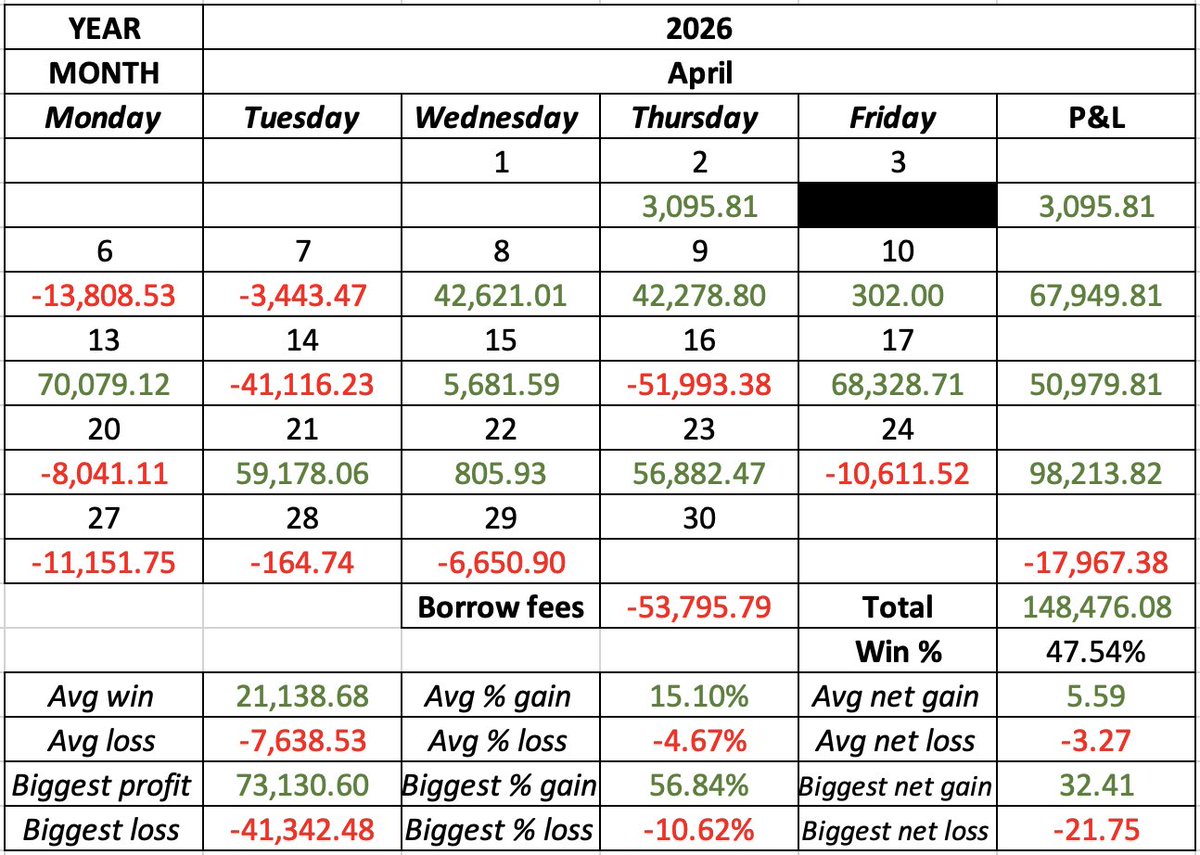
4/26 recap: $148,476.08
By the opportunities and some bigger wins I was having it felt like April would be blowing March out of the water. Throw in too many long losers and very high fees this month creates a sub par bottom line to what I would’ve expected. Still a good month, excited for May.
A record month with still open positions in $AAOI $AMZN $ARM $DELL $DOCN $IGV $LITE $MU $NVDA $PL and a short in $AXTI.
Second best April for the S&P 500 of ALL TIME!!
Not sure how the market follows this up, but it was suer incredible to experience it!
Jane Street hired this junior at $220k-$600k /year because he uses AI to analyse TRILLIONS of data
in this 1-hour lecture - he show how to research trillion of data points thanks to his machine
Bookmark & watch it, instead of Netflix to learn how to do the same!