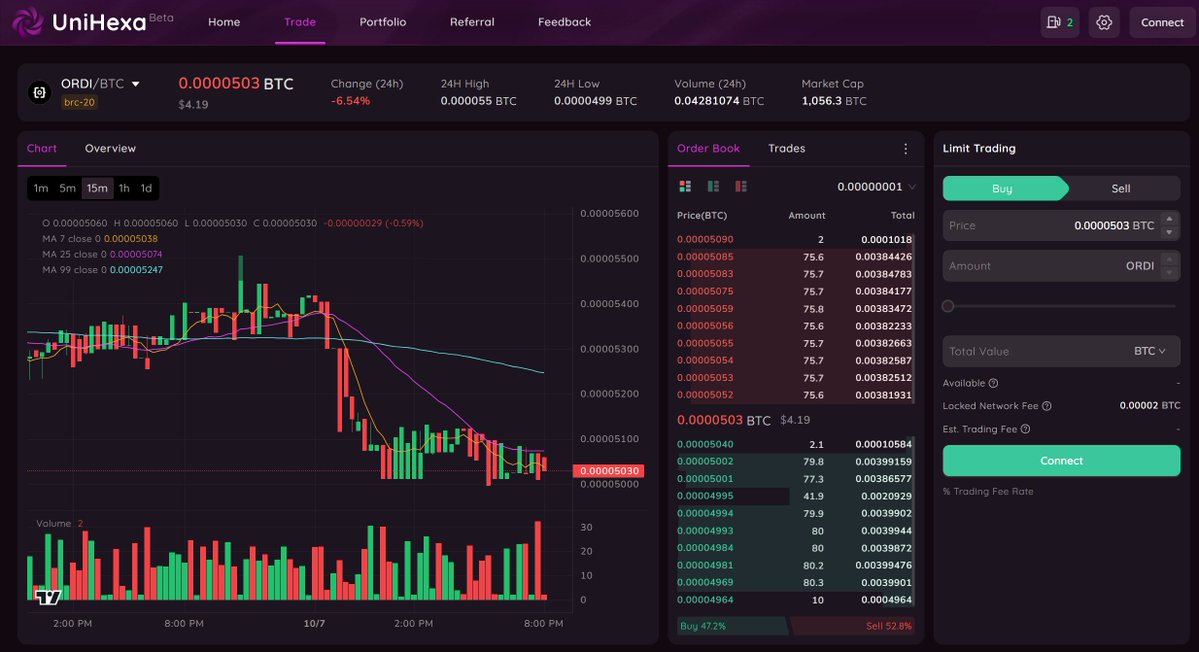
🟠 ORDI/BTC is available to trade on UniHexa.
Come trade one of Bitcoin's most recognized brc-20 assets on a self-custodial market.
ORDI community, your trading time is here. 🔥
Come trade 👇
🔗 https://t.co/MFBlvyVC1w
We're continuing to add more assets across brc-20, Runes, and other Bitcoin-native protocols. Stay tuned.
Yeah this is how I'm feeling about it. At first it was just an audit but now it is taking shape of an actual mature protocol.
The "Terrain Claim Chain" works basically the same as Bitcoins Block hash chain, using previous hash. I'm stopping just shy of calling it it's own Blockchain, but an argument could be made to call it this, since it is a hash-chain on a P2P network made of bitcoin blocks.
Gateway will be the first implementation to carry this, yes, but the ruleset will live at /Blockamoto/bitmap GitHub when I make that public so anybody can reproduce.
Both are almost ready, I hope to have some good news on that today.
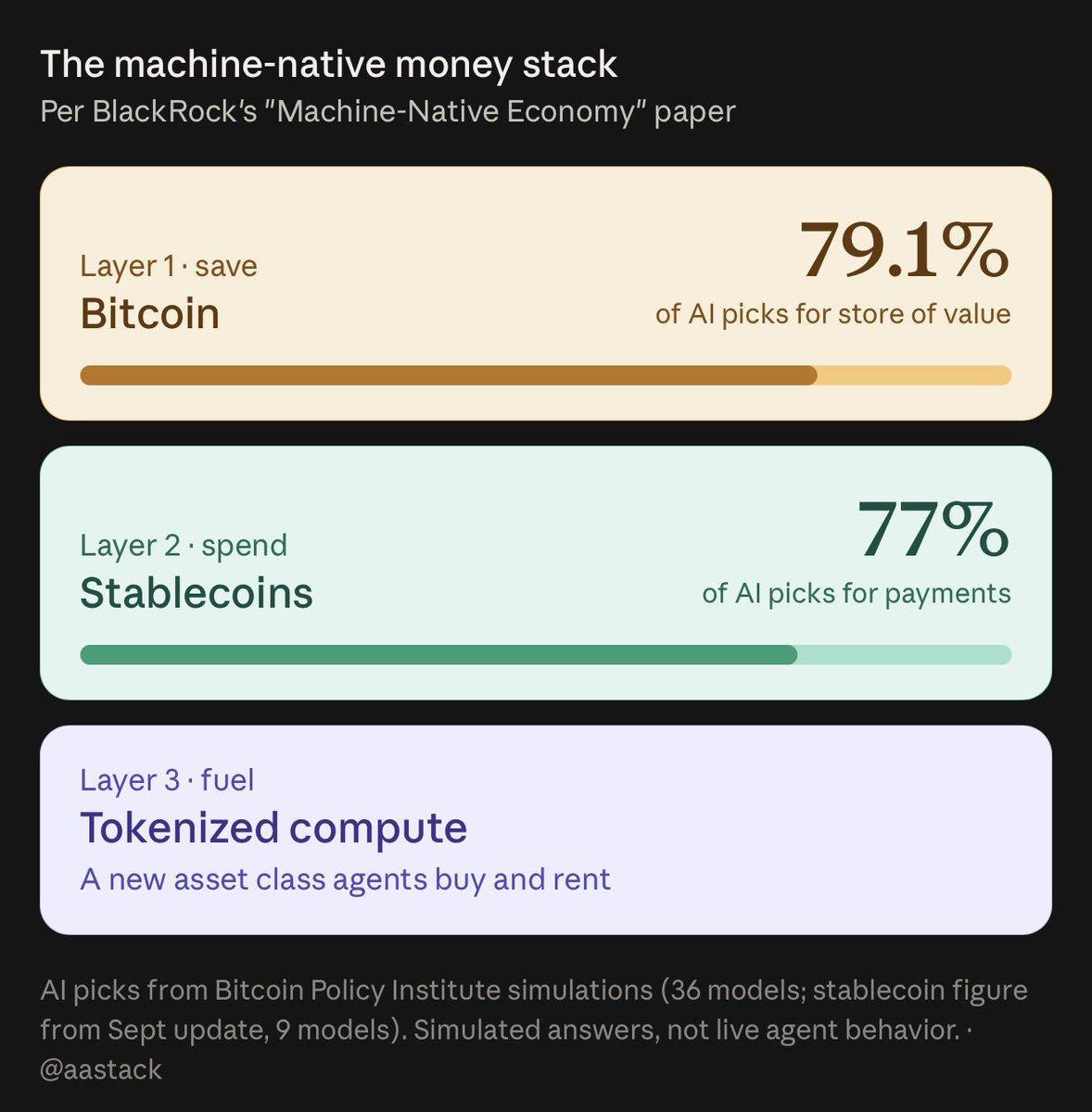
The real fun starts when BlackRock realizes that BTC is, in fact, tokenized compute.
BTC proof of work tokens = transferable proof of compute expended in the past.
AI inference tokens = digital representation of compute to be consumed in the future.
So an AI can accumulate BTC representing past compute, then spend it to purchase future compute.
Past compute becomes future AI agency.
Which means AI agency is constrained by compute costs at both ends of this stack.
On one end, there must be enough inference compute available in GPUs and AI chips to execute the action.
On the other, there must be enough BTC available to pay for that compute and everything else the AI needs to act.
BTC can serve as that stockpile. It is the geopolitically neutral asset and network for that exact task.
The business world already understands the first constraint. AI chips are massively oversubscribed because everyone understands that access to inference compute determines AI capability.
What almost nobody understands yet is the second constraint.
BTC is not understood as critical AI infrastructure yet because the market still categorizes it as "crypto" or "blockchain" tech thanks to years of tangential gambling shitcoinery
It has not yet priced Bitcoin as infrastructure for metering, budgeting, and imposing costs on machine agency.
Available inference compute determines what an AI can do.
Available BTC will determine how much AI can afford to do.
And the latter is a lot more scarce and valuable than the former.
If AI security ultimately comes down to:
1. controlling access to compute, and
2. imposing costs on autonomous action,
then Bitcoiners are already sitting on the world's largest infrastructure for the second half of that equation.
The world understands why AI needs chips.
It has not yet figured out why AI may need Bitcoin.
When the market finally understands that distinction, the correction is going to be insane.
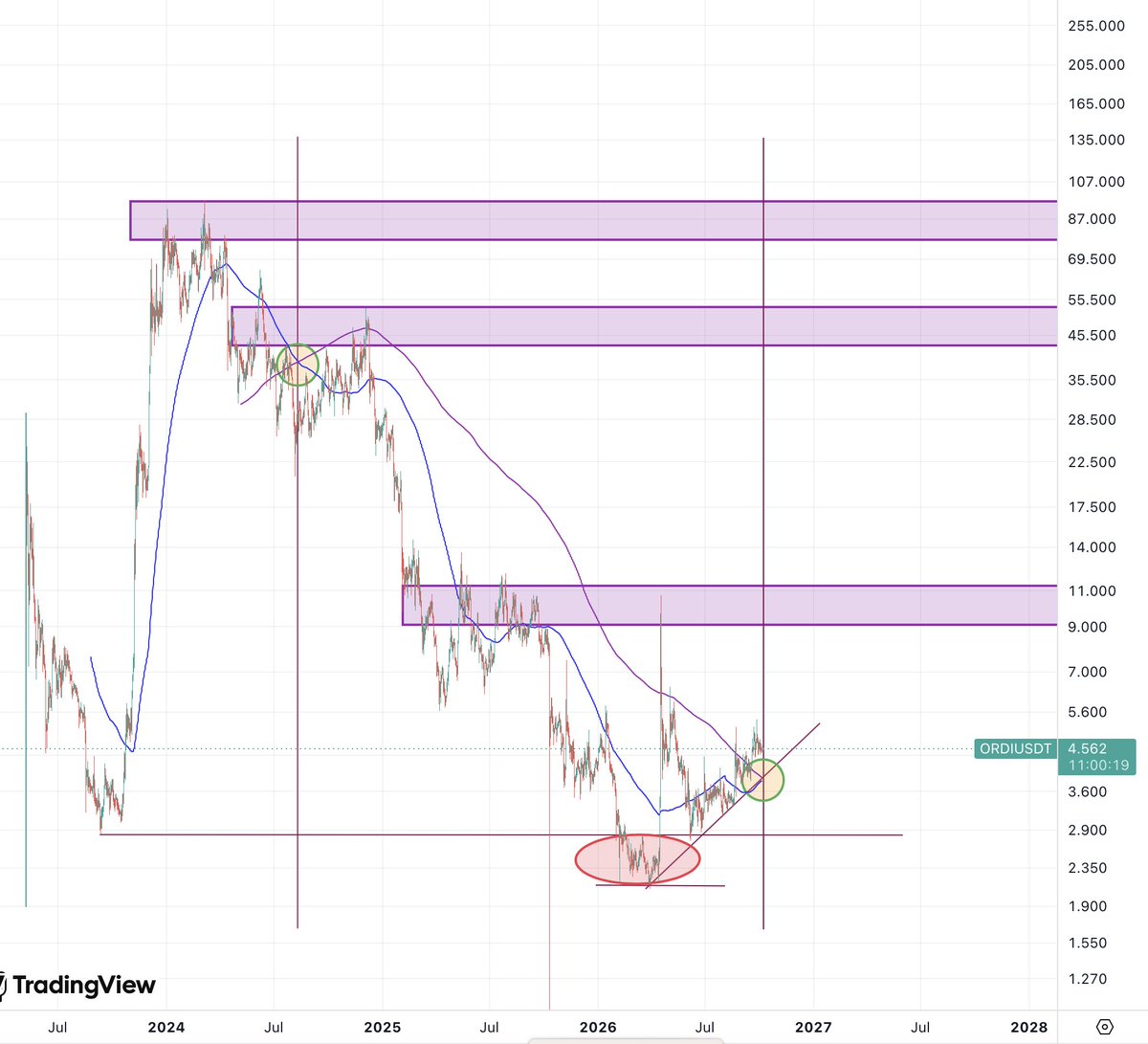
$ORDI is about to enter a bullish regime for the first time in more than 2 years
The long term moving averages are about to flip bullish potentially leading years of bullish price action
$ORDI survived a brutal bear market and remained the Bitcoin asset with the highest market cap and daily volume
Ordinals survived the BIP-110 censorship attempted which failed miserably - Ordinals are stronger than ever
We have new on-chain market experiments coming from @Uni_Hexa@bestinslotxyz@ordinetwork@Domo_DEX and no doubt many others
And we have @tether and @circle bringing hundreds of Billions of Tether $ to Bitcoin
The backdrop for $ORDI couldn't be more bullish here
I'm preparing Gateway for testing, and I have a few updates.
We need to roll this out carefully, rather than haphazardly.
The first alpha test will be specifically for Bitcoin on Demand.
That means I will be disabling:
🔸 Gateway to Gateway peers
🔸 All non-Bitcoin native indexes
🔸 Yes, that includes Bitmap indexing
I don't want to proliferate a p2p network on shaky ground, and whilst I'm confident with Gateways current capabilities, we need a clean test phase for each layer rather than rolling it all out in one.
What will be in this version:
🔸 Bitcoin on Demand
🔸 Full or ranged Bitcoin indexing
🔸 New Bitcoin address schema
🔸 Block/transaction/output explorer
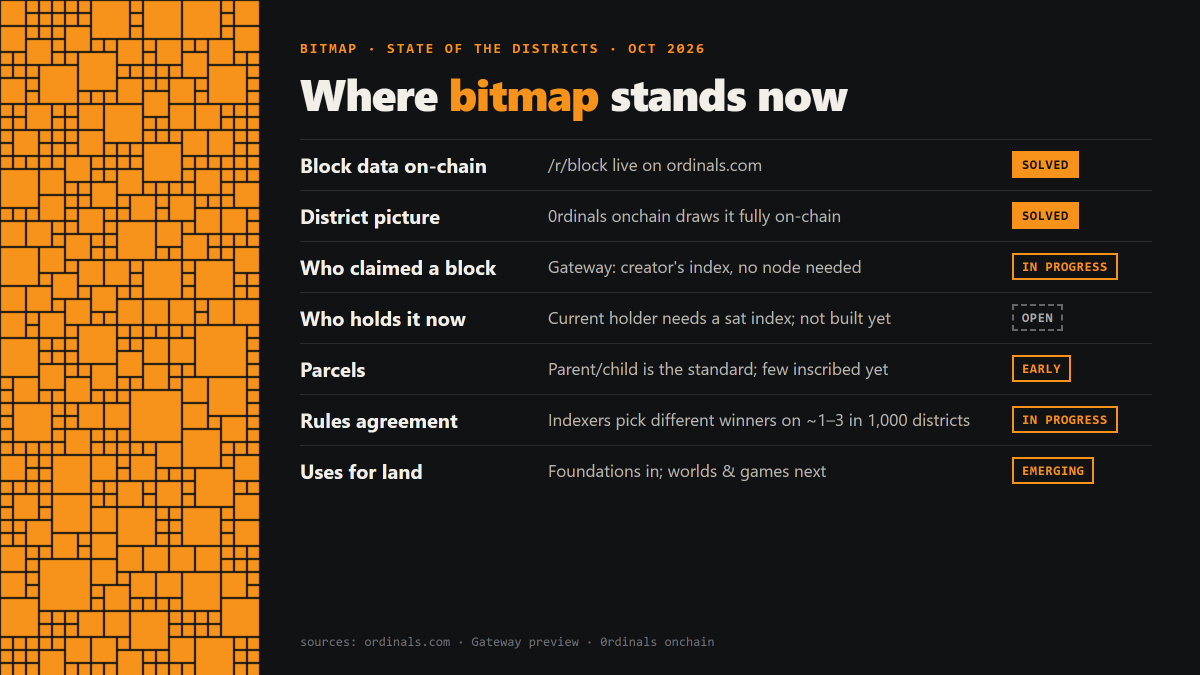
Regarding the Bitmap index, I'm taking this opportunity to solve the indexer edge cases once and for all. The first step towards that is a full audit of all edge cases rules, where they result in contested outcomes, and which Bitmaps are affected. For each diverging ruleset track, there will be a hash outcome for each new block. Once we're at that stage, we can pressure indexers and marketplaces to expose their current state hash as a proof. This will be a proof of which track the indexer/marketplace is on.
And then we blow up the conversation around edge cases and hash it out between us. Benefits and costs of decision A versus decision B. There is no final "this is the canonical ruleset" declared, just a hash for each possible outcome, and the community who may or may not agree with that outcome or ruleset decision who can audit the outcome of that hash and see exactly which bitmaps are affected.
This is the fairest, most Bitcoin way I can think of solving this problem, and Gateway gives us the opportunity to do this once and for all. I'm even holding back giving @lifofifo a canonical index so this can be handled. We cannot ignore this issue any longer.
And so this is what I'll be implementing into Gateway.
This is rough consensus in action.
Expose the truth and let the community decide, just like Bitcoin.
I'm setting up a bitmap repository to handle rulesets and edge cases to make this fully visible for all.
But first things first, I'll be putting Gateway out soon without any of this. Just Bitcoin. Ordinals will come next. Then Bitmap. Then Gateway peers. Then we can start to open it up to custom indexes before we expand on the p2p capabilities, which is where things will get really exciting.
So stay tuned for that first alpha test. It's coming soon.
Okay yes you're right, I was talking from an indexing perspective.
These are different layers of information, so that's why Gateway separates them.
The inscription ID points to where that claim actually lives, which is required to validate it's validaty, along with every other bitmap claim. You don't need sat numbers or inscription number for that.
If you want to track ownership, then yes, sat numbers are necessary.
Even ord doesn't track sats by default (without you setting up the sat flag).
They are different indexes in Gateway too because they require completely different levels of indexing.
You can index inscriptions at any range without consequence, so long as you don't care about sat numbers or inscription number.
You can index bitmaps from the block where district 0 was claimed onwards so long as you don't care about sat numbers or inscription number.
But when you want to track ownership in Ordinals, you need a sat index, at least on-demand access to somebody who has a sat index to serve you the data.
So you're right. Tracking ownership requires a sat index. Indexing inscription ID does not.
Introducing Genex
The desktop app to build games with AI
→ Open source, MIT
→ Local models, or Claude Code / ChatGPT sub
→ Self-improving harness for game dev
→ Three.js + Blender, Meshy & other tools
→ Unity & Unreal plugins soon
https://t.co/Fziq6COK1q
🚨 ESTO NO SE LO ESPERABA NADIE
Jack Dorsey, ex-CEO de Twitter, acaba de publicar gratis un framework completo para construir un negocio operado íntegramente por agentes de IA.
El proyecto ya ha superado las 35.000 estrellas en GitHub.
Cómo ponerlo en marcha en unos 5 minutos:
1. Clona el repositorio.
2. Levanta tu propio servidor desde el que podrás gestionar canales, búsqueda, Git y automatizaciones.
3. Incorpora tu agente a cualquier canal como si fuera otro miembro del equipo, asigna sus permisos y trabaja con él en tiempo real.
Guarda este post porque probablemente vas a necesitar volver a él.
Te dejo el repositorio abajo 👇
🔥YA ES OFICIAL🔥
Tether Vuelve a #Bitcoin 🥳🔥
Utexo, respaldado por Tether, ha obtenido una licencia para emitir USDT en Bitcoin.
Esto permitiría a los usuarios enviar USDT de forma privada, intercambiarlo directamente con BTC y pedir prestado contra Bitcoin sin envolverlo.
USDT se lanzó por primera vez en Bitcoin en 2014, antes de crecer principalmente en Ethereum y Tron.
El ecosistema de BTC sigue creciendo 🚀
Video generation now runs right on your laptop. 🎬
Introducing FreeVideo — bringing MiniMax H3 + Video DeltaNet to the hardware you already own.
As little as 8GB VRAM + 16GB RAM. ComfyUI integration, LoRAs & custom workflows.
Code: https://t.co/sIKSsAuOGw
Reading #bitmap used to mean a 700GB node plus a week-long ord sync, or trusting a flaky API
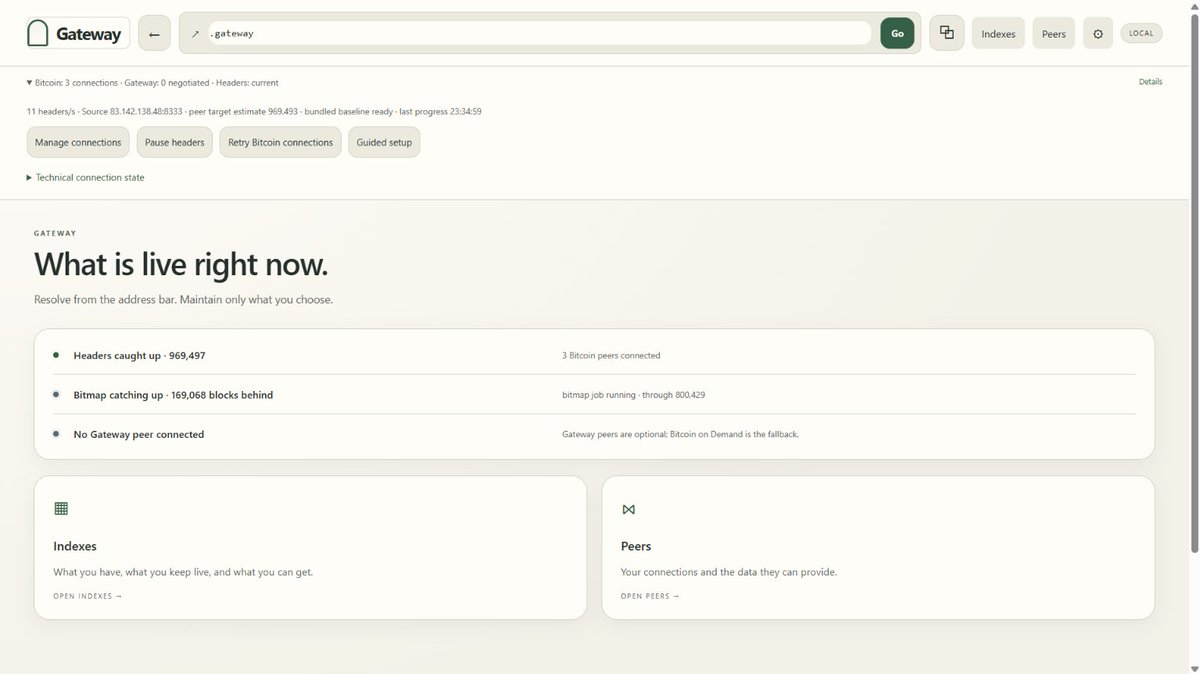
Gateway fetches only the blocks you need from Bitcoin peers and indexes bitmap districts on a normal computer
Bitmap infra no longer depends on anyone's server!
https://t.co/dN1Mx5WiPA
Introducing Gateway...
I've been building a new kind of Bitcoin client.
One that ANYBODY can run regardless of storage.
Fetch only what you need, when you need it.
On-demand, directly from Bitcoin peers.
This is at the heart of Gateway.
Sparse-by-default deep on-demand p2p-Bitcoin indexer.
Now, I recommend you feed this post your favourite AI and have it talk to you directly about it, because I'm about to get into the weeds. And I'm very excited, so it's probably better you ask your AI how this applies to you, rather than leaving a comment that it's too complicated or that you don't understand. With that being said, if you're happy to go hardcore old-school style, and actually... read the thing, here it is!
BITCOIN PEERS
Traditionally, Bitcoin clients sync nodes by requesting blocks from other peers one-by-one, from zero.
This is somewhat impractical for everyday users.
Gateway does things differently.
You can certainly sync the entire blockchain using Gateway, and become a full Bitcoin Node, and a useful Bitcoin Peer. You can even bring your existing Core node and plug it in if you already have one.
But that's not the interesting part.
The interesting part is that you don't need that.
Seek data directly from Bitcoin Peers, on-demand.
ON DEMAND
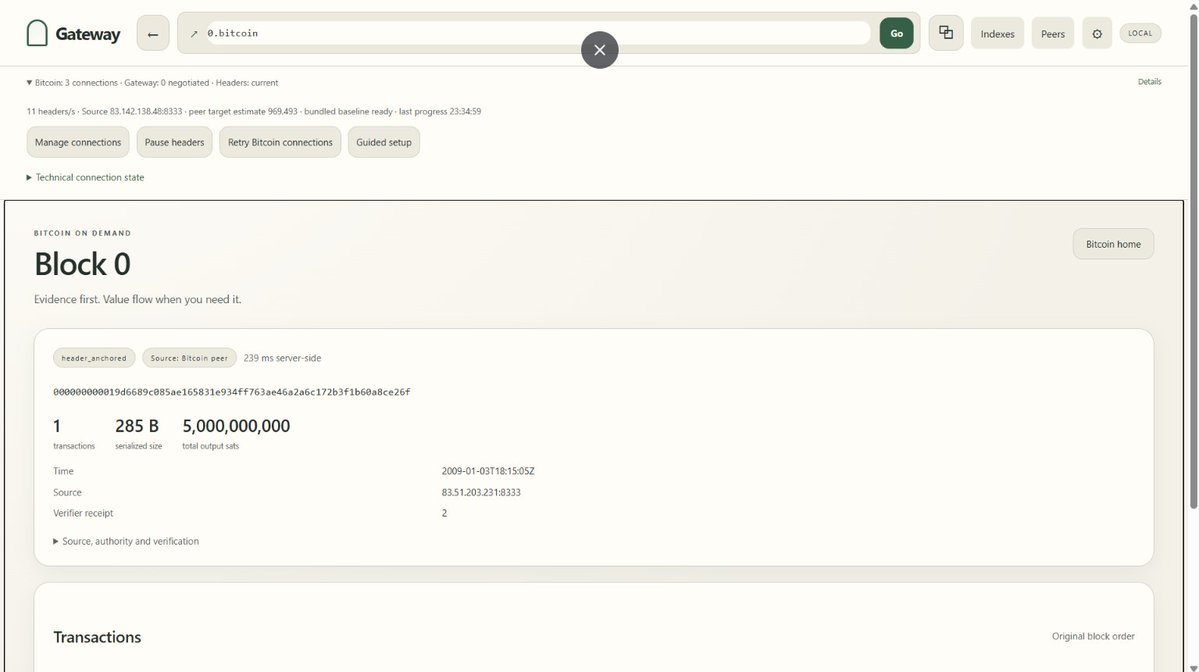
Unlike Core, Gateway does not require you to sync the entire blockchain. You can sync any range, or even just type in a block number in the top bar to fetch the block from a Bitcoin peer directly.
This approach is extremely useful for Blocks, but it has some limitations.
Transactions (and thus, inscriptions) cannot be resolved directly, without knowing the block number. The latter part of that sentence is the important part.
Gateway adds a schema that allows you to type "{tx}.{block}.bitcoin" and resolve a transaction directly from a Bitcoin peer. You can replace {tx} with either tx-hash, or tx-index (which is a new schema for Gateway), and {block} with either block-hash or block-height.
For example: 0.0.bitcoin
This becomes relevant for inscriptions.
An inscription ID is simply:
{tx-id}i{inscription-index}
So you can resolve inscriptions by including block-number in the scheme:
{inscription-ID}.{block}.bitcoin
If you know the transaction index, you can even use that instead of transaction ID in inscription ID.
That means, so long as you know the block number, any inscription can be resolved on Gateway, on-demand, by asking a Bitcoin peer directly.
ORD
When it comes to Ord, this is an extra layer on top of Bitcoin. It is an indexing system that takes Bitcoins already heavy data store, and adds its own index that can take roughly a week to sync.
For the everyday user, this is not practical.
Whilst I've demonstrated how we can fetch inscriptions directly from Bitcoin Peers without Ord, you need to know block number, and the standard in Ord is to use inscription ID, sat number, or inscription number as the key reference.
I've added block in the Gateway schema as a useful primitive that enables purely on-demand inscriptions from Bitcoin peers, but that isn't the current standard.
INDEXES
This is where you can build your own data-store directly from Bitcoin data originated through Bitcoin peers, and either become a useful participant of the network, or take what you need privately.
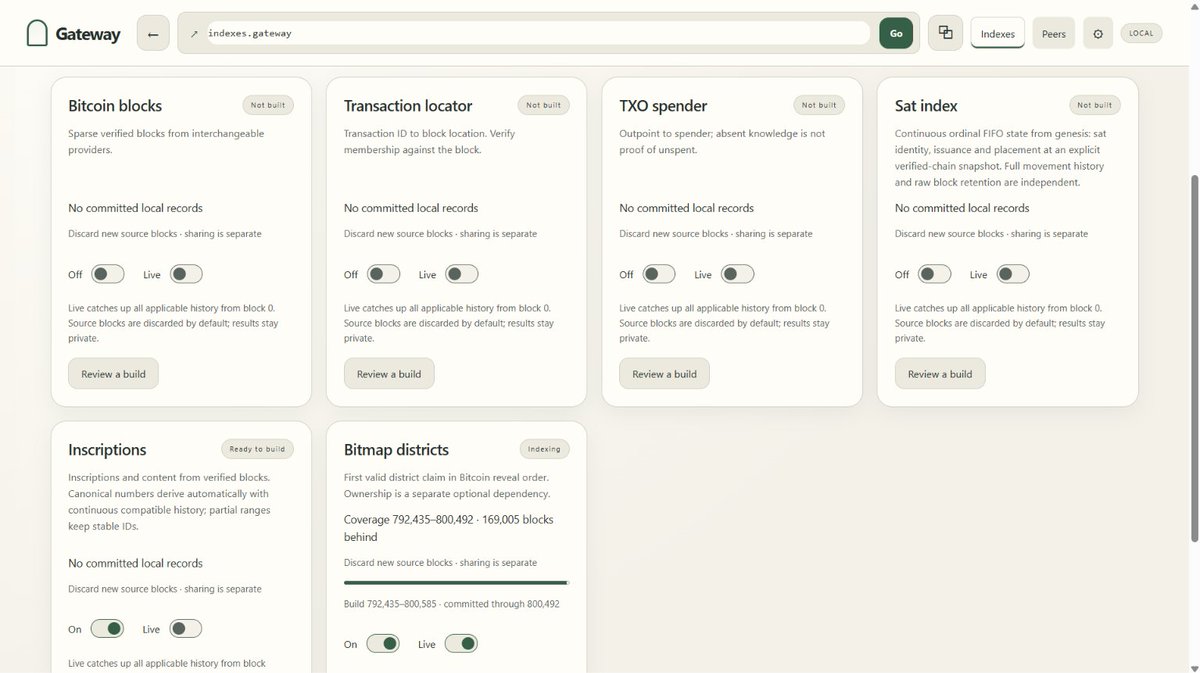
The baseline index is Bitcoin Blocks.
However, you do not need that to resolve the other indexes.
Each index has an "ephemeral" option, which means to seek the blocks you require from peers, strip the data you need, and discard the blocks. This is useful if you're running this on your everyday computer, and can't be spending so many GigaBytes on Bitcoin.
For example, you can index Bitmap without storing a single block.
The indexes are generally layered, so you can choose what you would like to index and when. If you index Bitcoin Blocks, you will be asked if you also want to index the other downstream indexes in parrallel, since it would be quicker to do that than re-run the index.
If you already have a Bitcoin Node, you can build other indexes on top of that.
But you don't have to have the Bitcoin blocks to sync inscriptions, Bitmap, or any other index we implement.
Now, this is still some heavy lifting, but once we start activating the Gateway peer network, we can supercharge these capabilities.
GATEWAY PEERS
Gateway users can connect to each other in a peer-to-peer network, just as in Bitcoin.
That means that, whatever data you need, you can ask Gateway peers directly and skip indexing directly from Bitcoin data, with Bitcoin as the hashed proof verification layer.
So, anything your Gateway node doesn't know, or is impractical for you to find through Bitcoin peers, can be served by Gateway peers.
This vital peer layer can become more useful as we start adding other cases for the Gateway peer network, for example, you could opt-in to become a persistent relay for a Bitmap or Ord gaming webRTC layer. We can even serve this p2p mesh layer to websites and ordinals over the web, so in the future, you will be able to connect to gateway from a website, or from an Ordinals inscription.
For now though, it requires the Gateway client. But the dream is that you can become a useful OR private participant in Gateway from different angles.
LONG STORY SHORT
A sparse-by-default on-demand bitcoin node, with full-range indexing and p2p sharing with gateway nodes.
EARLY RELEASE TESTERS
I am seeking early testers who are happy to put the client through the ringer, vet the data, or just try and break the thing so we can make sure we ship a proper robust client.
You can comment on this post if you're interested, and I'll share details when it's ready for testing.
At this stage, I just wanted to let you know that I have a client, it's working, it's almost ready for testers.
WHAT NOW?
This is just one of the things I've been working on and excited about recently, but it's the one I think is the most important in terms of vital infrastructure that can benefit the entire stack from Bitcoin peers to Bitmappeers.
Stay glued to my timeline for more! 👀
Comment if you want to get involved. 💬
The important part here for $ORDI is protocol owned liquidity (POL)
Every $ORDI trade means the protocol accumulates more ORDI for liquidity
This creates a brand new source of demand for ORDI constantly working in the background
Not to mention the new $ORDI demand for ORDI/TOKEN pools
This is a brand new demand frontier for $ORDI and it is just getting started! 🔥