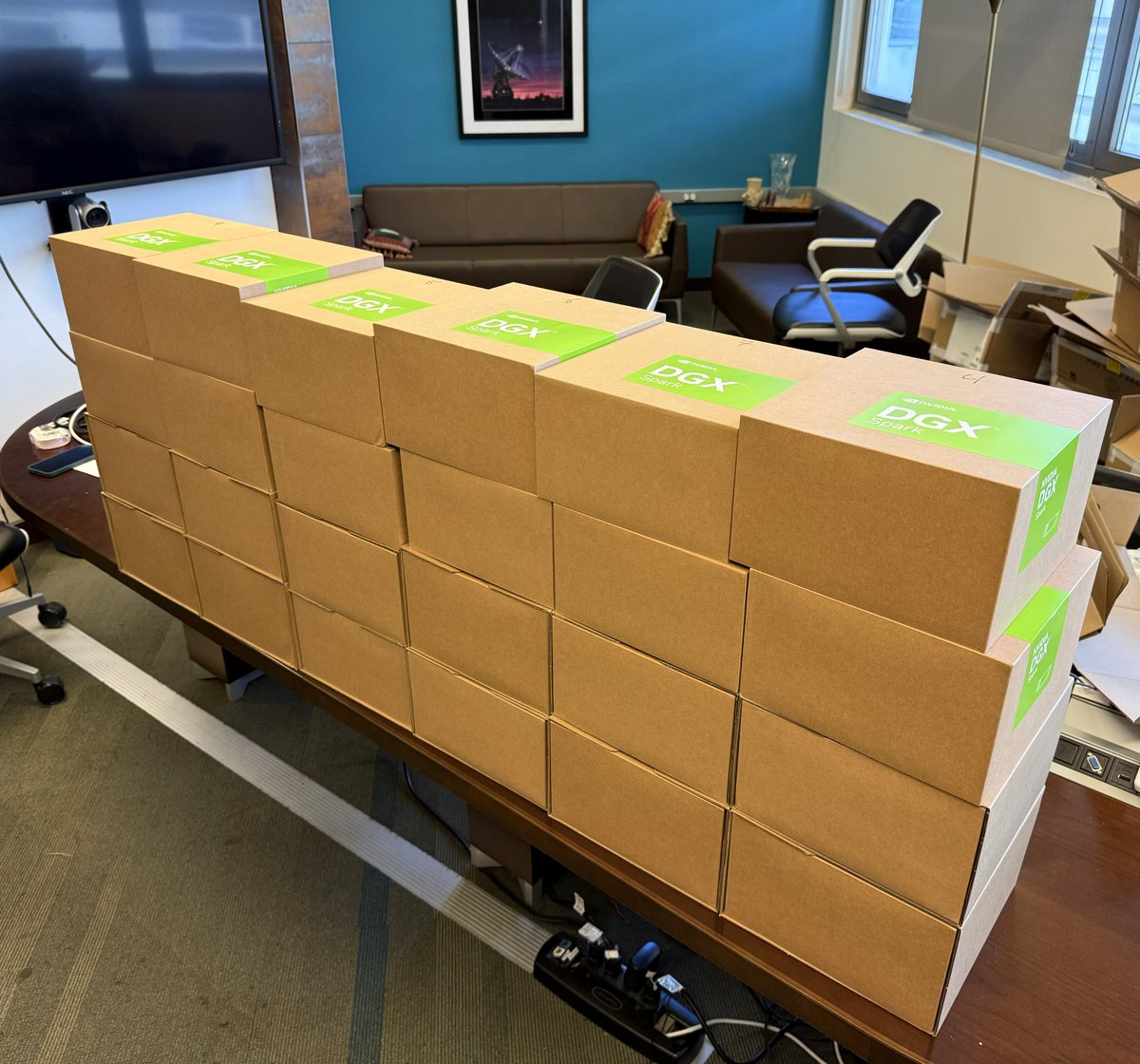
We are confident GPU-accelerated signal processing is the future of radio astronomy. Our Stelline Developer Kit, based on @NVIDIAAI DGX Spark, lets us develop compute and networking capabilities locally before deploying to observatories.
First units headed to scientists now!
"Whether we are alone in the universe – whether other intelligent, technological civilizations are also out there ... [is] the most compelling question in science" says @Mike_Garrett in an interview with @RoyalAstroSoc Astronomy and Geophysics magazine https://t.co/GwcVjCAuUJ
Throwing our hat in the ring for making better distributions for generative modelling, representation learning and data driven discovery for science! 👀🧵[1/13]
Our new paper from @brkthroughprize Listen @OxfordPhysics graduate student Brian Rogers explores how guided latent flow matching can be used to uncover information buried in large datasets: https://t.co/DSeVCElAAA
Wits University School of Physics is looking for a PhD applicant to study dark matter searches with radio telescopes under the supervision of Dr. Geoff Beck. The PhD is funded by Wits and comes with the opportunity to travel to CNRS in France to work with the astroparticle physics group there.
Applications/enquiries can be sent to [email protected]
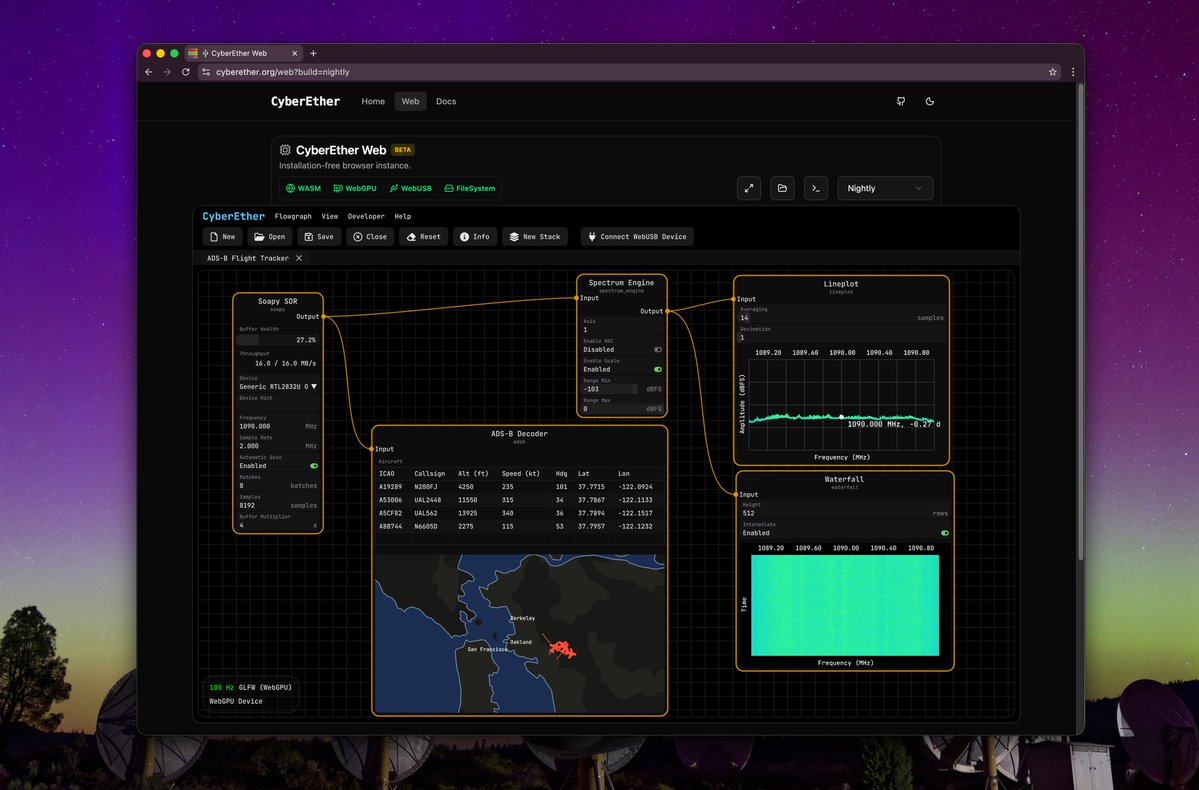
You can track flights with ADS-B from your Chrome-based browser using CyberEther Web and a RTL-SDR. No drivers, just WebUSB + WebGPU + Web Assembly. https://t.co/qIYyJlu3Cq
Hidden pulsars.
A supermassive black hole.
A new candidate signal.
What’s happening at the heart of the Milky Way?
SETI Live, today at 2:30 pm PST with William J. Welch Postdoctoral Fellow Karen Perez.
Join us and bring your questions!
WATCH LIVE: https://t.co/ecDwpDklzv
NEW: Breakthrough Listen, NSF Green Bank Telescope Probe Galactic Heart for Hidden Pulsars
Astronomers using the GBT have discovered a possible millisecond pulsar - if confirmed, the first found in the Milky Way's Galactic Center. @brkthroughprize
https://t.co/8yRWJv8SOh
Researchers from @Columbia and Breakthrough Listen have published new results from the Breakthrough Listen Galactic Center Survey. The survey identified an intriguing pulsar (MSP) candidate near the supermassive black hole Sagittarius A*.
https://t.co/AAUCCWHqVq
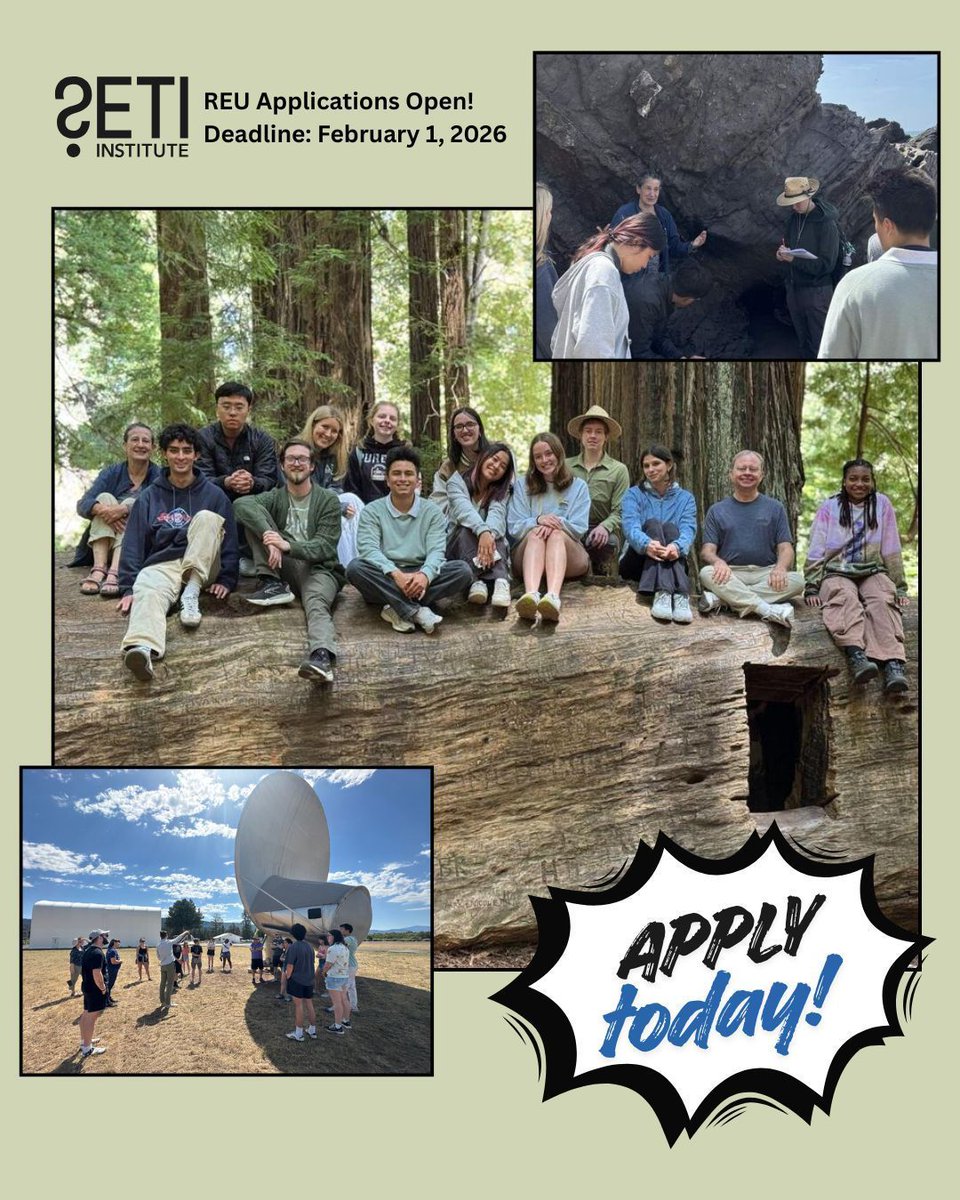
DEADLINE APPROACHING: It's that time of year! The SETI Institute, a non-profit private scientific research institution located in California’s Silicon Valley, invites you to apply for a summer Research Experience for Undergraduates program for highly motivated students who are interested in research related to astronomy, astrobiology, and planetary science. You will work with scientists at the SETI Institute and NASA Ames Research Center. Research topics span the field of astrobiology, from microbiology to planetary geology to observational astronomy.
The application deadline is February 1, 2026.
Learn more and apply: https://t.co/BvUhDKApNP
PRESS RELEASE
The SETI Institute announced that nominations are now open for the 2026 Tarter Award for Innovation in the Search for Life Beyond Earth. The Tarter Award recognizes individuals whose projects or ideas significantly advance humanity’s search for extraterrestrial life and intelligence.
Named in honor of Dr. Jill Tarter, SETI Institute co-founder and leader in the field of SETI research, the award celebrates contributions across science, technology, education, art, philosophy, law and ethics that support the SETI Institute’s mission to search for life and intelligence beyond Earth. Tarter received the inaugural Tarter Award in 2024.
“The SETI Institute’s Tarter Award recognizes innovators whose creativity produces a concept that helps improve the search for intelligent life beyond Earth, even though its original purpose was something entirely different,” said Tarter. “Although the Keder Welt was invented so long ago that no official inventor has ever been identified, the person who came up with that exceedingly efficient way of attaching fabric sails to a ship’s mast has greatly improved the antennas of the Allen Telescope Array, allowing a radome cover to protect the sensitive electronics at the heart of the signal detection system. We are looking for other creative individuals and their creations that we can use in unexpected ways to do our mission better.”
The Tarter Award is open to any individual or individuals whose innovative work has demonstrably impacted the search for life beyond Earth. For serious consideration, a nominee's contributions should generally have been published, at least in part, in peer-reviewed journals or subjected to an equivalent expert review.
The nomination period opens on January 15, 2026, with a deadline of March 31, 2026.
Learn more: https://t.co/oBFbQM0y1k
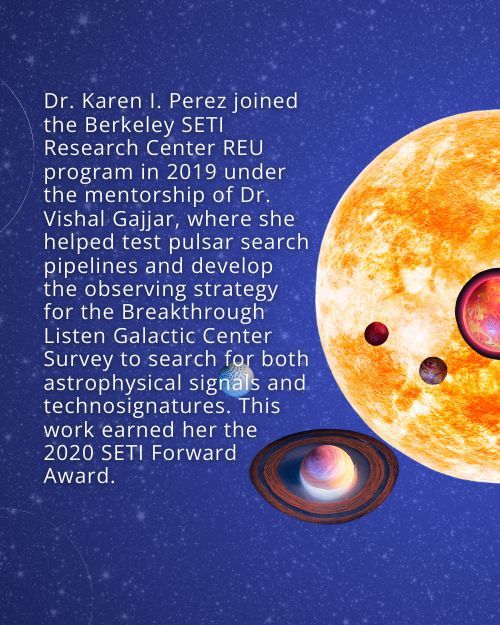
Dr. @Karen_I_Perez joined the @BerkeleySETI Research Center REU program in 2019 under the mentorship of Dr. Vishal Gajjar, where she helped test pulsar search pipelines and develop the observing strategy for the Breakthrough Listen Galactic Center Survey to search for both astrophysical signals and technosignatures. This work earned her the 2020 SETI Forward Award.
As the 2025 Jack Welch Postdoctoral Fellow at the SETI Institute, Dr. Perez works on developing real-time, machine learning and GPU-accelerated analysis pipelines for detecting single-pulse transients, as well as narrowband and broadband technosignatures using the Allen Telescope Array in Hat Creek, CA.
Not Just Aliens is the SETI Institute’s weekly series featuring scientists exploring astrobiology, heliophysics, planetary science, and more — expanding the search for life beyond Earth. And sometimes, we feature scientists looking for technosignatures!
#Astrobiology #SpaceScience #SETI #NotJustAliens #SometimesAliens
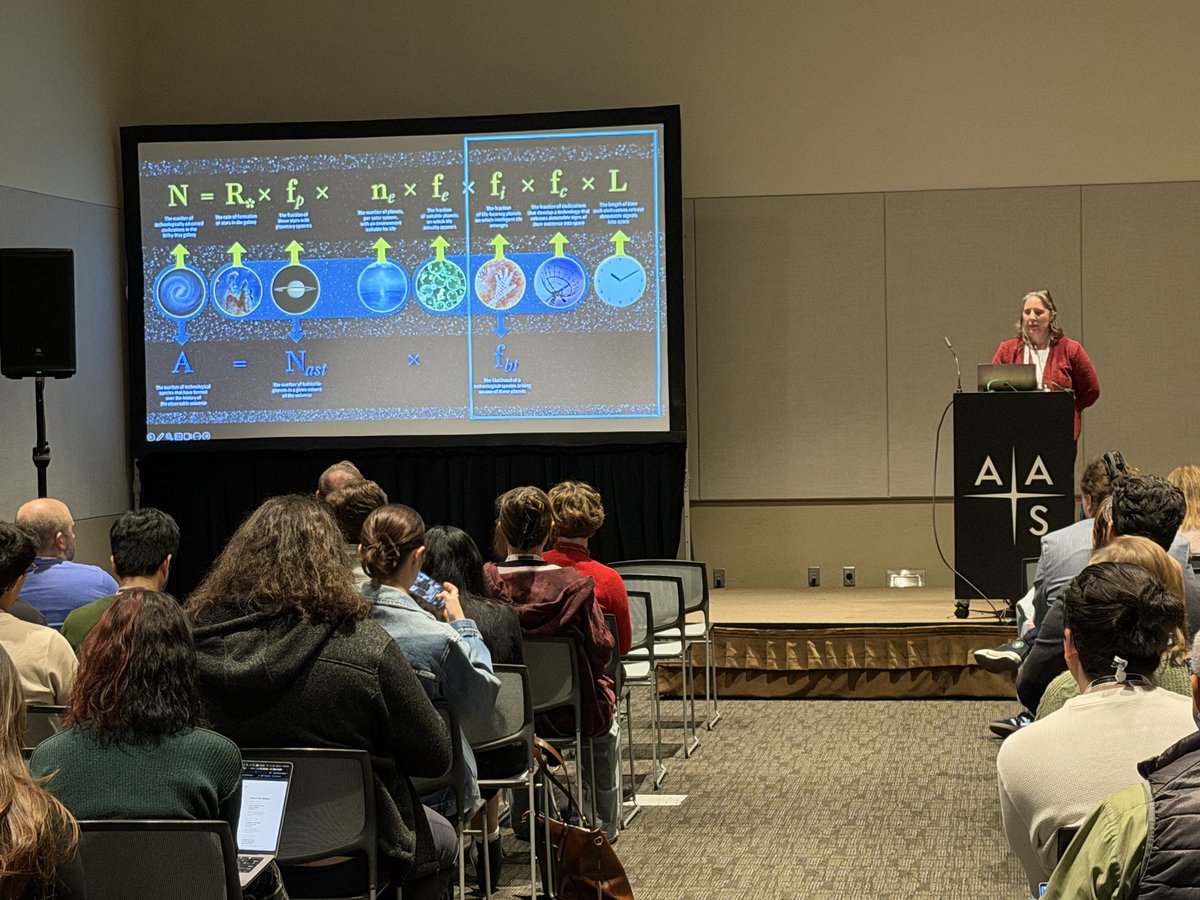
Prof. Chenoa Tremblay (COSMIC and BLUSE Project Scientist) presenting SotA technosignature searches on the VLA and MeetKAT at AAS 247! @TheNRAO@SKA_Africa
Technical papers just dropped: https://t.co/ssrOMnbZvH and https://t.co/TeIuYcW6up - both were lead by former Berkeley SETI interns. Applications for summer 2026 are open at https://t.co/i9GIS8xWJk
No-one would be more excited than us if 3I/ATLAS was a spaceship. But we've been looking at it since shortly after it was discovered, and there's no sign it's anything other than a natural (albeit interesting) object. https://t.co/T3B2t6Kk2E