Our mission is to lead humanity's quest to understand the origins and prevalence of life & intelligence in the universe and share that knowledge. #notjustaliens
🌍 What makes a planet habitable? And how can studying planetary climates help us understand the possibility of life beyond Earth?
The SETI Institute and @UniofOxford are launching a new three-year postdoctoral fellowship in planetary climate and habitability!
This joint fellowship will support independent research into exoplanets, planetary atmospheres, climate, and the conditions that could allow life to emerge and survive.
The selected researcher will be based at Oxford, collaborate with scientists at both institutions, and help advance our understanding of potentially habitable worlds.
📅 Applications close December 15, 2026.
🔗 Learn more: https://t.co/mm2sv25jCm
#Exoplanets #Astrobiology #PlanetaryScience #ResearchFellowship #SETIInstitute
#PPOD: The Star That Keeps Surviving Its Explosions 🌟
Deep within the spiral galaxy NGC 4559, approximately 30 million light-years from Earth, a massive star has been putting on a spectacular show. Known as AT 2016blu, the star is at least 33 times as massive as our Sun and has undergone repeated, dramatic increases in brightness. These outbursts resemble supernova explosions, but unlike a true supernova, the star survives each event. This composite image combines optical observations from the Sloan Digital Sky Survey with X-ray data from NASA's Chandra X-ray Observatory, highlighting the region where this extraordinary star resides.
New Chandra observations suggest that AT 2016blu has a previously hidden companion, either a neutron star or a stellar-mass black hole. Approximately every 113 days, the two objects approach one another, allowing the compact companion to capture material expelled by the massive star. As this material spirals inward, it heats up and emits powerful X-rays, which may heat surrounding gas and produce the brilliant visible-light outbursts. The discovery offers new insights into the complex interactions between massive stars and their companions, and the processes that may precede a genuine supernova.
Credit: X-ray: @NASA / CXC/Univ. of Virginia/M. Aghakhanloo et al.; Optical: SDSS; Image Processing: NASA/CXC/SAO/P. Edmonds
#astronomy
👽 What if the secret to finding alien signals isn't WHERE we look, but WHEN we listen?
SETI Institute scientists are using game theory to explore how civilizations separated by light-years might independently choose the same moments to communicate.
📡 TODAY on SETI Live, Dr. Sofia Sheikh joins host Dr. Lauren Sgo to discuss Schelling points, cosmic timing, and how the Allen Telescope Array is helping researchers investigate this fascinating approach to the search for extraterrestrial intelligence.
🔴 Join us LIVE at 2:30 pm PST (5:30 pm EST)!
Watch here: https://t.co/63H5WbFSdz
#SETILive #SETI #ExtraterrestrialIntelligence #GameTheory #Astronomy
#PPOD: A World All Its Own 🪐
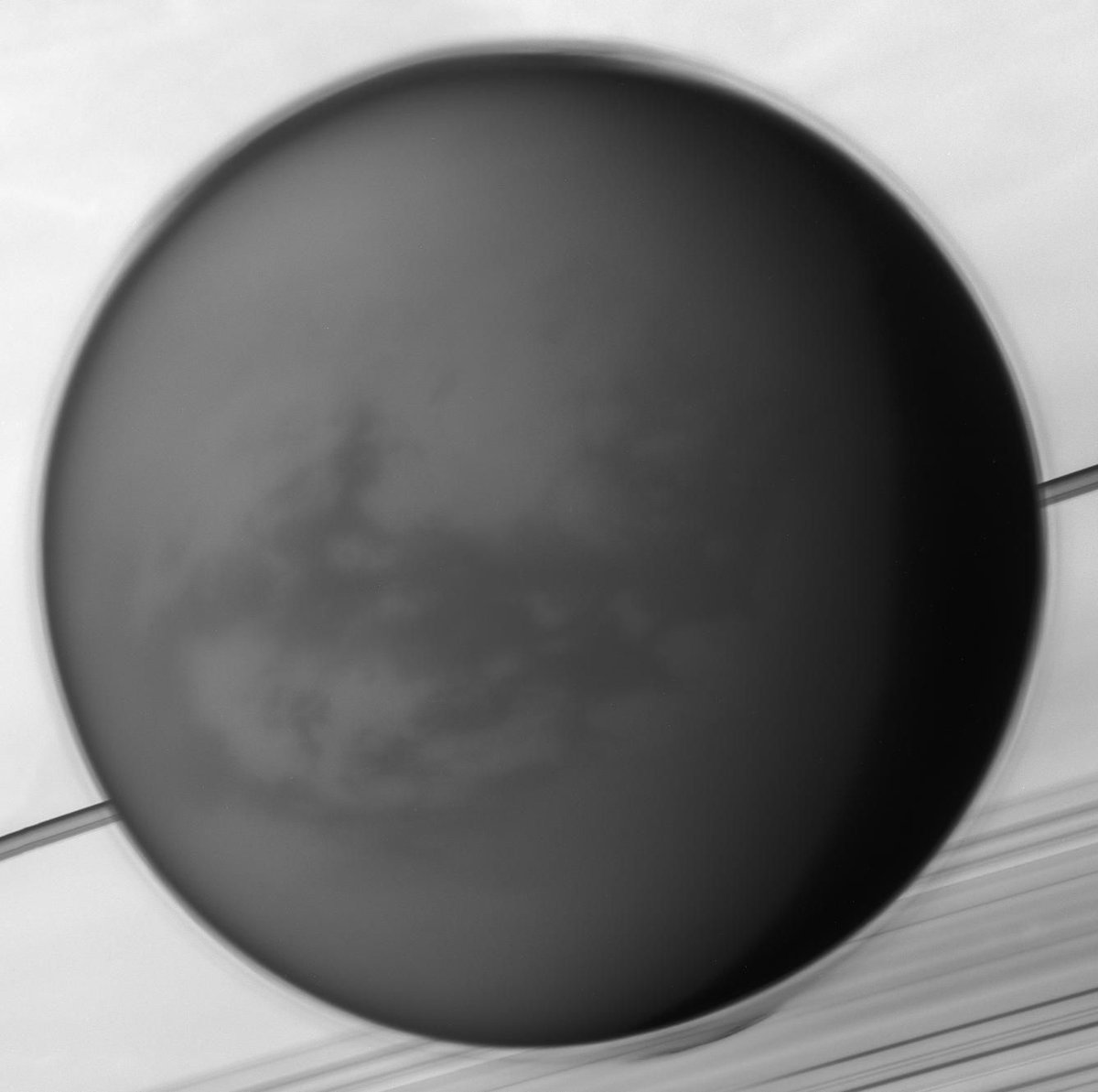
Saturn's largest moon, Titan, appears suspended against the giant planet and its rings in this remarkable view captured by NASA's Cassini spacecraft on May 6, 2012. Measuring about 5,150 kilometers across, Titan is larger than Mercury and is the only moon in our solar system with a substantial atmosphere. A delicate, detached layer of atmospheric haze is clearly visible around its edge and becomes increasingly complex near the poles.
Titan's thick, nitrogen-rich atmosphere contains methane and a complex mixture of organic compounds produced by sunlight-driven chemistry. These reactions create the atmospheric haze that obscures much of the moon's surface in visible light. Beneath that veil lies a remarkable landscape of dunes, mountains, and lakes and seas of liquid methane and ethane. This mosaic of four images, captured from approximately 770,000 kilometers away, looks toward the dune-filled region known as Shangri-La, where ESA's Huygens probe landed in January 2005.
Credit: @NASA@NASAJPL@Caltech@spacescienceins
#planetaryscience
🌌 From the Big Bang to Planet Earth: What can the universe's history tell us about its future?
Join @ucsc astrophysicist Dr. Alexie Leauthaud for a free public lecture on dark energy, recent DESI discoveries, and the mysteries of our evolving universe.
Presented by the SETI Institute and Silicon Valley Astronomy Lectures (SVAL).
📅 TONIGHT, Wednesday, November 18, 2026
🕖 7:00 p.m. PST
📍 Smithwick Theater, Foothill College, Los Altos Hills, CA
🎟️ Free and open to the public!
Learn more: https://t.co/QiaOkYNnFo
#Astronomy #Cosmology #DarkEnergy #SETIInstitute
🚀 One light-day from Earth. Nearly 50 years of exploration.
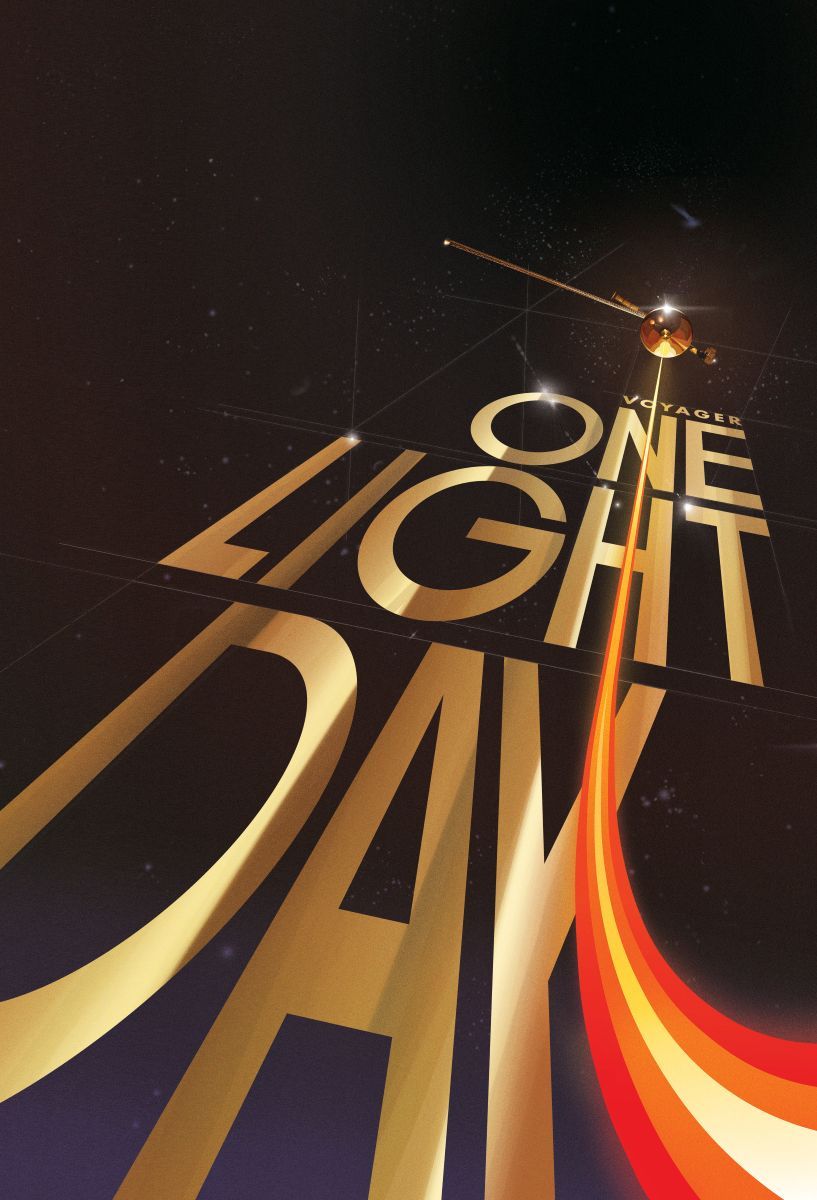
NASA's Voyager 1 has reached an extraordinary milestone: approximately 25.9 billion kilometers from Earth, so distant that a radio signal takes an entire day to reach it.
SETI Institute planetary scientist Dr. Pascal Lee joined Jesse Weber to reflect on Voyager's remarkable journey, its scientific legacy, and the Golden Record it carries into interstellar space.
Could an extraterrestrial civilization ever discover that message from humanity? The odds are extraordinarily slim, but the possibility remains fascinating.
🎥 Watch the conversation: https://t.co/RAIV5NaJIw
#Voyager1 #SpaceExploration #GoldenRecord #SETIInstitute
🚀 One light-day. Nearly 50 years. One extraordinary journey.
Today, November 18, 2026, NASA's Voyager 1 will become the first human-made object to reach one light-day from Earth—approximately 25.9 billion kilometers away.
That means a radio signal traveling at the speed of light takes 24 hours to reach the spacecraft. A reply takes another 24 hours.
Launched in 1977, Voyager 1 continues its journey through interstellar space, carrying humanity's Golden Record and sending scientific data home.
Nearly half a century later, we're still listening.
🔗 https://t.co/jPEdTqDvtb
#Voyager1 #SpaceExploration #InterstellarSpace #NASA #SETIInstitute
#PPOD: Mars' Remarkable Morning Cloud ☁️
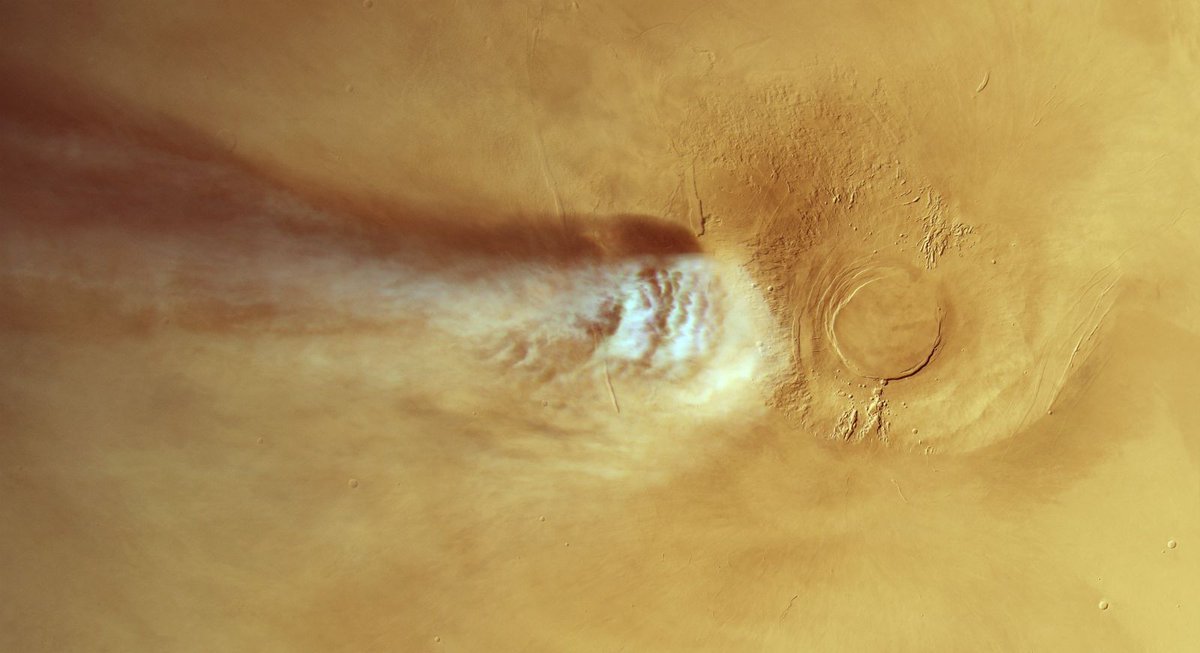
A long, wispy cloud stretches across the Martian landscape in this image captured by ESA's Mars Express spacecraft on June 24, 2024. Known as the Arsia Mons Elongated Cloud, this remarkable formation extends approximately 980 kilometers downwind of Arsia Mons, a volcano that rises about 20 kilometers above the surrounding terrain. The cloud is made of water ice, not volcanic emissions, and its shadow is visible on the surface below.
Unlike most clouds on Earth, this enormous formation follows a remarkably predictable daily cycle. During certain seasons, it develops in the early Martian morning, grows to lengths of up to 1,800 kilometers, and then rapidly evaporates as temperatures rise. Scientists are investigating how atmospheric conditions near Arsia Mons allow water vapor to form ice particles, including a process called homogeneous nucleation. Understanding this unusual cloud helps researchers study water behavior and the complex dynamics of Mars' thin atmosphere.
Credit: @ESA@DLR_en@FU_Berlin
#planetaryscience
🪐 Imagine an object as massive as Jupiter — but made almost entirely of dust.
Sounds bizarre? That's just one possibility emerging from new research on how planet-mass objects might form in the dusty environments around supermassive black holes.
In this clip from SETI Live, researcher Wladimir Lyra explains why these hypothetical objects would be unlike the planets we're familiar with.
🎧 Hear the full conversation with Bhupendra Mishra, Wladimir Lyra, and SETI Institute scientist Dr. Lauren Sgro, now available as a podcast!
https://t.co/75XAdaFpAs
#SETILive #BlackHoles #Exoplanets #Astrophysics #Astronomy
🔭 What if your backyard telescope could help people around the world explore the universe?
@Unistellar and @Skymapperspace have announced a partnership that lets owners of compatible Unistellar smart telescopes connect their instruments to a global observing network through SkyBridge.
The network will enable users to share telescope time, observe remotely from locations worldwide, and contribute to collaborative astronomical research.
SETI Institute astronomer @AllPlanets, co-founder and CEO of SkyMapper, is helping bring this vision of connected, accessible astronomy to life.
🌍 Learn more: https://t.co/N4aEiImoq2
#Astronomy #CitizenScience #Unistellar #SkyMapper #SETIInstitute
#PPOD: A Changing Amazon Delta 🌎
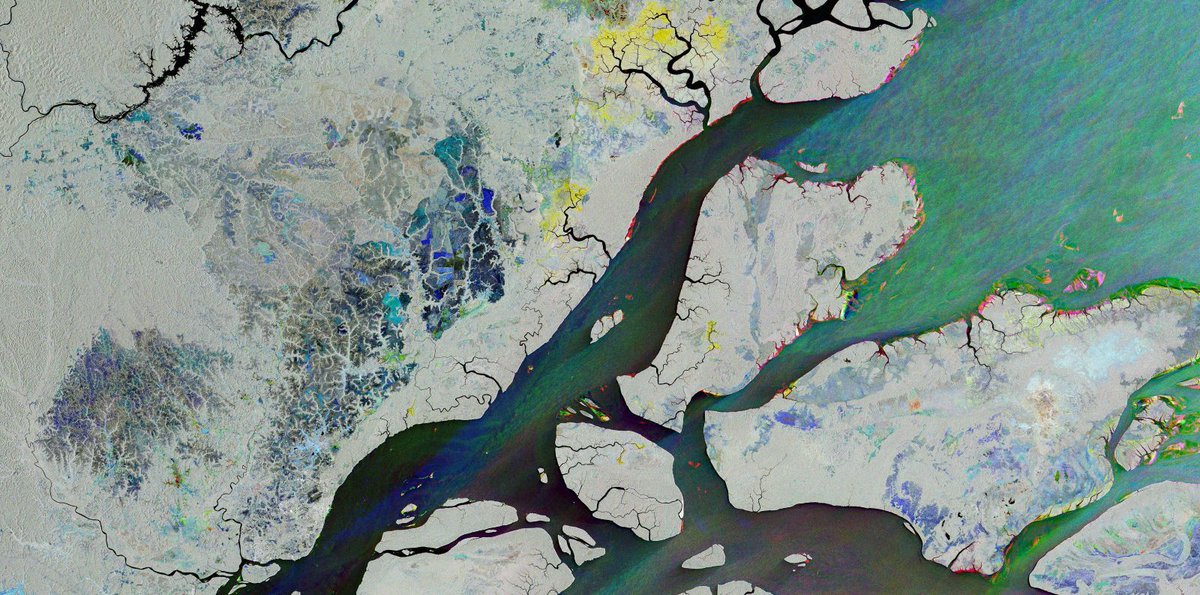
The Amazon River meets the Atlantic Ocean in this colorful radar image captured by Europe's Copernicus Sentinel-1 mission. The city of Macapá, Brazil, sits near the lower left of the image, surrounded by rainforest, mangroves, and an intricate network of waterways. Located almost directly on the equator, Macapá appears in grey, while brilliant patches of blue, green, and red reveal changes across the surrounding landscape.
This image combines radar observations from August 15, September 20, and October 26, 2026, assigning a different color to changes detected on each date. Blue areas may indicate vegetation growth, while red regions along riverbanks and islands suggest shoreline changes. Even boats appear as tiny colored blocks in the water! Unlike ordinary cameras, Sentinel-1 uses radar to observe Earth's surface through clouds and darkness, helping scientists monitor changing environments, agricultural activity, and coastal landscapes in one of the world's most dynamic river systems.
Credit: Contains modified Copernicus Sentinel data (2026), processed by @ESA
#planetaryscience
#PPOD: Early Risers 🌄
A slender crescent #Moon and brilliant #Venus rise together over the Andes in this beautiful photograph taken at dawn on November 7, 2026, from ESO's Paranal Observatory in Chile. Below the celestial pair, the Llullaillaco volcano rises more than 6,700 meters above sea level, its summit capped by clouds. The volcano lies approximately 190 kilometers from the observatory, while the Moon and Venus appear almost close enough to touch.
Despite their apparent proximity, the two worlds were separated by an enormous distance. The Moon was approximately 390,000 kilometers from Earth, while Venus was about 45 million kilometers away. Both appeared as crescents because we were viewing mostly their unilluminated hemispheres, although Venus's crescent was too small to distinguish with the naked eye. ESO astronomer Luca Sbordone captured the scene after finishing a night of observations at the Very Large Telescope, a reminder that even astronomers studying the distant universe can find extraordinary sights waiting just outside.
Credit: L. Sbordone / @ESO
#planetaryscience
☀️ What would happen if the Sun unleashed a superflare?
An extraordinarily powerful solar eruption could disrupt satellites, damage electrical infrastructure, and trigger intense geomagnetic storms. But what would it mean for people here on Earth?
In this week's #SETILive, SETI Institute heliophysicist Dr. Becca Robinson asks Dr. Valeriy Vasilyev of the Max Planck Institute for Solar System Research about the potential consequences of a solar superflare.
🎥 Watch this clip, then catch the full conversation: https://t.co/eb23cIdCr2
#SolarScience #SpaceWeather #Astronomy
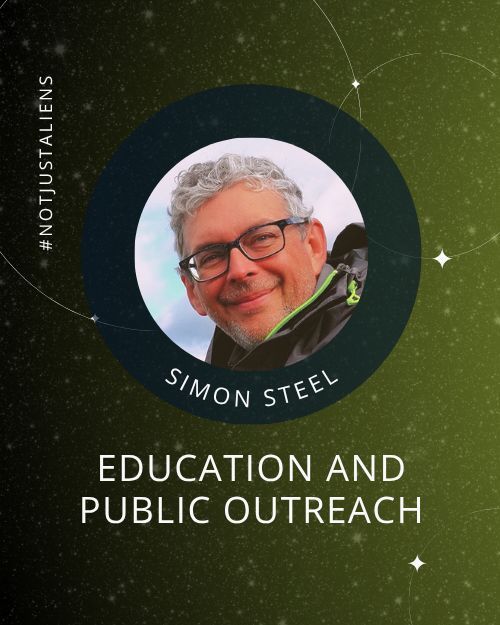
Dr. Simon Steel is Deputy Director of the Carl Sagan Center for Research at the SETI Institute. As an observational astrophysicist, he specialized in optical spectrophotometry and was interested in the star formation histories of galaxies.
Simon bridges the gulf between the complexities of modern space science and the public fascination with the wonders of the Universe. An award-winning lecturer and teacher, Simon has presented on all aspects of the cosmos, from black holes to aliens to Stonehenge, at museums, universities, NASA centers, and aboard cruise ships.
Not Just Aliens is the SETI Institute’s weekly series featuring scientists exploring astrobiology, heliophysics, planetary science, and more — expanding the search for life beyond Earth.
#Education #PublicOutreach #Space #Science #SETI #NotJustAliens
👽 What if aliens are waiting for the right moment to call?
Searching for extraterrestrial intelligence isn't just about where we point our telescopes. It might also be about when we listen.
SETI Institute researchers are using game theory to explore how two civilizations might independently choose the same time or place to communicate, even without knowing the other exists.
📡 Join SETI Institute research scientist Dr. Sofia Sheikh and host Dr. Lauren Sgro for a fascinating discussion about Schelling points, cosmic timing, and how the Allen Telescope Array is helping test this approach.
🔴 SETI Live | Thursday, November 19, at 2:30 pm PST (5:30 pm EST)
Watch live: https://t.co/63H5WbFSdz
#SETILive #SETI #GameTheory #ExtraterrestrialIntelligence #Astronomy
🪐 What happened to Neptune's original moons?
Neptune's largest moon, Triton, may have arrived as an outsider, disrupting an earlier moon system. Most may have been destroyed or scattered, but one moon, Nereid, could have survived that ancient upheaval.
In this episode of SETI Live, host Dr. Moiya McTier talks with researcher M. Ryleigh Davis about the turbulent history of Neptune's moons and what their remnants can reveal about the distant planet's past.
🎧 Listen to the full conversation: https://t.co/ROjSYOhk3N
#SETILive #Neptune #PlanetaryScience #Astronomy
#PPOD: A 4.1-Billion-Year-Old Piece of Mars ☄️
This slice of a Martian meteorite holds clues to the Red Planet's earliest history. Named Teghaza 001 after the region of Mali where it was discovered in 2022, the meteorite formed more than 4.1 billion years ago, making it one of the oldest known pieces of Mars on Earth. This reflected-light image reveals a variety of minerals, including iron-titanium oxides, pyroxene, and plagioclase transformed by the intense pressures of an impact. Scientists use images like this to identify minerals for detailed laboratory analysis.
Teghaza 001 preserves evidence of Mars' ancient volcanic crust and its interactions with water. Researchers determined that Martian water altered the rock about 4.1 billion years ago, suggesting it formed even earlier. Eventually, a powerful impact blasted it off Mars, sending it on a journey through space before it landed on Earth. By studying its mineral composition and age, scientists can reconstruct conditions on early Mars and investigate how the planet's water and geology evolved.
Credit: @NASA@NASAJPL@Caltech
#planetaryscience
🚀 Looking to strengthen your science proposal-writing skills?
Join SETI Institute scientists Christina Richey and Brandon Rodriguez at #AGU26 for an in-person workshop focused on communicating science effectively in federal funding proposals.
📅 Sunday, December 6, 2026
🕣 8:30 a.m.–5:00 p.m.
📍 AGU Annual Meeting — in person only
Learn practical approaches to proposal development, scientific storytelling, and building resilience in a challenging funding landscape.
If you're attending AGU, don't miss this opportunity to sharpen your skills!
🔗 https://t.co/I1ORilJryq
#ScienceCommunication #ResearchFunding #SETIInstitute