@dailychartbook@ChiefChartmaker 75% of all S&P500 profits and 40% of all capex are generated by a hanfull of tech / AI leaders (AI 35% vs rest 9% NI margins) The dramatic growth in what is largelly circular capex decreases FCF.
@WarrenPies Growth pushed higher than would otherwise be if the comparison would be in real terms. An increase in inflation causes revenues to rise faster than labour costs and financing as these lag inflation increasing a company's leverage and expanding margins thus increase earnings.
Las week a Moodys recesion indicator stoot at 49.5, having risen from very low values recently. Historically whenever this indicator surpassed 50 an economic recession followed within 12 months.
🇺🇸 Recession
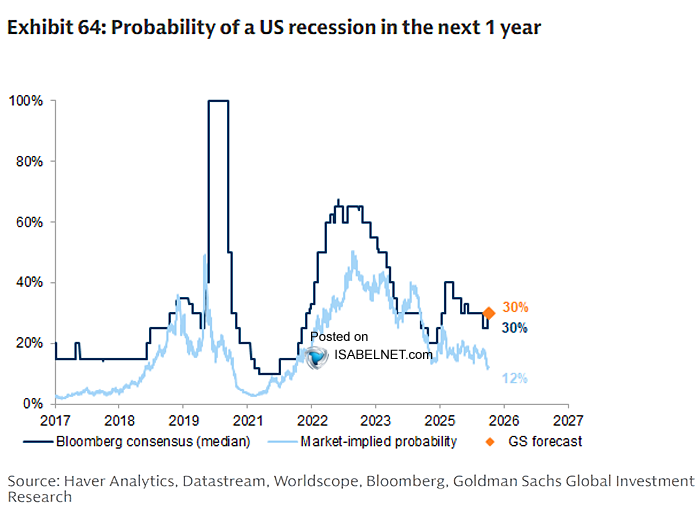
Markets are pricing in just a 12% risk of a US recession within a year, but Goldman Sachs remains more cautious, putting the likelihood at 30%. Are markets a bit too optimistic?
👉 https://t.co/m11iBkSWhc
h/t @GoldmanSachs $spx #spx#recession#stocks#equity
@ReneSellmann Correct me if wrong but I guess that to compare returns of an active manager to the S&P500 index you may need to adjust the index annual return for the selection or removal of stocks ("survivor bias") as it adds +1.6%, compare them on a risk adjusted basis and in real terms.
@KobeissiLetter Dispersion in stock returns rises whith increase unceirtanty and when nearing bear markets. Currently dispersion has started to rise yet far from being streched.
@ethanrkho The millenium model on its fundation relies on a strick trader selection process and a proprietary dynamic risk budgeting approach to allocate capital. In the pass this methodology resulted in very high turnover of managers and limited capital allocated to a single trader.
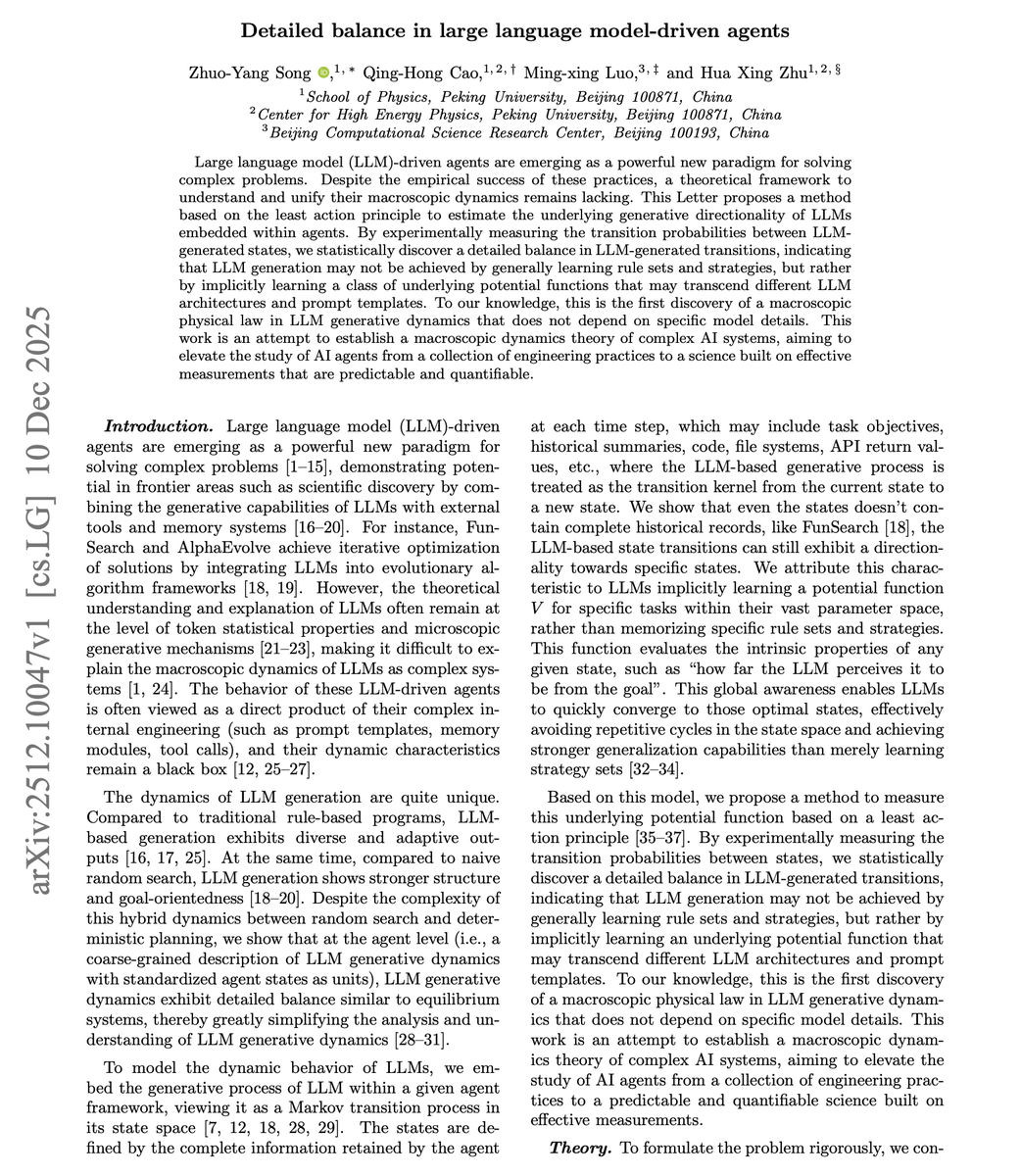
This new paper is wild!
It suggests that LLM-based agents operate according to macroscopic physical laws, similar to how particles behave in thermodynamic systems.
And it looks like it's a discovery that applies across models.
LLM agents work really well on different domains, but we don't have a theory for why.
The behavior of these systems is often viewed as a direct product of complex internal engineering: prompt templates, memory modules, and sophisticated tool calling. The dynamics remain a black box.
This new research suggests that LLM-driven agents exhibit detailed balance, a fundamental property of equilibrium systems in physics.
What does this mean?
It suggests that LLMs don't just learn rule sets and strategies; they might be implicitly learning an underlying potential function that evaluates states globally, capturing something like "how far the LLM perceives a state to be from the goal." This enables directed convergence without getting stuck in repetitive cycles.
The researchers embedded LLMs within agent frameworks and measured transition probabilities between states. Using a least action principle from physics, they estimated the potential function governing these transitions.
The results across GPT-5 Nano, Claude-4, and Gemini-2.5-flash: state transitions largely satisfy the detailed balance condition. This indicates that their generative dynamics exhibit characteristics similar to equilibrium systems.
In a symbolic fitting task with 50,228 state transitions across 7,484 different states, 69.56% of high-probability transitions moved toward lower potential. The potential function captured expression-level features like complexity and syntactic validity without needing string-level information.
Different models showed different behaviors on the exploration-exploitation spectrum. Claude-4 and Gemini-2.5-flash converged rapidly to a few states. GPT-5 Nano explored widely, producing 645 different valid outputs in 20,000 generations.
This might be the first discovery of a macroscopic physical law in LLM generative dynamics that doesn't depend on specific model details. It suggests we can study AI agents as physical systems with measurable, predictable properties rather than just engineering artifacts.
Paper: https://t.co/UO1pMWxctY
Learn to build effective AI Agents in our academy: https://t.co/JBU5beIoD0
@NoLimitGains Breakdown of the 8 trn to refinance in 2026. 5trn < 2 maturities WA coupon 3% 3trn > 2 maturities. WA coupon 2% to 2.5% what is the issue on refinancing? Much higher rates?
@LynAldenContact Pellet production is derived from non comercial forests and sawmill wood waste. The drying wood chips intended to increase its MJ/Kg caloric prior to compacting extracts harmful gasses leaving a carbon neutral product (CO2 released is = to the CO2 absorved) producing 1.7 MJ/KG