Today, I put on my hat as an analyst for a major bank and examined everything Ripple has announced over the past eight weeks—viewing it all as a single, cohesive operation. Because that is exactly what it is. And I need to share what this analysis reveals.
Ripple isn’t just selling crypto products to the banking sector. Instead, it is acquiring, licensing, and connecting every point through which money flows—and then replacing the underlying plumbing with its own infrastructure.
Look at the entire stack, layer by layer:
The money: RLUSD—regulated by New York, with reserves now under the federal oversight of the OCC. It currently stands at $2.5 billion and is growing.
The rails: The XRP Ledger (XRPL)—enabling settlement in 3–5 seconds, 24/7, for mere cents.
The vault: Their own newly approved federal bank, complemented by BNY (Bank of New York) acting as custodian for RLUSD and XRP. BNY holds $63.4 trillion in assets under custody—making it the largest custodian on the planet.
The markets: Ripple Prime (formerly Hidden Road, acquired for $1.25 billion), offering brokerage services, margin, and perpetual contracts.
Treasury management: Ripple Treasury (formerly GTreasury, acquired for approximately $1 billion)—a software platform used by over a thousand corporations to manage their cash, including American Airlines, Subway, and—as of today—Robinhood.
Distribution: Robinhood, with its 28.6 million clients, integrating RLUSD into its app; and DriveWealth, which serves over 100 brokerage firms.
Assets: Money market funds from Franklin Templeton and Aviva, tokenized on the XRPL; global trade invoices via C2FO; and government treasuries, as seen in a pilot program with JPMorgan.
Legitimacy: 85 licenses, a federal charter, the participation of three central banks in the BLOOM project, Cantor Fitzgerald serving as a treasury partner for XRP, and the U.S. Secretary of the Treasury speaking at their conference.
No bank in the world possesses all eight layers. JPMorgan has five; BNY has two; Visa has one and a half. Ripple is bringing them ALL together.
And do you know where the real business lies? In the "float." Every dollar of RLUSD in circulation represents reserves invested in Treasury bills, yielding 4%—a return that, by a stroke of GENIUS, cannot be paid out to the holder. The issuer keeps it. With 2.5 billion in circulation, that amounts to roughly 100 million per year. If Robinhood, Ripple Treasury, and C2FO increase that float tenfold, it becomes a billion-dollar-a-year business—without charging a single commission.
The masterstroke, however, is the method. Back in 2018, Ripple tried to win over banks one by one. Now, they don’t ask for permission: they ACQUIRE companies that already have the payment flows, then overhaul their underlying plumbing. The client doesn’t "migrate" to crypto; one day, they simply discover that the software they’ve always used is now settling transactions on a blockchain.
And where does XRP fit into all this? Pay close attention—this is the crucial part.
Institutional adoption always follows this sequence: you start with a simple product—something any risk department can easily grasp—such as a stablecoin, a tokenized fund, or treasury management software. Once you’re integrated into the rails—once your cash reserves reside there and your payments flow through that system—the final step involves the network’s native asset: XRP. It acts as a bridge, enabling instant currency conversion without the need for "dead money" sitting idle in various countries. It is the asset used to pay the fees for every transaction on the ledger—the toll for the entire highway.
Do you want proof that this final phase is already underway? BNY, the world’s largest custodian, hasn’t just added RLUSD to its platform—it has added XRP. Why would the planet’s largest custodian add support for XRP if its institutional clients weren’t demanding it? No one builds a vault for an asset that no one intends to store.
The current price reflects none of this. And that is precisely where the opportunity lies: the price is always the last thing to catch on. First, the infrastructure is built; then, simple products are introduced; next, volume begins to flow; and finally, the price adjusts to reality. It always happens in that order. We are currently in the third of four phases.
My conclusion is: Ripple aims to be—for tokenized money—what Visa, BNY, the DTCC, and SWIFT are, collectively, for today’s money. $XRP is the native asset of that entire machinery.
⚠️60 SECOND WARNING - YOU HOLD ANY #XRP!!!!
REAL ESTATE VALUED AT $650 TRILLION WILL BE UNLOCKED ON XRP LEDGER IN 48 HOURS USING REALTOKEN ON XRPL!!
$0.003 TO OVER $748.32 FOR REAL TOKEN OVERNIGHT POSSIBLE!
BUY REAL TOKEN ON MEXC: https://t.co/pFYyqwfAhc
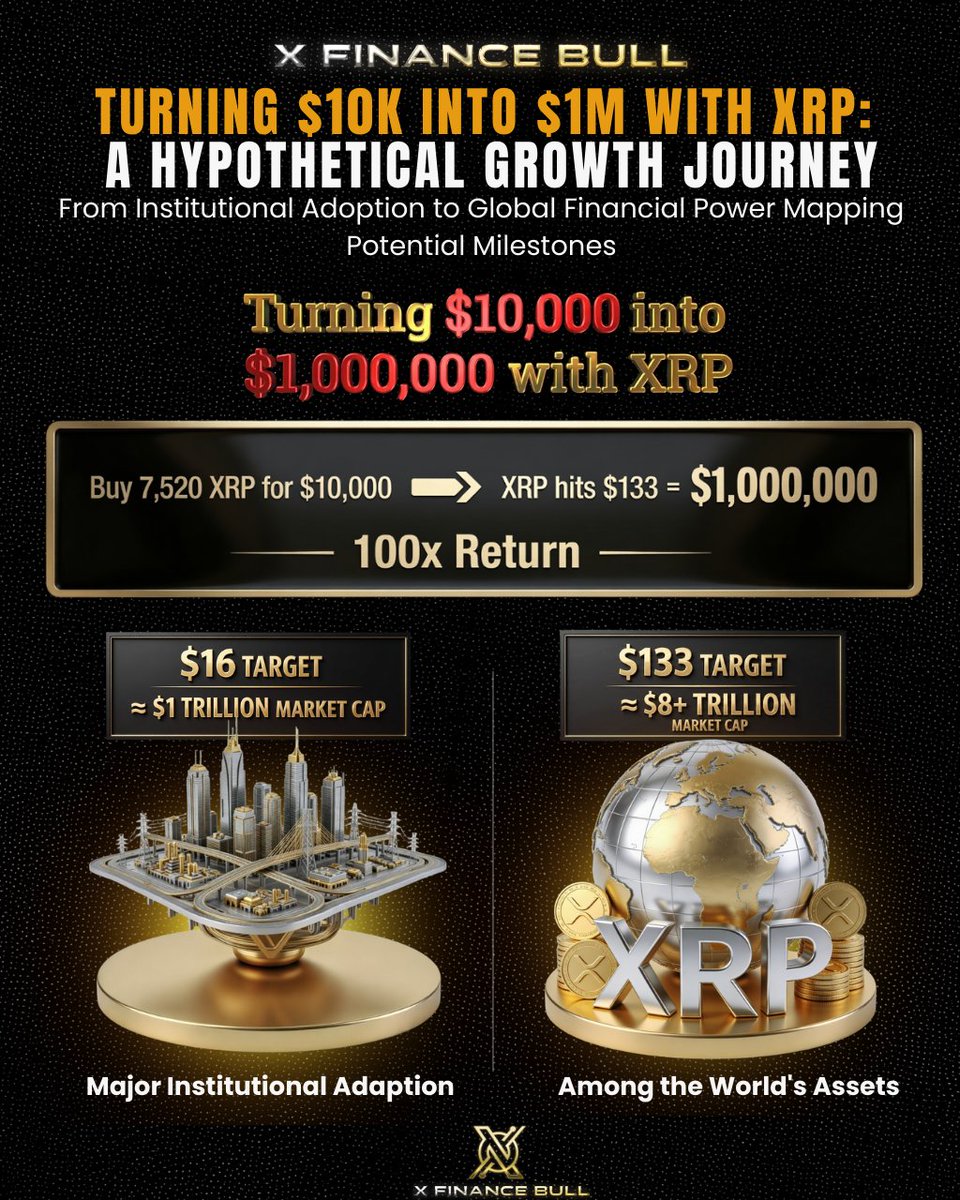
People ask if $10K in $XRP can become $1M
At ~$1.33, $10K gets you about 7,520 XRP.
XRP at $16 = ~$1T market cap. Your position is worth ~$120K. Requires sustained ETF inflows and real institutional settlement volume.
XRP at $133 = ~$8T market cap. Your 7,520 XRP hits $1,000,000.
$8T sounds wild until you look at what $XRP is positioning to settle.
Global FX does $7.5T per day.
Cross-border payments exceed $150T annually.
Ripple National Trust Bank. RLUSD live. ETFs at $1.25B. Hidden Road clearing $3T+ through DTCC.
I'm not predicting. I'm showing the math and the infrastructure behind it.
You decide.
Repost if you’ve already decided on $XRP
🚨 MASSIVE ALERT 🚨
A GIANT billboard just dropped in NYC:
XRP 💳 Mastercard – 8.25.25 👀
👉 Issued by WebBank
👉 Teased by @Gemini: “Prepare your bags”
Mass adoption for #XRP is coming FAST. 💥
August 25, 2025 could change EVERYTHING. 🚀
If you put $10k👉only three (3) years ago, your best return today:
🏆🏆🏆XRP: $77,716
🏆🏆Bitcoin: $52,450
🏆ETH: $19,087
The reality is ... #XRP just got started.
🙏Image Source: @XrpHodL_
‼️ ARE STABLECOINS (#JPMORGAN COIN / #USDC) A DANGER TO XRP? @JoelKatz
➡️ "IF YOU IMAGINE DOZENS OF #STABLECOINS, HUNDREDS AND HUNDREDS OF MARKETS IS PROBABLY NOT GOING TO BE AS EFFICIENT AS GOING THROUGH SOME SORT OF ASSETS THAT AGGREGATE LIKE THE DOLLAR DOES TODAY - THE DOLLAR SORT OF AGGREGATES DEMAND FOR SMALLER CURRENCIES - WE SEE #XRP PLAYING THAT ROLE" - DAVID SCHWARTZ @Ripple
SOURCE: https://t.co/W5sSCuMXRm
BOOOOOM! CANADA CENTRAL BANK BEGINS USING #XRP FOR PAYMENTS!! THE PRICE OF XRP WILL BE $10!!
To understand Ctf Token on THE #XRPL is about to jump from $0.30 to $247!! WITH ONLY A QUARTER OF XRP MARKET CAP and you can Generate passive income!!
This is THE FUTURE OF #XRP AND MILLIONAIRES BEING MADE THROUGH CTF TOKEN ON THE #XRPL
Trade link: https://t.co/DCE8f2u7G1 @TokenCTF
#Bitcoin explained simply:
You work hard to make money.
You trade a huge percentage of your one and only life for a paycheck.
Meanwhile the government can double the money supply with a mouse-click.
Here's the harsh reality: If you hold cash in a bank, you're having your time stolen as the government destroys your purchasing power.
So your only choice is to invest in assets to avoid getting debased by the government.
If you invest well, you can outpace inflation and live a better life.
But what's the best way to invest that money for a better future?
People use homes, stocks, bonds, and even art to save money.
But they all have downsides.
None of them were meant to be a vehicle for "savings" so they are all imperfect in their own way.
- A house is stuck in one place, has maintenance and insurance costs, and usually requires taking out debt to "own".
- There's an unlimited supply of government debt (bonds) and they lose purchasing power over time as government spending spirals out of control.
- Businesses have limited life spans and tons of operational risk. They can also create equity from thin air.
- Art isn't fungible. To sell it you need to find a buyer who wants your particular artwork AND is willing to pay your price.
#Bitcoin is a new form of savings technology that solves the problem of how to store your wealth.
It was engineered to be an ideal form of property to hold long term and increase your purchasing power over time.
It's finite.
It's backed by energy.
It doesn't decay like a building.
It can be bought and sold in tiny amounts.
You can hold it for decades without any fees.
It can be taken with you anywhere in the world.
It isn't tied to the fate of any one country or industry.
And it has been the best performing asset over the past decade+
Quite simply: People who have chosen #Bitcoin as their primary savings vehicle have experienced large gains in purchasing power consistently over time.
And now it's at the very beginning stage of adoption by the largest asset managers in the world.
Which means the risk-reward has never been better.
The risk has been significantly reduced now that it has SEC approval and is being pushed into retirement portfolios of BlackRock and Fidelity clients.
The reward of buying at the beginning of the new wave of capital that is just starting to arrive is obvious.
In short, it's still early.
And because Bitcoin is the best savings technology known to man, it will always be a great place to store profits from hard work.
Bottom line: Life gets continually cheaper for Bitcoin holders, and more expensive for people who choose to store value in other assets.
So choose your store your value wisely.
Major asset performance since governments started wildly debasing currencies in 2020:
🚨XRP HOLDERS THIS IS HUGE🚨
#Mastercard has entered a partnership with #Ripple and will use #Xrp for its cross-border operations 🚀🚀
#Xrp is the holy grail!