#AI is developing exponentially. #USA must act now @POTUS @GOP @DNC and AI companies share the responsibility @Google @ChatGPTapp @xai. We must walk a razors edge to survive… the odds arent great. https://t.co/quOhxFmjCe
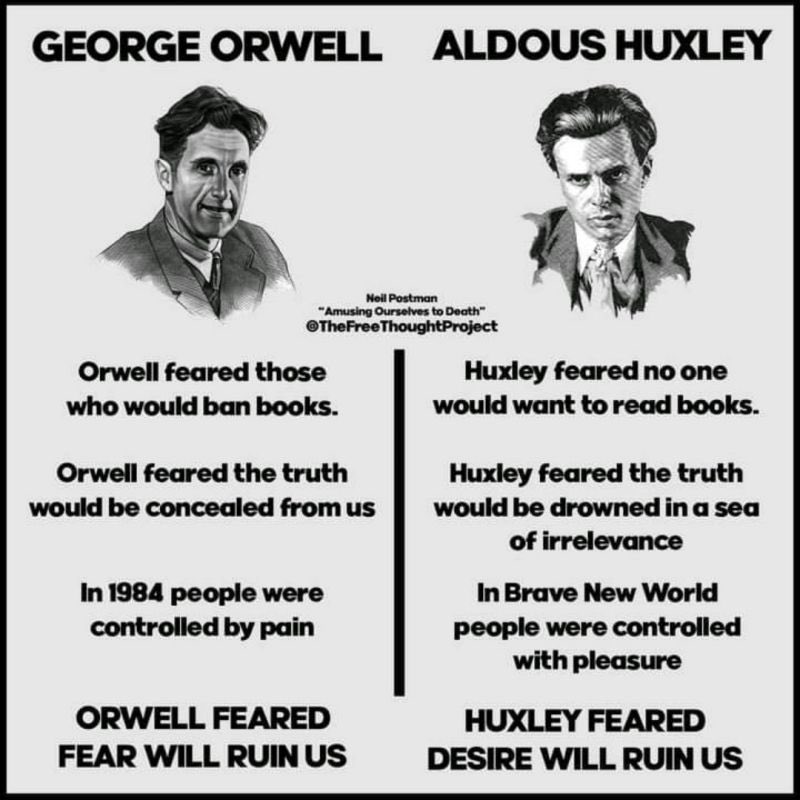
One of my longest-standing arguments is that we are not living in Orwell’s 1984, where truth is centrally suppressed and censored by force (that’s former communist societies, modern-day China, Russia, North Korea).
We are living in something much closer to Huxley’s Brave New World.
The truth is not hidden - it is almost always readily available. But it is buried beneath an industrial quantity of noise: propaganda, outrage, half-truths, conspiracy theories, influencer theatre, algorithmic rage bait and an endless stream of content designed not to inform us, but to keep us emotionally stimulated.
The modern information system does not need to censor the truth when it can simply drown it in noise.
A fact no longer has to be disproven - it only has to be surrounded by a hundred competing claims, stripped of context and nuance, turned into partisan ammunition and pushed into the same feed as celebrity gossip, memes and 15 second videos engineered to deliver the fastest possible dopamine hit. By the time the truth reaches us, it appears as just another piece of content competing for our attention.
That is the more sophisticated form of control: not preventing people from knowing, but exhausting their capacity to care.
Orwell feared a world in which people would be deprived of information. Huxley feared a world in which they would be given so much distraction, stimulation and triviality that they would lose the desire to seek it.
The defining struggle of our age is therefore not simply between truth and censorship, but between truth and indifference.
It's not. Why ? Because 25 pct or more of a doctor's time is spent dealing with conglomerates that do all they can to make the doctor's care more difficult, and expensive, for both the doctor and patient.
For every future agent we give AI doctors to deal with this friction, and to improve the quality of care, the conglomerates will have multiple adversarial agents doing all they can to delay and deny, to minimize their cost and maximize their float
We see this already as the conglomerates use AI to find every possible way to manipulate contracts, and find ways to mislead, while hospitals hire companies for Revenue Cycle Management, who charge as much as 10 pct of revenue to have their agents try to do the reverse. It's the agentic version of Mad magazine Spy vs Spy
I'll give you a further example. There isn't a single company, including yours, that knows the actual cost of the care they purchase for your employees and families. Not one.
Cost is an important component of health care decision making. @a16z includes costs in defining its benefits. But you are blind to all but the total bill you pay.
Your carrier, your ASO, your PBM, any company that touches the economics of care for your company is going to do everything they can to prevent you from using AI doctors or agents successfully
If you want to see that change, stop working with the healthcare conglomerates. Write agents that define , optimize and contract directly with providers, to eliminate the uncessary middlemen.
Feel free to use https://t.co/WgRSm7lM7X to train them.
Until the conglomerates are disintermediated , HC in this country will continue to be fucked
Mike Rowe is a great American.
The lie I was told in the 1990s was this:
“Dutch, why would you enlist in the Marine Corps? If you’re going to serve, become an officer.”
Because I wanted to learn the job before I ever led the people doing it.
Years later I heard the same thing.
“Dutch, why would you greet patients at our ambulatory surgery center? Why work scheduling? Why learn billing? Why start at the bottom?”
Because that’s where the business actually lives.
The front desk teaches service.
Scheduling teaches operations.
Billing teaches incentives.
The floor teaches reality.
For thirty years we told an entire generation that success meant skipping the work that makes everything else possible.
Then we acted surprised when nobody wanted to do it.
Entry-level work isn’t something to escape.
It’s where competence begins.
Wanna know how they are doing it? @bcbstx is taking any 99204/99214 or 99205/99215 from in-network independent physicians and auto downcoding to a 99203/99213.
But they are being hella sneaky and not actually changing the code on the remittance advice.
They are using the following- “CO - Contractual Obligations
186 - Level of care change adjustment
N610 - Alert: Payment based on an appropriate level of care.”
Payment changes, adjustments change but not the actual code in remittance. CO-186 seems to be their little AI bot tool to downcode no matter what. They aren’t even paying attention to diagnosis codes or obvious complexity based on diagnostics etc.
So sneaky in fact- physicians may not even realize what has happened to them until it is too late.
Got a new diagnosis of metastatic cancer? According to @BCBSTX - worth a 10 minute visit
Pass out at home and go to your doc or urgent care instead of the ER? According to BCBS- worth a 10 minute visit.
Good news for providers- you can appeal/dispute this absolute trash with the staff you can’t afford to pay! Or better yet- you can get tied up in litigation for years. 🤬
First they came for the physician owned hospitals, then they came for the freestanding ERs, next they went after all facility based physicians, and finally they went after independent primary care and specialists. This IS the attempt at the final blow to Texas physicians. Comply or be assimilated into employment!
#insurancefail
Lyn Alden: Money supply in the developed world has historically grown around 7% per year.
The average salary raise = Maybe 2-3%.
Over a decade, you're getting a smaller and smaller share of the total money supply just by showing up to work.
"People kind of look around and say, 'why does it seem like everything's more expensive? I'm still earning money, but it just doesn't feel like it goes as far.'"
"And a lot of times they're right."
FT @LynAldenContact@PeterMcCormack.
Excellent points Anthony and thank you!
That CMS appears to be adopting a “site neutral” mind set is very important indeed beyond the changes that they are making to reimburse radiology services at the Medicare Physician Fee Schedule (MPFS) rate.
Should the Agency continue with the site neutral concept for other “provider based services” (I don’t use the “P” word but that is the term for it), I believe that there would be a very large offset to “pay for” an inflationary type adjustment to the MPFS.
If I have a Pt visit with my cardiologist in January, he sells his practice to the hospital in February and I return in March for a follow up visit, why should my March bill by 2-4X of my January bill (which now includes a facility bill) when it is the same physician, same office, same equipment and staff? The answer is that the “provider based” billing rules allow for it but this too needs to change.
NB—CBO’s estimate of the 10 yr savings for site neutral rates for outpatient depts. is over $156B in 10 yrs—that would go a long way for a MPFS CPI-U adjustment.
What if instead of you buying insurance, Non Profit hospitals were required to provide care, beyond the ER, and finance whatever portion the patient could not afford?
It would be at a zero interest rate, with the monthly repayment, deducted from your paycheck, set at 10pct or less of your income.
(Medicaid and Medicare wouldn't change )
BUT, the taxpayers would guarantee the payment to the hospital at 100pct of Medicare rates.
Taxpayers guarantee small business loans. Guarantee student loans. Guarantee mortgages. And more.
Why not the cost of care that is beyond your means ?
This means the hospital won't lose money. They won't deal with insurance carriers and the incremental overhead burden, and so many other admin functions that run through the big carriers could be evaluated as well
What do you think ?
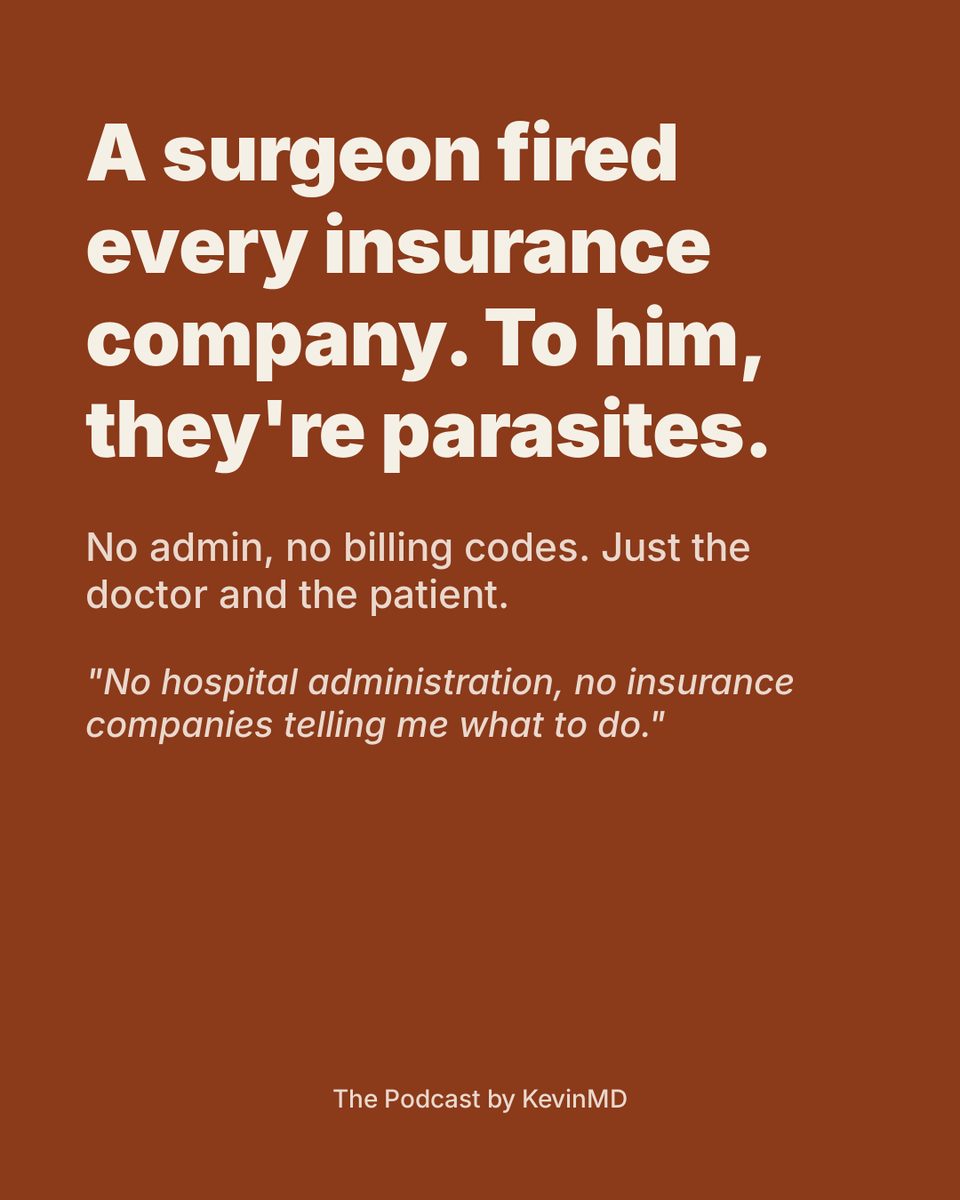
An orthopedic surgeon calls insurance companies "parasites" and says the records system every doctor uses "isn't meant for note-taking, it's meant for billing." So he cut all of it.
Daniel Paull spent nine years training to do exactly what everyone else does: take a hospital job or join a large group, accept insurance, see a high volume of patients, run the standard machine. He looked at the machine and refused to build it.
His reasoning is the part worth sitting with, because it is structural, not sentimental.
To accept insurance, he says, he would have to hire roughly five full-time people and rent more office space. That overhead does not appear from nowhere. It has to be earned back, and the only way to earn it back is volume: more patients, less time with each one, shorter visits, less of the relationship he thinks is the actual core of medicine.
Then there is the software. When he says the electronic records system "isn't meant for note-taking, it's meant for billing," he is naming a design incentive most patients never think about. The technology in the exam room is optimized for the payer, not for the encounter. It exists to justify a claim, not to help a doctor think.
So he removed the whole apparatus. No hospital administration. No insurance company deciding how long he is allowed to spend with a patient. Just the doctor and the person in front of him.
What that buys on the patient side is not abstract. Same-day or next-day appointments instead of a two-month wait. The doctor's actual phone number, texts answered directly. If he is running late to you, he texts you himself. Compare that to the standard version everyone has learned to accept: wait two months, sit for two hours, and often be seen by the PA anyway.
His verdict on the layers he cut out is one line. They are parasites, and they are gone.
Here is the uncomfortable reframe worth bookmarking: much of what a patient waits through is not clinical necessity. It is the operational cost of the payment layer, passed down the line as delay.
Two years in, he runs an office, does surgeries, makes roughly fifty house calls, and says he is happier than he ever was inside the system.
Listen to the full conversation on The Podcast by KevinMD. Link in the replies.
What is the single layer between you and your doctor that you have never understood the purpose of?
#DirectCare #ThePodcastbyKevinMD
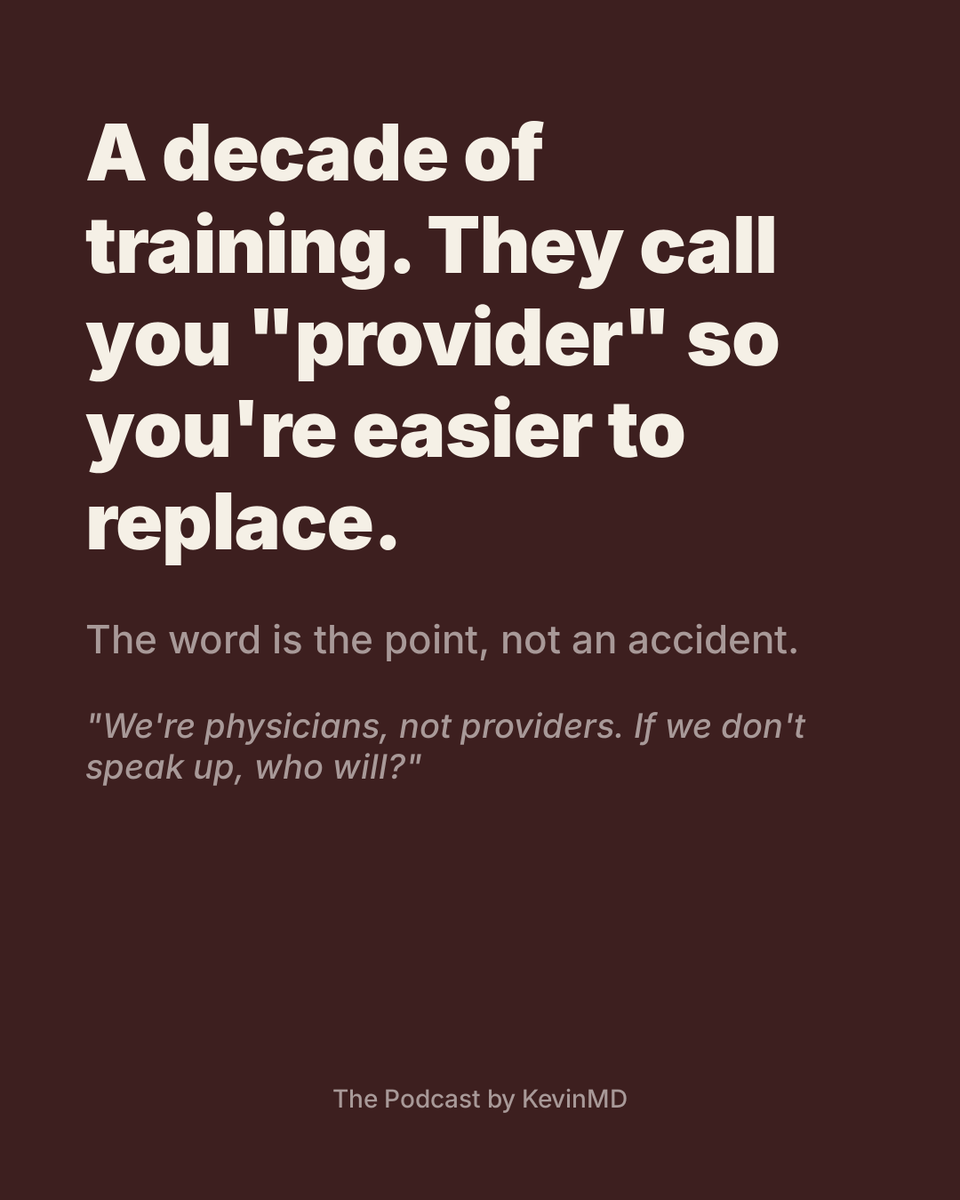
Calling every clinician a "provider" is how you make them replaceable.
This is the part that gets waved off as a style quibble. It is not. The word is doing structural work, and once you see the mechanism you cannot unsee it.
Start with what the label does. Lump the physician, the nurse practitioner, and the physician assistant under one term and they start to look interchangeable. Interchangeable people are easy to swap out. You do not deprofessionalize a workforce with a memo. You do it with a noun. The word is not describing the work. It is softening the ground for replacing it.
Now the history, because the word did not come from nowhere. "Provider" entered the system in 1965, when Medicare began paying any "provider of services." That single phrase put the person at the bedside in the same category as the hospital and the insurance company. The clinician and the billing entity got filed under one heading. One word, and the distinction between caring for a patient and billing for one quietly collapsed.
That collapsed distinction is the whole point, because the two things on either side of it answer to completely different masters. A physician's first obligation is to the patient. A corporate entity answers to its board and its shareholders. Those are not the same job. One word should not be allowed to pretend they are. This is why the American College of Physicians framed it not as a matter of taste but as a matter of ethics: the word you choose decides which of those two obligations you are actually naming.
And it is worth knowing what the word "physician" carries that "provider" throws away. Janet Jokela, MD, former treasurer of the American College of Physicians, points to the root. The Latin origin of "compassion" means "to suffer with." A patient is, at root, one who suffers. That relationship, to suffer alongside the person in front of you, is what the word was built to name. "Provider" carries none of it. It describes a transaction. It cannot describe a vocation.
None of this means the nurse practitioner or the physician assistant should be flattened either. They are clinicians. They are harmed by the same erasure. The label that dissolves the physician dissolves them too. The villain here is the system that finds it convenient to call everyone the same thing, not the colleagues standing next to each other under it.
So the correction is small and deliberate and entirely within reach. Doctors are crossing "provider" off forms and writing "physician," then signing underneath. Some have trained their staff to do the same. One document at a time. It is the only kind of correction that scales, because it happens everywhere the word appears.
Listen to the full conversation on The Podcast by KevinMD. Link in the replies.
What is the first thing you would change about how clinical teams get labeled? #PhysicianNotProvider #ThePodcastbyKevinMD
There is only one way to know if you or your company got a good price for anything - The vendor makes it easy for you to match the price you paid, to the price you were supposed to pay.
Great companies with great prices want you to know you paid a great price.
Shitty companies, like most of healthcare, don't want you to be able to match the price you paid to the price you were supposed to be charged.
It's the number one way to know if you are getting ripped off
Warren Buffet: "I can end the deficit in five minutes. You juts pass a law that says that anytime there is a deficit of more than 3% of GDP, all sitting members of Congress are ineligible for reelection."
Is there a smart politician that would propose legislation that any healthcare company, fined, across all states or federal agencies, more than one time , is not eligible (including affiliated companies), to do business with the federal government for at least 5 years ?
1/ After @AnthemBCBS (or @ElevanceHealth or whatever they are called this week; heads up that the corp. name changers may want to consider new names) reserved nearly $1B to re-pay CMS for numerous violations in #MedicareAdvantage (MA), Anthem paid CMS $342M amid Medicare Advantage sanctions threat.
How could the company refuse to re-pay MA overpayments? If physicians and hospitals fail to do so, they can face False Claims Act penalties for “reverse false claims.”
Potential CMS sanctions remain looming per CMS if the company does not come into compliance by the end of July.
Yet another sterling example of the urgent need to completely overhaul the MA system.
Oh, and @TheJusticeDept is separately suing Anthem for MA waste, fraud and abuse (link in this article) claiming that the company was garnering $100M+ in illegal payments.
https://t.co/fELj7araiW
MILTON FRIEDMAN:
"CONSUMERS DON’T PRODUCE INFLATION."
"PRODUCERS DON’T PRODUCE INFLATION.
"INFLATION IS PRODUCED ONLY BY TOO MUCH GOVERNMENT SPENDING AND TOO MUCH GOVERNMENT CREATION OF MONEY, AND NOTHING ELSE."
A do not resuscitate order is a legal document. About fifteen percent of the time, the family overrides it anyway.
Debbie Moore-Black, RN, spent thirty-three years in the ICU. She watched the same thing happen over and over. A patient, while they could still speak, made their wishes clear: no machines, no heroics, let me go when it is time. Then they slipped into a coma, the family took control, and the document stopped mattering.
The order is binding right up until the people in the waiting room decide it isn't. Once the patient can no longer speak, the family is in charge. They are not cruel. They are standing over someone they love, and they cannot be the ones to stop, so they rescind the order and ask the team to do everything.
"Everything" has a cost. It looks like a ventilator, wrist restraints, vasopressor drips, a chest tube, dialysis, and at the very end the chest compressions that come when a heart finally stops on a body that was never going to recover. The patient dies anyway, just slower and harder than they asked to.
Sometimes the case is so far gone that the team escalates. An intensivist sits the family down and is brutally honest. An ethics committee gets involved. In truly futile cases there is a point where the system will not continue, and the only way for the family to keep going is to find another physician who will take the case, which almost never happens. But most of the time it does not reach that point. Most of the time the team simply follows the family to the very end, and watches a person get a death they specifically said they did not want.
Here is the part worth saving. The paperwork is not the safeguard. The safeguard is a person. Pick someone you trust completely, tell them exactly what you want, and make sure they have the spine to honor it when you cannot speak and the room is full of people who love you too much to let you go.
The contrast Moore-Black draws is simple. One patient dies surrounded by machines. Another dies surrounded by quiet, with someone saying the thing that matters close to his ear. We are all going to die. The only open question is which of those two rooms we end up in.
If you had to name the one person who would honor your wishes when you could not speak, do you have that person yet, and do they know it?
Listen to the full conversation on The Podcast by KevinMD. Link in the replies.
#EndOfLife #ThePodcastbyKevinMD
455 people just got charged in a $6.5B healthcare fraud takedown.
Independent physicians need 14 passwords, 3 portals, prior auth, chart audits, recoupments, and divine intervention to get paid $87.
Fraudsters apparently just needed a billing company and confidence.
That’s the system.
I went to In-N-Out and ordered a cheeseburger. The cashier, a calm young woman named Destiny, asked me a question I did not expect.
"You want that Animal Style?"
I paused.
I did not know what this meant. But a samurai does not admit he does not know. So I answered with weight.
"...Animal Style."
"Cool. So that's mustard-grilled, extra spread, grilled onions, pickles. Yeah?"
I understood now. This was a sacred permission. For one meal, I was being told to put down my manners at the door. To eat the way a beast eats, without shame. I had waited my whole life for someone to give me this order.
"Yes," I said. "I will become the animal."
Destiny did not blink. "...Okay. You want your fries Animal Style too?"
I stopped. Even the potatoes?
"The potatoes also become animals?"
"I mean, they get cheese and sauce and grilled onions, so..."
"Then yes. Let the potatoes abandon their restraint as well."
"...Got it." She was the calmest woman I have ever met. "3x3, 4x4, or just the one?"
I did not know these numbers, but I knew a challenge when I heard one. "How many must I face?"
"It's, like, how many patties you want."
"How many is the most honorable?"
"...Four is a lot."
"Then four. A warrior does not ask for fewer."
She wrote it down without argument. A 4x4, Animal Style, with animal fries. She warned me once, kindly. "That's gonna be huge." I told her I was counting on it.
It arrived. It was a tower. Cheese and sauce ran down my hands the moment I lifted it. There was no clean way to eat it. There was no dignified way. That was the entire point.
I ate it like a beast. Both hands, no honor, grilled onion on my chin, and I have to be honest with you, it was the best thing I have ever put in my mouth.
For thirty years I have kept my manners at every table in the world.
They handed me a burger and told me to be an animal, and I have never felt so free.
So tell me, America.
The whole country knows the secret menu. What else are you hiding in plain sight?
And "Animal Style." Was I eating the animal, or finally becoming one?