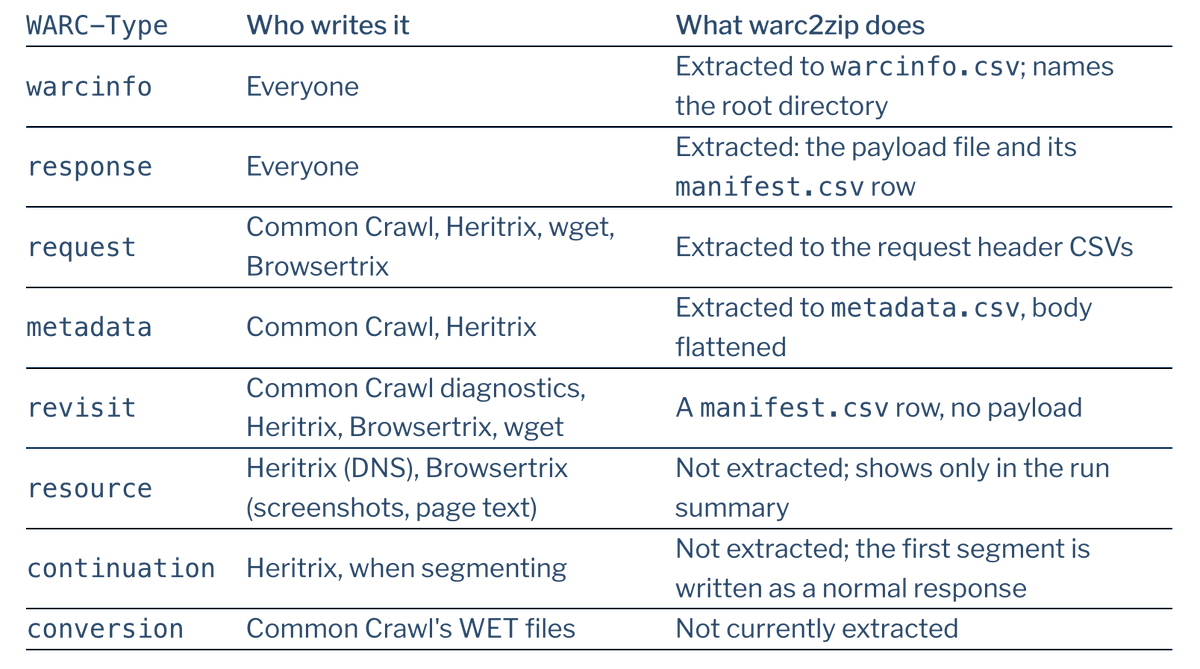
Introducing warc2zip
We are pleased to introduce warc2zip, a tool that allows anyone to turn WARC archives into simpler, zipped files that can be inspected with ordinary tools.
🔍 How can AI help assess Wikipedia quality at scale?
At the conference “Open Knowledge: #Wikimedia & Research in the CEE Region”, Dr. Włodzimierz Lewoniewski presented research on #Wikipedia content, information sources, data visualizations.
More info: https://t.co/KPHGotG0V5
📏 Measuring #Wikipedia Quality at Scale: Assessment of Content, Information Sources, Data Visualizations. 👨🏫 Presented at #OpenKnowledge: #Wikimedia & #Research in the CEE Region.
🧩 Slides: https://t.co/UtiHIHY4xA
"Can Language Models Play the Wikipedia Game?" (get from one article to another via article links) https://t.co/Yl4SqVXhIR
"No model significantly outperformed humans, although the best models (GPT-o3 mini, GPT-4o, QwQ:32B, and DeepSeek-R1:70B) achieved comparable success."
🌐🏆 The most prominent websites in Wikipedia information sources: to identify them, more than 400 million references from approximately 68 million articles across more than 300 #Wikipedia language editions were analyzed https://t.co/O6nXPp1nFv
🧩 A new interactive map of the most popular articles on English #Wikipedia is now available. You can use this tool to search for articles, explore them as colourful puzzle pieces, zoom in, and trace how readers move from one article to another. https://t.co/BEzXTBTaqJ
"WikiStar: A System for Shedding Light on the Hidden History of Scientific Wikipedia Articles", detecting edit types such as "technical term added" using an LLM classifier https://t.co/BeFTTmW41I
(with human-annotated benchmark dataset)
📢 #BestRef July 2026 update!
🔬4.2 million websites from more than 400 million #Wikipedia references across 300+ language editions were analyzed.
🌍 This update provides a unique view of the sources @Wikipedia relies on most.
🔍 Try it now: https://t.co/4V7DQD3nGa
🌐 Which websites matter most as information sources on #Wikipedia?
📊 More than 400M citations from 68M articles across 300+ language editions were analyzed, taking into account both citation frequency and article popularity.
🚀 Explore more: https://t.co/GW4FWAZyFn
📊 The obvious way to measure popularity of #Wikipedia articles is to count how many people read it.
🌐 #Wikilink analysis asks a different question: how many other articles depend on this page as a reference point?
💡 Measuring Wikipedia by #Wikilinks: https://t.co/o6m8Irv98m
New paper with Dylan Walker, now open access in Management Science: "The AI Democratization Paradox."
We ask: when AI lowers barriers to knowledge production, does it democratize participation, or amplify existing inequality?
A thread on Wikipedia + AI translation.
🎉 With Wikimania in full swing, the 2026 Wikimedian of the Year winners have been announced: French Wikipedia's Jules* (top honor), Laureates Dreamyshade & Barkeep49, Community Connector Chlod Alejandro, plus honorees Mari Avetisyan & Hijiri Umemoto. 🌍📚
https://t.co/UaIoIEi6EP
"Multilingual and Cross-Lingual Citation Needed Detection on Wikipedia for Lower-Resource Languages" https://t.co/z0p1oyT6AU (Data and code: https://t.co/jjSgdde5LP )
"SLMs [small language models] outperform LLMs on monolingual CND"
In the latest issue of our newsletter:
* "Wikilambda the ultimate: the Wikimedia foundation’s search for the perfect language" (with Wikifunctions/Abstract Wikipedia)
And other recent research publications involving Wikidata and Wikipedia
https://t.co/qPKXQR4hgo