The crazy thing about this dobale-for-non-Yoruba-brides discourse is that Yoruba men aren't even realising that some of the people supporting them are non-Yoruba women, including women from ethnic groups that once called Yoruba men slaves for doing the same thing.
@AyoBankole Ignore the ignorant Yorùbá FemiNazis harassing you in the quotes😆
Idobalẹ and other "Gbígbé Ìyàwó" protocols that makes Ìgbéyàwó legitimate are rites a Yorùbá Culture's Worldview demands a Yorùbá Man to performs b4 he can go ahead & "Gbé Ìyàwó" from her family household to his
First of all, Gele is not an Ika head wear.
It is Okuku our women wear.
We don’t claim what is not ours in Ika land.
Secondly, there is nothing like “Ika-Ibo”
It was wrongly used to identify the Enuani part of Delta State (then Midwest) during the civil war.
Bẹ̀bẹ̀fẹ́ is a condition Yorùbá women place on men asking for their hands in marriage. If Yorùbá women didn’t require it, it wouldn’t be a thing. Notice that it happens at the stage when the man is asking for the woman’s hand in marriage.
Ìdọ̀bálẹ̀ is how elders are shown reverence in Yorùbá culture, which, in this case, is the bride’s culture. Prostrating before people whose custom for example is to greet elders with “losho” is not only performative; it’s also meaningless to the people you’re doing it for. There are cultures in which people bow only to God, never to fellow humans. In such a culture, prostrating to ask for someone’s daughter’s hand in marriage would be considered sacrilegious.
1+1 =2 abeg.
One reason I hate speaking on this app is how quickly people resort to insults instead of simply disagreeing. I don't like insulting people, but mi o kin se omo lole lo gbesi wa.
I will insult you back and block you. I won't entertain that nonsense.
One thing that will never sit right with me about Nigeria weddings nowadays are Yoruba Grooms performing the “Idobale” for non-Yoruba brides. Alaga Iduro and Alaga ijoko should take note of this. Traditional weddings are meant to be according to culture.
@BerniceIsPretty@pontrol_777 No one has a problem with people from different ethnics getting married, I do have a problem with is marriage rites reserved for Yorùbá brides being done when the bride isn't one and that has been my stance from the first comment. First comment was even less about her attire...
@realnightmare0@Light6476842792@th3oddball@pontrol_777 You are the dumb one because not only are you functionally illiterate which hindered you from comprehension.
You are also inserting yourself in a discourse that doesn't concern you since you aren't Yorùbá yourself.
Stay blocked dimwit!
@BerniceIsPretty@pontrol_777 Nope, that statement is exactly why a lot of African cultures are been appropriated, origins erased or even being displaced.
There's absolutely nothing wrong with pointing out that a particular rite wasn't meant to be conducted, that's how cultural preservation works.
IT'S OFFICIAL! LAGOS, GET READY! 👑
Months ago, a passionate son of Lagos wrote to us about the gele. He asked that it be honoured, protected, and given its rightful place on the Lagos calendar.
We listened. We affirmed. And today, we deliver.
The Lagos Gele Festival is here! 🇳🇬
The gele is not just a headtie. It is a crown. It is Yoruba. It is ours. Born of our mothers, perfected by our artisans, worn across the world, and recognized everywhere as a symbol of who we are.
This festival will celebrate the stylists, the fabric makers, the tiers, the photographers, and the generations of women who carried this tradition on their heads and in their hearts.
📅 Sunday, November 8, 2026
⏰ 5:00pm
📍 Eko Amore Garden, Lagos
Come crowned. Come proud. Come ready.
This festival belongs to all of us.
Lagosians and lovers of Lagos, your ideas and input are welcome. Tell us how you want the Gele celebrated. Brands and partners who share this vision, walk with us.
For partnerships and enquiries:
📞+234 816 927 2885, +234 906 000 3431
One City! One Culture! Tie It High. The World Is Watching Lagos! 👑
Lagos, let's show the world why EKO FOR SHOW!
#IdrisConnect #LagosGeleFestival
@pontrol_777 By the time they start using irukere back, people will start to claim that we are copying them.
I hate the minimalism that has taken over our Yorùbá bride fashion, replacing iro and buba with komole, just jewellery no beads, no stoning of Gélé, no irukere.
@AdeJesuRe From him to his family to the Alaga, they have all failed in their responsibility to be a custodian of our culture.
Our Alagas are on TikTok telling people that anyone can use Alaga even if they aren't Yorùbá.
What we see in this video below is an issue with some Yoruba People.
Performing Yoruba's marital rites, to a non-Yoruba family, who have different traditions and marital rites from Yoruba culture, is foolish.🤡⬇️
@itsOnyim Another masterclass in dishonesty, selective quotation, and historical distortion.
Let us examine what the historical record and your own cited source actually say:
1. The Bogey of the Unnamed "Yoruba Commander"
You deliberately avoided naming the "Yoruba commander" because identifying Lt. Col. Victor Banjo immediately exposes your narrative. Banjo never planned or intended to "massacre" anyone, and there is zero historical evidence that he sought to "massacre the Midwest region into the Western region". If you have any credible record of this, produce it.
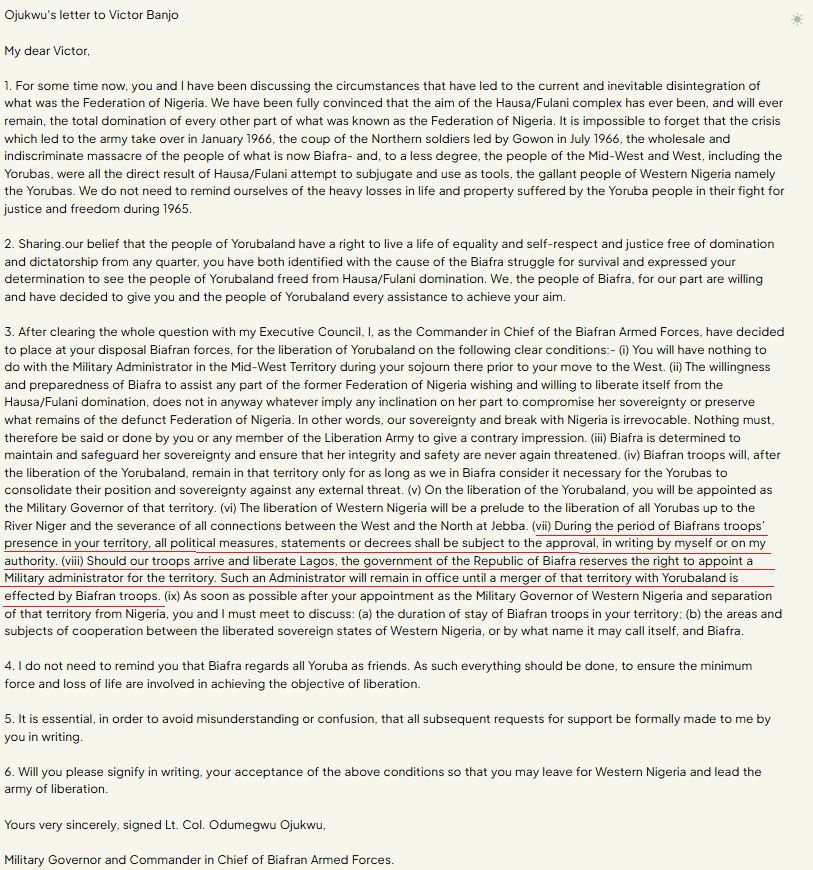
· Banjo was an uncompromising Nigerian federalist who sought to depose Yakubu Gowon's regime and restore a united Nigeria, declaring this in an unauthorized broadcast on August 14, 1967.
· In response, Ojukwu issued his August 24 directive, laying out strict, non-negotiable conditions before permitting Banjo to advance into the West.
· Ojukwu's instruction to minimize casualties applied specifically to the planned operation in Yorubaland; it was never proof that Banjo intended a massacre in the Midwest. Major Albert Okonkwo had already taken charge in Benin as the Mid-West administrator at this point.
· Condition 3(i) ordered: "You will have nothing to do with the Military Administrator in the Mid-West Territory during your sojourn there prior to your move to the West". This was not about preventing bloodshed; it was Ojukwu ordering Banjo to stop meddling with Okonkwo's administration. While Banjo's August 14 broadcast confirmed he had met David Ejoor and assured listeners of Ejoor's safety, it reflected an effort to secure local cooperation rather than Ojukwu's agenda. His preference for a non-Igbo Midwestern administrator did not mean he wants Ejoor installed as the administrator.
· Condition 3(ii) also directly countered Banjo's "One Nigeria" vision, warning that Biafra's assistance "does not in any way imply any inclination on her part to compromise her sovereignty or preserve what remains of the defunct Federation of Nigeria".
2. The Fiction of Ojukwu’s "Friendship"
Highlighting the line "Biafra regards all Yorubas as friends" is pure misdirection designed to conceal the terms of subjugation detailed in Clause 3. Ojukwu’s letter demonstrates that this was not an alliance among equals, but an arrangement designed to reduce Yorubaland to a vassal dependency:
· Indefinite Military Occupation: Condition 3(iv) declared that Biafran troops would stay in Yorubaland "only for as long as we in Biafra consider it necessary"
· Total Political Veto: Condition 3(vii) stipulated that "During the period of Biafrans troops' presence in your territory, all political measures, statements or decrees shall be subject to the approval, in writing by myself or on my authority".
· Unilateral control of Lagos: Condition 3(viii) reserved Biafra's right to appoint a Military Administrator over Lagos who would remain in power until a merger was "effected by Biafran troops".
In case the implications have escaped you, let us spell them out.
Who determined how long Biafran troops would remain? Enugu.
Who approved political measures? Ojukwu.
Who reserved the appointment of Lagos’s administrator? Biafra.
While Condition 3(ix) contemplated later discussions regarding the duration of the military presence and inter-state cooperation, those future talks did not erase the unilateral executive powers Ojukwu reserved for himself during the occupation.
This is not friendship; it is akin to the relationship between Nazi Germany and Vichy France.
3. The Ruse of The Republic of Benin and the Midwest Occupation Blueprint
The declaration of the short-lived "Republic of Benin" on September 20, 1967, was not an act of self-determination; it was a desperate political maneuver of an occupying force:
· Rather than dispelling local fears of the Midwest invasion being an "Igbo affair," Ojukwu dismissed Banjo's counsel to appoint a non-Igbo administrator and imposed Major Albert Okonkwo.
· Key Midwestern officials were systematically rounded up and deported to Enugu, including J.E. Imoukhuede (Secretary to the Government), J.A. Adeola (Commissioner of Police), Olu Akpata (Permanent Secretary), and Sam Uweni (NBC Chief Engineer).
· Over 150 administrative personnel were transplanted from the East to take over the Midwestern civil service without due process.
· More than £2 million was taken from the Central Bank of Nigeria branch in Benin and transferred to the Eastern Region's African Continental Bank (ACB).
· Non-Igbo civilian populations faced systemic harassment, targeted arrests, and extrajudicial killings alongside Northern residents.
This was a colonizing agenda engineered strictly from Enugu, which was precisely why Banjo balked at the alliance.
4. Denying Eyewitness Testimony: S.E. Orobator and the Tribunal Records
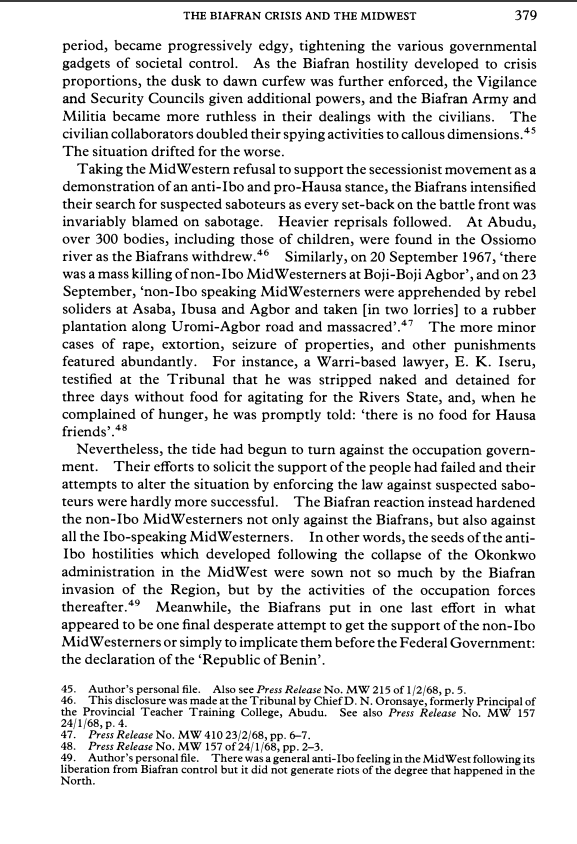
Claiming that S.E. Orobator relied only on "biased wartime press releases" is an attempt to erase sworn victim testimonies preserved in the historical record. The proceedings of the 1968 Chief D.N. Oronsaye Commission of Inquiry, referenced in the scholarly work, detailed civilian and eyewitness accounts::
· The Ossiomo River Discoveries: Over 300 bodies, including those of children, were recovered at Abudu from the Ossiomo River as Biafran forces withdrew.
· Targeted Mass Executions: On September 20, 1967, mass killings of non-Igbo Midwesterners took place at Boji-Boji Agbor. On September 23, non-Igbo civilians were apprehended at Asaba, Ibusa, and Agbor, loaded into two lorries, driven to a rubber plantation along the Uromi–Agbor road, and executed.
· Widespread Civilian Abuse: The inquiry recorded pervasive reports of rape, arbitrary arrests, looting, and unlawful confiscation of private property.
· Targeted Detention: Warri-based lawyer E.K. Iseru testified under oath that he was stripped naked and starved for three days simply for advocating for the Rivers State, told bluntly: "there is no food for Hausa friends."
Dismissing documented judicial inquiries, missionary records, and civilian eyewitness testimonies as lacking "independent evidence" is flatly false. It is a callous attempt to excuse Biafran military atrocities while minimizing the suffering of the victims.
I have attached the full transcription of the letter & the relevant page from Orabator's work so that people can read for themselves.
@just_blacccc@pontrol_777 You are a senseless individual and you are projecting that.
All over the world, intellectuals and even first world cultures are doing their best to preserve their culture, but I wouldn't expect you to know that since that requires significant brain activities that you lack.