Finally got a chance to listen to this awesome @PeterMcCormack podcast, where @LynAldenContact gives an absolute masterclass on money, exactly what is going on with central banks and bonds, and where our debt-laden system is ultimately, and undeniably, headed. Cannot recommend this one enough.
Bookmark or go listen now.
https://t.co/mSPtVsWtdi
⚡️The U.S. 30Y at ~5.18% is the market beginning to price fiscal dominance.
Before policymakers are willing to admit fiscal dominance exists.
This is the long end saying the old deal is gone.
For years, Washington could run deficits, inflate asset prices, expand entitlement obligations, fund wars, subsidize industry, push reshoring, support housing, and assume the bond market would eventually cooperate because inflation would fade and the Fed could cut.
Now the market is asking for a real price to finance the regime.
That is why this matters. The 30Y is not just another rate. It is the market’s judgment on long-term trust: inflation credibility, fiscal trajectory, Treasury supply, foreign demand, currency stability, and whether buyers believe they are being compensated for holding U.S. promises across decades.
At 5%+, the long bond starts changing behavior everywhere.
Housing cannot clear normally. CRE refinancing gets uglier. Private credit gets more fragile. Long-duration equities lose air. AI capex gets a higher hurdle rate. Federal interest expense gets louder. Banks, pensions, insurers, and leveraged investors have to respect duration again. The discount rate stops being background noise and becomes the central constraint.
The deeper problem is that the U.S. political system still wants a cheap-money world. It wants strong asset prices, lower mortgage rates, industrial policy, defense spending, AI infrastructure, tariff leverage, fiscal expansion, and consumer resilience. The bond market is saying those promises now compete for scarce capital.
That is the fracture.
This goes toward intervention. The system will not calmly accept a long-term free-market repricing of sovereign duration. Too much breaks. The likely path is pressure first, then disguised control: more bill-heavy issuance, buybacks, QT changes, liquidity tools, regulatory incentives for banks to hold Treasuries, and eventually deeper Treasury-Fed coordination.
They will not call it yield curve control.
The function will rhyme.
Big Print Update
In written answers to the Senate Warsh re-emphasized that he does not think inflation statistics are accurate and in his testimony he suggested using the "trimmed mean" which throws out outlier prices and is currently printing much lower than headline numbers. Wake up folks. Bessent is calling the shots and Warsh is going to cut short rates. They have to to reduce government interest expenses. Given that this administration doesn't move slowly, I could see an unscheduled Fed meeting right after May 15 and a 100 bps rate cut. Last chance to get on the sound money train at relatively attractive prices: gold, silver, bitcoin.
Is this the Big Print? Yes and no. M2 the monetary base grows when the banks make loans and print money into existence. The Fed creates money out of thin air in the form of reserves which it gives to the banks in exchange for Treasury Bonds. Literally with a mouse click. The bank reserves do not hit M2 but they allow the banks to increase their lending which does hit M2. It generally does this in a crisis (2008, COVID). Warsh has said that (absent a market disruption) he wants to shrink the balance sheet (i don't believe he can) but that lower interest rates fuel growth. He believes in AI productivity gains he and Bessent emphasize growth. Therefore, he will cut. Another credit/inflation cycle will begin. All other things being equal: inflationary. The big unknown? The Bond Market. If the bond market realizes that real yields are hugely negative it will sell off hard and drive the Fed into crisis mode and YCC. Given that the middle east problem appears to be dragging on my operating assumption is lower rates, credit growth, more inflation, stock and bond trouble and then the CRISIS which creates the Big Print on the Fed's balance sheet. If they were to lock long bonds at 2.5% which they did to finance WWII the bond market will look at the Fed and say "sold to you". The Fed Balance sheet is ~$6.6T. US Federal debt is $39T. So, Big Print 1: GFC $3.6T, Big Print 2: COVID $5.0T. Big Print 3: ???
None of us own enough sound money assets.
Goodbye, dollar milkshake theory.
In the movie Minority Report, Tom Cruise is part of a team which prevents crime before it can happen.
Fed swap lines being expanded to cover all US allies (non-allied countries have already de-dollarized their economies) prevents funding stresses before they become funding stresses.
Ergo, there will never be any "sucking" of liquidity from the global financial system into the US dollar even in a severe crisis, which means the dollar will lose its safe haven bid in times of stress.
If the world is short dollars, and the Fed supplies them, there is no consequence to being short dollars. You are actually encouraged to use dollars for carry trades, much like Abenomics did to the Japanese Yen.
The eventual outcome is the dollar becoming more of a transactional currency and less of a store of value.
This is great news for Asians. It means the end of permanent currency depreciation, making local equities more attractive relative to US assets. Pair high growth rates and favorable demographics with currency stability, and you have the perfect setup for an EM resurgence.
The Treasury Secretary does not understand the long-term implications of this Empire ending move.
Strategy has acquired 34,164 BTC for ~$2.54 billion at ~$74,395 per bitcoin and has achieved BTC Yield of 9.5% YTD 2026. As of 4/19/2026, we hodl 815,061 $BTC acquired for ~$61.56 billion at ~$75,527 per bitcoin. $MSTR $STRC https://t.co/ifGXjMeIZH
GM / GN Treegens 🌳
Our DAO has a way for YOU to make $99K IF you LOCK IN 🔒
Show up, take notes & let’s make Treegens the most impactful DAO on the planet 🌎
GIVEAWAY
3 .tgn NFTs with $TGN & $ENSURE airdropped
MAX ENGAGE:
👍
♻️
📑
📸
💬
⬇️REMINDER⬇️
https://t.co/31q6rmMCu5
As Warren Buffett once said, if you just buy your favourite assets near their 200-week moving averages and do nothing else, you’ll do just fine.
Bitcoin’s 200-week moving average currently sits around $59K.
🧵 The greatest wealth transfer in history isn't happening through new tech or fancy investments. It's hidden in plain sight: the gap between natural deflation and forced inflation. Let's explore why this matters for your future. 👇
My conviction grows in this every day.
- What we have just been through is a mid cycle top
- This is now a mid cycle bottom
- We will go on to make new highs this year
- Those waiting for October bottom at $40k will miss
I think we are about to enter a period in time of Bitcoins existence that shocks everyone, even the most staunch of bulls.
It is my view that we have just finalised an expanded flat correction patter, that will lead us into new highs within this year.
After this deep breakdown, the timing of this has been pushed back somewhat, but definitely, if it plays out, new highs will be this year.
The US economy has begun a very large phase of expansion that is not being priced in, and the new FED chair is going to be doing a lot more cuts than is priced in.
This is going to create an insanely prosperous economy with cheap money and productivity going through the roof from AI innovation.
ISM is starting to signal this to us, and the relevant industrial indexes are entering price discovery.
I have been early on this call and have suffered the consequences of that, with the market pushing harder down and staying irrational for a long time.
But the more that time passes, the more that data develops, the more this is the outcome I see.
They have already caused max pain to the downside with the most aggressive correction in Bitcoins history...
And not so soon they are going to do this to the upside.
That is my view.
Bitcoin right now is moving very similarly to how Gold did before its mammoth breakout, which subsequently lead to a $25tn market cap increase and record breaking monthly RSI's due to the sheer parabola of it.
Right now, we are at the C wave, the end of the expanded flat.
It is this part that causes the shake out as it breaks structure, convinces everyone its going much lower, only to reverse it hard and then on to price discovery.
That is what is next for Bitcoin, in my opinion.
Great question
When a bank issues a loan, it does not loan out deposits. It creates new money as a credit entry
You sign a loan agreement & it becomes an asset for the bank
Bank credits your account & the new deposit becomes new money in circulation
Banks are credit creators rather than intermediaries
Bank-created money is created with interest
Because the interest is not created in the money supply, the system requires perpetual growth, constant new debt or defaults
This is why the private credit system is inherently inflationary & extractive over time
Governments do not create new money to spend directly
They instead issue bonds purchased by banks, pension funds, foreign governments, or the central bank
This is government borrowing which is printing by selling promises
Government-issued money is also interest-bearing, which means it has the same inflationary dynamic as private bank credit creation
Tax serve 3 functions in a fiat system
1 Prevent inflation from excess government spending. If governments printed unlimited money, it would raise spending power without increasing production & create inflation. Taxes remove money from circulation, acting as a drain on the system
2 Give the currency value. If the government requires taxes to be paid in its currency, that alone creates demand
3 Redistribute and fund services. Funding services are not the main monetary reason, that’s the political justification. The monetary purpose is inflation control & currency demand
Governments spend money into the economy & taxes destroy part of that money to keep the system alive
This is the part people misunderstand the most
If new money is printed but does not create new goods, new services, new infrastructure or new real output, then you get more money chasing the same amount of goods, which raises prices
Examples:
Money printing for bailouts, war spending not tied to productive output, stimulus without corresponding output growth, interest-bearing credit expansion for consumption
This type of money requires taxation to remove excess money & prevent inflation
If new money is issued to create new productive output, the money supply increases in proportion to real wealth
Examples:
Building infrastructure, funding energy projects, paying workers to produce real goods & services or capital investments with measurable output
If production rises faster than money supply, no inflation occurs
In such cases, taxation is not required to offset the issuance, because real-world value backs the currency expansion
After the Weimar hyperinflation & Great Depression, Germany introduced Mefo Bills in 1934
It was a government-created promissory note issued to construction & industrial companies
They were not backed by gold, not borrowed from banks, backed by future labor & productive output & used to fund public work
Money was issued only when workers produced output
Idle labor was turned into productive labor
Factories, infrastructure & goods increased alongside the money supply
The credit carried no compounding interest & money was created only to mobilize productive capacity, not consumption or speculation
When money creation matches real productivity, inflation does not occur
Germany reduced unemployment from 30% to 0% in a few years without runaway inflation
Inflation problems emerged later only when issuance shifted to unproductive military expansion
Today’s system is a public–private hybrid
Banks create most money via credit, charge interest & expand the money supply
Governments issue bonds purchased by banks & central banks, borrow the currency they themselves issue & tax to control inflation created by both government & private banks
The government effectively outsourced money creation to private banks & then taxes you to stabilize the system for banks profit
They socialize the losses & privatize the gains.
It’s a ponzi scheme & you pay taxes to service the interest on banks debt.
💥BREAKING:
🇺🇸 PRESIDENT TRUMP: “UNFORTUNATELY, IN RECENT YEARS THE U.S. GOVERNMENT SOLD TENS OF THOUSANDS OF $BTC THAT WOULD NOW BE WORTH BILLIONS.”
“FROM THIS DAY FORWARD, AMERICA WILL FOLLOW THE RULE EVERY BITCOINER KNOWS…”
“NEVER SELL YOUR BITCOIN.”
Good Morning.
PLEASE READ THIS CAREFULLY! 🙏👇
I have said it before - I will say it again.
A massive Recession and Crisis are coming. The largest since 1930s.
The money printing of Central Banks have created a Monster in the Financial Markets.
Extreme over-valuations. A massive Bubble!
The Everything Bubble will burst! And we are getting closer.
The LEADING INDICATORS in my Business Cycle model rolled over in November 2024.
This has correctly identified Recessions (all - and no extra) since 1950.
Before THE GREAT FINANCIAL CRISIS they rolled over in November 2006.
The Titanic has hit the iceberg - and there is no going back.
The COINCIDENT INDICATORS are the ones telling us WHEN it begins - together with our IMMINENT RECESSION INDICATORS.
This is when the Titanic actually sinks!
Before THE GREAT FINANCIAL CRISIS they rolled over in November 2007.
The Recession began December 2007. Market topped October 2007.
These are suggesting that we are closing in on a point where it could begin! I say it again… “Closing in”!
HOWEVER - not signalling it just yet - but closing in!
In the FINAL PHASE - the Stock Market and Crypto will rally hard.
This is the due to the LIQUIDITY from Central Banks.
This phase has now begun!
Stock market, BTC, ETH, Altcoins will soar into December. Investors will be believe it is the “All Clear” signal.
They can not be more wrong!
At the same time we see the DXY developing a massive BOTTOMING PATTERN.
The RALLY in DXY is going to be extreme into 2026.
I cannot warn especially Crypto- and Bitcoin junkies enough - DESPITE the RALLY in these assets we likely will see into the final phase. ALTSEASON and new extreme ATHs.
There is NO FANCY THEORY on DIGITAL CODE!
It is complete NONSENSE!
And the ECONOMY IS SLOWING DOWN!
Be very, very careful!
Understand and treat this for what it is. A massive BUBBLE - which may seem to promise ENDLESS PROSPERITY! But it is a MIRAGE!
And it will BURST!
I hope and want the best for all of you! 🙏
🚨 BREAKING
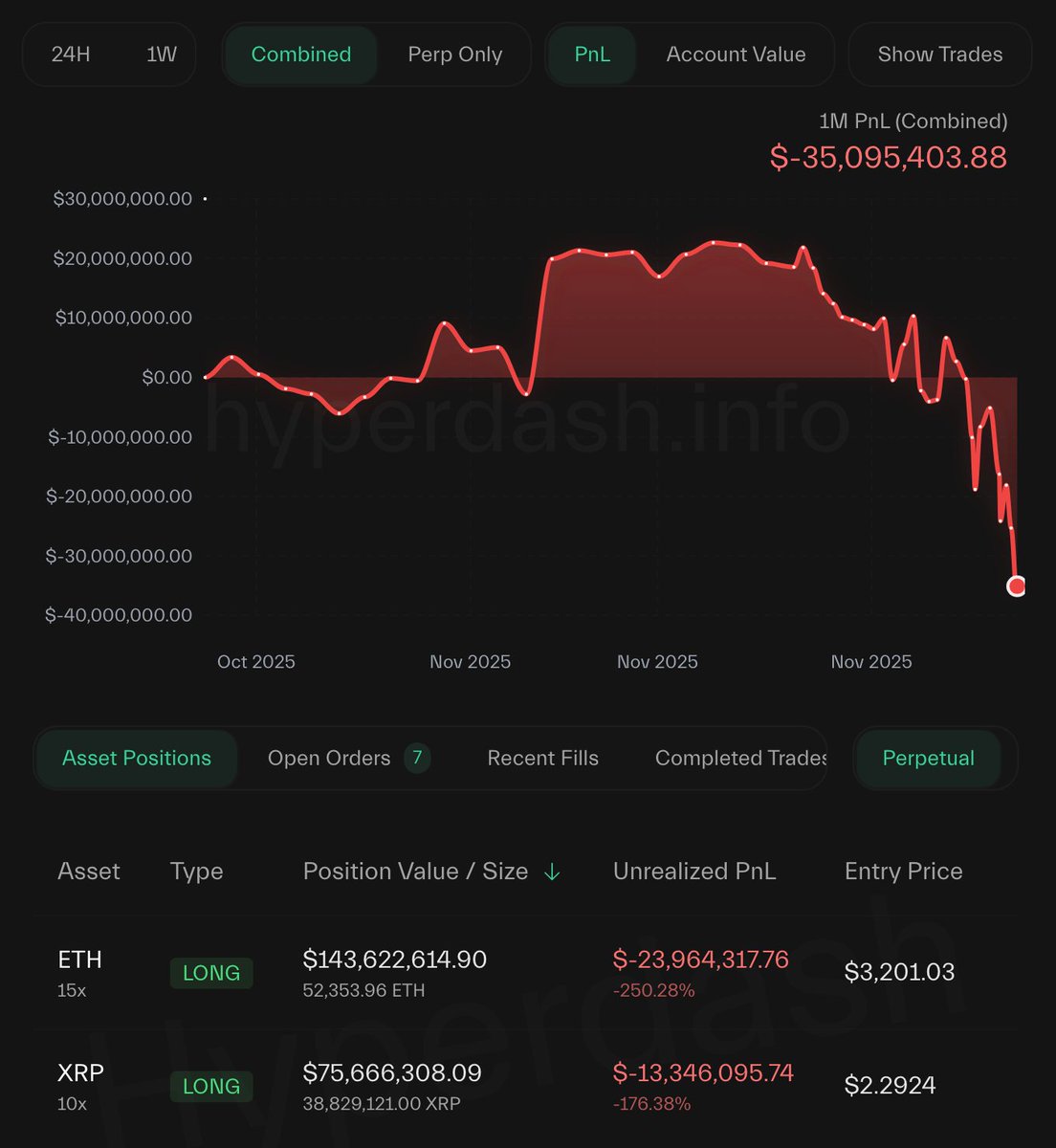
OG INSIDER WITH 100% WIN RATE JUST GOT FULLY LIQUIDATED FOR $220 MILLION.
HE WAS UP $100 MILLION JUST A FEW DAYS AGO, BUT NEVER TOOK PROFIT AND LOST EVERYTHING IN 10 MINUTES.
CRYPTO IS BRUTAL.
Bitcoin dips -30%
People’s reaction: extreme fear
Black Friday -30% sale on a new iPhone
People’s reaction: take my money
This is why most people stay poor
They buy liabilities on sale and sell assets on fear, the exact opposite of how wealth is built
Japan might have triggered something worse than the August 2024 crash.
And crypto felt it before anyone else.
Here's what is actually happening and why it matters:
Japan’s 10-year yield crossed 1.7%, the highest level since 2008.
This sounds like a small number, but for global markets it changes the entire direction of money flow.
For decades, Japan kept rates near 0%. That allowed Japanese banks, pension funds, and insurers to invest trillions outside Japan mainly into the U.S. Treasuries and global bonds because it earned them more.
When Japanese yields were near 0%, buying U.S. bonds made sense.
Now, with yields rising at home, that logic breaks.
At 1.7%, after currency hedging costs, Japanese investors lose money holding US debt.
So they do the logical thing: they pull capital back home.
This is where the real impact starts.
When a major T-bills buyer exits the US, the yields go up.
Higher yields tighten financial conditions everywhere.
That makes borrowing more expensive, refinancing harder, and leverage riskier.
Risk on assets always feels this first before equities.
It’s not about fear. It’s simply how liquidity rotates.
This is part of why markets have been choppy:
• Higher U.S. yields → tighter liquidity
• Strong dollar → pressure on risk assets
• Global funds reducing exposure → volatility rises
This is what caused the August 2024 crash and this time, the situation is even worse.
But here’s the part most people miss:
Whenever yields rise this fast, the probability of a policy response increases.
Central banks don’t step in immediately, they wait until stress becomes visible.
But the direction is predictable:
First comes slower tightening → then comes easing → then comes liquidity.
So what does this Japan move mean for crypto?
Short-term:
• Tighter global liquidity keeps volatility elevated
• Downside moves in BTC and alts are normal in this phase
• Risk-on assets stay sensitive to yields
Medium to long-term:
• Rising yields globally push central banks toward the next easing cycle as stock market and economy will feel a lot of pain
• Liquidity responses always start with the most liquid assets
• Bitcoin usually reacts before equities, because it has no earnings cycle, only liquidity sensitivity
So yes, Japan’s move is a shock.
Yes it tightens liquidity temporarily.
But it also moves the world one step closer to the next liquidity phase.
And every cycle has shown the same pattern:
Risk-on assets fall first, stabilize first, and recover first.
Crypto is at the front of that line.
Japan’s bond market just told politicians to sit down.
November 18th, 2025: Japan’s 40-year government bond yield hit 3.668%. All-time high since the security launched in 2007.
Here’s why this number ends the world you knew:
Prime Minister Takaichi announced $110 billion in stimulus spending. Economics textbooks say stimulus announcements lower bond yields by promising growth. Japan’s market did the exact opposite. Yields spiked 6.5 basis points in a single session.
This is a vote of no confidence in sovereign debt sustainability.
Japan owes 250% of its entire economy. Debt service already consumes 23% of annual tax revenue at current rates. Every 100 basis point yield increase costs an additional 2.8 trillion yen annually. The math stops working above 4%.
The market just priced in that threshold approaching.
But the real devastation happens elsewhere.
Twenty trillion dollars in global investments were funded by borrowing yen at near-zero rates. Borrow at 0.1%, invest at 8%, pocket the difference. The largest arbitrage trade in human history. Every hedge fund. Every sovereign wealth fund. Every pension seeking yield.
Built on Japanese rates staying frozen forever.
That assumption died yesterday.
When 40-year yields trade at 3.67%, the arbitrage collapses. Borrowing costs rise. The yen strengthens as capital returns home. Borrowed funds become more expensive to repay. Wellington Management estimates 4-8% yen appreciation in the next six months.
Forced liquidation begins automatically. Positions turn unprofitable. Margin calls trigger. Twenty trillion dollars starts moving in reverse.
Correlation studies show 0.55 relationship between yen carry unwinding and S&P 500 drops. Emerging market currencies fall 1-3% within thirty days. US Treasury yields jump 15-40 basis points from reduced Japanese demand.
Your 401k holds positions funded by yen loans. Your tech stocks trade at valuations assuming cheap leverage continues. Your emerging market bonds depend on foreign capital that’s now leaving.
The critical test arrives November 20th. Japan auctions 40-year bonds. If bid-to-cover falls below 2.5 times, it confirms insufficient demand. Failed auctions create death spirals. Weak demand forces higher yields. Higher yields accelerate unwinding. More selling. Weaker demand.
Greece. Portugal. Italy. The playbook is known.
Except Japan is the world’s third-largest economy and largest creditor nation. When Japan’s markets break, the cascade doesn’t stop at borders.
The bond market delivers verdicts politicians cannot overturn.
November 18th was judgment day.