General Laura Richardson, commander of the U.S. Southern Command, put it bluntly: Latin America is not a "democracy-first zone," but a resource-first zone.
Oil, lithium, gold, rare earth elements—Venezuela happens to possess all of them.
When a country controls key energy and strategic resources but is not within the dominant system, it is almost inevitable that it will be "under scrutiny."
Energy is never just energy; it is another form of power.
The reason why Venezuela is under attack
U.S. Southern Command chief General Laura Richardson just said the truth out loud:
the U.S. focus in Latin America isn’t “democracy” — it’s controlling oil, lithium, gold, and rare earth minerals. Venezuela, with the largest oil reserves and key strategic resources, is the main target
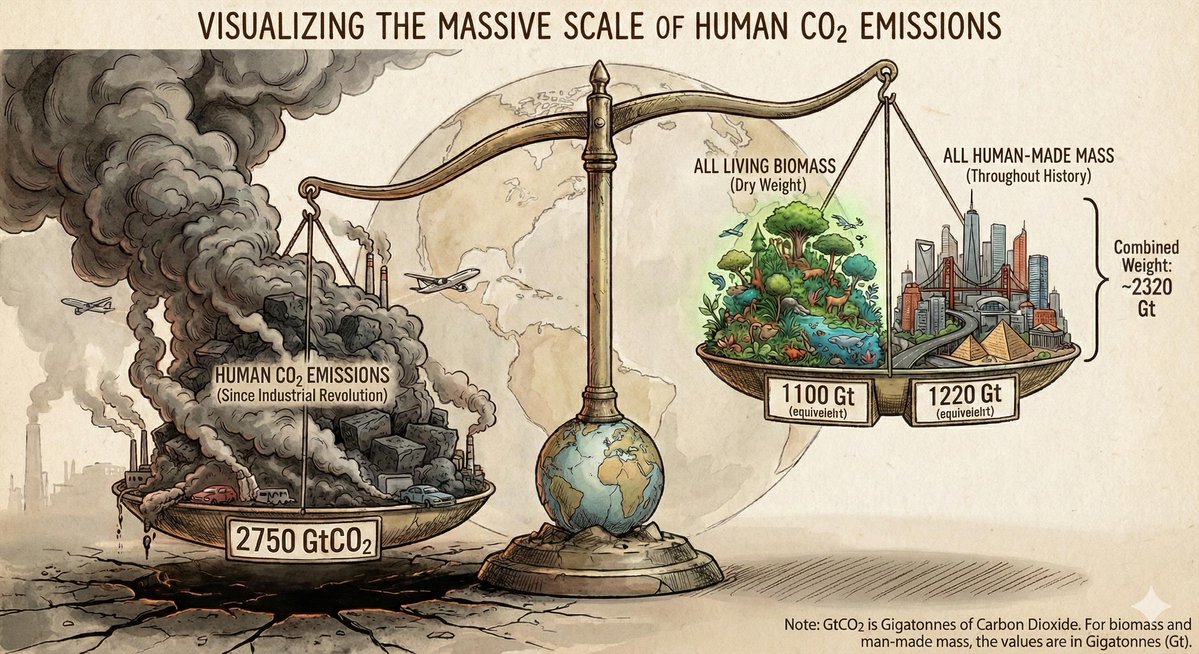
Since the Industrial Revolution, humanity has emitted approximately 275 billion tons of carbon dioxide.
The absurdity of this figure lies in the fact that it even exceeds the total mass of all living organisms (dry weight) on Earth plus everything that humans have built.
This is not merely a climate issue, but a warning on a civilizational scale—when the weight of byproducts begins to exceed life and creation itself, perhaps we should re-examine the meaning of the word "development."
Humans have emitted 2750 gigatons of CO2 since the industrial revolution from burning fossil fuels and land use change. To put this in perspective, this is more than the (dry) mass of all living things on earth and everything humans have ever built combined:
2026 doesn’t feel like a fresh start — it feels like a continuation.
Of lessons learned, values tested, and paths chosen.
Standing in London tonight, I’m choosing patience, perspective, and long-term thinking.
#2026 #London#LongTermThinking#NewYear#Perspective#LifeStrategy
Space programs reveal national priorities better than speeches.
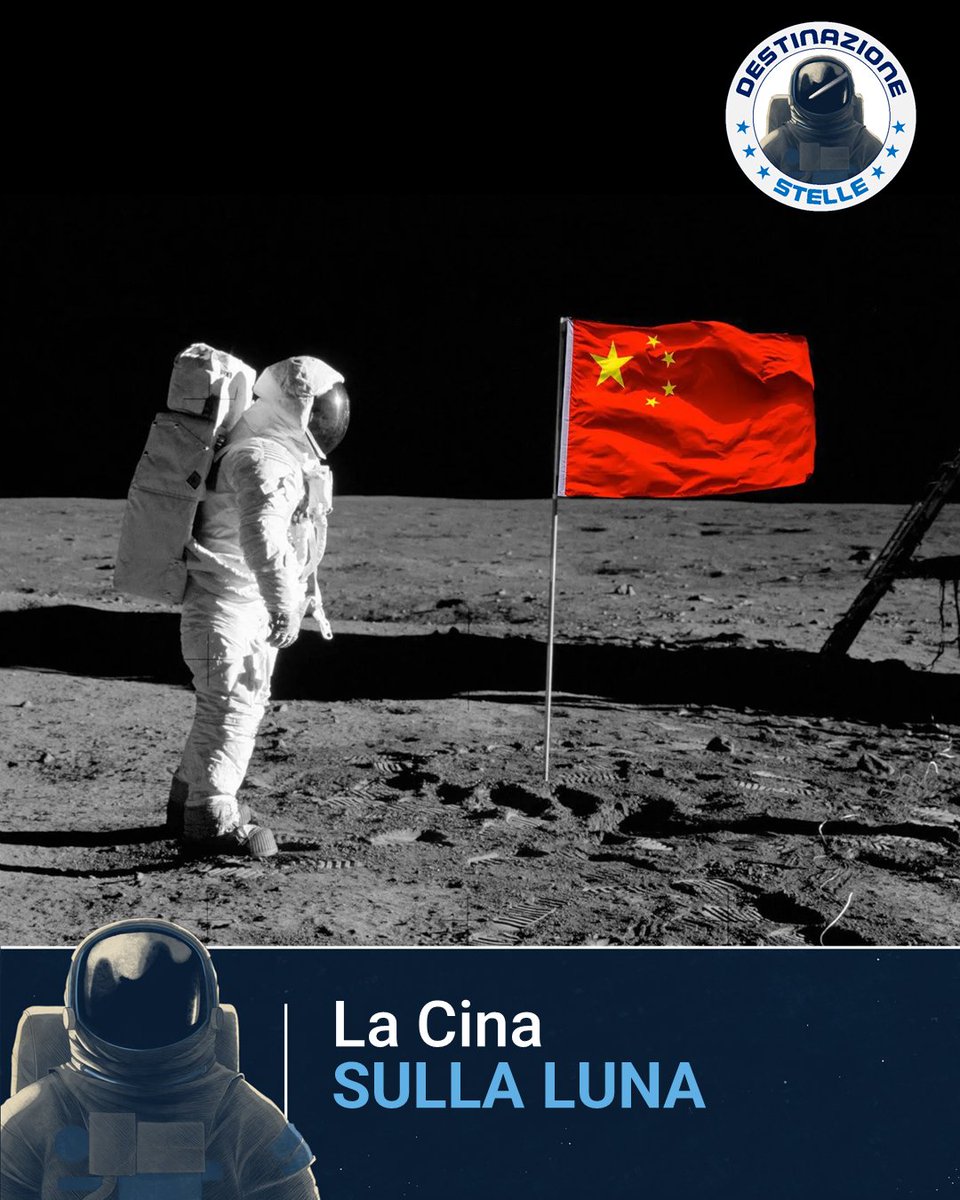
China’s lunar roadmap reads like a systems-engineering case study: clear phases, redundancy, cooperation, and patience.
The question isn’t who wins a headline moment — it’s who builds the architecture that lasts.
#SystemsThinking #SpaceEconomy #China #Moon #DeepTech
Entro il 2030 la Cina manderà sulla Luna due “taikonauti”. È un’impresa straordinaria, se si pensa che fino al 2003 quella nazione non aveva ancora portato un essere umano nello spazio. Ma negli ultimi vent’anni la Cina ha condotto un ambizioso programma di esplorazione della Luna e ha colmato tutto il ritardo che aveva nei confronti degli Stati Uniti.
Il programma cinese di esplorazione lunare è iniziato nel 2007 con sonde robotiche ed è stato composto da tre fasi, ognuna con un obiettivo ben preciso: prima orbitare intorno alla Luna, poi atterrare, infine prelevare campioni e riportarli sul nostro pianeta. I primi lander e rover cinesi sono atterrati sulla Luna nel 2013, mentre nel 2020 la missione Chang’e 5 ha riportato sulla Terra campioni di suolo lunare: era la prima volta dal 1976 che questo accadeva.
Nel 2024 la missione Chang’e 6 è stata la prima in assoluto ad atterrare sulla faccia nascosta della Luna, un’impresa tecnicamente difficile sia perché il terreno è più accidentato sia perché da quella posizione è impossibile comunicare direttamente con la Terra e serve un satellite relé in orbita lunare. Nel 2026 la missione Chang’e 7 atterrerà nei pressi del polo Sud lunare, l’area in cui sono dirette tutte le prossime missioni, alla ricerca di ghiaccio d’acqua nei crateri permanentemente in ombra.
Tutte queste missioni hanno visto la collaborazione di altre nazioni, sia europee sia di altri continenti.
Per l’esplorazione umana della Luna, la Cina userà due razzi Lunga Marcia 10 che partiranno a breve distanza l'uno dall'altro dal centro spaziale di Wenchang. Il primo lancio porterà in orbita lunare la navetta Mengzhou ("Nave dei sogni") con a bordo tre astronauti, mentre il secondo lancio porterà il lander Lanyue ("Abbracciare la Luna"). Una volta arrivati in orbita attorno alla Luna, i due veicoli si agganceranno. Due taikonauti passeranno dalla Mengzhou al lander Lanyue per scendere sulla superficie, mentre il terzo rimarrà in orbita ad aspettarli. Resteranno al suolo per 48-72 ore, durante le quali raccoglieranno campioni e installeranno esperimenti scientifici.
Al termine della missione, la parte superiore del lander Lanyue accenderà i motori usando la parte inferiore come rampa di lancio. Il modulo tornerà in orbita lunare e si aggancerà di nuovo alla Mengzhou. Gli astronauti rientreranno nella navetta principale con i campioni raccolti. Infine, la Mengzhou accenderà i motori per uscire dall'orbita lunare e puntare verso la Terra, atterrando nel deserto della Mongolia Interna, la regione più settentrionale della Cina.
Nel frattempo gli Stati Uniti e i loro partner stanno portando avanti il programma Artemis, che prevede ll primo dei nuovi sbarchi sulla Luna nel 2028. Questa volta l’obiettivo non è soltanto mettere piede sul satellite, ma costruire una serie di infrastrutture al suolo e in orbita lunare. Lo sbarco è soltanto il primo passo, ma inevitabilmente ci sarà molta attenzione verso chi lo farà per primo. Saranno di nuovo gli americani? Le scommesse sono aperte.
This isn’t just about energy or manufacturing — it’s about strategy.
China treated infrastructure, energy, and industry as power, not ideology.
While others debated narratives and net-zero symbolism, China built capacity at scale.
The largest transfer of industrial power in human history didn’t happen through war or treaties — it happened through factories.
#GlobalShift #Manufacturing #Energy #China #Geopolitics #LongTermThinking
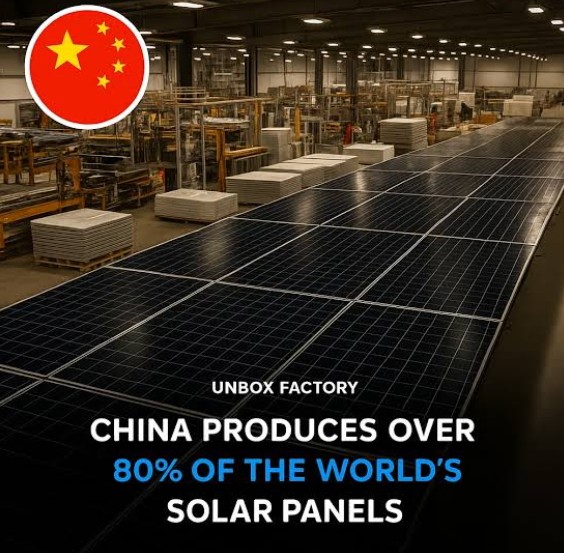
China makes 80% of the world’s solar panels, 75-80% of all batteries, 60-65% of wind turbine parts and 55% of global crude steel production. This is more than the next 15 countries combined. China is still commissioning six state-of-the-art coal plants a month, reaching 50-80 GW a year– these are cleanest coal plants ever built.
Its the workshop of the world and its output is now roughly equal to or larger than the US + Japan + Germany + South Korea combined. Some sources say it exceeds the entire top 9-10 nations combined when including gross production—but definitely larger than the US + EU + Japan alone. It's all consistent with IEA and industry reports.
China’s manufacturing share of global GDP went from 6% in 2000 to 30% today; America's fell from 22-25% to 10-15%; and Europe’s collapsed from 25% to 14-15%. This miracle is embarrassingly simple: Abundant coal energy, no net-zero cults, and a government that sees steel mills and giga-factories as strategic assets. It's the biggest transfer of wealth and power in human history.
This global power handover happened without guns, fanfare or treaties. One side builds things; the other side writes letters or pays influencers to sell PR agenda. However it happened, it's a shameful time for the West.
Figma's Dylan Field aptly summarizes the impact of AI: Artificial intelligence is lowering the barrier to entry while simultaneously raising the ceiling of productivity. More people are thus able to solve their problems, while experts can create value on an unprecedented scale and at an unprecedented speed. The real change isn't just about efficiency, but about "who can participate and how far they can go."
#AI #ArtificialIntelligence #Productivity #Figma #DylanField #FutureOfWork #TechTrends #Innovation #CreatorEconomy
Dylan Field at Figma frames the impact of AI in one of the best ways: AI lowers the floor of access to a domain and raises the ceiling of productivity. The gains come from more people solving their own problems, and experts getting far more done than they could’ve before.
🎄✨ This year's Christmas tree is more than just decoration; it's a love letter to my child.
A doll I hung on it myself is her fairytale in her eyes, and also the world I want to protect for her.
The meaning of a holiday may not be about the quantity of gifts,
but about—the light shining through the tree as the child turns it,
and the patience and love a mother has poured into preparing for life's journey, for a pure and innocent love.
May she grow up surrounded by love during this holiday season,
and I will always stand by her side. 🤍🎄
#ChristmasVibes #MotherlyLove #HolidayRituals #GrowingUpWithYou #HomeIsLove
Advances in artificial intelligence are occurring simultaneously across multiple dimensions: from the evolution of machine learning paradigms to the continuous enhancement of next-generation model capabilities; and from more mature compliance and governance frameworks to in-depth research into advanced AI systems.
Recent key developments are not only reflected in "stronger models," but also in clearer standards, more defined boundaries, and more enforceable accountability.
The next stage of AI is not just about technological breakthroughs, but also about the co-evolution of technology, governance, and social consensus.
Internal combustion engine vehicles waste up to 80% of their fuel energy.
Electric vehicles, on the other hand, use electricity to directly drive the transmission system. Their efficiency advantage is structural, not a short-term technological gain.
This is not just an energy transition, but an efficiency revolution that long-term capital is betting on.
#EV #ElectricVehicles #EnergyTransition #LongTermInvesting #CleanTech #FutureOfMobility #Investing #SustainableInvesting
ICE vehicles waste a whopping 80% of the energy in their fuel. Electric vehicles are propelled by entirely different mechanisms. Energy enters the vehicle as electricity, which directly powers the drivetrain: EVs need not convert one form of energy to another resulting in much higher efficiency.
Life doesn't need much explanation.
In the quiet of the night, treat yourself to a glass of red wine, some music, a touch of fragrance, allowing your body and emotions to slow down simultaneously.
True luxury is never about how much you possess, but about knowing how to treat yourself well.
Loving yourself is the beginning of a lifelong romance. 🍷✨
#SelfCare #SoftLife #SlowLiving #LuxuryMindset #EveningMood #LifeAesthetics #RomanticizeYourLife
Unleashing America's energy potential is not just a slogan.
Encouraging energy exploration and production on federal lands and the outer continental shelf, ensuring all states and territories have access to sufficient, reliable, and affordable energy, and solidifying America's long-standing position as a global energy leader.
Repealing the blanket electric vehicle mandate and returning to science, the market, and public participation—policies must withstand peer review and public comment.
Energy security is, in essence, national security.
#EnergyPolicy #EnergySecurity #AI #Climate #USPolicy
Unleashing American Energy
“It is the policy of the United States to encourage energy exploration and production on Federal lands and waters, including on the Outer Continental Shelf, in order to meet the needs of our citizens and solidify the United States as a global energy leader long into the future.”
Ensure “an abundant supply of reliable energy is readily accessible in every State and territory of the Nation.”
“Eliminate the ‘electric vehicle (EV) mandate’.”
“To guarantee that all executive departments and agencies (agencies) provide opportunity for public comment and rigorous, peer-reviewed scientific analysis.”
Market confidence in the energy sector has been low for a long time, partly due to the prevailing narrative that "oil demand is about to peak," which has greatly influenced capital allocation and corporate investment decisions.
When long-term supply and demand realities deviate from mainstream narratives, capital markets are often forced to reprice in the latter part of the cycle, and the energy industry may be at such a critical cognitive inflection point.
Important development: sentiment towards the energy sector remains at a record low, and in my opinion one of the largest reasons for this has been the relentless doomsday preaching by the IEA proclaiming "the end of oil." This narrative, supported by eco-evangelistic "scenarios" based on hope and political aspirations, completely distorted investors' and politicians' views alike on the long-term outlook for oil.
The result? Lack of interest in energy equities (= depressed valuations) and an accepted belief in "stranded asset risk" which lead to rise in investor activism encouraging oil companies to pivot towards renewables. For those who succumbed to the pressure, the result was the incineration of billions of dollars from poor investments. Too, given the change in investor demands, companies stopped adequately investing in new projects, with the growth rate of non-OPEC supply forecasted to peak this year. We will soon wake up to a world where the largest source of incremental supply of the past decade (US shale) is no more, OPEC will have little if any spare capacity, and yet the fairy tale of imminent peak oil demand will now be replaced with the view that the demand for oil will grow for decades more!
I'm hopeful that this pivot by the IEA will lead to a meaningful improvement in sentiment towards energy stocks, while also allowing politicians, especially in Canada, to see the world through a more realistic energy lens. The era of "energy ignorance" must come to an end...it has cost our country too much already.
On the shores of Lake Como, time seems to stretch out.
The same applies to career; it's not about going as fast as possible, but about finding the right rhythm.
Truly important decisions often stem from clarity, patience, and a long-term perspective.
Beneath the seemingly calm surface of the lake lies depth and strength.
Both life and career require learning to move steadily forward at the right stage.
#LakeComo #LakeComo #Italy
#CareerRhythm #LongTermism #LifeManagement
#ClearDecisionMaking #SteadyProgress #LifeStrategy
Having just attended a collaboration conference about AI startups, I can better appreciate the accelerating pace of our times—technology is changing, the ways humanity seeks answers are changing, but the flame of curiosity and creativity has never been extinguished.
#AIAge
In the face of ancient civilizations, human time stretches out dramatically. The questions etched in stone still resonate across millennia in our code and algorithms today.
#History#Civilization#AIAge#ExploringTheUnknown
Indeed, if Finland's position holds such a significant place in the approval of the EU proposal, it undoubtedly presents an opportunity for Finland to secure a better agreement. However, all decisions need to be made after weighing various factors to ensure that the final outcome achieves long-term benefits. Everyone's perspective has its value, and the ultimate goal is to find the best solution.
@MarkoTapio3 That sounds intriguing! A trip to Tajikistan and Afghanistan must be full of unique cultural and adventurous experiences. I'd love to know more about the details and feelings of that trip if I had the chance.