I FOUND THE SMOKING GUN 🌋
$10T per day bond market. Every DLT use case over the past 8 years in one document. 630 members. Goldman. JPM. BlackRock. FED. BOE. SWIFT.
Here is the 100% proof:
ICMA June 2026 confirms that @Chainlink is Swift's plug-and-play bridge for 11,000 banks to every blockchain and DLT on earth.
• ethereum:0x514910771af9ca656af840dff83e8264ecf986ca now confirmed to be the bridge between Swift, 11,000 banks and every distributed ledger that exists.
Canton $354B per day. $8T in a single month. Up 392% YoY. Peak TVL of all DeFi was $180B. Canton clears that in a month from Broadridge alone. Majority of repo cases in this document are @CantonNetwork@CantonFdn.
• JP Morgan JPM Coin moving natively to Canton. $2-3B/day. London Stock Exchange Group live on Canton. 11 global banks. canton-network:native
There is $639B idle bank cash that DLT eliminates. How much of that will flow to institutional grade DLT rails?
In this video:
• SpaceX tokenized on @Solana same day as NASDAQ. $1.75T valuation. $SOL becoming the everything, everywhere all at once network.
• DTCC's own patents name $XRP and $XLM. Multiple rails connected now through Hidden Road and other acquisitions.
• Archax streaming yield to investor wallets every second on Hedera. hedera-hashgraph:native. Back to the Future. Attention economy use cases are ready.
Every network connects through the same pipes. Those pipes are built.
The flood is coming.
@Cointelegraph wait... Swift DTCC and EuroClear are all going live Q4?
almost like Swift (financial messaging), CSDs like DTCC and EuroClear (assets) and banks (payments) have been coordinating an upgrade of the tightly integrated Global Financial System 😏 $LINK
https://t.co/EGsMCPrUvc
LIVE: Fidelity International, a global asset manager with $1+ trillion total client assets, launches its first tokenized fund FILQ, powered by Chainlink.
Through onchain NAV, Chainlink is enabling Fidelity International to bring regulated yield-bearing liquidity into 24/7 digital market.
DTCC processes $4.7 quadrillion in annual securities transactions. They’re now leveraging the @chainlink Runtime Environment (CRE) for their Collateral AppChain to enable 24/7 liquidity. This isn't a pilot; it’s the modernization of global market infrastructure.
NEW: @The_DTCC is integrating Chainlink data and orchestration standards into the DTCC’s Collateral AppChain.
DTCC and Chainlink are advancing 24/7, near-real-time collateral workflows across global markets and blockchains.
Today we announced progress toward our goal of advancing 24/7 collateral mobility. DTCC’s Collateral AppChain, a shared infrastructure platform for collateral, will leverage the Chainlink Runtime Environment (CRE) and @chainlink data standard to enable near real-time collateral management across financial markets and blockchains.
The integration will enable the seamless pairing of asset prices, valuations, and movement, with the aim of overhauling how market risk is managed globally and unlock greater capital efficiency.
This milestone reflects our broader vision to enable 24/7, near real-time collateral management across the global financial system.
Read the full announcement: https://t.co/ELVio44scA
The reason Solv picked Chainlink CCIP as our official cross-chain infrastructure partner:
The short answer: Trust is cheap, verification isn’t.
Chainlink runs SolvBTC through a structured report card (see example generated on Apr 20) that scores our setup against best practice, chain by chain:
- Overview & current setup: full map of how SolvBTC is deployed per chain — contracts, dependencies, integration surface
- Authority hierarchy & security model: is SolvBTC at the highest standard (MCMS + Timelock) on every chain
- Permissions: key pool roles and privileged actors, per chain
- Cross-chain architecture summary
- Rate limiter safety matrix
- Gas overhead config matrix
As the asset issuer to SolvBTC, the cross-chain infrastructure provider is one of the single biggest counterparty risks we carry. As a client, I've been deeply impressed by the level of detail and rigor Chainlink brings to the relationship.
From day one, they've shown real professionalism, willingness to work alongside us to continuously raise the standard, and the discipline to keep us in check.
That is invaluable.
Clarity Act is now poised to accelerate the “Bretton Woods 3.0” framework that I’ve talked about.
The yield “ban” is cosmetic & simply something for banks to tout as a victory.
It bans stablecoins from paying you interest for just holding them: the way a savings account does.
But it explicitly allows stablecoins to pay you rewards for using them: buying things, lending, providing liquidity, participating in any program..
Now consider that those rewards can be calculated based on how much you hold & for how long.
I think that’s what we just call interest, but it will now be rebranded under a new name.
So, the implications:
- The fact that there is now a carve-out for stablecoin yield will accelerate the Bretton Woods 3.0 system.
If the ban had been real (no yield in any form) there’s no reason for anyone to hold stablecoins over a bank account. Stablecoin adoption would flatline (especially in Developed Markets) & Bessent’s $3.7T target would be hard to achieve.
This carve out keeps the incentive to hold stablecoins, which keeps the growth flywheel spinning.
- CBDCs can’t compete. No central bank would design its digital currency to pay activity based rewards calculated by balance & duration (too close to monetary policy). However, dollar stablecoins can. So in every market where a CBDC competes against a $ stablecoin, the dollar product is economically superior. The Clarity Act now guarantees that advantage persists.
- The dollar now goes global without permission. The new text allows platforms to pay incentives for payments, remittances, & settlement activity using stablecoins. That’s a subsidy for global dollar adoption funded by private companies (not taxpayers). Meanwhile, increasing Treasury demand in the background.
For example, a Filipino worker now gets a rebate for sending remittances in USDC. There’s an additional incentive for him to now transact in stablecoins, which, unbeknownst to him, purchases American debt behind the scenes. A win-win for global stablecoin users & the American economy (fiscal situation).
The compromise looks like a ban.
But it’s actually a growth mandate.
As I’ve stated, the US government needs stablecoins to scale because it needs someone to buy its debt.
Bretton Woods 3.0
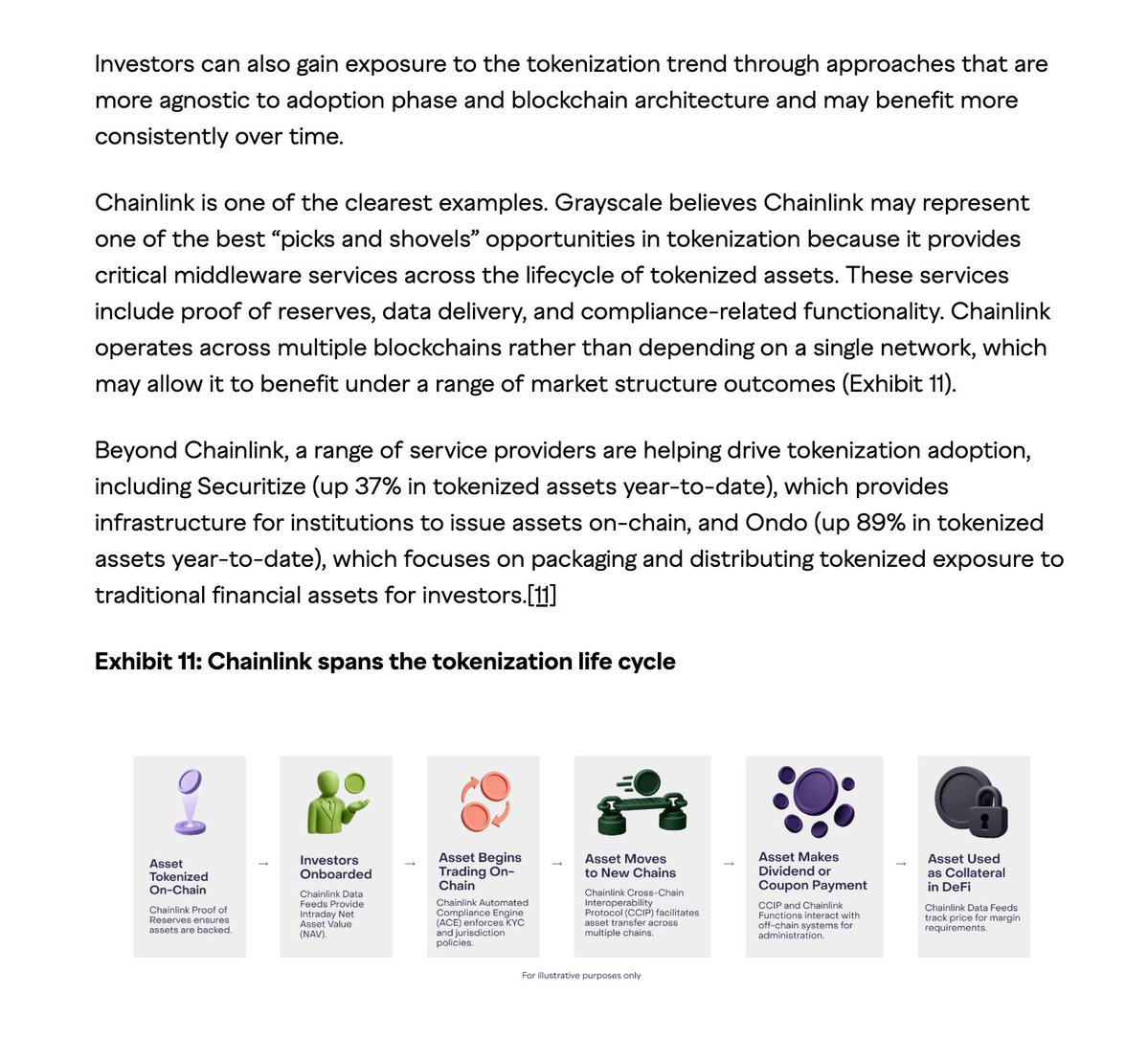
New @Grayscale report covers why Chainlink $LINK is one of the best "picks and shovels" opportunities in tokenization 🔥
Chainlink provides the data, interoperability, compliance, privacy and orchestration standards that power the full end-to-end lifecycle of tokenization
@willhamilogden and @LowBeta break down every stage:
✅ Asset tokenized onchain → Chainlink Proof of Reserve → Verify assets are backed
✅ Investors onboarded → Chainlink Data Feeds → Provides intraday net asset value (NAV) data
✅ Asset begins trading onchain → Chainlink ACE → Enforces KYC and jurisdiction polices
✅ Asset moves to new chains → Chainlink CCIP → Facilitates secure cross-chain asset transfers
✅ Asset makes dividend or coupon payment → Chainlink CCIP and Function → Connect to offchain systems for administration
✅ Asset used as collateral in DeFi → Chainlink Data Feeds → Validate asset value for margin requirements
An advanced institutional workflow, spanning multiple chains, enterprise systems, and APIs, all coordinated by the Chainlink Runtime Environment (CRE)
Importantly, Chainlink is fully blockchain-agnostic, so it doesn't matter which chains are adopted by capital markets, they all still need Chainlink
"It is hard to imagine the tokenization of capital markets playing out without tools like Chainlink, regardless of which blockchain is leading."
The two other service providers named in this section, Securitize and Ondo, both use Chainlink to power the distribution of their tokenized assets across onchain finance
Just released: “Chainlink in Plain English” – why Chainlink matters for stablecoins, tokenization, and mass-scale adoption.
Written for traditional investors, by crypto experts.
Share it with the Chainlink skeptic in your life.
https://t.co/CXD1K6JEyH
Chainlink just posted this on their Linkedin.
Amazon web services (AWS) just spotlighted the missing $LINK between traditional finance and blockchains: @chainlink Runtime environment (CRE)
This is the second time @chainlink mentions they are working closely with Amazon in a short period of time.
$LINK everything!
No luck involved here sir. Architecture.
CCIP by @chainlink was built around the exact failure that just drained Kelp, and the difference isn't a slightly better config. It's a different threat model from the ground up. Every CCIP message is validated by two completely independent networks before it can execute on the destination chain. The main Chainlink DON observes the source chain, reaches consensus on the messages and their ordering, and commits a Merkle root to the destination. That's the same shape as any oracle network. The part that matters is what happens next. A second network, the Risk Management Network, watches the source chain on its own, independently rebuilds that Merkle root from scratch, and has to explicitly "bless" it before any message under that root can be executed. No bless, no execution.
A compromised primary network cannot move funds on its own. A buggy primary network cannot move funds on its own. A primary network with a key leak cannot move funds on its own. That second network isn't a different quorum of the same thing. It's a separate Rust codebase (smartcontractkit/risk-management-network), separate team inside Chainlink Labs, separate set of node operators, zero shared nodes with the main Go client. Different language, different binary, different infra, different people. A bug in the Go client cannot exist in the Rust one. An operator compromised on one side has no signing rights on the other. Both repos are public and you can audit the consensus logic, the blessing logic, the curse logic, and the signer set yourself.
That's what client diversity looks like when someone actually builds it. LayerZero's marketing says DVNs can be diverse, but in practice every major DVN runs the same closed source "essense" client and pipes signed messages into a LayerZero operated collector. You cannot prove two "independent" DVNs aren't the same binary on the same box run by the same operator under two names. Kelp's config was 1-of-1. One signer. One closed client. $292M of trust sitting on a single key whose provenance nobody outside LZ can verify.
RMN also has a kill switch that lives outside the system it protects. Any RMN node that sees anomalous state, a reorg, a finality violation, a message that shouldn't exist, a rate limit breach, can push a single curse transaction to the Risk Management Contracts on every chain and the entire CCIP lane halts globally in one tx. No multisig coordination, no 46 minute pause window, no scramble to find the right pauser key. Kelp needed 46 minutes to pause. In that window 116,500 rsETH walked out the door and the attacker tried twice more for another 40,000 each time, only stopped because the pause finally beat them.
Rate limits live inside the OnRamp and OffRamp contracts themselves, enforced by the protocol. Every lane has a per-token throughput cap and an aggregate cap that refills over time. You cannot drain 18% of a token's supply through a CCIP lane in a single txn because the contract reverts before the transfer settles. This isn't something the app developer has to remember to configure. It's the default behavior of the rails. Kelp's OFT Adapter had no equivalent. One lzReceive call released 116,500 rsETH with no throttle anywhere in the path.
The operators themselves are economic security, not just signing keys. CCIP DON operators are public companies with public identities (@linkpoolio , @cryptomanuf, @googlecloud, various others), each running independently audited Chainlink nodes. You can verify on chain what is signed and how long nodes been running. Contrast that with the DVN space, where you cannot even verify that the address listed as the Nethermind DVN is actually operated by Nethermind, because the signer wallet has never publicly identified itself or signed a proof of ownership.
And this isn't theoretical. PrimordialAA flagged LayerZero's DVN architecture 18 months before Kelp, then flagged Stargate's specific 2-of-2 admin wallet setup 8 days before Kelp. LayerZero publicly dismissed both as "gas abstraction" and "0 implication on security." Eight days later a different OApp using the same class of architecture got drained for $292M. @ChainLinkGod has been explaining this for two years. None of this was a mystery. The warnings were in public, the on chain evidence was in public, the code was in public.
So when the reply is "just use Chainlink," it's not superstition and it's not branding. It's the observation that CCIP made specific architectural choices that make the Kelp-style attack mechanically impossible. One network signs funds away? Blocked by RMN bless. Bug in the node client? Blocked by Go and Rust diversity. Operator compromised? Blocked by the second operator set. App didn't remember to configure a rate limit? Protocol enforces one anyway. Something weird happening that the automated systems didn't catch? Any human operator at RMN can curse the lane globally in one tx.
Everything I just described is verifiable from an RPC right now, in two public repos, with public operator identities and public signer sets. That's the actual argument. It's not "trust Chainlink," it's "Chainlink built the system so that trusting them isn't the thing holding it up." Two networks, two languages, two teams, two codebases, two independent verifications, a global curse, protocol level rate limits, public operators, slashable stake. All of it on chain. All of it auditable.
"Don't jinx it" is understandable after watching $292M vanish in 46 minutes. But the security of the system isn't a vibe. It's the Merkle root that two independent networks both have to agree on, or the message doesn't move.
Excited about the continued rollout of top institutional data on-chain via Chainlink; @sixgroup, the exchange of Switzerland has adopted @chainlink as the data standard it is using to get critical market data on-chain: https://t.co/GpQP6dnYnJ.
Chainlink is the global leader powering DeFi and TradFi RWAs, with this data helping increase institutional demand for both. This is now starting to be driven by TradFi users wanting their existing data sources on-chain as they move more capital into institutional grade RWAs, which require market data to function in similar ways to how DeFi couldn't operate without a reliable data layer like Chainlink. Below are just some more examples of top institutional grade data providers choosing to put their data on-chain via Chainlink as the leading data standard powering over 70% of DeFi globally, with it now becoming the data standard that their institutional users will be asking for in order to consider an RWA as reliable enough to put institutional capital into.
Also, being able to easily access key market data from CRE workflows should accelerate your speed of building a tokenized fund, tokenized equity, on-chain vault and many other on-chain financial products. If Chainlink is the place you can receive all your needed market data, reference data and identity data on-chain, that is just the first initial level of Chainlink integration for your RWAs. If you are then choosing to build your entire on-chain financial product via CRE because it can help you reliably create key conditional statements around the use of that data, with privacy and off-chain level compute scalability, that is a whole new level of Chainlink integration. The type of data listed below opens the door for DeFi, Prediction Markets, RWAs and many new categories of on-chain smart contracts to adopt Chainlink, but then once the full capabilities of reliable on-chain data are combined with CCIP cross-chain and CRE chain abstraction, that becomes a whole different level of orchestration, reliability and privacy.
S&P: https://t.co/6udBRjSzTU
FTSE Russell: https://t.co/gCpz6Eu99v
Tradeweb: https://t.co/d18kWaCifK
Deutsche Börse Group: https://t.co/KANxCI6uIF
Intercontinental Exchange: https://t.co/QWS7ETO9Kd
Coinbase: https://t.co/FS2MLqy4VB
Among many others....
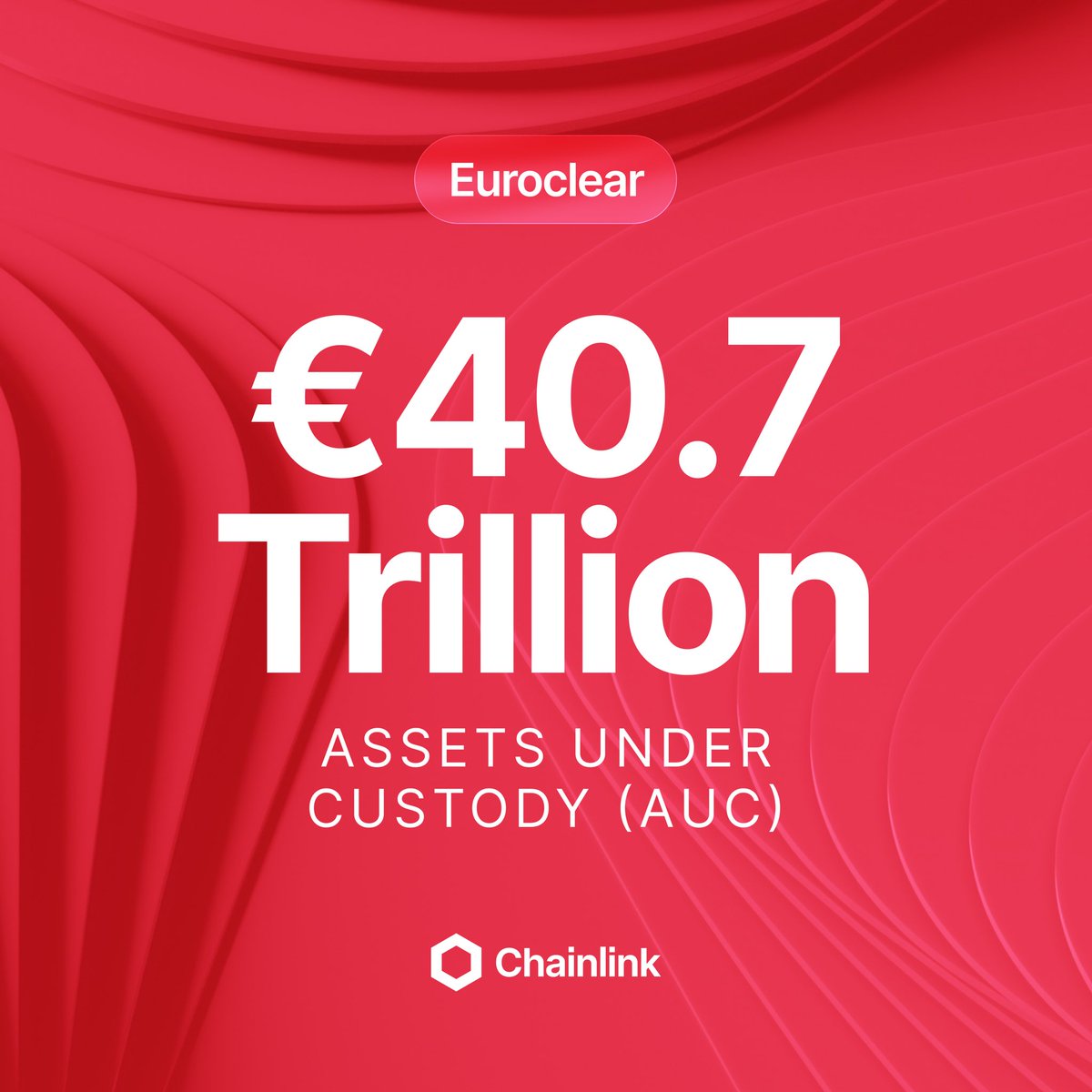
Euroclear has €40.7 trillion ($46+ trillion) in assets under custody.
Together with Chainlink, Euroclear is solving the yearly $58B+ corporate actions problem.
Euroclear 🤝 Chainlink
Bitwise CIO Matt Hougan explains the reason $LINK tokenomics have been so constrained up until now
“There’s a good reason why the economic alignment with the token is complex and that reason is named Gary Gensler. He made it illegal for there to be a direct economic tie”
now that $LINK is officially classified as a digital commodity Chainlink Labs can feel comfortable green lighting its full economics roadmap (Chainlink Economics 2.0)