On every scale of cognition, the brain’s job is to predict. It’s how we perceive the world at a fundamental level, it’s what drives our amazing capacity for cooperation, and it’s why we make sophisticated, abstract, ideological models of the world. They help us predict.
Oklahoma City fans definitely have the strongest Jonestown vibes on a good night, and it’s always fun to see someone give them some kool-aid. #GoSonics
@theomercer1877 I don’t know. My persistent hope is that great teachers and students will fold this powerful tool into the expansion of human knowledge, as they did with writing and calculators and web search. But I don’t know what that looks like, and higher ed is under a multi-front assault.
Having spent the last 3 years teaching at a large state university, I think the main challenge exposed by AI is that many of our (most senior, respected) professors don’t even know what student learning or growth looks like; they’ve been engaged in the simulacrum for a while. 1/3
Next up in my series about whether my 9 year old daughter will be going to college: I talked to 12 professors about how AI has changed their classrooms. https://t.co/8m0SBvRyKp
@GhostOfSocrates The essay has always been a lousy tool of assessment; no one thinks or writes like that, save lawyers and academics. It’s long overdue for an overhaul.
Now that this equilibrium has been upset, professors resent being asked to do what true education should ask of everyone involved: try something new and hard, and grow from your failure. 3/3
It was just easier for them to fake teaching than it was for students to fake learning, which kept the credentialing function in place. Tuition money flowed, underwriting research that bestowed status, and students were burdened with debt and disdain. 2/3
@jaycaspiankang@Tyler_A_Harper This was a great piece, and I appreciate and admire the commitment to the fundamental task of teaching that most of your sources expressed, explicitly and implicitly.
@Freyy_is It’s not that AI writing can’t be detected; of course it can, so much of it is uncanny dreck. What makes this moment so unnerving is that it’s nearly impossible to tell what writing *isnt* AI.
@SeanTrende Lovely. Congrats on your hard work. Happiness and fulfillment are learned skills, not outcomes, and it sounds like you have taught Judson well.
There isn’t a single of an incumbent center left (or center right) victory in ‘24. The twin tumults of COVID and inflation made the world’s industrialized democracies a little fasc-curious, and everyone touched the hot stove. And now we’re in the midst of the pendulum swing back.
Read between the lines — basically all the Democrats botched 2024.
But none of them want to admit their piece or take it on the chin.
Not the Biden folks, not the Anita Dunn SuperPAC, not the obama folks who ran Harris’s campaign, not Harris folks and surely not podcasters. 1/2
Another big study on cell phone bans finds that “average effects on test scores are consistently close to zero.” There is no evidence banning phones had any significant effect on school attendance, classroom attention, or perceived online bullying. https://t.co/XWrmZXP7qr
@SeanTrende Claude for coding and writing; ChatGPT is far superior for images.
NotebookLM for academic and source-related work (citations, especially).
Grok is a useful filter: anyone who recommends it need not be taken seriously.
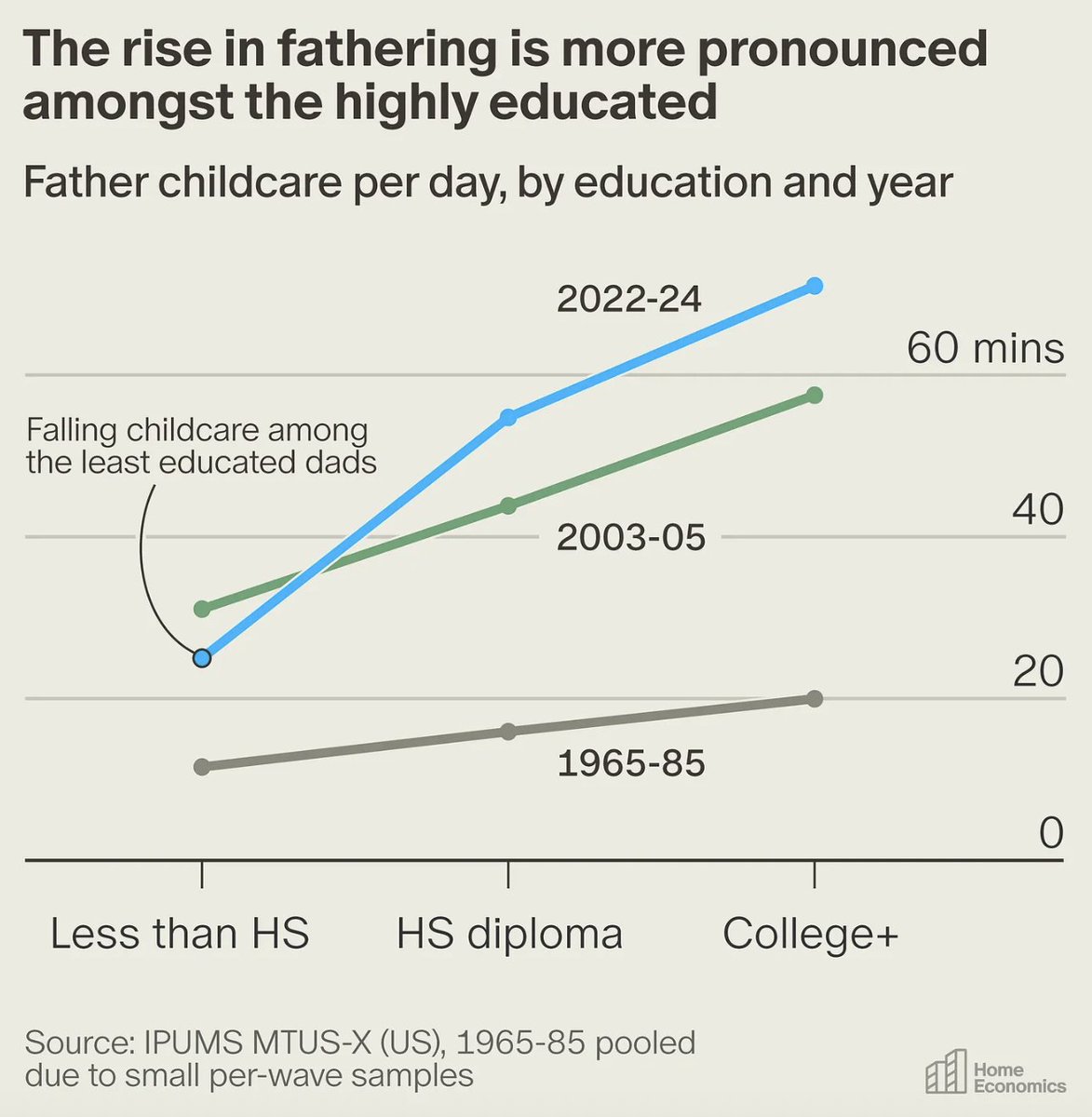
New newsletter: MODERN FATHERHOOD WOULD BE UNRECOGNIZABLE TO A 1950'S DAD
Compared to their Boomer parents, childcare time among Millennial dads has more than doubled.
Compared to their Silent Generation grandparents, it’s nearly quadrupled.
You will be hard-pressed to find any part of day-to-day modern life that has changed more in the last half-century than the way today’s parents—and fathers, in particular—spend their time.
The new American dad is more present and more exhausted—but also, more satisfied with life. What's behind this half-century transformation? Today's piece combines history, economic analysis, and gorgeous charts galore from @AzizSunderji