$VIR erasing all of its ECLIPSE-1 gains after issuing a seemingly unnecessary public offering with already $1bn in cash. May present a buying oppy tomorrow AM with their additional catalysts coming in Q1 2027
in early months BCVA - 15LL risk will be reduced in the drug arm but likely won’t separate from placebo. In GA the lesion begins to spread parafoveally. It is not until later in disease progression when the lesion encompasses the fovea that central acuity and BCVA drops off. This is why ARCHER II selects for patients later in disease progression. I do think 15 months is enough time for stat sig separation between arms
RBP4 antagonism works in Stargardt directly addressing the ABCA4 mutation but is a really poor mechanism for GA. Fenretinide failed in GA on both lesion reduction and vision functional endpoints. $BLTE Tinlarebant is very unlikely to surmount the efficacy bar for lession growth reduction set by Syfovre and Izervay in GA
@PositiveTopline I agree Vona likely wont have an impact in the early months on BCVA 15-LL but that makes sense given natural history GA progression. The 15mo timeline of ARCHER II and trial design that selects for patients w/ a greater # of BCVA 15-LL events provides some reassurance
On closer look at $MIRM AZURE-1 vs $VIR ECLIPSE-1 in HDV at 48weeks:
- MIRM HDV RNA TND response is actually largely similar to VIR if you account for the differences between assays. At least in the 48wk AZURE 1 data (300mg arm). But lack of dose response for MIRM is strange
-MIRM safety actually looks much better than VIR, specifically on flu like reactions likely driven by added siRNA mechanism of VIR
-VIR has stronger registrational package especially w/ H2H data vs Hepcludex and ECLIPSE 2 coming
-Think long term VIR could prove more durable than MIRM given siRNA mechanism. This could give it market differentiation. Need more data tho - SOLISTICE 98wk post-hoc show 10/10 pts with continued response even after treatment cessation indicating curative potential
-VIR also has strong HbSAg reduction data. MIRM does not provide this metric. Could be another market differentiator indicating crossover potential of HDV therapy into HBV and supporting longer term efficacy to Tobe + eleb
Overall I think the two HDV assets are more similar than they are different on efficacy at 48 weeks and MIRM is winner on safety. Still think VIR has upside potential into year end tho given where it’s trading currently and Q1 catalysts. VIR may also prove the more durable therapy with additional data give it’s added siRNA
TL;DR: Keep engaging on X—the outside perspective is valuable despite the noise. Pharma executives’ career incentives can push them to overpay for “safe” assets, while small biotech investors may uncover overlooked opportunities using AI, novel data, and unique analyses. More dialogue could improve investment decisions: even one insightful question could save billions and help get treatments to patients more efficiently.
@DaveARicks Some thoughts I wanted to pass along for you to consider, as I find your effort to engage directly with the community a big positive to us (even if you're still deciding on whether it is on your end):
1) Though it might be uncomfortable at times, I've personally found the net benefit of the discourse to outweigh the annoying downsides (also, the "mute" feature for less-than-value-add posters on X can be your friend if you haven't yet located it)
2) I hope you find it a useful way to communicate in a much more direct way with the world, and in this case, a subset of people who are passionate about investing. Your personal touch on your posts has been refreshing
3) I've had the opportunity to interact with senior pharma BD and R&D pharma executives (including a few who are my personal and professional friends) and personally know a good deal of biotech fund managers. My opinion is that there is an echo chamber that can exist within any organization or industry sub-group, primarily due to different incentive structures and personalities of those who gravitate to different types of careers. While I think you're right to point out there's a lot of self-interested individuals on X, the principal/agent problem exists at all levels. My feedback would be that, from an outside perspective, pharma business executives are always weighing their own personal advancement and job risk with what ultimately is the best decision for the company. That can sometimes lead them to be at odds with finding the best risk-adjusted opportunities that synergize well with existing and future company infrastructure and strategic objectives, and instead to favor assets that is the least likely to be a black mark on their career. That leads to, in my opinion, a lot of overpaying for "de-risked biology" and vulnerability for the product to achieve an attractive ROIC
4) As you know, the culture set within the institution, and the incentive structure, has a huge impact on how that manifests. Pharma has human and capital resources and data that we on the buyside dream we would have access to, and one day I hope perhaps we can collaborate better with pharma, at least at arms-length, in order to get drugs to market more efficiently. But small funds and some individuals have something else that I think is special: a drive to innovate the capital allocation and investment process in what has historically been a very inefficient capital allocation industry (LLY is more of the exception than the rule). We're working on a lot of really cool ways to integrate AI, statistics, alternative longitudinal patient data, and market data to find truly mispriced assets using a lot of novel approaches. We've been able to get conviction on programs that have worked (or haven't worked) through this innovation that, from my interactions with pharma, have not been fully explored on their end. If we can do it with a de minimus amount of resources compared to pharma, why not start a dialogue to see how we bridge that gap? We'll never understand your business to the extent you do, but I do think we can compare in certain areas as it relates to predicting probabilities of success, market opportunities, and assigning value to that under a variety of market regimes. Thought partnership sometimes requires grinding through a lot of bad fit ideas to find the one that changes the direction of a company or reinforces a strategic objective.
5) In my experience, a good thesis comes down to 2-3 key questions that need to be answered and a ton of boxes and ticking and tying that needs to be done. Sometimes it takes a unique perspective to consider how one can get an edge on those unique questions -- there's a lot of completely odd and self-serving takes on X, but it only takes one good question or one new risk pointed out that your team hasn't yet considered to save $1-$10bn+ in cash. Hopefully that's net helpful at the end of the day -- the patients really do matter and the world is dependent on us all to find ways to deliver therapies to them with increasing efficiency and reduced sunk costs.
$CLDX efficacy data largely similar to $CUE. Safety for $CLDX is concerning with 2 cases of anaphylaxis in Q4W dose and ~10% of patients with neutropenia. $CUE safety profile as presented yesterday is relatively benign, although we need more specificity around TEAEs. $CLDX trading at 2.98Bn and $CUE at 205.36MM. $CUE is looking like a long after initiation of ph2b/3. They are cash poor currently so will need to raise additional capital or partner in order to initiate registrational trials.
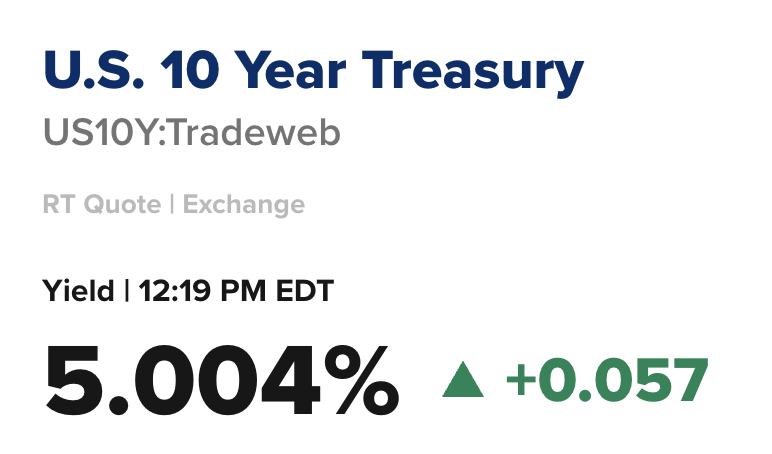
Many stocks that were up yesterday on softness in yields, are giving back their moves today as yields recover. 10-year yield is back above 5%
The bond market is making it obvious: Fed hikes & Treasury buybacks are not what the bond vigilantes want. They want an end to the war.
$RARE approval in Sanfilippo A with strong label is bullish for $QURE, which also used a natural history control in HD ph3. Next update is 4 year data. If consistent with 3 year update, approval is very likely. Particularly given their initiation of a pbo-controlled trial
A rate hike doesn't address the core problem.
Inflation is being driven by wholly external forces.
All hiking will do is destroy some demand from the bottom 80% of the K-shaped economy and create further hardship for smaller businesses.
But until the supply chain bottlenecks are fully addressed we can expect persistent inflation.
This while deficit spending rises because of increased short-end rates driving up the cost of capital where the government prefers to fund itself.
Another part of the problem is the structural stickiness of inflation for years. The Fed tried to combat inflation as best it could (again, destroying demand with rising rates) in 2022.
But even Powell with all of his transitory determination could not battle fiscal dominance. Ultimately the Biden administration won and Powell relented.
That, in turn, left a lot more structurally embedded inflation intact because there was no real credit cycle reset.
So here we are, years later, with above normal levels of inflation from any honest measure nearly the entire time.
And now we have exogenous inflationary catalysts that are becoming more and not less entrenched. This while global oil reserves run lower and lower and industry executives say that this is a real energy crisis that could last a long time.
Point being, the Fed can wave its magic wand and create some hardship to destroy demand, but that won't be sufficient to actually battle inflation. It will, however, temporarily help stocks and the long-end get a bid.
But until the Strait of Hormuz is truly open and the energy infrastructure of parts of the Middle East is repaired and rebuilt, we are likely to see not only higher prices, but also real energy scarcity in parts of the world that are reliant on Middle East exports, including potentially Europe.
So buckle up. This is a problem we're set to deal with until we have an actual solution. All the jawboning about peace deals and threats of utter destruction have lost credibility. Now reality is setting in . . .
3/3! Three positive Phase 3 readouts… and we’re just getting started.
Today, we’re sharing positive topline results from our Panorama study for DT120 ODT in generalized anxiety disorder (GAD). Following the successful readout from our Voyage study, also in GAD, this milestone demonstrates reproducibility and momentum across our trial program, advancing our mission to forge a new era of psychiatry.
This additional positive data readout reinforces our strong clinical foundation as we proceed down the regulatory pathway, with NDA filing anticipated in 1H 2027.
We’re grateful to all the participants and clinical teams who continue to make this progress possible. Learn more here: https://t.co/y8voPmLa3n
#MentalHealth #DefiniumTherapeutics #Psychedelics #GAD #HealthcareInnovation
@Denny_Truong98 How do you feel about PMN’s poor cash balance that gets them no further than topline ph1 data and the warrants that they own that will lead to major dilution if triggered on good data in q1 2027?
@Finsee_main Hey a couple things:
1) when I spoke with mgmt a few weeks back they said current cash balanace gets them to Q1 2027 topline ph1 data but they will need to either raise or partner thereafter
2) They also have warrants that will trigger if stock price meets the strike on data