Case 1: Ultra-endurance relay cyclist, Race Across the West (44h 20min). Mean glucose: 91 mg/dL during cycling — but with 9.2% time below 70 mg/dL. Long duration + fueling demands = real hypoglycemic dips.
The point: clinical CGM thresholds (70-140 mg/dL "normal") were designed for metabolic disease management. During elite extreme performance, these ranges don't apply. 160 mg/dL in an Everesting attempt isn't pathology — it's physiology.
What does blood sugar actually do during record athletic performances?
Researchers put continuous glucose monitors (CGMs) on 3 elite non-diabetic athletes during 3 very different extreme events. The results don't look like clinical textbooks.
Every one of us has some degree of asymmetry — handedness alone proves that, and roughly 98% of people show it. The real question isn't whether asymmetries exist. It's when they cross from normal variation into something worth fixing.
A 10% muscle asymmetry threshold is fine as a heuristic. The science behind it, though, is shaky.
I use a red/yellow/green system instead:
Green: <5% difference between sides. Leave it alone.
Yellow: 5–10%. Performance cost is real. Intervene.
Red: >10%. High priority – not a season-ender, but it gets treated like one in training.
These aren't absolute calls. Context changes everything.
Type of asymmetry matters. So does whether we're talking muscle size, functional output, or range of motion. The person's goals, activity level, and history all change the picture too.
Think of these zones as guardrails – more accurate to the literature than a hard 10% cutoff, but still just a starting point for the conversation.
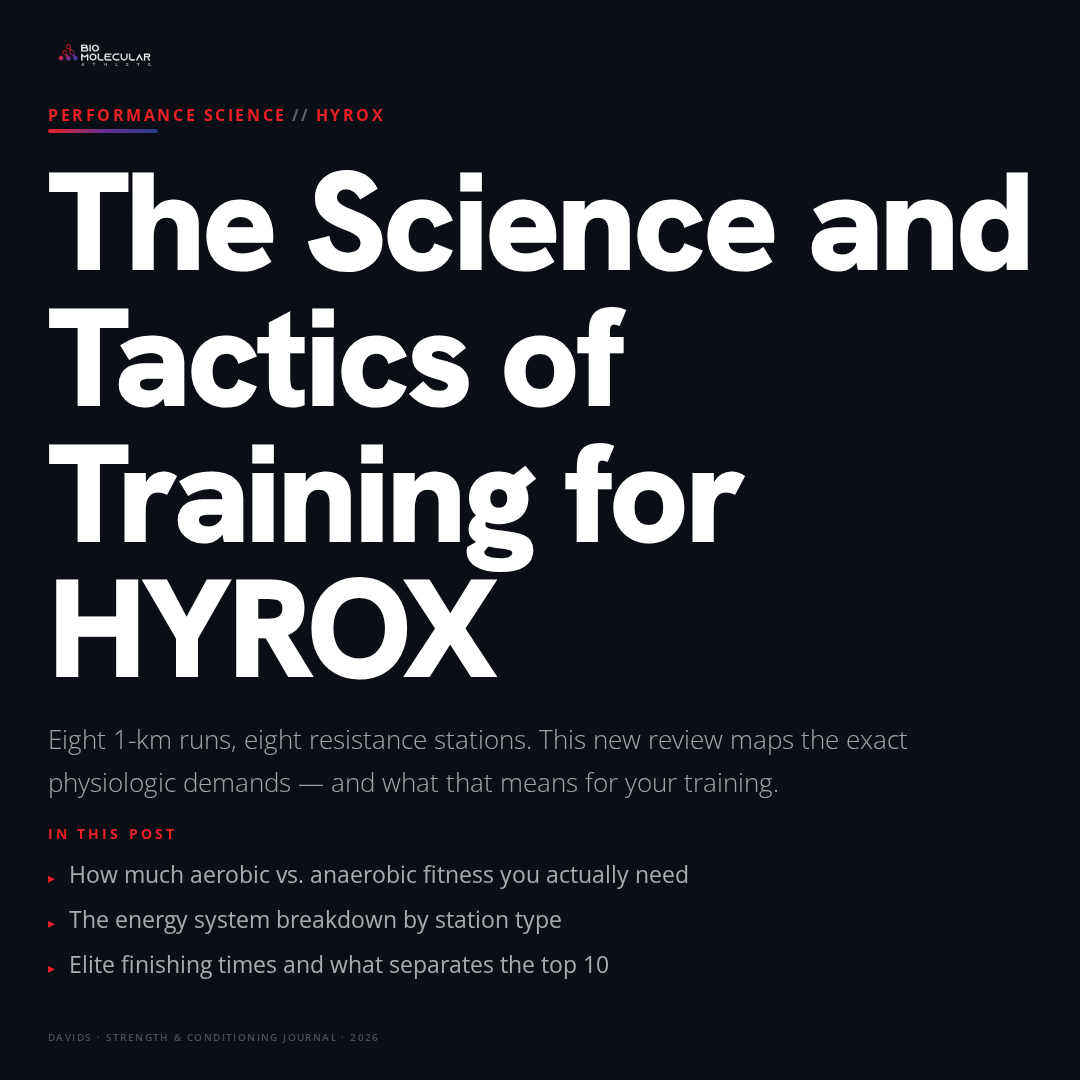
HYROX is one of the fastest-growing competitions in fitness. A new review is the first to map the actual physiology behind it — what determines who wins, and why.
Let's start w/ the demands...
New Perform with Dr. Andy Galpin episode: Identify & Fix Muscle Imbalances & Injury Risks
0:00 Introduction
2:30 The Three Types: Morphology, Quality, Function
9:09 Laterality: Skill vs. Force Dominance
13:21 Why Asymmetries Develop
19:47 The Bilateral Force Deficit
24:43 Investigate: How to Measure Asymmetries
29:27 Morphology: Tape Measures to MRI
30:41 Tissue Quality & Fat Infiltration
36:21 Functionality: The Unlimited Field of Tests
42:30 Interpret: When Do Asymmetries Matter?
43:25 Muscle Size: Is the Asymmetry Even Real?
51:02 Push vs. Pull & the Limb-Length Myth
58:44 Movement Screens & the FMS
1:01:30 Strength, Power & Injury Risk
1:04:25 Grip Strength Asymmetry & Aging
1:09:46 Symmetrical Sports & the Energy Leak
1:15:53 Red, Yellow, Green: The Real Thresholds
1:19:35 Intervene: Correcting Asymmetries
1:20:46 Why Plyometrics Work Best
1:23:50 The Five-Step Correction Program
1:31:59 The Volume Game
1:33:50 Resources & Final Takeaways
Includes paid partnerships.
How to build muscle:
Three pathways to muscle growth: mechanical tension (heavy loads), metabolic disturbance (high fatigue), and muscle damage. None of the three is required on its own. "You just have to make sure you do the work."
The only failing combination: low frequency, low intensity, and low volume at the same time. Keep at least one of those variables high and growth follows.
Blood flow restriction works: cutting off blood flow and training at as little as 30% of max load to failure produces hypertrophy equal to heavy lifting, through the metabolic disturbance pathway.
Protein redistribution is real: training legs while under-eating protein can cause the body to pull amino acids from upper body muscle tissue and redirect them to the quads.
@DrAndyGalpin on @hubermanlab
After bumping into a black bear while taking a hike with the family Saturday, I decided to do some science education into the wonderful bear species.
Bears might be the best teachers modern medicine has for the diseases of sitting still.
Months obese, months motionless — and they wake up metabolically healthy, strong, and clot-free. A new review asks how, and what we could borrow.
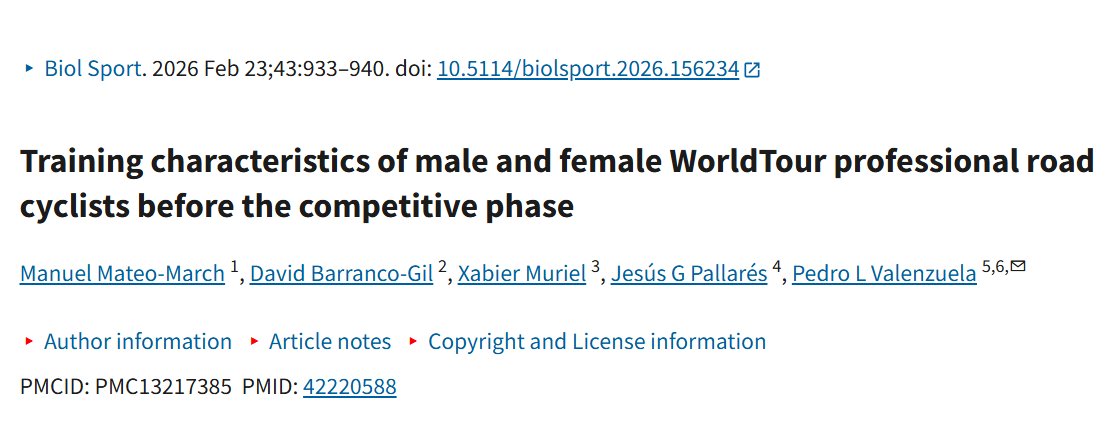
Attention cyclists: I always have a soft spot for papers like this bc they let the public see what pro athletes are really doing for training.
Some crazy numbers here. Kudos to authors!
https://t.co/g1YrZM0poc
New Perform with Dr. Andy Galpin episode: Female Training, Hormones & Nutrition: Fact vs. Fiction | Dr. Lauren Colenso-Semple (@drlaurencs1)
0:00 Lauren Colenso-Semple
1:51 The Lit Review That Never Was
7:01 Why Women Got Bad Training Advice
11:23 Individualization & Where Sex Actually Ranks
21:09 Estrogen, Rodent Models & the Anabolic Myth
34:52 Hormones Across the Menstrual Cycle
45:18 The Myth of the Textbook 28-Day Cycle
51:41 Why Female Research Is So Hard
57:55 Inside Lauren's Dissertation: Tracers & Biopsies
1:06:10 Strength, Power & Hypertrophy: No Phase Effect
1:14:13 The Real Role of Testosterone & Menopause
1:23:36 Becoming a Better Consumer of Science
1:50:10 Low Energy Availability & RED-S
1:57:30 Advice for the Average Woman
Includes paid partnerships.
Is your skin related to dementia?
Neat paper here. To be clear, there's almost no data at this point (esp. for anything suggesting causation) - but will be interesting to follow in the years to come (maybe).
https://t.co/bPeIa2OKir
The most interesting thing about GLP-1 drugs and alcohol isn't that people drink less — it's what shifts underneath. Across the research so far:
— ~54% fewer alcohol-related events
— ~45% lower relapse
— 30–50% lower odds of developing AUD
🔥 The Catalyst Newsletter is here.
From @DrAndyGalpin and Coach Dan Garner.
⚡️ Exclusive Videos
🧠 Research Reviews
🧰 Tools, Tricks & Tips
🎥 Live Q&As & Events
🎁 Big-Time Giveaways
Join Now: https://t.co/Djk11Uagbx
🌴 @DrAndyGalpin is heading to Miami June 6th — and he’s bringing the future of performance science with him!
🧬 If you’re serious about leveling up your game, this is where you need to be.
Want in? Click the link to learn more…
👉 https://t.co/zXmX0h8WYJ
Want to speed up your metabolism?
Here's what science says about boosting your metabolism. There are numerous evidence-based ways that actually work! But… most of what you've heard is wrong. So, let’s clear up the confusion on what’s bogus, what’s real, and what ‘speeding up your metabolism’ really means - and what it does not!
A deep dive into the research with surprising findings:
First: You can't actually "speed up" your metabolism. That's like saying you can make your car drive faster when it's parked.
What you can do is influence how many "miles" your metabolism drives each day.
Here's how it works:
Your Total Daily Energy Expenditure (TDEE) has 4 components:
1. Exercise Activity (EAT): 0-30% of calories
2. Non-Exercise Activity (NEAT): 5-30%
3. Thermal Effect of Food (TEF): 8-15%
4. Resting Metabolic Rate (RMR): 40-80%
The research shows there are both acute (temporary; minutes to hours) and chronic (long-term; days to weeks or months) ways to influence these components. Most of the nonsense in this topic comes from people making claims about things that enhance ‘metabolic rate’ acutely - which as you’ll see, is actually quite easy to do. But this is very deceiving because acute increase often means very little in the long-term, especially for outcomes like fat loss, and they aren’t necessarily increasing your metabolism in the way you think (they ramp up RMR, for a few minutes, but then it goes right back down to normal, or even below baseline). So, it’s quite easy to deceive with legitimate science here.
That said, let's look at what actually works for acute changes, and by how much:
Acute Boosters:
1. Spicy foods (peppers, ginger, chilis, etc.)
- Increases RMR by 3-5%
- Effect lasts 1-2 hours
- Often through capsaicin in chili peppers
2. Cold exposure
- Lowering room temp by few degrees
- Can lead to significant fat loss over time
3. Caffeine
- Increases RMR by 3-11%
- Lasts 1-3 hours
- Also reduces appetite
4. Green tea
- 4-5% RMR increase
- Similar duration to caffeine
- Compounds with caffeine for better results
But here's what's really interesting: The chronic (long-term) changes are what really matter for sustainable results.
Research shows 4 key factors for long-term metabolic enhancement:
1. Quality Sleep
- Poor sleep reduces RMR
- Increases hunger hormones
- Can reduce fat loss by 55%
- Affects muscle preservation
2. Fish Oil (3g/day)
- 14% increase in RMR
- 19% increase in fat oxidation
- 4% increase in lean mass over 12 weeks
3. Muscle Mass
- Each pound burns 6-10 extra calories daily
- Primary factor in age-related metabolic decline
- Explains up to 80% of RMR variance
4. Exercise
- Strength training: +100 cal/day RMR
- Cardio: +50-60 cal/day RMR
- Combined: +75 cal/day RMR
The most effective approach? Combining multiple strategies:
- 200 cal from additional exercise
- Fish oil + green tea (+25-50 cal)
- Protein increase (+45 cal from TEF)
- 15-min daily walk (+100 cal)
- Small calorie reduction (-80 cal)
This approach works because it:
- Doesn't crash your metabolism
- Preserves muscle mass
- Avoids adaptive thermogenesis
- Creates sustainable habits
The key isn't finding one magic solution - it's stacking small, evidence-based changes.
Remember: Your metabolism isn't "fast" or "slow."
It's responding to your daily choices in sleep, nutrition, activity, and muscle mass.
Focus on these factors consistently, and you'll create lasting metabolic health.