We built the World's first Bitcoin Security Oracle.
Bitcoin sealed built on @TracNetwork and @tap_protocol
5 live signals.
One verdict.
BSPI right now: 94.11/100 — CRITICAL
Who will foot the bill when subsidies run out?
NAT will.
https://t.co/oLHgnVnt9g
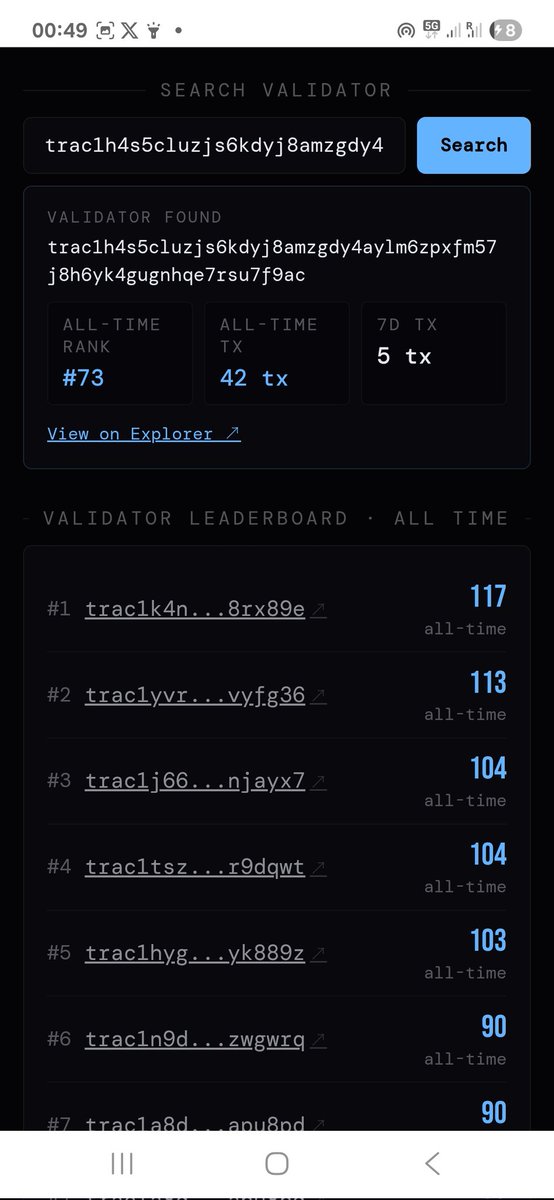
Validator lookup is live.
Search any @TracNetwork validator to view:
• All-time rank
• Transaction count
• 7d activity
• Leaderboard position
Building the data layer for TRAC.
https://t.co/KLsh5ZkN2y
🔥 SpiderPool First Launch|BTC Same-Block Dual Rewards Now Live! DMT-NAT (NAT) Officially
Released!
Dear Miners,
Major update has officially launched! SpiderPool now supports the BTC block-associated asset NAT (DMT-NAT), marking a new era in Bitcoin mining rewards 🚀
From now on, no extra actions are required. As long as your mining machines are connected to SpiderPool and running normally, you will automatically receive a second reward from the same block.
NAT and BTC operate under the same hash rate, same chain, same block, and same address. Rewards are generated synchronously with Bitcoin blocks and automatically stacked.
✔️ No configuration changes required ✔️ No additional cost required ✔️ Automatic reward stacking
One hash rate, double rewards!
📌 Notice: Please ensure your NAT receiving address is properly bound to guarantee successful reward distribution to all miners.
SpiderPool Team
@Ziggy_Hung@TracNetwork 37,690 This is the total count of ALL confirmed transactions on the TRAC network since genesis. This includes:
Token transfers (TNK sends/receives)
Validator validations
Fee transactions
Balance initializations
Any other MSB transaction type
8832 Tx Are all time transfers
The market is noisy.
The math is not.
Bitcoin’s security budget declines over time.
Miner incentives matter.
@natgmi is one of the few ideas actually trying to solve the problem.
New video 👇
Why $NAT Will Take off To 100Million Market Cap 🚀 First Bitcoin Miner Pool Distributing NAT SOON!
We break down why $NAT is starting to attract deeper attention across the Bitcoin ecosystem and why the conversation around it keeps coming back to one core issue: Bitcoin’s long-term security model. What begins as a discussion around growing community conviction quickly turns into a much bigger conversation about miner incentives, the halving cycle, and the structural pressure created by a security budget that depends on an asset continuing to grow while the underlying subsidy keeps shrinking.
We explore why that math matters more than most people want to admit. Bitcoin’s security is tied to miner revenue, yet that revenue is designed to decline every four years unless price growth keeps offsetting the drop. The problem is not new, but it becomes harder to ignore as returns compress, competition for compute increases, and the cost of securing an increasingly valuable network becomes more difficult to justify with the same or weaker economic support.
From there, we explain why $NAT stands out as more than just another token narrative. The thesis presented in this episode is that $NAT offers a way to introduce a more stable source of value to miners, one that is not locked into the same exponential decay as Bitcoin’s base subsidy. That is why we frame $NAT as a serious economic mechanism rather than a speculative side story, and why they see it as directly connected to Bitcoin’s future rather than orbiting around it.
The episode also covers signs of growing adoption, including new trading access via @tap_protocol support on @Satflow, increased visibility across platforms like https://t.co/bD0sGINBYS and https://t.co/teThlPmDPg, and discussion of @SpiderPool_com work toward $NAT distribution for pool participants. That potential shift matters because it pushes $NAT closer to the kind of liquidity and accessibility miners would need in order for the model to scale in a meaningful way.
What makes the conversation especially interesting is the contrast between @natgmi's steady progress and the broader weakness across crypto markets. While many assets continue to spiral during a rough stretch for the sector, the hosts argue that bear markets tend to expose what actually has substance. In their view, this is when real problem-solution projects become easier to spot, because the noise fades and fundamentals matter again.
The bigger message here is that $NAT is being positioned as part of a much larger answer to Bitcoin’s incentive design, not as a detached community trade. The more miners, pool operators, and ecosystem participants engage with it, the more the idea begins to move from theory into infrastructure.
By the end of the episode, the tone is clear: the case for $NAT is not built on hype, but on a growing belief that Bitcoin eventually needs a stronger economic support layer than price appreciation alone can provide. Whether that thesis plays out exactly as expected or not, the discussion makes one thing hard to dismiss: the market may still be early, but the underlying problem is very real.
What is TRAC actually doing right now?
Not price. Not speculation.
Actual behavior.
We built a live page showing: • Where TRAC is moving • Who’s accumulating vs depositing • Validator activity • Wallet growth
Right now: QUIET
Take a look 👇
https://t.co/KLsh5ZkN2y
@AndreWGMI Most people here are debating why.
We’re tracking what’s actually happening.
NAT mint + wallet flows already show: → miner-linked wallets active
→ early sell pressure forming
Still early… but the signal is there.
https://t.co/oLHgnVnt9g
@natgmi@tap_protocol
@natgmi@iman_blockrun@ordinalswallet The signal is real.
NAT = +$22/block
Security gap = massive
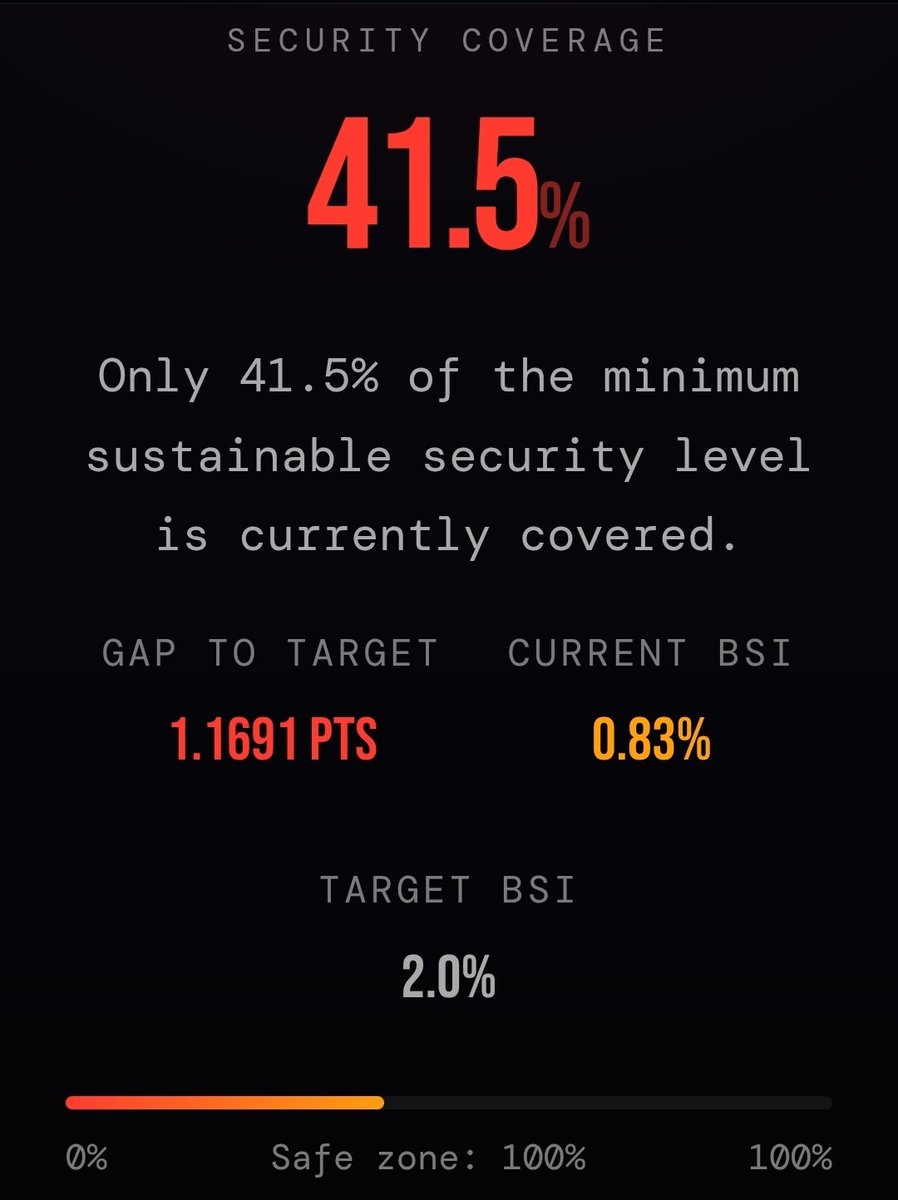
Coverage = 41.5%
Miners are testing new revenue streams.
Tracking it live ↓
https://t.co/FsyhMVaACs
Update:
New metrics added to Bitcoin Security Intelligence
→ Coverage vs sustainable level
→ Real security gap
→ NAT contribution per block/day
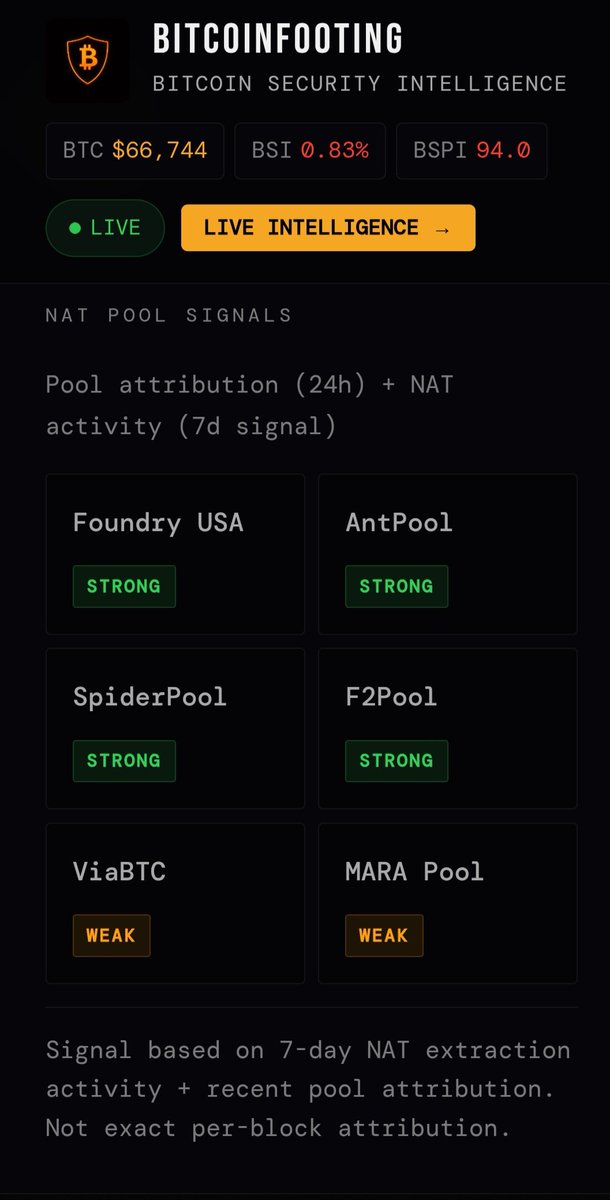
→ Pool participation signals
We don’t assume solutions.
We measure them.
Live ↓
https://t.co/FsyhMVaACs
@btcreevolution@rarity_garden@TheBlockRunner Agreed — security is sustained economic flow.
The question is whether that flow actually reaches miners at scale.
If it does, it strengthens the security budget.
If it doesn’t, the gap remains.
That’s what we’re trying to quantify in real time.
NAT just showed impact score 58.3/100.
Without NAT: 495 years to Bitcoin security target.
With NAT: 24 years. 20x faster.
This is what @rarity_garden and @TheBlockRunner built.
We just measure it.
https://t.co/oLHgnVnt9g
#Bitcoin#NAT#DMT
@fightfear1@rarity_garden@TheBlockRunner Not intentional — it’s a measurement gap we’re fixing.
We see NAT signals, but pool-level attribution isn’t perfect yet.
So we’re moving to:
strong / weak / unknown + participation rate
@Bankless Quantum risk is real long term.
But Bitcoin’s current security pressure isn’t quantum — it’s economic.
Fees are ~0.6% of the security budget (target ~50%).
Subsidy halves every 4 years.
Security declines unless something replaces it.
We track this live:
https://t.co/7XOFsN8LTa
Everyone talks price. Few track security.
Fees are ~0.6% of Bitcoin’s security budget.
Subsidy keeps halving.
Model shows:
~492 years to reach sustainable fee security (at current conditions).
The question isn’t today.
It’s the trajectory.
#Bitcoin#BitcoinMining#NAT
NAT Impact Score: 58.3/100
Still early. But it's moving.
Without NAT the security budget declines every halving.
With NAT there's a supplemental mechanism that grows as subsidies fall.
The math is on-chain. The data is live.
https://t.co/FsyhMVaACs
#Bitcoin#NAT#DMT