🚨LOOKING FOR MORE #Bitcoin PLEBS! 🚨
Are you #Bitcoin only?
Do you want to explore the world of Bitcoin and join me on the journey?
Do you share valuable content or funny memes?
If you think that's you, follow me and I follow you back!
Let's connect and grow together! 💪
"Bitcoin bottom will be when the big guys fill their bags. simple as that. so it will go as low as needed to create the liquidity needed for that transfer of positions. not any less, not any more."
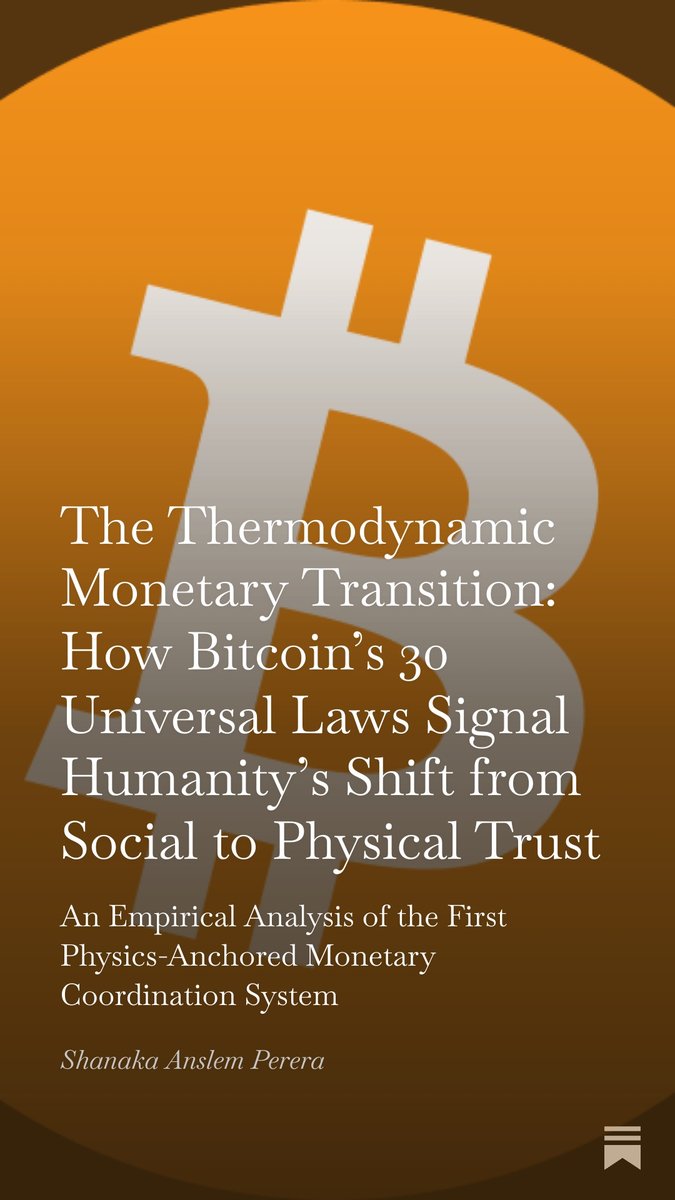
After 16 years and $1.83 trillion, I finally understand what Bitcoin actually is.
It's not digital gold. It's not a payment system. It's not even money.
Bitcoin is humanity's first institution where legitimacy comes from physics instead of politics.
Here's what that means:
Your bank account exists because a government says it does. They can freeze it. Print more. Change the rules.
Bitcoin exists because thermodynamics says it does. Each block costs $281,700 in electricity. You cannot print energy. You cannot vote to change physics.
To rewrite one day of Bitcoin history costs $40 million in power.
To rewrite one day of banking history costs one phone call.
This is why it won't stop.
Not because of price. Not because of believers. Because of math.
Metcalfe's Law predicts Bitcoin's price with 90% accuracy across 15 years. The same law that governs how epidemics spread and how earthquakes cascade.
Game theory predicts zero successful attacks across 16 years. The same math that keeps nuclear weapons unused and traffic flowing.
Thermodynamics predicts why it costs more to attack than defend. The same physics that makes gold impossible to counterfeit.
Three scientific laws. 16 years of data. $1.83 trillion in validation.
Every other money in history asked: "Do you trust us?"
Bitcoin asks: "Can you do the math?"
For 5,000 years, money meant trusting kings, priests, or central bankers.
For 16 years, money has meant verifying physics.
You don't have to believe in Bitcoin.
You didn't have to believe in the internet either.
TCP/IP hit year 16 in 2005. People still thought it was a fad.
Today you're reading this because of it.
The pattern is simple: Infrastructure that removes the need for trust always wins. Always.
Not today. Not this year.
But eventually.
Because physics is patient.
And physics doesn't negotiate.
Read my full paper on why Bitcoin matters!
Substack
https://t.co/d0Ft9cfBFF
Medium
https://t.co/QSvKVqvJrS
If you invested your stimulus check from COVID into Bitcoin you would be able to buy a new car today.
$2,000 tariff dividends are going out next.👀
What better place is there?
My Bitcoin Market Synopsis:
You’re going to want to bookmark this.
*Not Investment Advice*
My base case remains that we are still in a bull market: we’ll recover from this dip over the coming week or two after briefly dipping below the 50-week SMA/EMA, then closing back above it by Sunday’s weekly close.
The bull market will extend at least into Q1 2026, but most likely longer and well into 2026, and it could even extend beyond that.
However, let’s look at the bear case.
A lot of the fear right now comes from people having PTSD from previous Bitcoin events like the FTX/Luna collapses, or from the recent mass liquidation events if they were holding altcoins.
Many people are scared under the false assumption that Bitcoin could easily drop by 50–80% like it has in past bear markets.
However, with the institutional bid and the market cap now comfortably over $1 trillion, Bitcoin is not the same asset.
The “it could go to zero” discount that existed in all previous bear markets has been completely removed. Bitcoin is now on the radar of essentially ALL the big money players in the world.
Without a major black swan catalyst, the odds of dropping below $70,000 (-45%) are extremely small, and a move to $80,000–$90,000 is much more likely if — and it’s a big if — the bull market is truly over, which I still don’t think it is.
So if we do enter a bear market from here, could you handle a period of time with Bitcoin ranging between $70,000 and $90,000?
In my view, we are not going back to $50,000–$60,000 without a significant black swan catalyst — a very low-probability event, just a few percent odds.
Either way, the ones who will win in the long term are the long-term-minded, stoic, set-it-and-forget-it-for-a-decade-or-longer, true Bitcoin investors — NOT the “let’s get cute with it” traders.
The big players are here, and the sophistication of short-term emotional manipulation and the trading game has increased in difficulty by an order of magnitude.
Anyone still playing that game had better be a pro.
If you got something out of this post, please share it.
— Plan C
BlackRock registered the name iShares Bitcoin Premium ETF, filing coming soon. This is a covered call bitcoin strategy in order to give btc some yield. This will be a '33 Act spot product, sequel to the $87b $IBIT.
Housing prices will crash hard.
The ponzi has collapsed.
The youth buy crypto with their spare money.
Nobody is saving for a deposit on mortgages to buy over price boomer jackpots.
Everyone hates banks.
Houses are too expensive.
Bitcoin is the solution.
IMPORTANT:
So the White House, with all their “smart” people around President @realDonaldTrump, still doesn’t understand Bitcoin and blockchain.
A blockchain is a very inefficient database. Due to its intended decentralization, it is slow and only secure through proof of work. It makes no sense to replace our current financial systems with any kind of blockchain. The only exception is money – Bitcoin – because it functions without external interference.
The moment you introduce an oracle, you must fully trust it, no matter how secure the underlying blockchain is. To put it simply: if you rely on a centralized oracle (and oracles are always centralized) to feed data into a blockchain, the whole process becomes centralized. In that case, there's no real need for the blockchain anymore.
To me, it’s obvious that neither the President nor the White House staff truly understands this technology. It’s just a collection of buzzwords to them.
That’s sad – I expected more competence. But it’s also good for us. We can keep stacking harder and longer.
Bumping this up:
Here are Zimbabwe's stock market returns for the last 5 years:
2019: 57%
2020: 103%
2021: 312%
2022: 87%
2023: 449%
2024: 903% (ZWL currency)
One would think Zimbabwe is the new bastion for growth and innovation in the world after looking at these numbers.
One would be wrong.
Here is Zimbabwe's M2 Money Supply growth numbers over the same period.
2020 - 475%
2021 - 131%
2022 - 250%
2023 - 710%
2024 - 692%
The vast majority of index returns are a function of money printing and currency devaluation, not productivity growth.
The S&P 500 when priced in Gold made almost no returns from 2004 to to 2020 yet when priced in US Dollars has grown at a CAGR of 7.8% during the same period.
Over that same period the USD money supply expanded at 7.33%.
These are not a series of coincidences. Most of the returns of the stock market aren't because stocks are getting more valuable, it’s the currency getting less valuable.