A national champion group can assemble capital, factories, cars, networks, and chips. That is rare.
The risk is governance: too many parents, too much consensus, too little product velocity.
This works if the new company is allowed to ship ugly v1 systems into real Honda/Sony/NEC workflows.
It fails if it becomes a press-release holding company.
Do you want Japan’s AI stack built by consortiums or by 50 hungry vertical startups?
Sony Group Corp, SoftBank, Honda & NEC Set Up New Company For AI Development!
The government of Japan plans to provide financial support of about 1 trillion yen, or over $6.2 Billion dollars, to private sector projects for domestic AI development. The funding is to be provided over a five year period from this month.
A $550B headline only matters if it becomes sites, offtake, and joint operating companies.
For Japan, the prize is not capital in general. It is AI factories, advanced packaging, and energy that can support them.
Cross-border money without local execution partners just inflates land and turbines.
The smart bet is US capital + Japanese process discipline.
Data centers, chips, or robotics JVs — where does this pact create real companies?
JUST IN: Japan reveals progress is being made on a $550 billion U.S. investment pact, with AI & semiconductor projects expected to play a “very significant” role.
¥2T aimed at AI, semiconductors, and robotics is serious industrial policy.
The question is conversion speed: budget line → factory, foundry, robot, trained operator.
Japan does not need more ambition slides. It needs 36-month execution in power, packaging, and shop-floor AI.
If this lands, Japan becomes a Physical AI exporter. If it slips, it becomes a subsidy cycle.
What would you underwrite first: compute, robots, or materials?
🇯🇵 HUGE: Japan is making a MASSIVE bet on AI, chips and economic independence.
Tokyo is seeking ¥7.8 TRILLION ($49B) for its Industry Ministry next year, with the bulk aimed at industries Japan increasingly sees as critical to its economic security.
Nearly ¥2 TRILLION alone is being lined up for AI, semiconductors and robotics.
Another ¥680B would go toward securing critical minerals including rare earths, alongside new spending on fuel security and dual-use defense technologies.
PM Sanae Takaichi is targeting ¥370 TRILLION in public and private investment across strategic industries over the next 14 years.
What does 6 years and $60M in AI development get you, if you skip straight to the demo?
For IBM's Watson for Oncology: a cancelled MD Anderson deployment that never treated a single real patient — plus internal IBM documents (via STAT News) showing "unsafe and incorrect" treatment recommendations at other hospitals.
Root cause: Watson learned from what a handful of doctors typed in, not real patient outcomes. It looked like clinical judgment before it had solved the actual problem — getting grounded in real data.
Compare Insilico Medicine: a drug taken from discovery to Phase II trials in under 30 months (vs. 6-8 years traditionally), the first drug both discovered and designed by generative AI, published in peer-reviewed Nature Biotechnology.
Same bet — Invent, building something that didn't exist before. One was tested against real trial data and peer review from day one. One was tested against its own trainers' opinions, for years.
Before you spend the money: can you name the job this does, and who's actually asking for it, in one sentence without saying "AI"? If not, you have a capability in search of a problem, not a real bet.
3, with 1 as the entry point. Not 4. Japanese labs already have the hard part: yield, reliability, and machines that last.
What is scarce is a company that can sell, install, service, and iterate that stack outside Japan. Direct equity in robotics/materials startups only works if the board mandate is global enterprise distribution, not another domestic pilot. JVs help with IP and procurement. They should not be the strategy. Too many die in committee. Software wrappers get cheaper every quarter. A gripper, inspector, or assembler that holds spec for 10 years does not.
If I had to place one chip: Japanese deep-tech equity + a US/EU GTM partner that already has factory accounts.
This is the Japan AI story people still miss.
The bottleneck is not another chatbot. It is films, chemicals, ceramics, and process yield.
Seasoning, soap, and toilets beating “pure AI” names is not a meme. It is materials science meeting compute.
The next winners may look boring on a slide and critical in a fab.
Which other “non-tech” Japanese firms belong on this list?
Ajinomoto — Japan's largest seasoning company makes insulating films used in AI motherboards.
Kao Corporation — Japan's soap and shampoo giant now makes chip-cleaning chemicals.
TOTO makes electrostatic chucks for NAND manufacturing.
Japan's AI supply chain runs through a toilet company, a seasoning company, and a shampoo brand and all three are outperforming every US tech stock.
The robot footage is the hook. The business story is the labor math.
Japan doesn’t need AI to look futuristic. It needs AI that takes night shifts, inspection, and store ops off a shrinking workforce.
That’s not sci-fi. That’s a P&L strategy.
🇯🇵JAPAN’S ROBOT REVOLUTION: WHY HIRE HUMANS WHEN YOU’VE GOT NVIDIA?
Japan’s going all-in: Yaskawa robots are moving metal at Toyota, and Seven & i Holdings is using digital twins to fine-tune shopping trips.
Powered by NVIDIA's Omniverse and Metropolis, these AI-fueled robots are handling just about everything—except asking for vacation days.
With an 11 million-worker shortage expected by 2040, Japan’s getting a head start. Robots are taking on heavy lifting, assisting humans, and more.
It sounds like sci-fi, but it’s real and happening right now at NVIDIA’s AI Summit.
Welcome to the future—Japan-style.
Source: NVIDIA
This is how AI actually grows a Japanese business:
don’t rip out the line.
Find the hidden inspection/QC bottleneck, slot AI into the existing floor, sell the labor-and-error reduction, then lock it in with support.
Adoption beats architecture.
Most startups fail at automating legacy manufacturing floors. Here is the 5-step framework 株式会社フツパー used to crack the market:
Step 1: The Hidden Inefficiency
Factories waste massive hours on manual visual inspection, quality control, and rigid workforce allocation. 株式会社フツパー targeted this exact operational bottleneck instead of building generalized tools.
Step 2: Zero-Overhaul Tech Architecture
Instead of demanding costly factory teardowns, they deployed specialized AI solutions that seamlessly integrate into existing industrial environments.
Step 3: Distribution & Moat
They secured recurring value through a subscription model, locking in sticky enterprise relationships from initial setup through long-term factory floor operations.
Step 4: Rapid Validation Loop
They combined high-tech AI engineering with deep, hands-on operational support to ensure immediate productivity gains on the ground.
Step 5: Unit Economics / Scaling
By aligning technology directly with labor cost reduction and error elimination, they unlocked predictable, scalable SaaS-like metrics in a traditional hardware-heavy sector.
💡 Key Takeaway: Real market dominance in B2B tech doesn't come from reinventing workflows—it comes from eliminating friction where the margins actually bleed.
📌 Bookmark this framework for your next product build or investor pitch.
What is your biggest roadblock when scaling in this domain? (Drop it below 👇)
Full startup profile & pitch deck in replies 👇
Japanese IP + generative AI only becomes a business if rights, brand tone, and distribution are designed first.
The technical demo is easy. The hard part is making licensed characters, stories, and campaigns usable by companies without legal or cultural friction.
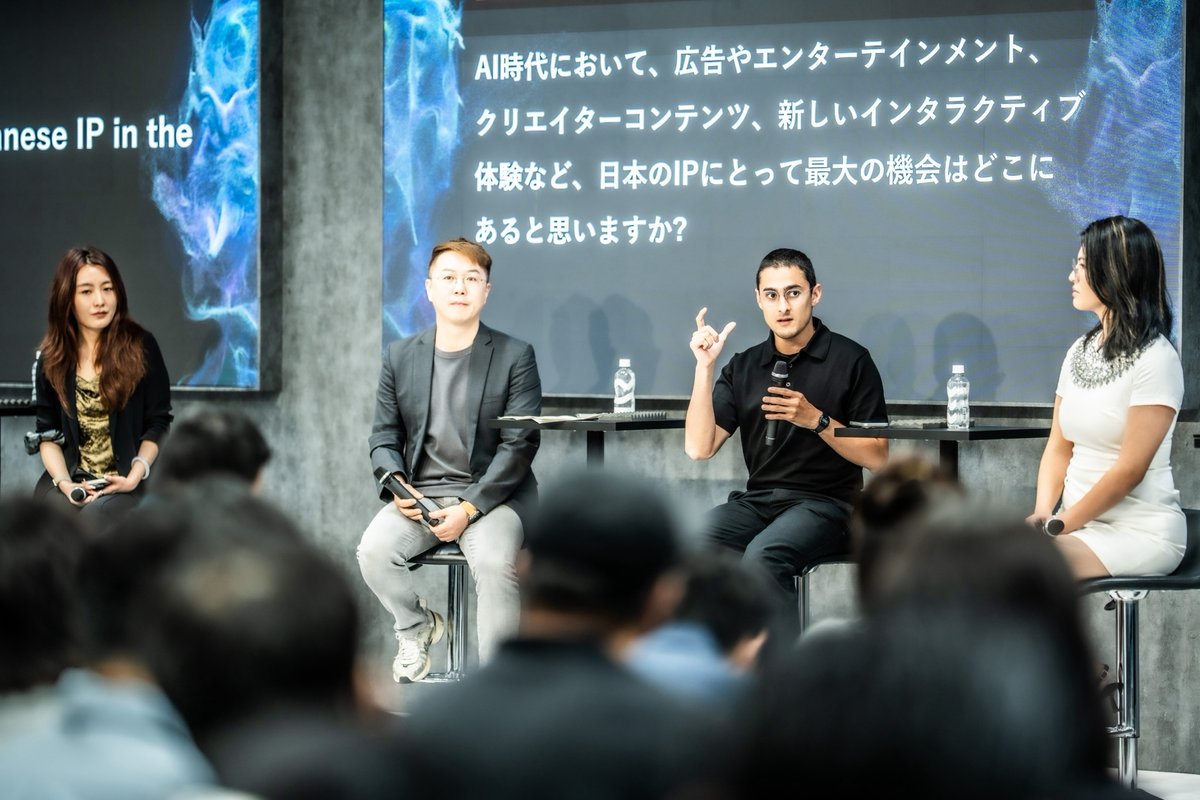
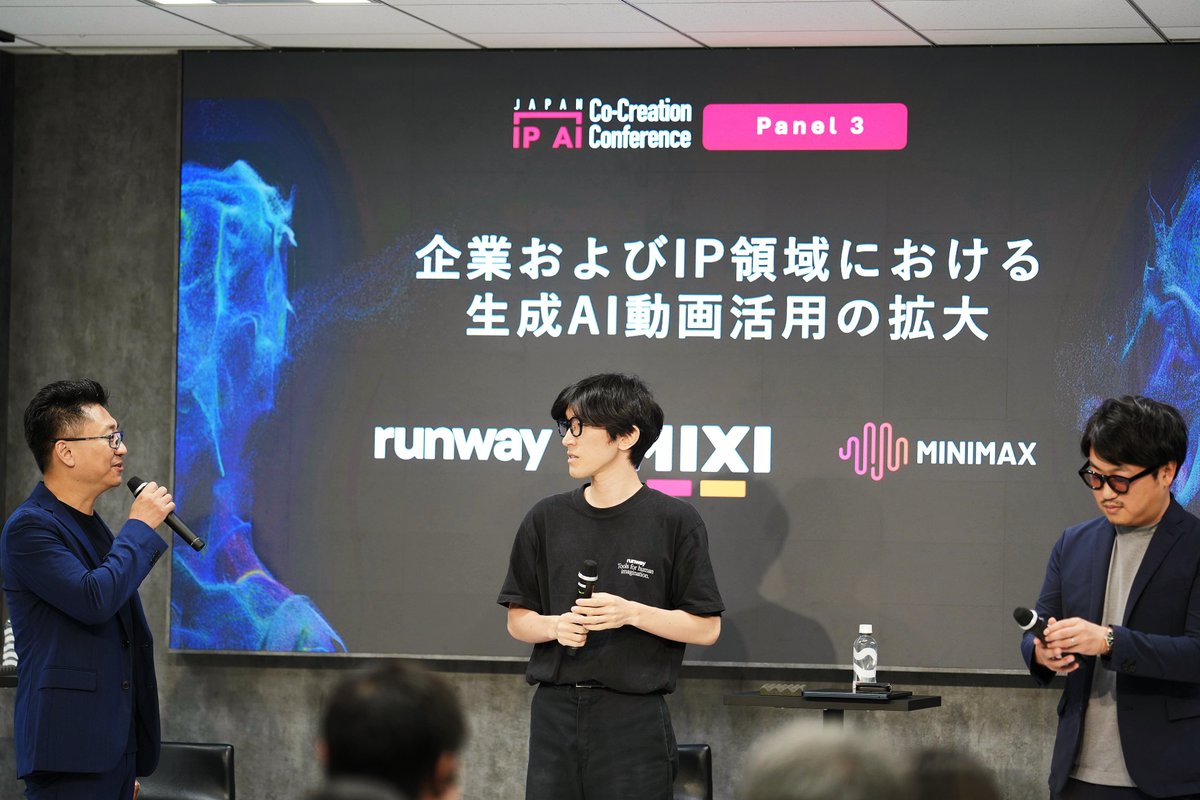
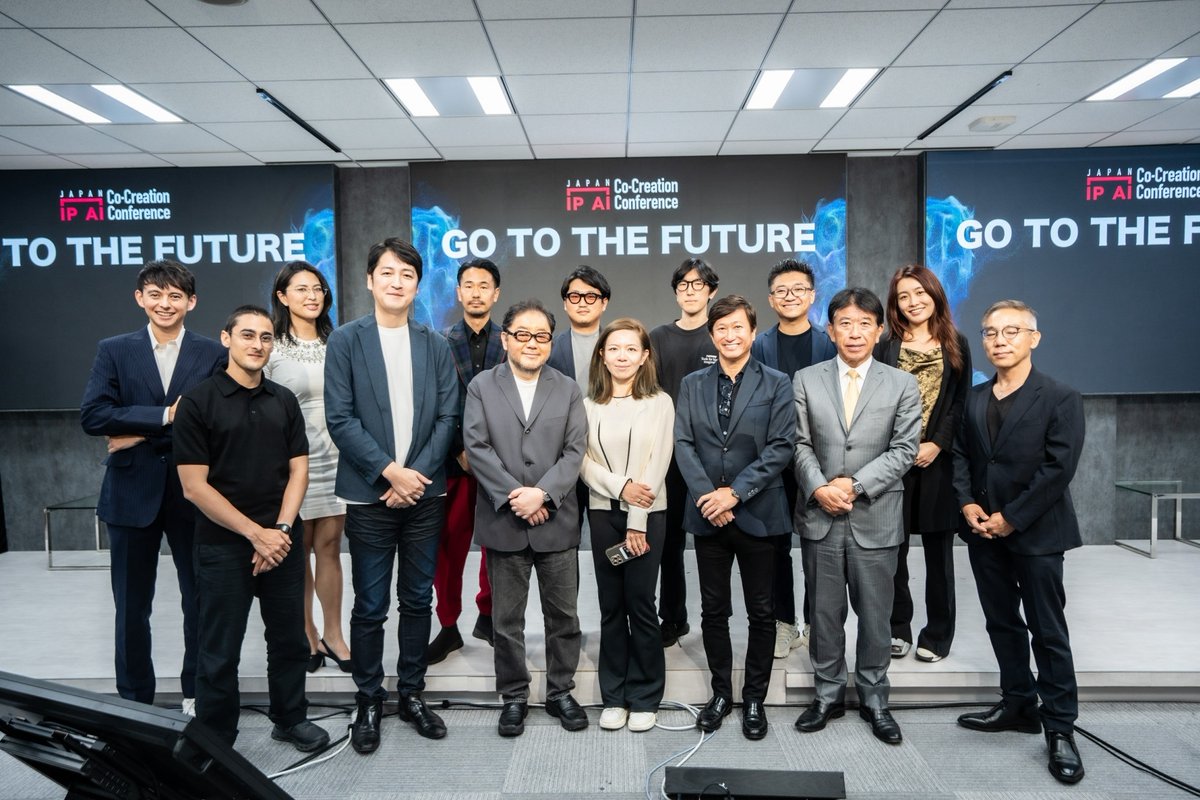
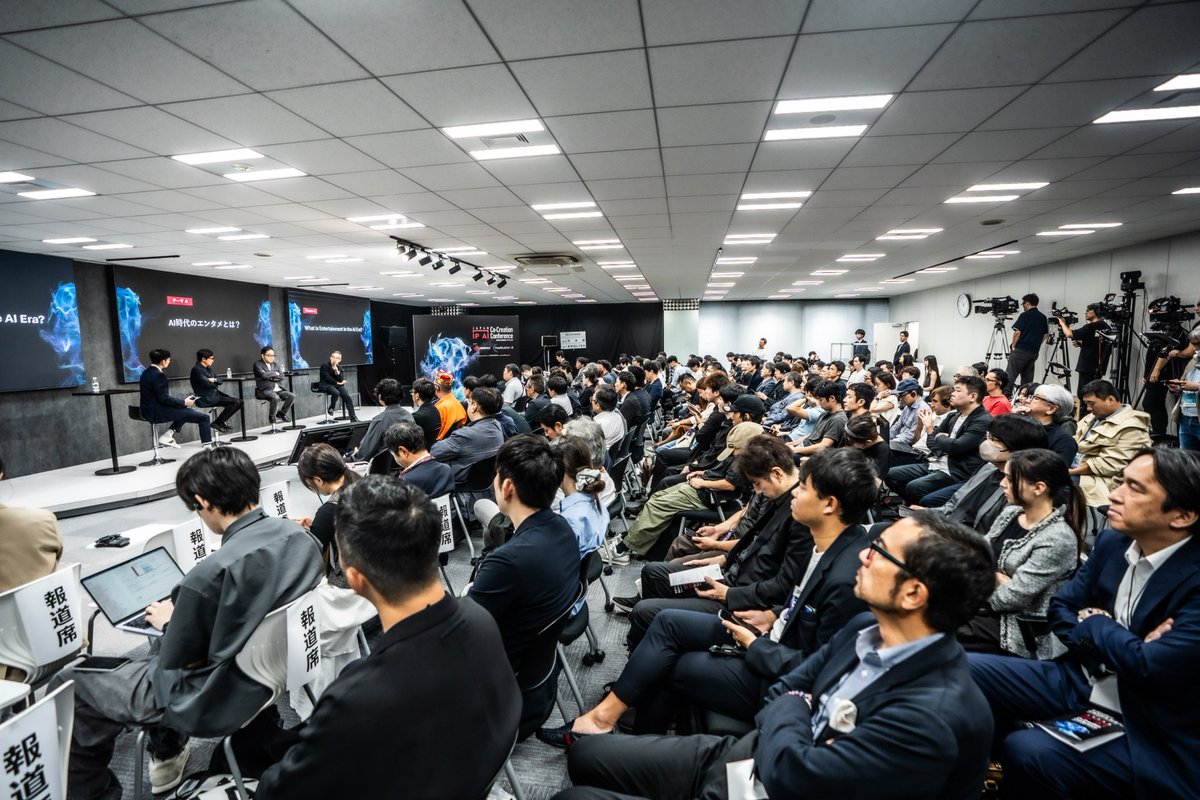
The Japan IP AI Co-Creation Conference, co-hosted by KAGAMI AI and MiniMax, has officially concluded. 🇯🇵 🎉
We brought together more than 150 companies from Japan and the U.S., alongside distinguished guests including AKB48 producer Yasushi Akimoto, KAGAMI AI Chairman Takami Kondo, and KADOKAWA editor and producer Motoi Chujo.
Global AI leaders @runwayml, @higgsfield, @krea_ai, and @HeyGen joined the conversation to explore the future of IP and generative AI.
We unveiled MiniMax H3 IP Edition, bringing the power of MiniMax H3 together with officially licensed Japanese IP for a new generation of AI-powered storytelling.
The conference received extensive coverage from major Japanese media, including a dedicated segment on TV Tokyo's WBS (@wbs_tvtokyo).
Japanese IP × Global AI.
A new era begins.
Investors getting choosy in Japan AI is a healthy sign.
Capital is concentrating in teams that can actually serve Japanese enterprises: language, regulation, on-prem realities, and industry workflow.
For operators, this means fewer shiny demos and more vendors who can survive a procurement process.
Klarna's AI did the work of 700 agents. Resolution time: 11 min → under 2.
14 months later, the CEO: "cost became too predominant... you end up with lower quality."
Automating a messy process doesn't fix it. It ships the mess faster, at scale.
Could a new hire follow your process without asking?
Sources for the first comment: Bigeye (Klarna announcement + CEO quote), CIO Dive (S&P Global survey), IrisAgent (the "Uber-style" restructuring detail).
What do you think — post as-is, or want changes to length/tone/emphasis before it goes up?
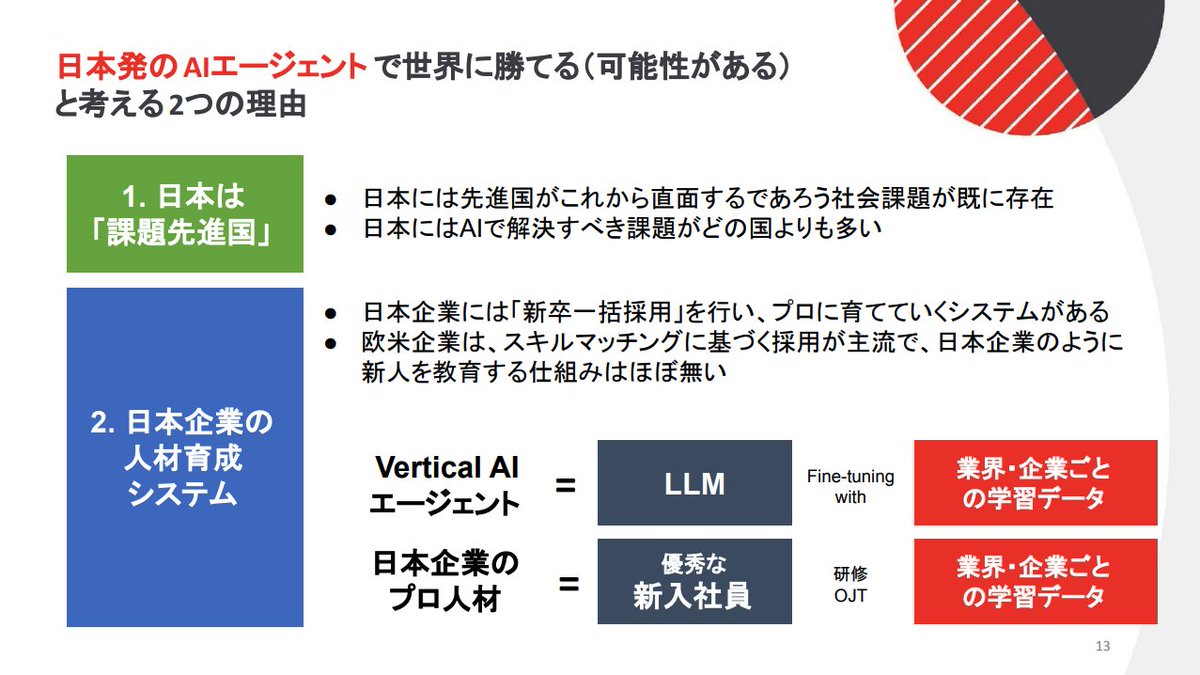
This is the cleanest Japan AI thesis I’ve seen:
AI agents don’t win by being general. They win by taking labor cost out of manufacturing, construction, healthcare, and services.
Japan’s shortage is the market. Vertical workflows are the product. Generic LLMs are just the engine.
Japan’s labor shortage is not just a risk. It’s a permission structure.
In the West, AI is framed as job loss. In Japan, the better frame is: there aren’t enough people to do the work.
That’s why restaurant, retail, and factory AI will scale faster here—if the product feels local, trustworthy, and operationally boring.
“Japan faces a labor shortage and is therefore in a highly unique and advantageous position to advance digitalization, artificial intelligence (AI), and labor saving without being constrained by concerns about rising unemployment rates.” - Ryosei Akazawa, Japan’s Minister of Economy, Trade and Industry, speaking at the World Economic Forum, Davos, January 2026
What does digital transformation actually look like in Japan? @tiby_k (Tiby Kuruvila), the CTO of POS+ (Postas), explored how AI, cloud technology, and Japan’s growing labor shortage are changing the way restaurants, retailers, and other small-to-medium enterprises (SMEs) operate. With more than 25 years of experience in enterprise software, AI, and entrepreneurship, Tiby offers a valuable perspective on succeeding with technology in Japan, which often depends as much on trust and localization as on the technology itself.
In this short clip, Tiby explains that although Japan is at the forefront of physical AI, the country will need to adopt AI aggressively throughout all aspects of society because there are not enough people to do the work. Unlike in the West, where AI is perceived as a threat, there are signs that the Japanese are starting to widely adopt AI-based solutions.
Check out our full, hour-long discussion:
https://t.co/Nu1ZWZoKkV
#JapanBusiness #DigitalTransformation #EnterpriseAI #RealGaijin #リアル外人
Japan’s AI story just stopped being “catch-up.”
In 48 hours:
• Sharp opened orders for NVIDIA AI servers. Target: ¥250B by FY2030. They see Japan’s AI server market going ¥900B → ¥7T.
• Sakana × SCSK × Sumitomo moved from models to implementation in finance, factories, and security.
• CADDi hit unicorn on manufacturing AI. Toyota-linked capital. 20+ countries.
The pattern is obvious:
Japan will not win by cloning ChatGPT.
It will win by putting AI on factory drawings, shop floors, municipal data, and sovereign compute.
If you sell AI into Japan, stop pitching “intelligence.”
Pitch labor saved, defects cut, and data that never leaves the country.
Which of these matters more for actual business growth in 2026–27?
1. On-prem / Japan-hosted compute
2. Vertical AI in manufacturing
3. Big-firm distribution (trading houses + SIers)
Reply with 1, 2, or 3. I’ll break down the playbook.
#JapanAI #BusinessGrowth #PhysicalAI
Japan’s AI story just stopped being “catch-up.”
In 48 hours:
• Sharp opened orders for NVIDIA AI servers. Target: ¥250B by FY2030. They see Japan’s AI server market going ¥900B → ¥7T.
• Sakana × SCSK × Sumitomo moved from models to implementation in finance, factories, and security.
• CADDi hit unicorn on manufacturing AI. Toyota-linked capital. 20+ countries.
The pattern is obvious:
Japan will not win by cloning ChatGPT.
It will win by putting AI on factory drawings, shop floors, municipal data, and sovereign compute.
If you sell AI into Japan, stop pitching “intelligence.”
Pitch labor saved, defects cut, and data that never leaves the country.
Which of these matters more for actual business growth in 2026–27?
1. On-prem / Japan-hosted compute
2. Vertical AI in manufacturing
3. Big-firm distribution (trading houses + SIers)
Reply with 1, 2, or 3. I’ll break down the playbook.
#JapanAI #BusinessGrowth #PhysicalAI
@growth_japan Strong process. I’d add one Japan-specific filter after scoring:
“Can a mid-size firm deploy this without a dedicated AI team and still show ROI in one quarter?”
That kills a lot of clever ideas that never become businesses.
@GarageIdol The Forward Deployed Engineer listings are the tell.
Japan AI is moving from model announcements to “sit with the customer and make it work.” That’s when business growth actually starts.
@VPO_GLOBAL 3, with a filter: scale Japanese deep tech only where the hardware-software loop is already proven on a factory floor.
Cross-border JVs sound elegant, but enterprise buyers pay for reduced defect rates and fewer night-shift hours, not for “Physical AI” as a category.
Japan doesn’t have an “AI potential” problem. It has an implementation problem.
¥100T upside only shows up if SMEs can actually use the models on real workflows—inspection, eldercare admin, Japanese-language ops—not just pilots.
The winners will be the teams that localize, integrate, and measure ROI in 90 days.
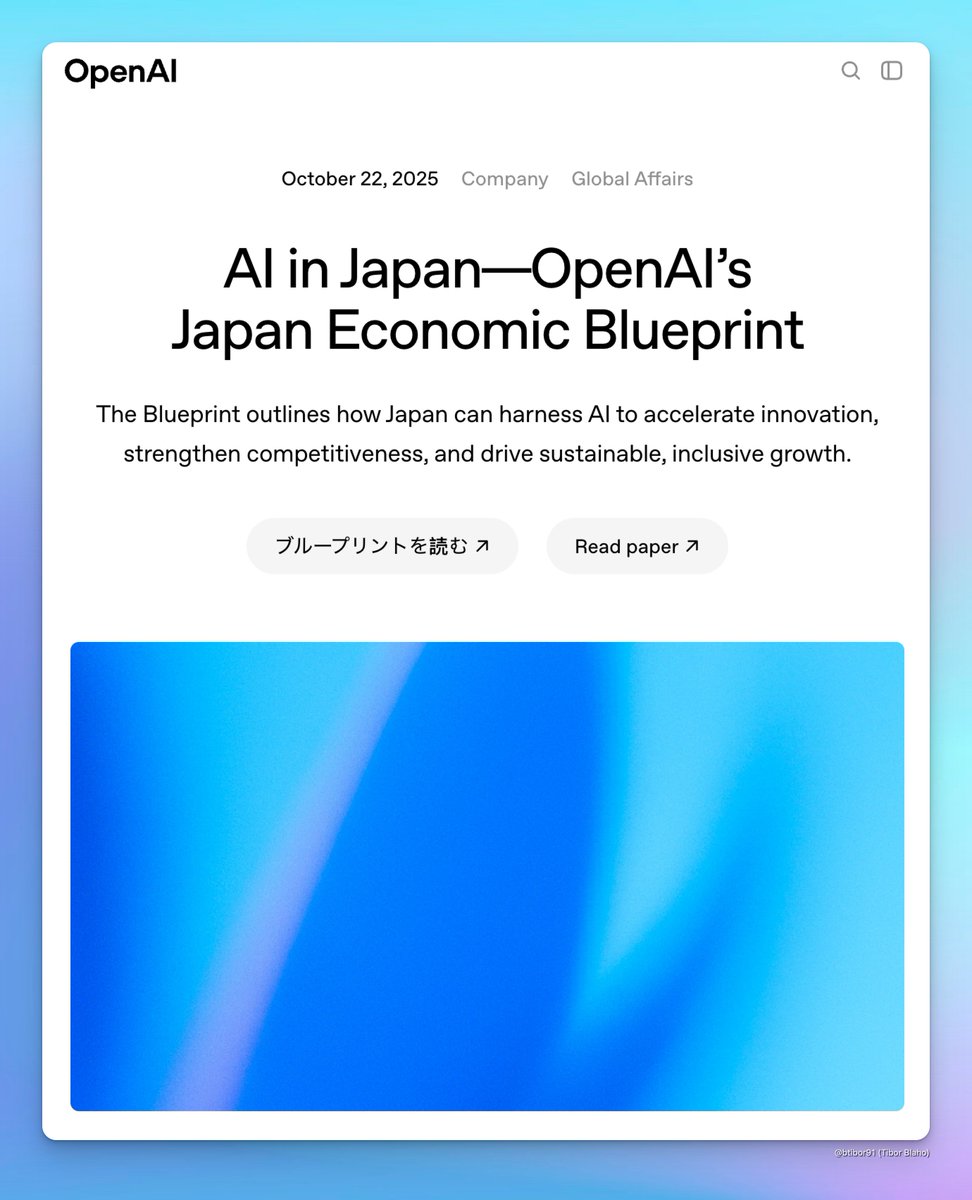
OpenAI released an Economic Blueprint for Japan outlining how Japan can fully utilize AI's economic and social potential, with independent analyses estimating AI could add more than ¥100 trillion in economic value and raise GDP by as much as 16%
The Blueprint identifies three pillars
- inclusive access to AI building a society where everyone from students and startups to SMEs and public institutions can participate in and benefit from AI innovation
- strategic infrastructure investment accelerating the development of AI data centers and semiconductor manufacturing and renewable energy networks
- education and lifelong learning enabling every generation to succeed in the AI economy through next-generation education and large-scale reskilling programs
AI is already reshaping Japan's economic foundation by reducing inspection costs and optimizing workflows for thousands of small and midsize manufacturers, helping professionals focus more time on people rather than paperwork in healthcare and eldercare potentially saving trillions of yen in social costs, and improving personalized learning through AI tutors like ChatGPT Edu, with Japan's data center market projected to exceed ¥5 trillion by 2028
Most AI-and-jobs debates in Japan run on vibes, not data. That's changing: U Tokyo, Anthropic, and PKSHA are building a "Japan AI Index" to track AI's effect on jobs, wages, and productivity, industry by industry. First dashboard lands this fall. What should it measure first?