@RandomWordsGuy@MuslimBigBoss@Onepeg@BMFiore2@MattHausmannAtx The short answer is, it did! He eventually effectively settled a lawsuit by another shareholder by repaying the company the 5 million Euro.
But this was after he did all the funny business, so Kurvitz and Rostov are still suing him arguing he should not have been able to do it.
@LMplusG@mliker27@bdquinn@mehdirhasan To be clear before I say this, I despise Trump.
However: there's a *large* segment of voters that only judge presidents on the economy, and the economy in Trump's first term was good. So their impression of him was "loud but competent".
@DanAncona@davidshor@tbonier "Determinative" is probably too strong a word, but clearly that's the most important week, right? If you had to pick one week to spend on, you'd have to pick that one and it's not close, right?
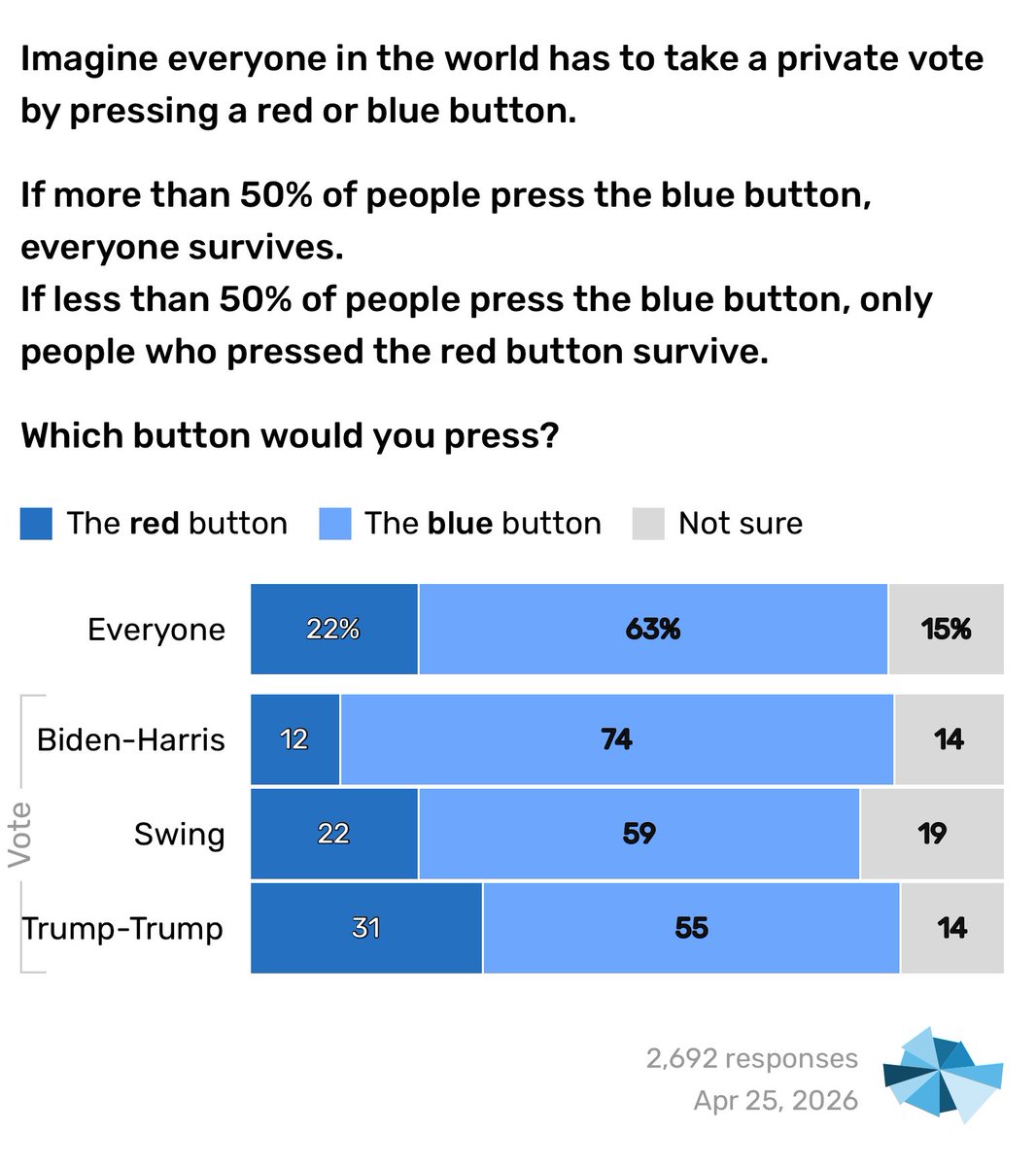
@zeanxe@ChesBurks@beaver_edits@ZPostFacto It doesn't do nothing. Both buttons do something. By pressing red you're making a blue victory less likely and therefore increasing the chances of many people dying.
@beaver_edits@TheKayaplaaya@jakobthomas761@MostlyGay2@ZPostFacto No, it's the person setting up the game. Or arguably also the red-pushers, who are cooperating with the person setting up the game.
Blue isn't making anyone else risk their lives, they're risking their own lives to save others.
@thetweeteregg@ZPostFacto@Hondo320F16 No discussion is part of the premise though. Plus if it's truly universal some people can't discuss. What button does a baby push?
@Review_bra@ZPostFacto@JohnnyBlack_HS When polled by an actual pollster, blue wins by huge numbers: https://t.co/kVKLb194yj
Also people regularly pick the superrational choice on the prisoner's dilemma even with serious stakes. So I think you're just factually wrong.
@canadian_finch@biggestjoel@G0ffThew Ah, but even 95% of people picking red is *much* worse than 51% of people picking blue. 5% of people globally is greater than the population of the United States.
@Vexarian@CyanSorrow@G0ffThew What? Red has an *obvious* fail state.
Many people have a strong intuition that pressing red is morally wrong and so simply would not do it under any circumstances. What if one of those people is your mom? Or your wife? Or your kid?
@biggestjoel@G0ffThew@EthicalHype Admittedly, this is not with anything actually on the line.
But also, people behave superrationally in the prisoner's dilemma even when there's something on the line, so I actually don't doubt this result.
@lymanstoneky ...in the sense that the trolley problem, pushing the fat man, and disembowling the patient are all the "same scenario".
Which is to say, just because they're structurally the same doesn't mean they're actually the same. The framing matters! A lot!
an extremely potent midwit test is whenever people brainlessly copy-paste Senate justifications onto conversations about the Electoral College
the EC doesn't reward small states or rural states, it rewards whatever states happen to have a 50/50 partisan split
@ContraPoints@KyleJos1917 While I understand that, I also think that a lot of the things you said in that post are somewhere between "oddly doomerist" and "just plain false".
I stopped doing criminal defense because of prosecutors (long list of reasons why), but most of what this guy identifies as being sign juries are broken is the jury system functioning exactly as intended.
Jury nullification isn’t just about principled opposition to a particular law in all instances, it’s also the community making its own decisions about whether they want to make someone a criminal for particular conduct. This is far preferable to a bureaucrat deciding that question. That’s why we have juries: so the public gets to decide who’s a criminal, not the government
Juries are also SUPPOSED to hold the government to an extremely high evidentiary burden. Prosecutors think a conviction rate below 90% means something is wrong with juries. It doesn’t. It’s supposed to be really hard to take away someone’s liberty.
@ASFleischman@notelpmeTy_A I think the idea is that a juror could think there's a much higher than 50% probability that the defendant committed the crime, while being about 50/50 on whether they feel like the evidence is enough to convict.