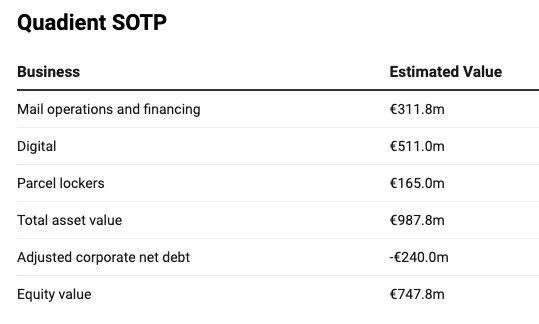
I get to a bit higher upside, but this is spot on. Very overlooked for exactly these reasons. All set to change in the next six months with large capital returns likely.
Quadient $QDT is a French communications company made up of 3 parts; a shrinking but profitable mail equipment business, a growing software portfolio and a parcel-locker business.
At first glance, Quadient doesn’t look attractive. Mail is in structural decline, group revenue fell 5% last year and net debt has increased to €683 million euros against a market cap of just €500 million.
However, Quadient’s reported debt is overstated by leases and a customer financing business that should actually unlock cash flow as the mail business shrinks.
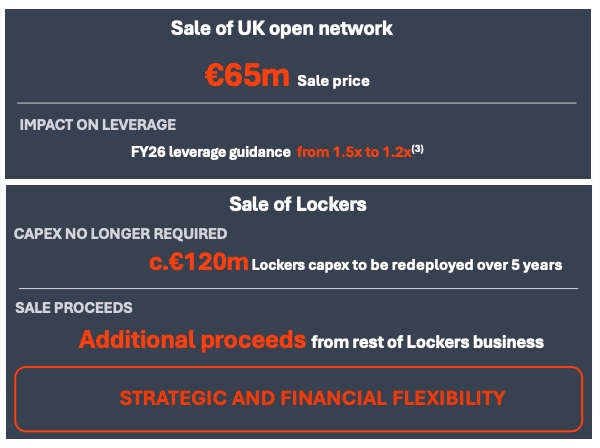
And last month, Quadient announced plans to exit its parcel locker business entirely, including an agreed €65 million sale of its UK operation. These disposals should release more cash and simplify the business.
Meanwhile, Quadient’s software business is growing steadily, hitting $264 million ARR in the first half. So if you value the software business at 2x ARR, that already covers the company’s current market cap.
A very conservative SOTP puts upside around 40%. If management hit their targets the upside is much larger at least 100%+
Long story short - they may sell a loss-making ebit business for 200mn out of a market cap of 440mn. You then get a 260mn arr software business that has grown 15% over the last years and a declining cash cow mail business …. DYODD - long $qdt
Quick update on favoured idea Quadient $qdt
Market cap around 440mn. They had announced they’d sell their parcel locker business which had a negative ebit contribution last year. They sold the UK assets for 65mn whilst this was at best b/e EBITDA this year (1/n)
Or one could look at the ifrs5 accounting and see that net assets held for sale are now 181mn. The uk assets are still in there and they made a bv gain. Assuming around 20mn gain then the remaining assets carrying value is 160mn.
Both ways get you to a round park number. (4/n)
@gregoryblotnick@MarcoBe83242064 He does though because he has once said he uses a 15% opportunity cost of capital. If there is 0 upside with that discount rate then he would buy it because it hits his 15% target. The cost of equity is your implied return in dcf with upside / downside the return on top.
❗️We just bought almost 1% of a tiny European gas producer.
And we think it may be one of the most asymmetric bets we’ve found this year.
European gas is back above €80/MWh, storage levels are low, and we don’t think Europe’s energy problems are over.
We’re Europeans ourselves, so our thinking is simple: if we’re going to freeze at home this winter, we’d rather get rich while doing it than just freeze.
Over the past few weeks, we’ve therefore bought as many shares as liquidity allowed. Together with our partners, we now own close to 1% of the entire company.
And liquidity matters here. A large part of the shares is held by management, insiders and other long-term holders, so building a meaningful position isn’t particularly easy. We don’t plan on selling ours anytime soon either.
Why do we like this setup so much?
• Potential ~5x production growth. The company is approaching several important catalysts that could allow production to increase dramatically over the coming months and years.
• Multiple near-term catalysts. Permits, reserve development and new production could all materially change the economics of the company. Several of these catalysts could arrive within the next few months.
• Extremely attractive gas economics. The company produces exceptionally clean, low-cost natural gas and sells its production essentially at spot prices, even achieving a premium to the relevant benchmark.
• The downside case still looks attractive. We don’t need another European energy crisis for the investment to work. If only a few things go right and gas prices eventually normalize, we still see a realistic path to 100%+ upside over the next 3–4 years.
• The bull case is much more interesting. The company owns additional projects to which we believe the market currently assigns essentially zero value. If those assets are developed and European gas prices remain elevated, our bull case points toward roughly a 5x return over the next four years.
• And management is unusually aligned. The CEO has significant skin in the game, takes relatively modest compensation, and doesn’t want to endlessly recycle cash into new oil & gas projects. The objective is to derisk and monetize the existing assets and ultimately return the cash to shareholders.
That last point is particularly important to us. We’ve looked at plenty of tiny commodity producers where management seems more interested in building an empire than creating per-share value. We think the incentives here are very different.
The asymmetry is what ultimately made us build such a large position.
If European gas prices normalize significantly, we believe the company can still create substantial shareholder value simply by executing on the assets it already owns.
But if Europe’s energy crisis persists, production ramps as planned, and some of the assets currently valued at essentially zero begin to be monetized, the economics become completely different.
It’s also exactly the kind of diversification we’re looking for right now. While seemingly everyone is chasing the same AI trades at increasingly demanding valuations, this is a tiny, overlooked European gas producer with completely different return drivers and potentially enormous operating leverage to one of Europe’s biggest macro risks.
My colleague put together what I think is one of the best write-ups we’ve published on our Substack so far — very concise, straight to the point, and easy to follow. Definitely worth a read if the idea sounds interesting.
Our full investment thesis, valuation scenarios and the company itself are all in the Substack write-up below.
Quadient trades at 6.7X this year and 6X next year earnings. They pay out a solid dividend and as the Group CEO has made himself CEO of the valuable software business, I wouldnt be surprised there is more corporate action to take place in the N12M. DYODD (6/6)
The parcel locker business is not very attractive and they may sell a part or all of it - with the conclusion expected to be disclosed on September 23. Given the negligible EBIT contribution - even a small level of proceeds will reduce the EV/EBIT multiple. (5/n)
@IggyOnInvesting@jsshgnt Especially on their asset management business which would me the biggest risk for me as their returns haven’t been great. Nonetheless there is a large cohort that is fine with lower deposit rates to fund green projects.