Discretionary trading and technical analysis have hands down been one of the worst reputations online, as every broccolihead now draws lines on the chart and claims you can make millions trading Nasdaq futures.
/1
A DEEP DIVE INTO FINDING YOUR UNIQUE EDGE
One of the beautiful things about trading is that there isn’t just one way to make money. Markets reward creativity, yet most retail traders voluntarily choose to play the same game as everyone else. Everyone wants to be @Qullamaggie, nobody wants to develop their own strengths.
There is nothing wrong with that, but you’re competing in one of the most crowded parts of the market.
A question more traders should ask themselves is: What do I already know, care about, or have the potential to understand better than almost everyone else trading the same stocks?
I think this is one of the most underapreciated ways to build a trading edge. Take w/e your natural strengths and interests are, develop genuine expertise in them, and then combine that knowledge with technical analysis and execution.
If you work in medicine, maybe you have the foundation to understand biotech clinical trials better than the average trader. If you’re an engineer, maybe you can develop an unusually deep understanding of semiconductors. If you’re a lawyer, maybe bankruptcies or regulatory situations are easier for you to understand. Even hobbies and interests can eventually become useful if they lead you toward an area of the market where you understand something other participants don’t.
For me, one example has been oil. I’ve closely followed the oil market for well over a decade. At this point I’ve lived through enough OPEC meetings and supply disruptions that when something major happens, I’m starting w a very different knowledge base than someone who suddenly decides to trade oil bc it’s in the news.
That mattered this year during the Iran war, when understanding the oil market and the potential consequences of different disruptions gave me a much better framework for trading the moves. When all the fundamental barrel counters were panicking, yet the price action said otherwise… that was a big opportunity. same thing happened years ago when Saudi Arabia’s Abqaiq facility was attacked.
Bc I’m still a technical trader, I don’t need that fundamental expertise to tell me exactly when to buy or sell but it can give me context or conviction.
Much like in business, markets tend to compensate you when you combine two distinct areas of expertise in a way very few people can. Your goal doesn’t necessarily need to be becoming the best technical trader in the world or the world’s foremost expert on oil. Being very good at both can create a combination that relatively few people possess.
Here are five other areas that have either made me a lot of money or that I think are worth studying:
1. Exchange-traded debt and preferred securities
This is one of the most boring and overlooked areas of the market. I first learned it by relentlessly reading about these securities well over a decade ago, and recently that knowledge came back into play with my $STRC trade.
Although these securities trade on exchanges like common stocks, many behave more like fixed-income instruments. Their value can depend on yield, credit risk, interest rates, par value, call provisions, conversion rights, and where they sit in the capital structure.
Most equity traders know very little about this. If you become an expert, you can occasionally find inefficiencies that don’t exist in highly competitive large-cap stocks. Every once in a while, they can approach the closest thing markets ever offer to free money, although those situations are rare and require a deep understanding of the risks.
2. Become a biotech expert
Biotech has its own language: clinical trial phases, primary and secondary endpoints, FDA advisory committees, PDUFA dates, Complete Response Letters, and enough medical terminology to make your head spin.
That complexity keeps traders away, which is exactly why it’s worth learning.
A company announcing that it “met its primary endpoint” might sound obviously bullish. But was the effect clinically meaningful? What did investors expect? How does it compare with competing therapies?
Markets can be much less efficient when participants are forced to interpret highly specialized information in real time. Combine that understanding with excellent technical execution and suddenly you have a skill set that is much harder to replicate.
3. Mergers & acquisitions
This came into play last week with a huge opportunity in $WDAY.
When I was at my trading prime, this was one of my best and most lucrative areas of expertise. Through intense study and data tracking, I developed a strong feel for where stocks should trade following different M&A headlines.
That allowed me to get far more aggressive and precise when the right opportunities appeared. I still relied heavily on the chart and price action, but I was interpreting that price action with a much deeper understanding of the situation.
4. Index rebalancing
Recently it became public that two pods at Millennium reportedly generated almost $4 billion in one month around major index rebalance trades.
When an index changes its constituents, billions of dollars of passive capital can be forced to buy or sell. Sell-side analysts, quantitative funds, and sophisticated hedge funds spend enormous amounts of time forecasting these changes for exactly that reason.
5. ADR and cross-market arbitrage
This is a massive strength of my good friend, @skyquake_1 . We recently saw SK hynix trade at a substantial premium in the U.S. compared with its home listing.
Sometimes these premiums exist because conversion isn’t practical or there are regulatory restrictions. Other times they’re temporary dislocations. But if you attend @Traders4ACause meetups, you’ll encounter international traders that monitor and take advantage of these opps that most of us (including me) are mostly ignorant to.
These are only five examples. You could build expertise in sell-side research, earnings reports, small-cap dilution, bankruptcy, or countless other areas.
I’d actually start by looking at yourself. What are you already unusually interested in? What did you study? What industry do you work in? What subjects are you willing to read about for hundreds of hours when everyone else finds them painfully boring? Those are all clues about where you might be able to build an informational advantage.
One of the biggest advantages individual traders have is the freedom to specialize. You can become obsessed with one tiny corner of the market even if it only produces a handful of exceptional opportunities each year. You also don’t need to abandon technical analysis to do it. If technicals are already your strength, keep developing them and layer additional expertise on top.
Technical trading will probably always make up the majority of my edge. But the most interesting opportunities often come when I can combine those trading skills with something else I happen to understand unusually well.
Figure out what that “something else” could be for you.
Detailed BTC Top-Down Outlook
bookmark away, not making this an article.
1W
> declining volume for ~5 weeks now = high disinterest.
> 44 weeks of bearish weekly trend being resistance for any attempt at a counter trend rally (started w/ 10/10.
> historical cycle statistics in image.
(will post separately about comparison to this and potential divergence)
I’m incredibly proud & excited to finally share what we’ve been building for the past 3 years…
https://t.co/rwNzbHYUiy is now live 🚀
In a world of conflicting health advice, how can anyone distinguish between what’s supported by science and what’s just opinion?
I wanted to build something new. A place where scientists, engineers, industry leaders, and the public come together, where people can understand what the science actually says, and where we move healthcare beyond treating sickness toward extending healthy lifespan well beyond what’s currently possible.
Explore the new Lifespan Magazine. Watch the Lifespan show. Ask scientists questions. Join a global community. And help support research and the next generation of scientists working to extend healthy human lifespan.
I believe we’re at the beginning of a revolution in our understanding of human aging, and perhaps one day, our ability to change it. I want everyone to be part of it.
Built by scientists. Built for you. https://t.co/rwNzbHYUiy
Life’s too short. Let’s change that, together! 👊
——
Note: The views of Lifespan & its team are their own & do not represent the views of Harvard, Harvard Medical School, or their affiliates✌️
"My bro, my man, if only I wrote an entire book on how to let people know about your stuff. How to get strangers to want to buy your stuff. And this book is free on my podcast."
Here is my AI investing guide.
Sitting here August 2026, my current best thoughts are as follows:
1. LPS (Land Power Shell) is still the most obvious and fastest path to cash on cash returns. Lots of value can be assembled and traded quickly at this layer. And as data centers get more pushback, energized land can explode in value. Very bullish here.
I’ve stepped into this layer very aggressively. My partner @anitavlallian and I have acquired almost 6GW coming online in a ramp from today thru 2029 of grid power and behind the meter.
2. Silicon - I helped get @GroqInc off the ground in 2015 and we licensed it to @nvidia for $20B Dec2025. I won’t invest or incubate anything in this layer now. The perf demands of the chips are too high, manufacturing precision is too complex and supply chain influence to get adjacent components like memory isn’t possible for a startup anymore. Lots of capital will be wasted here chasing Groq and Cerebras’ success. Note that both startups made sense a decade ago when these constraints were much more modest.
3. Clouds - Clouds are very very lucrative but very hard to build and very expensive and technically complicated to maintain. And as alignment becomes a more important issue, I expect the clouds will be asked to build robust KYC and attest to it. This makes the risk:reward ratio skewed. I don’t want to be responsible when the USG says a cloud allowed a bad actor to do something bad because of poor KYC.
4. Models are complicated. The big open question is how much of the revenue being generated by them today is because of tokenmaxxing and poor model behavior. If it’s a lot, then the annualized revenues will diminish meaningfully even as token consumption inflects upwards. This is the big economic question at this layer.
5. Harnesses are where the action is and why I started @8090solutions two years ago. In a nutshell, the harness helps enterprises owns their proprietary context (what Alex Karp calls their ‘alpha’). This is an enterprise’s data, workflows, evals, and business rules. A harness that gives this to an enterprise is what creates very low model-agnostic switching costs, which further reinforces my views of #4 above.
6. Applications will be another long term winner along with harnesses. This is where the differentiation between “off the shelf” and “custom time and materials” melts away. Every company, with the right harness, can now imbue their alpha into the software that runs their company. I expect this to mean that “off the shelf” is largely replaced with custom software creating a huge opportunity to write these solutions for companies. Build once and sell repeatedly is a laggard GTM motion for a SaaS world that isn’t needed here. Think custom by design, alpha embedded, proprietary by nature.
Fin.
Good luck to all the players!
I think a useful mental model for trading is to focus first on moving away from the things that reliably produce failure, rather than trying to move toward the things that appear to produce success.
Both approaches may seem equivalent, but they lead to very different decisions. Trading is taking risk and risk is exposure to luck. Therefore, outcomes are not directly controllable. The only thing you fully control is your error rate. So that's where most of the work should go, right?
Tennis is a great analogy here. In professional tennis, players mostly win by producing exceptional shots. In amateur tennis, matches are usually decided by who commits fewer unforced errors. The winning strategy is simply to keep the ball in play and stop taking dumb shots.
In that sense, good trading is often less about discovering the perfect action and more about systematically eliminating the actions that are known to be destructive. You approach success indirectly by systematically removing the behaviors that make success harder.
🉐 Announcement: Product Enrolling (+limited offer) 🉐
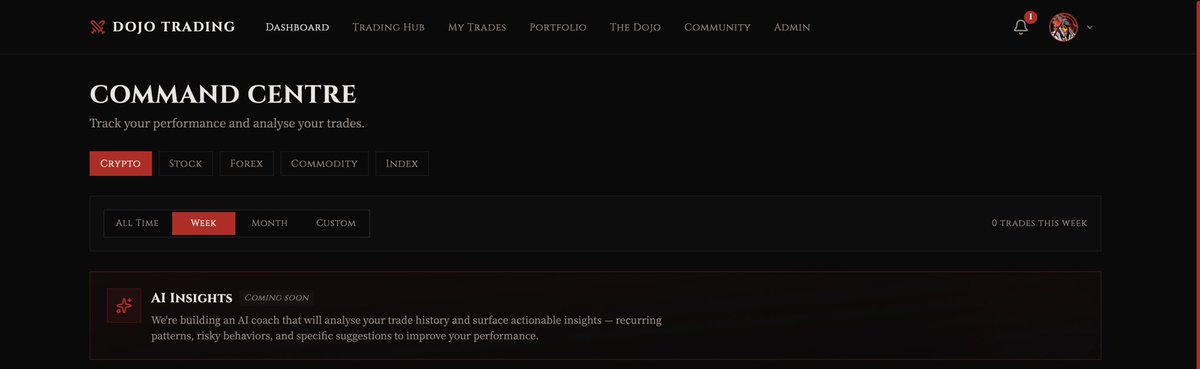
As you know, we’re just 3 weeks away from the release of our proprietary app and I want to showcase all the features and future plans we have in mind.
This wi be massive and game changer for many. (read till the end)
🉐 Dashboard
In here you’ll be able to monitor your active and passive portfolios, manage futures, spot, stocks, commodities, and crypto from one professional workspace.
🉐 Trading Hub
Probably one of the most interesting features.
Members will be able to plan their setups (see here -> https://t.co/7konHfsmce)
and share them in the hub, if they want.
In this way, people will interact with each others about trading setups creating a collaborative environment.
🉐 MyTrades(aveanced trade management)
As shown in the video, members will be able to organize setups by strategy, risk management, and key trading parameters to track and improve performance.
🉐 Sensei AI
We will also integrate the Sensei AI that will analyze your trades to identify strengths, weaknesses, recurring mistakes, so you will grow step by step.
🉐 Smart Portfolio
Members will be able to track assets and receive Sensei AI-driven insights on risk exposure, diversification, and portfolio optimization.
🉐 The Dojo (Next-Gen Education)
How many PDF pages does Notion have?
More than 2.000, an educational trading book, but it’s time to level up.
It will be a fully redesigned educational experience integrating all learning materials into one modern platform and the goal is to integrate guided learning paths, simulations, quizzes, and progress tracking tailored to every trader level.
🉐 Future plans:
1️⃣ Integrate AI market scanner to discover real-time trading opportunities based on your trading style and preferred strategies.
2️⃣ Integrated live sessions
The final goal is to detach from Discord and being able to follow the live sessions directly inside the platform.
3️⃣ Custom Workspace
Personalize your environment with modular dashboards, watchlists, and custom layouts.
4️⃣ Integrated Economic Calendar + seasonality
Over time, I want to give access to a built-in macroeconomic calendar with AI-enhanced market context and filtering tools + seasonality charts for trading specific commodities.
5️⃣ Ranking & Reputation System
Why not building credibility within the community through quality analysis, setups, and contributions? Why not give them rewards for this? This is something I also have in mind.
6️⃣ Multi-Broker & Multi-Exchange Sync
And what if we can allow people to connect brokers and exchanges to automatically sync portfolios, trades, and performance?
Another thing I have in mind.
As you can see, the goal is to build more than a trading platform, but a complete ecosystem combining education, trading, technology, and collaboration.
This is my long-term plan.
⚡❗Limited offer⚡❗
At the moment, the price continues to remain $9.99, but considering all the work done during these 3 years and this integration, it will increase to $20.00/month starting from the 10th of June.
You got time to lock in your sub lifetime at the original price till that date.
Don't sleep on it, quality already speaks and will speak louder in the coming months.
Altseason is a mind virus for newbies.
The basic assumption is: Bitcoin runs, then consolidates; the liquidity that accumulated in BTC rotates downward. If you want to be specific, you could even say first into majors, then through mid-caps, and eventually into the long tail of small-caps and absolute shitters. It's a sequential, almost mechanical picture of capital flowing through the market. Holding your favorite shitters through this period is, in effect, holding a lottery ticket on a hypothesized regime change.
Strip the narrative away, and what people actually *want* but never really articulate is: exposure to trending altcoins. Trend is the actual unit of return. If you want exposure to trending altcoins, the right object of analysis is trend itself. Concretely: identify what is likely to trend in the near future based on observable signals rather than on a thesis about a project's fundamental future.
TL;DR: Fuck altseason. Be in trend when it's present and out of it when it isn't, and size accordingly.
👁️- Soft commodities update - 👁️ (must read)
Back in late March, the macro setup in soft commodities was becoming increasingly clear to my eyes and since the post, the basket is up +47%.
I wasn’t looking at ☕️coffee, 🍬sugar, 🍫cocoa, and cotton as isolated markets, but through the macro drivers that historically move the entire complex: 🇧🇷Brazilian FX and energy.
That was the foundation behind my bullish view.
Today, with softs bouncing strong and some exposures already delivering major returns, the picture is even more interesting because this move wasn’t random.
The market has started to realign with the macro backdrop that had already stopped confirming the previous weakness.
And the core framework remains the same: 🇧🇷Brazil + oil.🛢️
Over the last few months, FX has not created new bearish pressure.
If anything, the stabilization in BRL removed one of the main macro headwinds that had accompanied the previous decline.
At the same time, oil continued to strengthen and that matters more than most people think.
But more broadly, stronger oil supports the entire agricultural complex through higher input costs, transportation dynamics, and inflationary pressure across commodities.
What we were seeing between March and April was therefore a divergence: macro drivers were turning supportive + soft commodities themselves were still pulling back = price action was underperforming the macro environment.
And that gap is exactly what the market has started to close, as you saw.
Because after a move like this the question is no longer whether there was value, It’s how much upside remains before the market fully prices in the new macro equilibrium.
The framework I’m still watching remains unchanged:
🛢️Oil → needs to remain in good structure
🇺🇸🇧🇷USD/BRL → avoid another aggressive weakening in the real
As long as energy remains firm and BRL stays relatively stable, the macro backdrop continues to support soft commodities.
And more importantly, this move reinforces a key idea:
often the best signal doesn’t come from the commodity price itself, but from the relationship between the commodity and the macro drivers that are supposed to move it.
Intermarket analysis.
Oh, and by the way, asset managers aren't fully positioned yet..I would take a look into those soft commodities that present divergence between price/COT to spot good trades. (there aren't many, so it's not hard to find them)
Think softs will run more.
Alright guys, here I am with my analysis on the altcoins.
Please read everything carefully because every step is very important.
So, as you can see from the chart mentioned, at the end of 2025 I had given some targets for the altcoins.
I had also highlighted my main areas of interest: the HTF CBOB, the green zone, and the blue zone, which is a BB just below that area, around 140 to 150 billion more or less.
Now, I’m not claiming I was completely right, because if I’m being honest, I really wasn’t.
I was expecting more of a grind around the green zone, with an accumulation phase and an outperformance from altcoins before this period.
So, I can say I more or less identified the right areas, but I definitely got the timing wrong, because I started accumulating a bit too early.
Fortunately, thanks to solid risk management, I’m fairly comfortable with the situation, but still, I could have handled it better, and that has to be acknowledged in the interest of full transparency.
Anyway, as you can see, the blue zone has been partially mitigated, and between February and May we’ve seen what could effectively be a timeframe PO3, with a distribution phase, a manipulation phase, and now a potential expansion.
Now, within this potential expansion zone, we have the 2WBB 200B, which for now is slowing price action down a bit.
That’s why, in a PO3 context, what I would like to see is a solid retest of 196B or 182B, so that we can confirm acceptance back into the range.
At the moment, it looks like this scenario may actually be unfolding, and if confirmed, the technical target would be 236B, which is the range high for the PO3, and potentially the high-probability zone I identified between 288 and 300B.
If we don't get our confirmations, altcoins will likely take their lows that have been formed on the grind up fully mitigating the 140B BB and potentially lower to 100B where we have the most important demand zone.
Now, what’s important to weigh in this situation, though, is Bitcoin’s condition, because its weekly trend still hasn’t changed and it remains in a bear market context, since no major highs have been reclaimed yet.
So how could altcoins potentially outperform?
Well, in my opinion, the best-case scenario is that Bitcoin moves into the area of interest, which could be around $83K, $84K, or even $90K approximately, forms a ranging or potential distribution pattern, and that this then allows altcoins to move higher.
Why do I say this?
Because right now we’re already seeing some relatively “random” pumps.
We’ve seen SUI and we’ve seen TAO for example and in short, some altcoins are still performing well + some of them are already showing trend reversals. (focus on trend shifts, enter on PBs)
My framework is that investors looking to exit one sector could use altcoins as a liquidity proxy before eventually redistributing back into Bitcoin.
That would be the ideal scenario for me, and it’s what I want to keep monitoring closely.
If I see a bearish divergence between the price of Bitcoin and the big caps through intermarket analysis (big caps LHs while BTC ranging) I can take it as a +1 for the distribution thesis.
At the moment, as stated slightly above, I will put my focus on the coins that have produced MSS observing the situation step by step.
One day the 288/300B area will be filled, but we cannot predict when.
For the past months, we’ve been building something behind the scenes for the Dojo. ⚔️
The beta version of the new Dojo Trading Terminal / Dashboard is finally done.
I recorded a short walkthrough below so you guys can see everything we’ve been building behind the scenes.📽️
This isn’t a separate product...
Every active and future Dojo member gets access included.
The official release will be in a couple of weeks after final refinements.
After the official launch, the Dojo price will increase.
All current members and everyone who joins before release will keep the current $10 price locked in permanently.
So if you want access before the price increase, now is the time to join.
Watch the walkthrough below. 👀