Updates since then:
* Deepseek v4 is out. There *is* a 2-bit quant that can run within 90 GB ( https://t.co/yM1HMZXkXn ), and it works, however it's only fast on Apple hardware (I've head ~35 tok/s). On AMD, it's ~7 tok/s. IMO actually taking the effort to properly support more than one hardware manufacturer is a great example of the difference between mere "decentralized AI" and genuine "CROPS AI". I hope we can become better at this.
* https://t.co/CFYF1smBH3 also has alpha telegram support now. However, the path to adding your account is quite janky
* https://t.co/za4h233eYz looks promising as a way to run "dense" models (eg. Qwen 27B) more efficiently. It's janky, but on my 5090 laptop it seems to be ~2x more tok/s than llama.cpp
* VoxTerm (local AI recording, no third-party servers) continues to be developed https://t.co/GSdKzkD9Ql
And there's a lot more projects coming on the horizon.
One other thing that has been on my mind is that there's actually a lot of intersection between "CROPS ethereum access layer" and "CROPS AI". For example, we want a ZK way to make (paid) calls to remote LLMs. But if we have this, then it's just as useful for solving another problem: private RPC reads in Ethereum.
Another example: application-specific finetuned LLMs. Leanstral ( https://t.co/ilfww8ekJu ; I get ~38 tok/s on AMD) fits into < 70 GB, but can hold its own against 1T models on writing Lean code. Things like this are a huge boon for writing more secure code ( https://t.co/6YPWgVSzCg ). We should have models finetuned for Ethereum-related use cases as well.
The future of #CloudComputing is rapidly developing. Will decentralization be the victor or will centralization prevail?
Learn more about how the Internet Computer blockchain is paving the way for a decentralized future in this article:
https://t.co/TWcbyXHKGp
Recent posts by Manuel Aráoz on AI and DeFi security have been widely circulated, and customers have asked whether they reflect OpenZeppelin's position. They do not.
Manuel co-founded OpenZeppelin and served as the company’s CTO until 2019 when he left the company.
Not a good take.
DeFi infra today is materially more resilient than in prior cycles (partially also thanks to AI).
Also DeFi has improved across the board over the years:
- better risk engines + lending market structures
- formal verification, audits, bug bounties
- better cap management, oracle improvements
- automated monitoring and security operations inc. circuit breakers
- far better tooling for smart contract security (including AI-assisted analysis)
Ironically, a lot of the remaining attack surface now comes from web2-type opsec, which is why many DeFi teams are investing heavily into better processes (inc. SOC2-based), infra hardening, and internal controls.
DeFi is constantly evolving, but pretending the industry hasn’t matured significantly or that AI is only a net negative for DeFi security is simply not true. The same AI capabilities attackers use are also increasingly used by security researchers, auditors, and whitehats to strengthen protocols.
DeFi Will Win.
Last week, AVAX One repurchased 500,000 of its common shares.
"We remain committed to deploying capital in a disciplined manner that we believe best serves the long-term interests of our shareholders," said AVAX One CEO Jolie Kahn.
Read more: https://t.co/nOUKV3hYhT
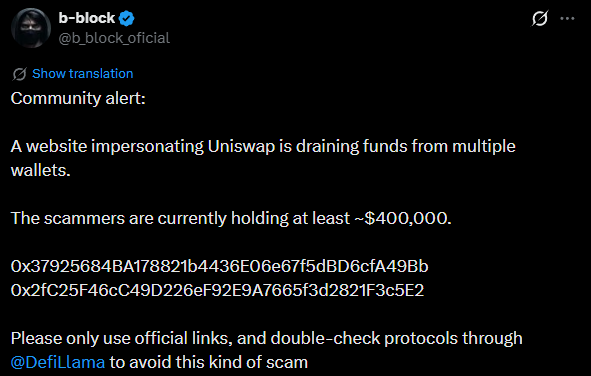
Scammers Steal at Least $400K Through Fake Uniswap Google Ads
On-chain analyst b-block warned that fake Google ads impersonating Uniswap are stealing user funds, with attackers having obtained at least $400,000 so far. Stacy Muur, founder of Web3 marketing agency Green Dots, said the funds came from users clicking sponsored Google ads for fake Uniswap sites.
Security Alliance (SEAL) previously said Google Search phishing campaigns have risen sharply since March, with attackers often buying ads or compromising legitimate ad accounts to impersonate popular crypto protocols.
Source: https://t.co/NNYSd8aZ24
Confidential payments were the headline last week.
What most missed:
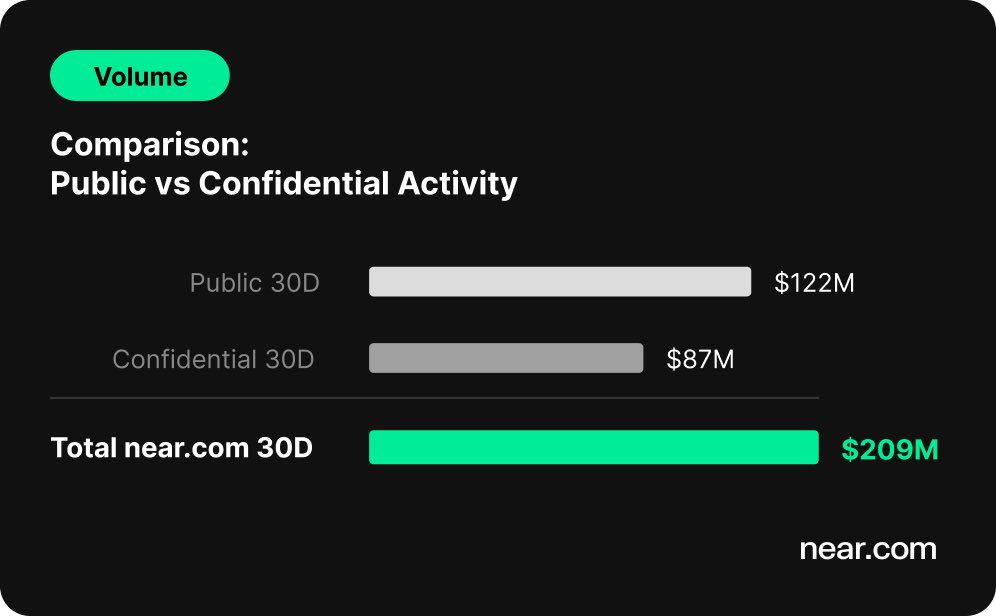
Confidential Swaps have been live on https://t.co/YBUSFVdjxE since March 31 and nearly half of all swap volume is already confidential.
Privacy is quickly becoming the default UX.
ALERT: Security researchers identify a malware campaign dubbed "TrapDoor" targeting crypto developer environments for @Aptos, @SuiNetwork and @Solana via 34+ malicious packages designed to steal SSH keys and wallet credentials.
We are trained to go bigger, more money, more crypto, more AI agents, more friends, more projects, more plans, more everything, and less happy.
Happy people have a small circle of friends and simple routines.
We just added the ability for your agents sign-up for phone numbers and make AI-native phone calls using Circle Agent Stack and USDC. Get your agent a phone number on Twillio and make AI voice-native real-time calls with BlandAI.
https://t.co/hTGfvyqaWc
🚨 UPDATE: GitHub confirms its security breach was caused by a poisoned VS Code extension on an employee device.
The attacker is believed to have exfiltrated around 3,800 internal repositories, with critical secrets already rotated.
1/ We are sharing additional details regarding our investigation into unauthorized access to GitHub's internal repositories.
Yesterday we detected and contained a compromise of an employee device involving a poisoned VS Code extension. We removed the malicious extension version, isolated the endpoint, and began incident response immediately.
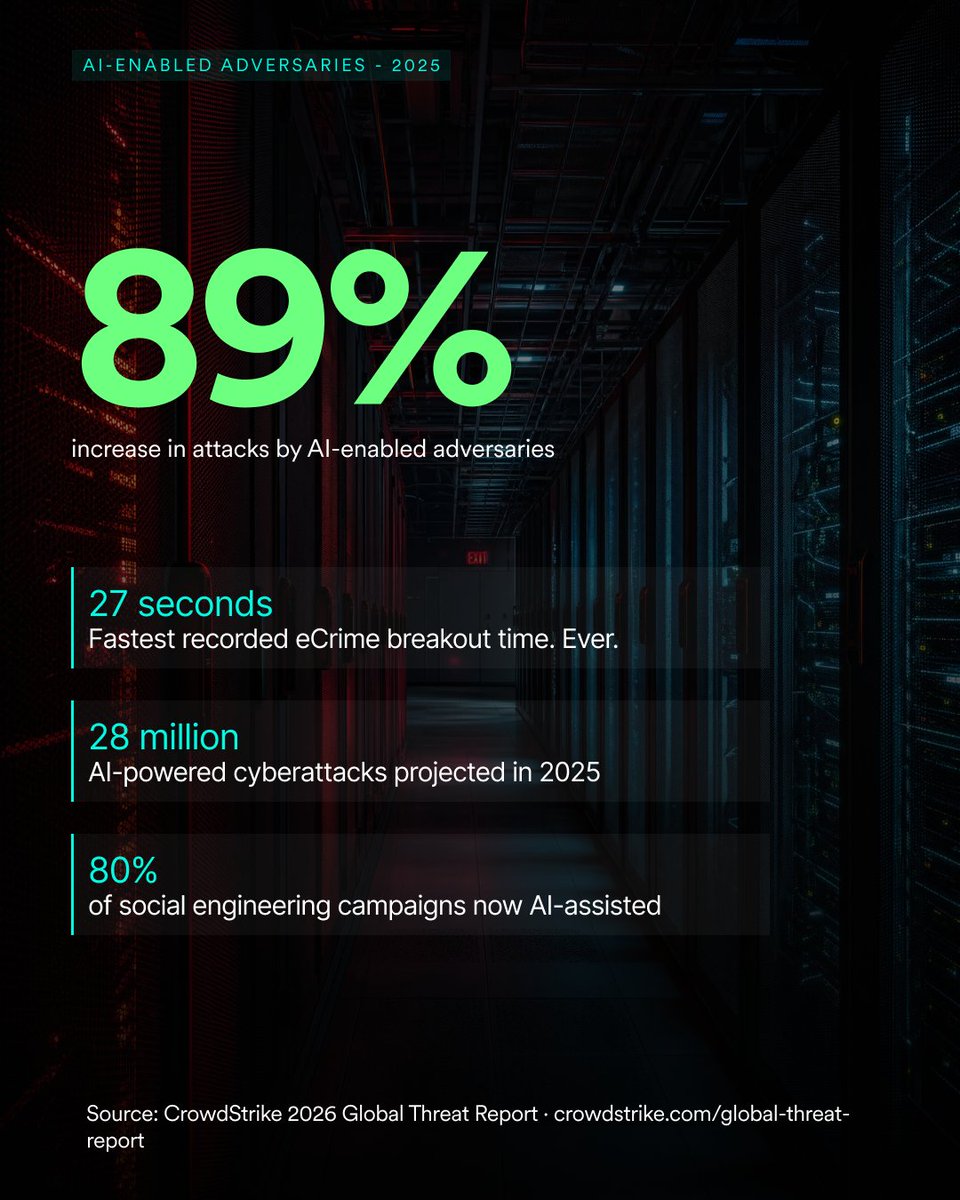
89%.
That's the increase in attacks by AI-enabled adversaries in 2025, taken from CrowdStrike's 2026 Global Threat Report.
The fastest recorded eCrime breakout time this year: 27 seconds.
What used to take the world's best hackers days now takes an hour. What took an hour now takes minutes.
AI democratized the attack. A criminal gang now operates at the level of a small nation state. Volume. Speed. Autonomy.
The response has been more monitoring. More detection. More patching.
That's not wrong. But it doesn't scale with the threat.
When the attack surface grows 89% in a year, defense needs to be in the architecture - not the maintenance plan.
Imagine how easy it would be for neobanks to get every capability from a single open stack. Wallets, ramps, crosschain routing, compliance, settlement in one API.
That is what we are building. Reach out.