@FinnStockinger Brutal. But this is the edge of chaos: where risk is highest and where the most creative moves happen. The game is to stay long enough to enjoy the ride.
The architecture of competition makes AI demand self-reinforcing. Individuals, companies and countries must adopt more capable tools just to stay competitive. Add AI-driven cyberattacks that force AI-driven defense, and AI stops being a choice.
Markets can reprice who captures the value. But AI development is here to stay and will even accelerate.
They learned that, no matter how dire the situation, they would find the courage somehow to battle to the very end.
That night the Bulls found the heart.
Phil Jackson, Eleven Rings: The Soul of Success
@Scobleizer Disagree. Pain is necessary.
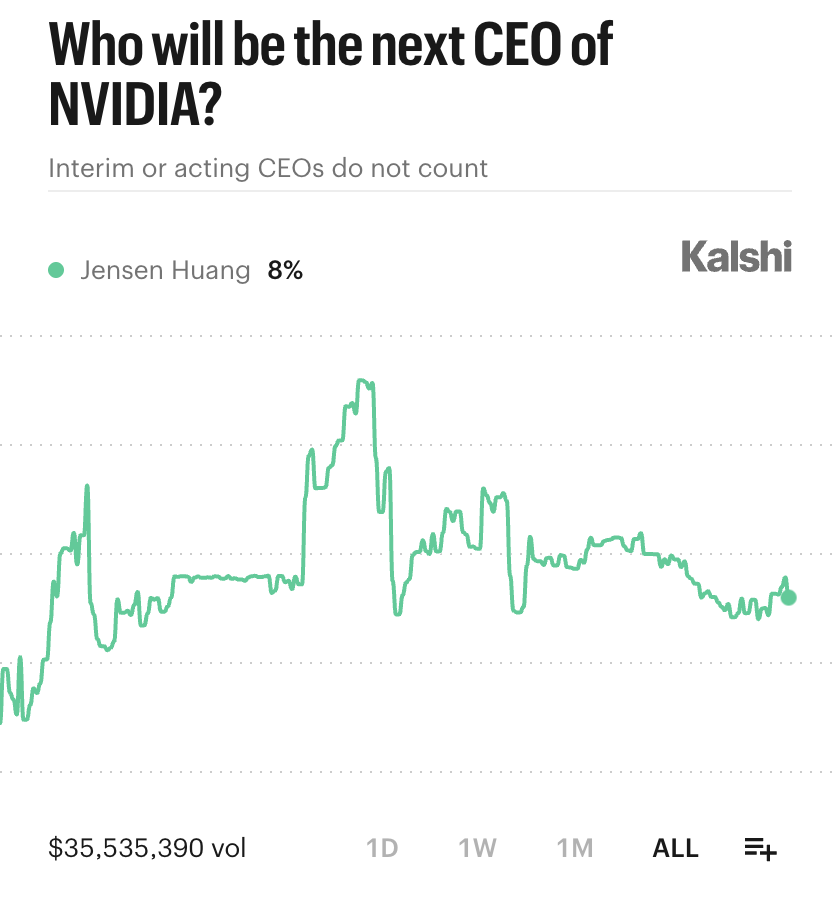
The more the stock drops, the higher the odds of a Jensen comeback. If the stock holds up, there is zero pressure to change. QED.
I believe the @nvidia board is not acting in the best interest of shareholders nor in a manner consistent with their fiduciary duties.
What we know is that the board fired Jensen or forced his resignation for violating company policy and/or in response to the accusation of an affair with a spy.
They did so without careful consideration of the impact on the company, its customers, its shareholders or other stakeholders.
They rushed to judgment without the benefit of careful due diligence or even with a basic understanding of the facts.
How do we know this?
We know this by how quickly Jensen was fired and how little was known at the time of his firing.
It takes time to convene a board meeting. There was time, maybe, for one Zoom.
And this is a decision that should have been made by a board sitting in person and carefully deliberating the facts once they are known.
And they should have slept on the decision and met again the day after to discuss the facts, the risks and the other implications of their decision.
The timing and lack of information did not allow for careful board deliberation.
While boards can fire a CEO for an inappropriate relationship with a subordinate, it should not be an automatic decision. That is why we have boards comprised of humans and not agents.
A board should consider whether or not such a relationship was consensual or whether it was an abuse of power dynamics. And a board has to consider what the impact of the firing is on all stakeholders.
If I were in this board, I would not have rushed to judgment based on articles in the media. I would have made sure the board had all of the facts so it could make a careful and informed decision.
Boards of Delaware companies have a duty of care which means they must make informed, prudent and good faith decisions. This clearly did not happen here.
What law firm is advising this board?
Or is the board even taken good legal advice?
It doesn’t look like it.
And now the board is compounding its failures by insisting that there is no possibility for Jensen’s return as CEO.
Why is it in the best interest of the company to foreclose the possibility of Jensen’s return and to do so before all of the facts are known? This is yet another breach of their duty of care.
Furthermore, the board has launched an investigation whose scope is unknown. Investigations can be extremely damaging to a company and should be carefully targeted to address whatever facts need to be known rather than be overly broad in scope.
In short, this looks like a series of major governance failures by directors that panicked due to headlines in the media. They likely felt compelled to do something because they were afraid of looking bad in the media, not because it was the right thing for them company.
They couldn’t stand the heat.
The board’s conduct here is shocking for a company of this scale and importance to our country and the world at large, particularly at this moment in history.
Everyone is solving the wrong equation: how to convince this Board to bring Jensen back.
Invert the variables. The founder is the constant; the Board is the variable.
If the current Board won’t act in the best interest of shareholders, employees, and America, you don't lobby the Board—you replace the Board.
Two Russian military aircraft. Japanese airspace off Fukuoka at 4 a.m., then down Taiwan’s east coast, exiting south of Taitung.
Russian aircraft have entered Taiwan’s ADIZ before, in 2010 and during the Cold War. What is different this time is the route: one flight crossed Japan’s sovereign airspace and Taiwan’s defense zone. Japan scrambled fighters and issued warnings. Taiwan tracked and responded.
And the timing: the eve of the first Trump–Xi–Putin meeting, less than two weeks before Taiwan’s local elections.
One flight path from Tsushima to Taitung will make closer coordination between Tokyo and Taipei harder to avoid.
Taiwan's Ministry of National Defense has detected 2 sorties by Russian military aircraft in Taiwan's ADIZ early on Nov. 17.
The aircraft entered from the northeast, flew through airspace east of Taiwan and exited the ADIZ south of Taitung, per the MND.
This is the first time Taiwan's MND has publicly reported Russian military aircraft in Taiwan's ADIZ.